Best Cannabis Strains for Creativity: Science-Backed Guide
Discover how terpenes and cannabinoids unlock creative flow. Science-backed strain recommendations for artists, writers, and creative minds.

Updated April 2026: Added links to new terpene deep-dives (terpinolene, pinene), updated Blue Dream’s popularity ranking (#1 nationally), and linked to newer activity-specific guides for art, writing, and music.
Why Does Cannabis Make Some People More Creative?
Here’s a fascinating paradox: cannabis has been the muse of countless artists, musicians, and writers throughout history—yet science has struggled to definitively prove it makes people more creative. What gives?
The answer? Creativity isn’t just one thing. It involves generating ideas, recognizing patterns, staying emotionally open, and making unexpected connections. Cannabis doesn’t boost all of these equally. Instead, it helps with specific parts of the creative process—for certain people, with certain strains, in certain situations.
A groundbreaking 2017 study published in Consciousness and Cognition found that cannabis users scored higher on convergent thinking tasks when sober—suggesting that regular cannabis use might actually train the brain for creative problem-solving [Schafer et al., 2012]. But the relationship between acute cannabis intoxication and creativity is far more nuanced than “get high, get creative.”
In this deep dive, we’ll explore the neuroscience behind cannabis and creativity, examine which terpenes and cannabinoids appear most linked to creative states, and provide science-backed strain recommendations organized by our High Families classification system. Whether you’re a painter seeking visual inspiration, a writer chasing flow state, or a musician hunting for that perfect melodic phrase, understanding the chemistry behind creative cannabis experiences will help you find your ideal strain.
The Neuroscience of Cannabis and Creativity
How Your Brain Creates
Before diving into how cannabis affects creativity, let’s look at what happens in your brain when you create. Creativity relies on two different thinking modes:
Divergent thinking is coming up with many ideas from one prompt. Think brainstorming and “thinking outside the box.” This uses the same brain network that’s active when you daydream.
Convergent thinking is finding the best answer to a problem. It’s editing and choosing the right idea from many. This uses the brain’s focus and analysis systems.
Highly creative people can easily switch between these modes—coming up with wild ideas, then picking the best ones [Beaty et al., 2016]. This is where cannabis gets interesting.
What Cannabis Does to Creative Brain Networks
THC increases blood flow to the frontal lobe—the brain region most tied to creative thinking [O’Leary et al., 2002]. Brain scans show THC boosts activity in areas involved in flexible thinking and idea generation.
But here’s the crucial finding: THC appears to primarily boost divergent thinking while potentially impairing convergent thinking at higher doses [Kowal et al., 2015]. This means cannabis may help you generate more ideas, but high doses could actually make it harder to evaluate and refine those ideas.
A 2014 study in Psychopharmacology tested this directly. Researchers gave participants either low-dose THC (5.5mg), high-dose THC (22mg), or placebo, then measured their performance on creativity tasks. The results were striking:
- Low-dose THC: No significant difference from placebo on divergent thinking
- High-dose THC: Actually impaired divergent thinking compared to placebo
The researchers concluded that the common belief that cannabis enhances creativity might be partly due to altered perception—people feel more creative even when objective measures don’t show improvement [Kowal et al., 2015].
The Role of Dopamine and Openness
Here’s where things get interesting. Cannabis releases dopamine in your brain’s reward system. Dopamine is closely tied to creativity—it makes you seek novelty, notice patterns, and pay attention to ideas your brain might normally filter out [Boot et al., 2017].
Cannabis also boosts “openness to experience”—a personality trait strongly linked to creative achievement. A 2017 study found that cannabis users score higher on openness than non-users. This personality difference explains much of the creativity edge seen in cannabis users [LaFrance & Bhatt, 2017].
The Terpene-Creativity Connection
Beyond THC: Why Terpenes Matter for Creative Flow
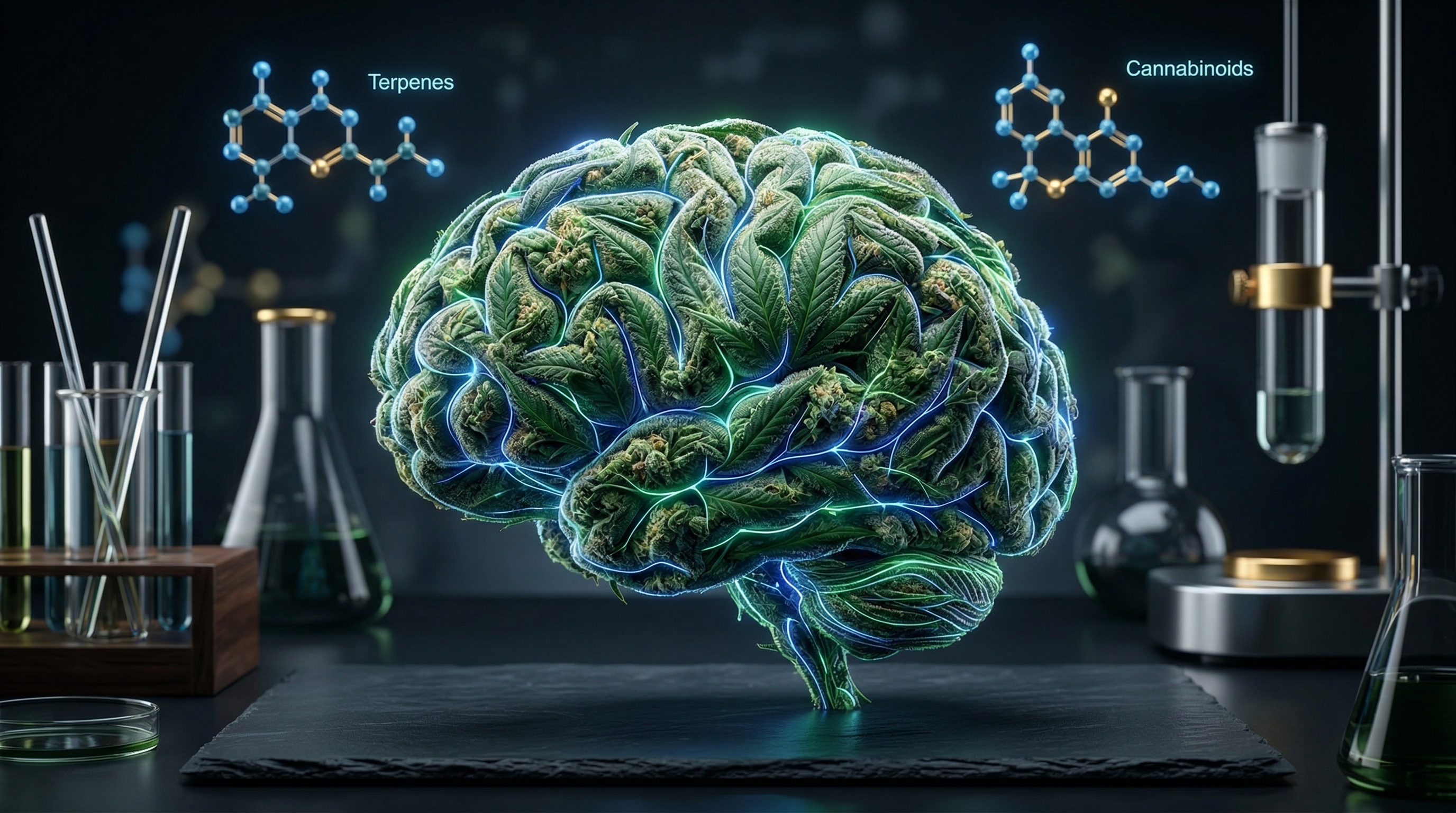
If THC alone doesn’t boost creativity—and high doses can hurt it—why do so many artists swear by certain strains? The answer points to terpenes. These are the aromatic compounds that give cannabis its smell. Research suggests they also shape its effects.
This is where our High Families system helps. Instead of using the shaky indica/sativa labels, High Families groups strains by their terpene profiles. This is much better at predicting how a strain will actually feel.
Terpenes Associated with Creative States
Limonene: This citrus-scented terpene lifts your mood and eases anxiety—both great for creative flow. Research shows limonene boosts serotonin and dopamine [Komiya et al., 2006]. A 2024 Johns Hopkins study found that vaporized limonene selectively reduced THC-induced anxiety in healthy adults [Spindle et al., 2024]. That trial measured mood, cognition and psychomotor performance rather than creativity specifically, so treat the creative benefit as an inference from lower anxiety, not a measured result. Strains high in limonene belong to our Uplifting High family and often help with social creativity and talking freely.
Pinene: The most common terpene in nature (found in pine trees), pinene may offset some of THC’s memory effects [Russo, 2011]. This makes it great for creative work where you need to stay focused and remember ideas as they come. Pinene also opens your airways, possibly sending more oxygen to your brain.
Terpinolene: This terpene has floral, herbal, and light citrus notes. It’s rare but shows up in many strains known for focus and mental clarity. Terpinolene strains fall into our Energetic High family—ideal for creative work that needs sustained mental effort.
Linalool: Found in lavender, linalool reduces anxiety [Guzmán-Gutiérrez et al., 2015]. Since anxiety kills creativity—it puts your brain in threat mode and stops exploratory thinking—linalool strains may help creatives who struggle with self-doubt or performance anxiety.
The Entourage Effect and Creative Synergy
The “entourage effect” means cannabis compounds work together—the whole plant creates different effects than THC alone [Russo, 2011]. For creativity, this means the mix of cannabinoids and terpenes may matter more than just THC percentage.
This is why strains in our Entourage High family—those with complex terpene mixes—often get the best creative reviews. Multiple terpenes working together may create a smoother, more controllable creative state than simple high-THC strains.
Best Strains for Different Creative Pursuits
For Visual Artists and Designers
Visual artists often benefit from seeing patterns, colors, and familiar objects in new ways. Research shows cannabis can boost “hyper-priming”—making loose connections between ideas [Morgan et al., 2010]. For visual work, try strains that sharpen your senses without making you sleepy. For a deeper dive into activity-specific picks, see our best strains for art and painting guide.
Recommended High Family: Uplifting High
Top Strain Picks:
- Super Lemon Haze: High limonene content promotes elevated mood while the sativa-leaning genetics maintain mental clarity. Users frequently report enhanced color perception and visual pattern recognition.
- Tangie: Another limonene-dominant strain with a bright, citrus profile. Known for producing a clear-headed, visually stimulating experience.
- Durban Poison: A pure landrace strain high in terpinolene, known for focused, energetic effects that can sustain hours of detailed visual work.
- Amnesia Haze: A legendary strain with a complex terpene profile that artists report enhances visual imagination and creative vision.
For Writers and Verbal Creativity
Writing needs both types of thinking: generating ideas and metaphors, then picking the right words and keeping things coherent. Research suggests lower doses work best for writing. High doses can hurt your verbal flow and memory—making it harder to turn ideas into clear sentences. For a more detailed look, check our best strains for writing and journaling guide.
Recommended High Family: Energetic High or Balancing High
Top Strain Picks:
- Jack Herer: Named after the legendary cannabis activist, this strain combines terpinolene, pinene, and caryophyllene for focused, clear-headed effects. Many writers report enhanced verbal fluency and the ability to sustain long writing sessions.
- Green Crack (or Green Cush): Despite its unfortunate name, this strain is beloved by creative professionals for its sharp mental focus and energizing effects. High in myrcene but balanced with terpinolene for alertness.
- Harlequin: A high-CBD strain with a roughly 5:2 CBD-to-THC ratio. The CBD may modulate THC’s effects, reducing anxiety while maintaining mild psychoactivity. Excellent for writers who find pure THC strains too distracting.
- Chocolope: A cerebral sativa known for its coffee-like aroma and uplifting mental effects that help words flow freely.
For Musicians and Audio Creativity
Making music uses many brain skills: hearing patterns, imagining sounds, expressing emotion, and coordinating your hands. Musicians have long said that cannabis changes how they hear time and sound—making them notice subtle rhythms and tones they’d otherwise miss.
Science backs this up: cannabis does change how we perceive time, often making moments feel longer [Sewell et al., 2013]. For musicians, this may mean paying more attention to the silence between notes and the complexity of rhythm. For deeper reading, see why music sounds better high and our best strains for playing music guide.
Recommended High Family: Uplifting High or Entourage High
Top Strain Picks:
- Blue Dream: The #1 most popular strain nationally, Blue Dream combines myrcene-driven relaxation with pinene’s mental clarity. Users report enhanced emotional connection to music and improved improvisational flow. You can even listen to its AI-generated strain soundtrack to set the mood.
- Pineapple Express: High in caryophyllene and limonene, this strain produces euphoric, socially engaged effects ideal for collaborative music-making and jam sessions.
- Strawberry Cough: Known for its sweet flavor and cerebral, anxiety-reducing effects. Musicians report it helps quiet the inner critic that can inhibit musical expression.
- Maui Wowie: A tropical classic that brings euphoric, stress-free energy perfect for extended jam sessions and musical exploration.
For Problem-Solving and Innovative Thinking
Problem-solving creativity—the kind used in engineering, startups, and science—needs you to see past the obvious and try new approaches. This is where cannabis may help most by reducing your brain’s tendency to ignore “irrelevant” information.
But problem-solving also needs logical thinking, so dose control matters a lot here. Microdosing or low doses tend to work best.
Recommended High Family: Balancing High or Energetic High
Top Strain Picks:
- ACDC: A high-CBD strain (often 20:1 CBD to THC) that provides subtle mental effects without significant impairment. Ideal for maintaining analytical capabilities while potentially enhancing creative flexibility.
- Cannatonic: Another CBD-dominant strain with gentle, clear-headed effects. Users report it helps them approach problems from new angles without losing logical rigor.
- Sour Diesel: For those who prefer more noticeable effects, Sour Diesel’s energizing, cerebral high is associated with fast-moving thoughts and enhanced ability to make unexpected connections.
- Ghost Train Haze: A potent sativa for experienced users that delivers intense mental stimulation and rapid-fire ideation.
Practical Guidelines for Creative Cannabis Use
Dosing for Creativity: Less is Often More
The research is clear: high doses of THC can impair the very cognitive functions needed for creative work. For optimal creative enhancement, consider these evidence-based guidelines:
-
Start low: Begin with 2.5-5mg of THC if using edibles, or take one small inhalation and wait 10-15 minutes before taking more.
-
Find your “Goldilocks zone”: Most creative professionals report a sweet spot—enough to shift perspective and reduce inhibition, but not so much that focus and memory suffer. This varies individually but is typically lower than recreational doses.
-
Consider CBD ratios: Strains with some CBD content (even 1:1 ratios) may provide creative benefits with fewer cognitive side effects. CBD appears to modulate THC’s effects on memory and anxiety [Englund et al., 2013].
-
Time your sessions: Creative benefits may peak during the first 1-2 hours of a session. Plan your most important creative work for this window.
Set and Setting for Creative Flow
Your environment and mindset significantly influence how cannabis affects creativity:
- Prepare your workspace: Have all materials ready before consuming. You don’t want to spend your peak creative window searching for supplies.
- Minimize distractions: Turn off notifications. The enhanced distractibility that sometimes accompanies cannabis use can derail creative focus.
- Capture ideas immediately: Keep a voice recorder, notebook, or instrument within arm’s reach. Cannabis-inspired ideas can feel profound but may be forgotten quickly.
- Create without judgment: Use the cannabis session for generative work. Save critical editing for when you’re sober and can evaluate with fresh eyes.
Tolerance and Creativity
Regular cannabis users may find that tolerance diminishes creative effects over time. Some strategies to maintain creative benefits:
- Take tolerance breaks: Even 48-72 hours can partially reset tolerance and restore creative effects.
- Rotate strains: Different terpene profiles may engage different neurological pathways, potentially reducing tolerance to specific effects. Learn more in our complete tolerance breaks guide.
- Reserve cannabis for creative sessions: If you use cannabis recreationally, consider keeping certain strains exclusively for creative work to maintain their novelty and effectiveness.
Key Takeaways
-
Dose matters enormously: Research shows high-dose THC can actually impair divergent thinking. For creativity, less is often more—aim for the lowest effective dose.
-
Terpenes may be more important than THC percentage: Limonene, pinene, and terpinolene are associated with the mood elevation, mental clarity, and reduced anxiety that support creative flow.
-
Use High Families to guide strain selection: The Uplifting High and Energetic High families are generally best for creative work, while Balancing High strains work well for problem-solving that requires analytical thinking.
-
Cannabis enhances divergent thinking but may impair convergent thinking: Use cannabis for brainstorming and idea generation, then edit and refine when sober.
-
Individual variation is significant: Personality traits, tolerance, and baseline creativity all influence how cannabis affects your creative output. Track your experiences with the High IQ app to discover your personal patterns.
-
The “joviality effect” is real: A 2023 study found that cannabis users don’t actually produce more creative ideas—they just feel more creative and rate their ideas (and others’) more favorably. This positive self-perception can still be valuable for overcoming creative blocks and self-criticism.
Frequently Asked Questions
Does cannabis actually make you more creative?
The science is nuanced. Cannabis doesn’t universally boost creativity—high doses can actually impair divergent thinking. However, low doses may help people with naturally low creativity by reducing inhibition and anxiety. Cannabis users also tend to score higher on “openness to experience,” a personality trait strongly linked to creativity. The key is finding your personal sweet spot: enough to shift perspective, not so much that focus suffers.
What’s the best THC percentage for creative work?
Lower than you might think. Research shows that 22mg THC significantly impaired creativity, while 5.5mg had neutral effects. For creative work, start with 2.5-5mg (edibles) or a single small inhalation. Many creative professionals report their best work happens at doses lower than they’d use recreationally. Consider strains with moderate THC (15-20%) rather than high-potency options.
Are sativa strains better for creativity than indica?
The sativa/indica distinction is scientifically questionable—it refers to plant morphology, not effects. Terpene profiles are far more predictive of effects. For creativity, look for strains high in terpinolene, pinene, or limonene regardless of their sativa/indica label. Our High Families system categorizes strains by actual terpene profiles, making it easier to find strains that match your creative needs.
Can CBD-dominant strains help with creativity?
Yes, especially for people who find THC-dominant strains too impairing or anxiety-inducing. CBD modulates THC’s effects on memory and anxiety, potentially preserving the creative benefits while reducing cognitive side effects. Strains like Harlequin and ACDC are popular among creative professionals who need to maintain focus and analytical thinking.
How do I find my optimal creative strain?
Start by identifying your creative challenge: Do you need more ideas (divergent thinking) or better execution (convergent thinking)? For idea generation, try Uplifting High or Energetic High family strains. For analytical creative work, consider Balancing High strains with CBD content. Track your experiences—noting strain, dose, and creative output—to discover your personal patterns over time.
Sources
-
Kowal, M.A., et al. (2015). “Cannabis and creativity: highly potent cannabis impairs divergent thinking in regular cannabis users.” Psychopharmacology, 232, 1123–1134. PubMed
-
LaFrance, E.M., & Cuttler, C. (2023). “Cannabis use does not increase actual creativity but biases evaluations of creativity.” Journal of Applied Research in Cannabis, 6(1). PubMed
-
LaFrance, E.M., & Bhatt, A.P. (2017). “Inspired by Mary Jane? Mechanisms underlying enhanced creativity in cannabis users.” Consciousness and Cognition, 56, 68-76. PubMed
-
Schafer, G., et al. (2012). “Investigating the interaction between schizotypy, divergent thinking and cannabis use.” Consciousness and Cognition, 21(1), 292-298. PMC
-
Russo, E.B. (2011). “Taming THC: potential cannabis synergy and phytocannabinoid-terpenoid entourage effects.” British Journal of Pharmacology, 163(7), 1344-1364.
-
Beaty, R.E., et al. (2016). “Creative Cognition and Brain Network Dynamics.” Trends in Cognitive Sciences, 20(2), 87-95.
-
Spindle, T.R., et al. (2024). “Vaporized D-limonene selectively mitigates the acute anxiogenic effects of Δ9-tetrahydrocannabinol in healthy adults who intermittently use cannabis.” Drug and Alcohol Dependence, 257, 111267. ScienceDirect


