Cannabis Company Earnings: Revenue, Profit and Cash Flow Explained
Read cannabis earnings beyond the headline. Compare revenue, GAAP profit, adjusted EBITDA, cash flow and 280E tax effects using 2026 examples.

Professor High

A cannabis company’s sales, accounting profit and cash generation answer different questions. Revenue tells you about sales. Net income includes accounting expenses and benefits. Operating cash flow tracks cash generated or used by operations. A strong number in one column does not settle the other two. SEC financial-statement guide.
That distinction is especially useful when a cannabis earnings headline pairs a big profit with a tax-policy development. Before deciding what changed, check whether the improvement came from selling products, an accounting adjustment, or cash actually arriving.
This guide uses reports available on September 7, 2026, including results for the period ending June 30. It teaches you to read the business behind the headline; it does not rank cannabis stocks or recommend a trade.
The five numbers worth keeping separate
| Measure | The question it helps answer | The next thing to check |
|---|---|---|
| Revenue | How much did the company sell? | Same-store trends, acquisitions and geographic mix |
| GAAP net income | What profit or loss did accounting rules recognize? | Tax effects and unusual gains or expenses |
| Adjusted or normalized EBITDA | What result does management report after specified exclusions? | The exact reconciliation and exclusions |
| Operating cash flow | Did operations generate or consume cash? | Working-capital changes and payment timing |
| Free cash flow | What remains under the company’s stated cash-flow calculation? | Capital spending, debt obligations and the definition |
Use that table as a reading order, not a scoring system. There is no universal passing grade across businesses with different assets, debt and expansion plans.
Revenue growth does not tell you how existing stores performed
Green Thumb Industries reported $306.7 million in second-quarter 2026 revenue, up 4.6% from a year earlier. Yet comparable retail sales fell 1.1% across the reported base of stores open at least 12 months. Those figures describe different groups: the whole business and an established-store comparison. Both can be true. Green Thumb Q2 2026 results.
When you open the next earnings release, ask: did growth come from existing stores, newly opened locations, wholesale customers, or an acquired business? If a company has international operations, also check its U.S. segment before calling consolidated growth an American-market trend.
A useful note to yourself might read: “Sales increased; I still need to know where.” That small pause prevents a company-wide percentage from becoming a claim about every dispensary.
Adjusted EBITDA is not the cash drawer
EBITDA stands for earnings before interest, taxes, depreciation and amortization. Words such as adjusted and normalized add another layer: the company excludes specified items from its calculation.
Green Thumb’s Q2 release put four different results alongside one another: $4.9 million of net income attributable to the company, $68.6 million of adjusted EBITDA, $84.3 million of normalized EBITDA, and $29.0 million of operating cash flow. Its normalized measure adds brand licensing fees back to adjusted EBITDA. The difference is in the definition, not a second pile of money. Green Thumb Q2 reconciliation.
Read the bridge from the GAAP result to management’s preferred measure. Circle costs you expect to see again. Then ask why excluding them helps you understand the business. A reconciliation makes that question possible; it does not make every adjustment equally informative.
The SEC cautions that non-GAAP measures can be misleading when they exclude normal recurring cash operating expenses or use inconsistent adjustments between periods. This is general guidance, not an allegation about either company discussed here. SEC non-GAAP interpretations, questions 100.01–100.02.
A tax benefit can lift profit without being a cash refund
Curaleaf’s management discussion for Q2 2026 reported a $38.8 million income-tax benefit for the quarter. It attributed the change primarily to reduced valuation allowances that generated approximately $65.1 million in combined federal and state deferred tax benefits. Those are accounting explanations, not a statement that $65.1 million arrived in a bank account. Curaleaf June 2026 MD&A.
The same discussion separates six-month tax changes involving uncertain tax positions, valuation allowances and expenses connected to Section 280E. Combining them into “tax savings” would hide what each item actually represents.
For a 280E-related earnings story, write down four questions:
- Is this a current tax expense, a deferred tax adjustment, a changed estimate of a disputed position, or a cash payment/refund?
- Which accounting period does it affect?
- Which operations does the company say qualify?
- What uncertainty remains in the tax notes?
Green Thumb attributed its Q2 tax-expense reduction partly to the end of 280E treatment for portions of its business following the federal medical-cannabis scheduling action. That company disclosure should not be expanded into “every cannabis business now has the same tax treatment.” Green Thumb Q2 tax discussion.
Cash flow needs a time period attached
Curaleaf’s release reconciles $50.305 million of operating cash flow from continuing operations to $17.390 million of free cash flow, after $32.915 million of property-and-equipment purchases net of disposals. These figures cover the six months ending June 30, 2026. They are not standalone second-quarter cash flows. Curaleaf Q2 release, free-cash-flow table.
That date heading matters as much as the number. Comparing six months of cash flow with three months of profit will produce a ratio, but usually not the ratio you intended.
The cash-flow statement also separates operations from investing and financing. New borrowing can raise cash even when operations consume it. Buying equipment can reduce cash despite positive accounting earnings. Changes in inventory, customer collections and payments to suppliers can separate operating cash flow from net income. SEC financial-statement guide.
“Free” cash flow needs one more check. The SEC notes that definitions vary and the measure may leave mandatory debt payments or other obligations outside its calculation. Positive free cash flow therefore does not mean all of it is available to distribute. SEC non-GAAP interpretations, question 102.07.
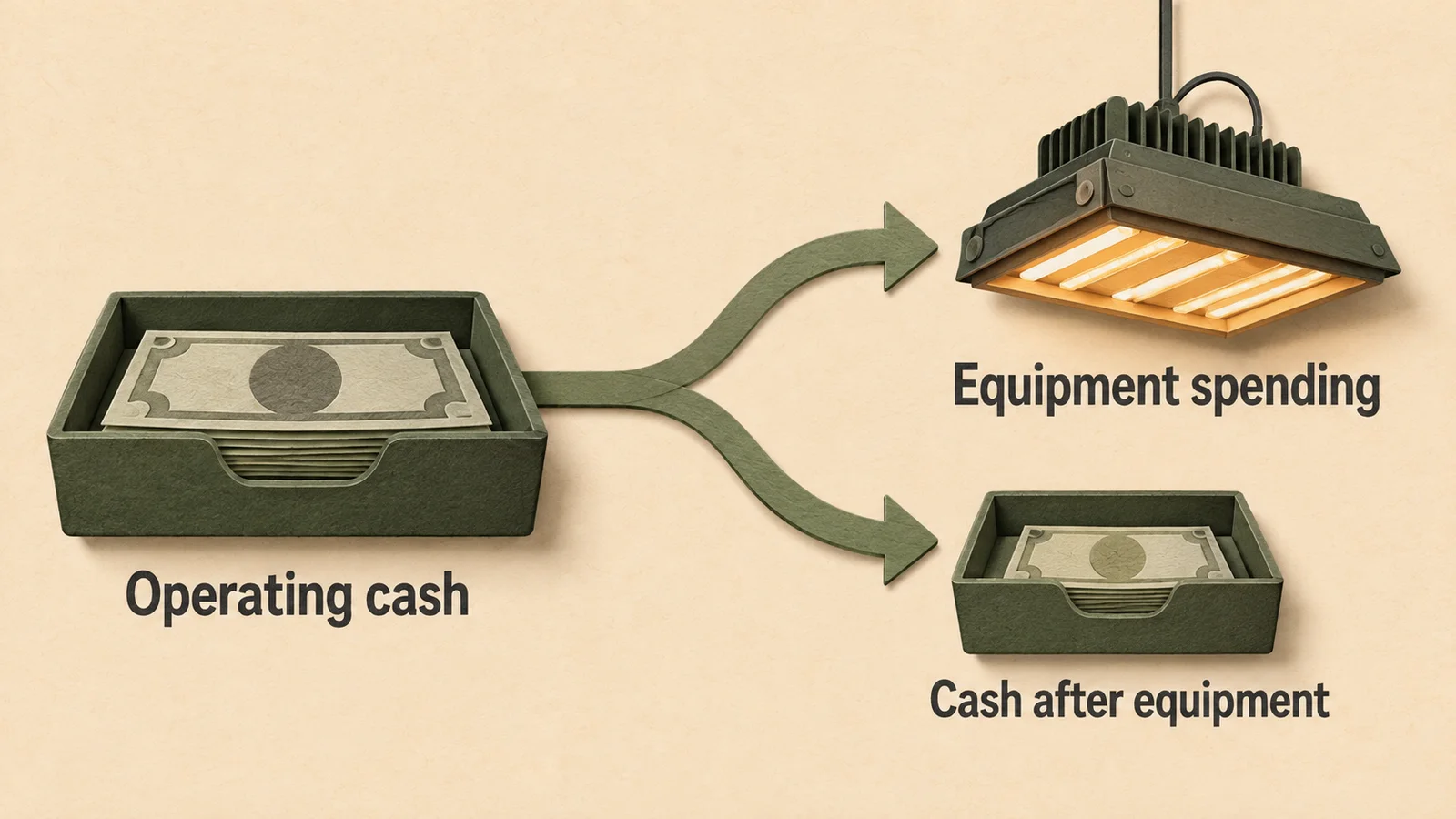
Simplified illustration: equipment spending uses part of operating cash. Cash after equipment may still face debt payments or other obligations. The pictured amounts do not represent company data.
A five-minute earnings reading routine
Open the release and its linked quarterly report together. Work through these steps before reading reactions:
- Mark dates and units. Quarter or year-to-date? Dollars or thousands? Consolidated business or one segment?
- Find the GAAP result. Keep net income separate from adjusted performance measures.
- Trace the adjustments. Read tax explanations and the EBITDA reconciliation rather than assuming what “normalized” means.
- Follow cash. Check operating cash flow, capital spending, financing and the ending cash balance.
- Read what comes due. Look at debt maturity dates and tax uncertainties before judging financial flexibility.
For example, Curaleaf’s June balance sheet separately lists $94.588 million in cash and equivalents and $12.380 million in restricted cash. Its headline cash figure combines those amounts. Reading both lines gives you a better question than simply repeating the headline total: what cash can the business access, and under what conditions? Curaleaf June 2026 balance sheet.
If your interest is choosing a store rather than following public companies, financial statements also cannot certify a product’s quality. Our dispensary buyer’s guide addresses the shopping decision separately.
Frequently asked questions
Can a cannabis company report a profit while its cash balance falls?
Yes. Profit is an accounting result; cash also moves through equipment purchases, borrowing and debt repayment. Read all three sections of the cash-flow statement before deciding what caused the decline. The explanation may be planned investment, operating weakness, or several factors together.
Is adjusted EBITDA useful?
It can help you inspect management’s view of performance if you understand the exclusions. Use the same definition across the periods you compare, and keep the GAAP result and operating cash flow alongside it. A larger adjusted number is not automatically a stronger business.
Does a cannabis stock rally prove a policy change is final?
No. A market price is not a legal document. Verify the actual order, statute or agency notice, including its scope and effective date. Then separately assess how the company accounts for it. This article makes no claim about today’s stock prices.
What should I check when the next quarter arrives?
Reuse the same date-and-definition checks. Ask whether sales quality, adjustments, cash generation and outstanding obligations tell a consistent story. Keep the source links with your notes so you can distinguish a changed business from a changed headline.
