Minnesota THC Drink Licenses: State vs. Local Approval
Selling THC drinks in Minnesota? Understand LPHE licenses, local retail registration, product rules, and the testing extension to May 2027.

Professor High
A Minnesota lower-potency hemp edible retailer needs both an OCM license with the applicable endorsements and local retail registration before making sales. Filing an application does not complete either requirement. The Office of Cannabis Management reinforced the two-approval requirement in its June 16, 2026 guidance. OCM local registration guidance
That distinction matters whether you are adding THC seltzers to a liquor store, opening a dedicated beverage shop, or trying to understand why a familiar retailer has paused sales. “We applied” and “we are licensed to sell here” describe different situations.
This guide focuses on lower-potency hemp edibles, or LPHEs, including qualifying hemp-derived THC beverages. For personal possession, home growing, and the broader dispensary market, use our Minnesota cannabis laws guide.
State licensing sources checked September 7, 2026. This is general reporting, not a determination that a particular business or product is compliant.
The cover uses two latches as a metaphor for separate approvals; it does not depict a required beverage-storage setup.
Can you still apply for a Minnesota hemp edible license?
Yes. OCM reopened applications on April 1, 2026, for LPHE retailers, manufacturers, and wholesalers. Its current application page lists these categories as accepting applications on a rolling basis. You do not have to treat the October 2025 application period as your last opportunity. OCM April announcement, current application process
Start from the current OCM page and its linked Accela application system. The page also contains the LPHE application instructions, eligibility guidance, and final plans of record. OCM says a business must be physically located in Minnesota to receive a license. A rolling application process is an opportunity to apply; it is not a promised approval date. OCM application resources
An old registration certificate can make this confusing. Minnesota previously used a hemp-derived cannabinoid product registration system. OCM now places its registration-to-license conversion guide in the historical resources section and says that conversion process is complete. Use the active licensing instructions when planning a new business. OCM archived conversion resources
Why an OCM license is only one part of retail approval
The state license and local registration answer different questions:
| Requirement | What to verify |
|---|---|
| State LPHE license | Has OCM actually issued the license for the intended business activity? |
| Applicable endorsements | Does the license cover what you will do, such as retail operations, delivery, or on-site consumption? |
| Local retail registration | Has the local government issued the registration needed to begin retail sales? |
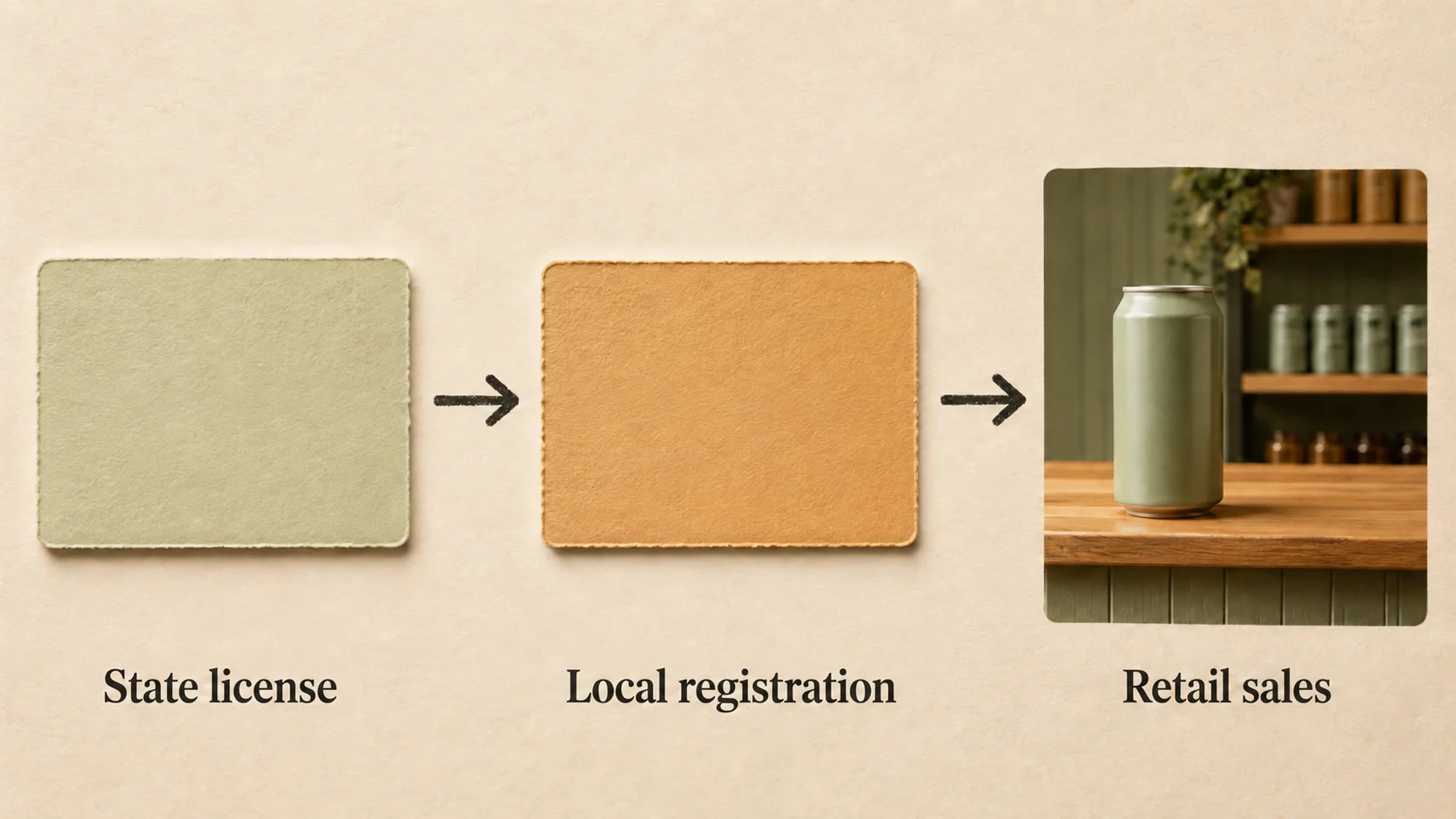
For an LPHE retailer, state licensure with the relevant endorsements and local registration precede retail sales. Product compliance and other operating requirements continue afterward.
OCM’s June guidance says that if state licensure and local registration do not arrive together, sales must wait until both are in place. The municipality has its own registration process, so contact it directly. OCM does not require you to upload proof of that registration to the agency; that does not eliminate your obligation to obtain it. OCM local registration guidance
Ask a concrete question when you contact the city or other responsible local authority: “What must happen after OCM issues my LPHE retailer license before you can issue my retail registration?” That is more useful than asking whether cannabis is generally legal in town.
Selling cans, serving drinks, and delivering orders are different activities
An LPHE retailer operations endorsement covers retail operations. On-site consumption and delivery have their own endorsements. The September 4 edition of OCM’s hemp business guide explains these activities separately. OCM hemp business guide
For example, placing sealed cans in a checkout transaction is a different operational plan from opening them for customers at tables. Adding home delivery changes the plan again. Map the actual customer experience before filling out the application; a business description like “beverage retailer” can leave those differences hidden.
Nor does an LPHE license authorize a general cannabis store. OCM’s April bulletin distinguishes qualifying edibles and beverages from hemp flower and hemp vapes, which LPHE businesses may not manufacture, import, or sell under that license. OCM product-category clarification
The product’s name is not enough. A supplier calling something “hemp” does not tell you which Minnesota license can handle it.
What changed for product testing in 2026?
The testing extension is enacted law, not merely a proposal. Minnesota’s 2026 Chapter 40, signed March 27 and effective the following day, extended the qualifying laboratory allowance to May 31, 2027. For LPHE testing, the law requires ISO/IEC 17025 accreditation with specific accreditation for cannabis testing. OCM describes the change as allowing qualifying out-of-state testing facilities. Chapter 40, OCM implementation bulletin
The extension changes which qualifying labs can perform the work. It does not waive testing: representative batch samples still have to be tested and meet the applicable standards. Chapter 40 testing requirements
For buyers, an out-of-state laboratory address alone is therefore not proof that a Minnesota LPHE product is noncompliant. Ask whether the laboratory qualifies and whether the report matches the product’s batch. Our guide to reading cannabis lab results explains how to make that second check.
Do older products have to disappear from shelves?
The product transition period ended March 31, 2026, but OCM described a limited route for certain existing inventory to remain in circulation. Its April local-government bulletin says licensed businesses may continue selling qualifying products already in their possession before March 31 if they meet the stated earlier manufacturing and testing requirements and carry both required universal symbols. Products made, packaged, labeled, and tested after that date must comply with chapter 342. OCM transition explanation
That is a reason to keep batch and acquisition records, not a blanket clearance for old stock. “We bought it months ago” does not establish that an individual product meets the conditions.
A practical check before your first sale
Put the actual documents together: issued license, relevant endorsements, local registration, supplier records, and batch test information. Then compare them with what staff will actually sell or serve. An approval for one activity should not quietly turn into a plan for three.
Build age verification into the transaction. Minnesota’s LPHE retailer statute requires checking that the customer is at least 21 before a sale or completed delivery. The retailer’s obligation does not disappear because the product is sold alongside ordinary groceries or beverages. Minnesota Statutes, section 342.46
Finally, keep state permission separate from federal status. OCM has warned license holders that federal hemp changes can affect business decisions while it continues administering Minnesota’s licensing system. This article does not treat a state license as a resolution of that separate federal question. OCM notice to businesses
Frequently asked questions
Is an LPHE application enough to begin selling?
No. OCM’s reopening announcement says applicants cannot manufacture, sell, or import LPHE products before receiving a license. Retail sales also require local registration. OCM application notice, local registration guidance
Can a town refuse every LPHE retail registration?
OCM says local governments cannot opt out of allowing LPHE retailers, but they can administer registration and regulate matters such as operating hours and distances from certain structures. That still makes the local process relevant to your address. OCM local registration guidance
Does lower potency mean a drink cannot get you high?
No. LPHE is a regulated product category, not a promise of no intoxication. OCM’s guide includes delta-9 THC beverages within that category. Read the actual cannabinoid amount and serving information rather than treating the category name as a description of how you will feel. OCM product definitions
