Cannabis and PTSD: What Therapeutic Research Shows
Explore what science reveals about cannabis and PTSD, from endocannabinoid research to practical considerations for mindful use.

Updated July 2026: Added the MAPS MJP2 Phase 2 trial (320 veterans, largest-ever PTSD cannabis RCT), the Wayne State Warrior CARE trial (500 veterans comparing THC vs CBD vs combination), and the 2026 Lancet Psychiatry meta-analysis. New internal links to clinical endocannabinoid deficiency, anandamide, and 28 clinical trials on mental health.
Why Cannabis and PTSD Research Matters Right Now
Here’s a number that should stop you in your tracks: an estimated 6 out of every 100 people in the United States will experience post-traumatic stress disorder (PTSD) at some point in their lives [U.S. Department of Veterans Affairs, 2023]. That translates to roughly 13 million Americans living with PTSD in any given year—people navigating intrusive memories, hypervigilance, emotional numbness, and sleep disruption that can make daily life feel like an endurance test.
Now here’s what makes this conversation urgent: conventional treatments for PTSD, including SSRIs and prolonged exposure therapy, don’t work for everyone. Research suggests that approximately 40-60% of individuals with PTSD don’t achieve full remission with first-line treatments [Steenkamp et al., 2015]. That’s a staggering treatment gap, and it’s one reason why so many people have turned to cannabis—often on their own, often without guidance.
Veterans, survivors of assault, first responders, and countless others report that cannabis helps them manage symptoms like nightmares, anxiety, and emotional flooding. But what does the actual science say? Is this a placebo effect, a coping mechanism, or is something genuinely therapeutic happening at the molecular level?
In this article, we’re going to walk through the research together—from the fascinating biology of your endocannabinoid system and its role in fear processing, to the clinical trials that are finally giving us real data. We’ll look at what’s established, what’s emerging, and where the science is still catching up to the lived experience of millions. Most importantly, we’ll explore what all of this means for you if you’re considering cannabis as part of a mindful wellness approach to trauma recovery.
A note before we begin: This article is educational, not medical advice. PTSD is a serious condition that deserves professional care. Nothing here should replace a conversation with a qualified healthcare provider.
The Science Explained
How Your Endocannabinoid System Processes Fear
To understand why cannabis might interact with PTSD symptoms, you first need to meet a system you were born with: the endocannabinoid system (ECS). Think of the ECS as your body’s internal balance manager. It’s a vast network of receptors (primarily CB1 and CB2), endogenous cannabinoids your body produces naturally (like anandamide and 2-AG), and enzymes that break those compounds down when they’ve done their job.
Here’s where it gets relevant to PTSD: your ECS plays a central role in a process called fear extinction. (For a complete primer, see our endocannabinoid system guide.) Imagine your brain has a filing system for memories. When something traumatic happens, your brain files that memory with a giant red “DANGER” tag. Fear extinction is the process by which your brain gradually learns to remove that tag—to recognize that the memory no longer signals an active threat.
In a healthy ECS, anandamide (sometimes called the “bliss molecule”) binds to CB1 receptors in the amygdala and prefrontal cortex—two brain regions that are essentially your threat-detection headquarters. This binding helps modulate the fear response, allowing your brain to process and eventually diminish the emotional charge of traumatic memories [Marsicano et al., 2002].
Here’s the problem: research suggests that people with PTSD may have a deficient endocannabinoid system. A landmark PET imaging study found that individuals with PTSD had significantly lower anandamide levels and increased CB1 receptor availability—essentially, the system was upregulated, hungry for cannabinoids it wasn’t getting [Neumeister et al., 2013]. Think of it like a thermostat that’s been turned up because the furnace isn’t producing enough heat. The system is working overtime, trying to compensate for a shortage.
This is what researchers call the “endocannabinoid deficiency” hypothesis as it relates to PTSD, and it’s one of the most compelling theoretical frameworks for understanding why cannabis compounds might interact meaningfully with trauma symptoms.
What the Research Shows
Let’s look at what clinical and preclinical research has actually found. We’ll separate the established science from the emerging findings so you know exactly where the evidence stands.
Endocannabinoid Signaling and Fear Memory
The foundational research here is robust. Animal studies have consistently demonstrated that the endocannabinoid system is essential for fear extinction. In a pivotal study, mice lacking CB1 receptors showed significantly impaired ability to extinguish conditioned fear responses [Marsicano et al., 2002]. When researchers enhanced endocannabinoid signaling in animal models, fear extinction improved [Gunduz-Cinar et al., 2013].
In humans, a study using functional MRI found that administering THC to healthy volunteers enhanced the extinction of learned fear responses and altered activity in the amygdala, ventromedial prefrontal cortex, and hippocampus—the exact brain regions implicated in PTSD [Rabinak et al., 2013]. This doesn’t mean THC “treats” PTSD, but it does suggest that cannabinoids interact with the neural circuitry of fear processing.
Clinical Evidence: THC and Nabilone
One of the most-cited clinical findings involves nabilone, a synthetic cannabinoid that mimics THC. In a study of military personnel with treatment-resistant PTSD-related nightmares, nabilone significantly reduced nightmare frequency and intensity compared to placebo [Jetly et al., 2015]. Participants also reported improvements in overall well-being and sleep quality.
A separate open-label study found that nabilone improved PTSD symptom scores, sleep quality, and reduced frequency of nightmares in a majority of participants, with effects maintained over several weeks [Fraser, 2009].

The Landmark MAPS Study
Perhaps the most significant recent development is the Multidisciplinary Association for Psychedelic Studies (MAPS) sponsored trial—the first FDA-approved randomized controlled trial of smoked cannabis for PTSD in U.S. veterans. Published in 2021, this study compared three active cannabis chemovars (varying THC/CBD ratios) against a low-THC placebo in 76 veterans with chronic PTSD [Bonn-Miller et al., 2021].
The results were nuanced: all groups, including the placebo group, showed significant improvements in PTSD symptoms over the study period. The high-THC group did not statistically separate from placebo on the primary outcome measure. However, participants across active cannabis groups reported notable improvements in specific symptom clusters, particularly sleep and emotional regulation.
This doesn’t mean cannabis “failed.” The study had significant limitations—small sample size, challenges with blinding (participants could often tell if they had real cannabis), and a short treatment duration. But it does mean we can’t yet claim that smoked cannabis is a proven PTSD treatment based on gold-standard evidence. The research is promising but incomplete.
What’s Coming: The Largest PTSD Cannabis Trials Ever
The PTSD research pipeline has never been stronger. Two landmark trials are underway as of 2026:
MAPS MJP2 Phase 2 Trial — The largest-ever randomized controlled trial of inhaled cannabis for PTSD has enrolled 320 veterans in a quadruple-blind, placebo-controlled design. Building on the MJP1 pilot (N=76), this trial tests high-THC flower versus placebo over 5 weeks and will provide the most robust evidence to date.
Wayne State Warrior CARE Trial — An even more ambitious 500-veteran trial comparing four arms head-to-head: THC alone, CBD alone, THC+CBD combination, and placebo over 12 weeks. Uniquely, it includes suicidal ideation as a co-primary outcome and features a neuroimaging substudy (PET + fMRI) measuring neuroinflammation for the first time in cannabis-treated PTSD patients.
A 2026 Lancet Psychiatry meta-analysis of all available RCTs found that the overall evidence base remains thin—only 3 completed RCTs specifically for PTSD—and the pooled data did not reach significance [Wilson et al., 2026]. This isn’t because cannabis doesn’t help; it reflects the decades of federal restrictions that prevented quality research. The trials above will fundamentally change the evidence landscape.
CBD: A Different Pathway
Cannabidiol (CBD) deserves its own mention because it appears to interact with PTSD through different mechanisms than THC. CBD doesn’t bind directly to CB1 receptors the way THC does. Instead, it may inhibit the enzyme (FAAH) that breaks down anandamide, effectively boosting your body’s own endocannabinoid levels [Leweke et al., 2012]. It also interacts with serotonin receptors (5-HT1A), which are implicated in anxiety regulation.
A case series published in 2019 found that CBD significantly reduced PTSD symptom severity in 91% of participants over an 8-week period, with the compound being well-tolerated alongside routine psychiatric care [Elms et al., 2019]. While a case series isn’t the same as a double-blind trial, these findings are encouraging and have spurred larger studies.
Animal research has also shown that CBD may disrupt fear memory reconsolidation—essentially interrupting the process by which traumatic memories are restabilized each time they’re recalled [Stern et al., 2012]. If confirmed in human studies, this mechanism could be profoundly relevant to PTSD treatment.
Practical Implications
Connecting Science to Mindful Use
So what does all this research mean if you’re someone living with PTSD symptoms and considering cannabis as part of your wellness approach? Let’s translate the science into practical considerations.
Start with the terpene conversation. The research suggests that different cannabis compounds interact with PTSD symptoms through different pathways. This is where our High Families framework becomes genuinely useful—not as a replacement for medical guidance, but as a way to think about what kind of experience might align with your needs.
For sleep disruption and nightmares—one of the most commonly reported reasons people with PTSD use cannabis—strains in the Relaxing High family, rich in myrcene and often containing meaningful CBD content, may be worth discussing with your provider. Myrcene has demonstrated sedative properties in preclinical research [do Vale et al., 2002], and the combination with CBD’s anxiolytic potential creates what some researchers call a complementary effect profile. Specific strains to explore include Granddaddy Purple, Northern Lights, and Bubba Kush. For more on how cannabis affects dream cycles, see our guide on cannabis and dreams, and for dedicated strain picks, our best strains for sleep.
For daytime emotional regulation and anxiety, the Relieving High family is worth exploring. Strains rich in caryophyllene are particularly interesting because caryophyllene is the only terpene known to directly bind to CB2 receptors [Gertsch et al., 2008], potentially offering anti-anxiety effects without the intense psychoactivity that can sometimes exacerbate hypervigilance. Consider strains like Girl Scout Cookies, OG Kush, and GG4 (Gorilla Glue). For high-CBD options that minimize psychoactivity, ACDC, Harlequin, and Cannatonic may be worth discussing with your provider.
For those exploring cannabis alongside therapy, understanding the cortisol-cannabinoid relationship and neuroplasticity effects may help inform your approach.
Important Considerations
There are critical nuances the research highlights that you should know:
-
THC and hyperarousal: While THC may help with nightmares and sleep at lower doses, higher doses can increase anxiety and paranoia in some individuals—symptoms that directly overlap with PTSD hyperarousal [Crippa et al., 2009]. This is why the “start low, go slow” principle isn’t just a cliché here; it’s a safety consideration.
-
Dependence and tolerance: Some research suggests that long-term, heavy cannabis use may actually downregulate CB1 receptors over time [Hirvonen et al., 2012], potentially worsening the very endocannabinoid deficiency that may contribute to PTSD symptoms. Mindful dosing and tolerance breaks may be important strategies.
-
Cannabis isn’t a standalone solution: The most promising research frameworks position cannabinoids as adjuncts to therapy, not replacements for it. The fear extinction research, for example, suggests that cannabinoids might be most effective when paired with exposure-based therapies—helping the brain do the processing work more effectively [Rabinak et al., 2013].
-
Talk to your provider: If you’re currently taking SSRIs, benzodiazepines, or other medications for PTSD, cannabis compounds can interact with these drugs. A knowledgeable healthcare provider can help you navigate potential interactions.
Tracking Your Experience
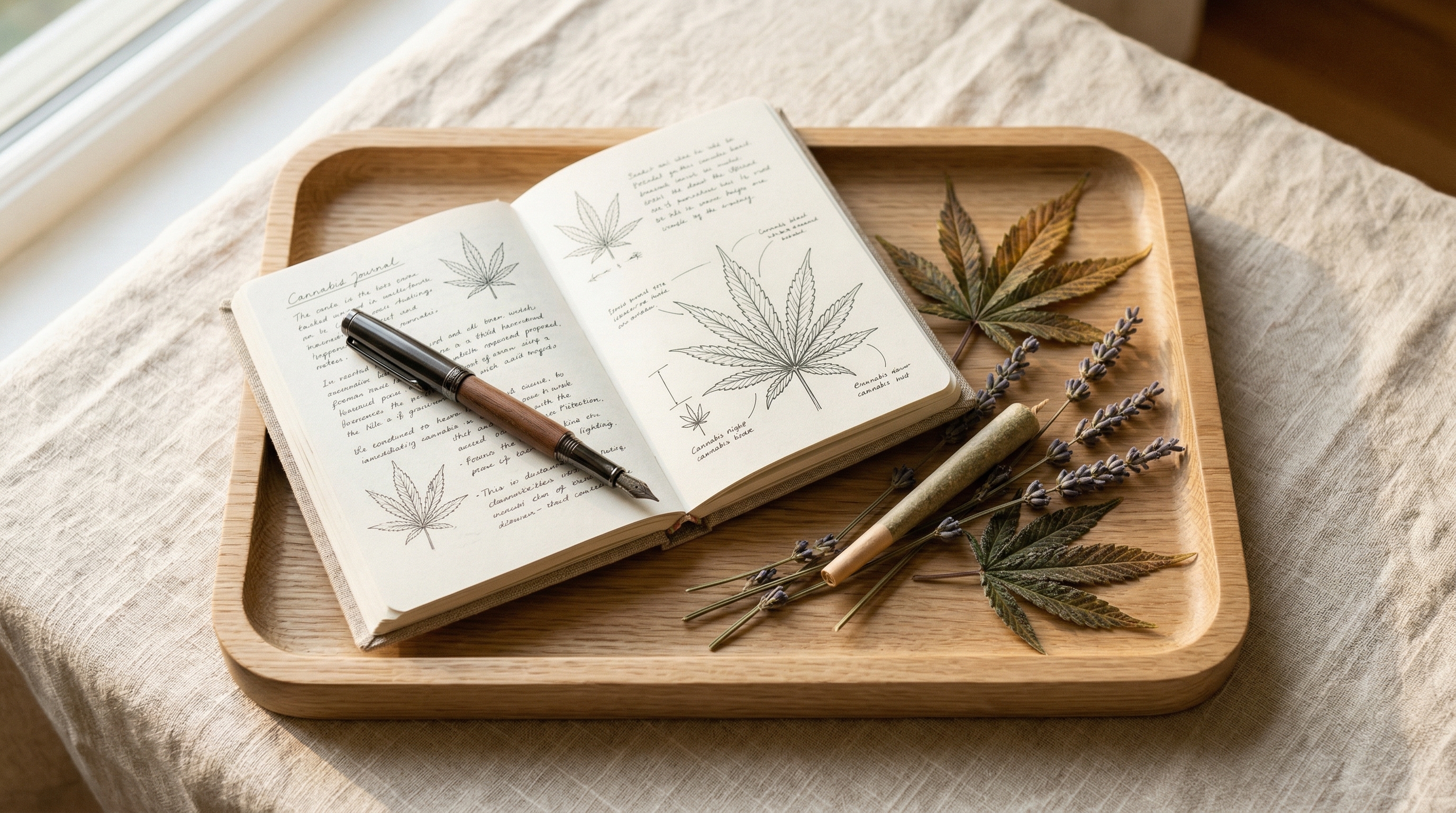
If you do incorporate cannabis into your wellness routine with professional guidance, consider keeping a symptom journal that tracks:
- What you used — strain name, cannabinoid profile (THC:CBD ratio), terpene information if available
- How much — dose, method of consumption, timing
- What you noticed — effects on sleep quality, nightmare frequency, anxiety levels, emotional regulation
- Context — were you also using other coping strategies (therapy, meditation, exercise)?
This kind of tracking turns anecdotal experience into personal data that you and your provider can actually use to make informed decisions.
Key Takeaways
- The endocannabinoid system plays a documented role in fear processing and extinction, and people with PTSD may have lower endocannabinoid levels—providing a biological rationale for why cannabis compounds interact with PTSD symptoms [Neumeister et al., 2013].
- Nabilone (synthetic THC) has shown clinical promise for PTSD-related nightmares, but smoked cannabis has not yet demonstrated clear superiority over placebo in the gold-standard trial we have so far [Bonn-Miller et al., 2021; Jetly et al., 2015].
- CBD may work through complementary mechanisms—boosting natural endocannabinoid levels and potentially disrupting fear memory reconsolidation—with early clinical data showing symptom reduction in most participants [Elms et al., 2019].
- Terpene profiles matter: Consider exploring Relaxing High strains for sleep support and Relieving High strains for daytime comfort, but always in consultation with a healthcare provider.
- Cannabis appears most promising as a complement to therapy, not a replacement. The science points toward cannabinoids enhancing the brain’s ability to process fear—which is exactly what evidence-based PTSD therapies are designed to facilitate.
FAQs
Can cannabis cure PTSD?
No. No current research supports the claim that cannabis cures PTSD. What the evidence suggests is that certain cannabinoids may help manage specific symptoms—particularly nightmares, sleep disruption, and anxiety—and may potentially enhance fear extinction when combined with therapy. PTSD treatment should always involve qualified professional care.
Is CBD or THC better for PTSD symptoms?
The honest answer is that we don’t have enough evidence to declare a winner. THC has shown more clinical data for nightmare reduction, while CBD appears promising for anxiety and may work through different mechanisms (boosting natural endocannabinoids rather than directly activating CB1 receptors). Some researchers believe a combination—leveraging the entourage effect—may ultimately prove most effective, but this remains an area of active investigation.
Why do so many veterans use cannabis for PTSD if the research is inconclusive?
Lived experience often runs ahead of clinical trials. Surveys consistently show that veterans report meaningful symptom relief from cannabis, particularly for sleep and hyperarousal symptoms [Betthauser et al., 2015]. The gap between patient experience and clinical evidence likely reflects the difficulty of conducting cannabis research (due to decades of federal restrictions) rather than an absence of real effects. The research is catching up, not starting from scratch.
Could cannabis make PTSD worse?
It’s possible, particularly with high-THC products used at high doses. Research indicates that excessive THC can increase anxiety, paranoia, and dissociation—all of which can overlap with and exacerbate PTSD symptoms [Crippa et al., 2009]. This is why informed, low-dose, terpene-aware approaches guided by a healthcare provider are so important.
Related Reading:
- Cannabis and Mental Health: What 28 Clinical Trials Actually Show
- Cannabis and GABA: The Anxiety Brake System
- Cannabis and Serotonin: The Mood Connection Beyond THC
- Cannabis and Neuroinflammation: How Cannabinoids May Protect
- Best Cannabis Strains for Stress Relief
- Best Cannabis Strains for Depression
- Cannabis and Sleep in Depression: What Self-Medication Research Reveals
Sources
- Betthauser, K., Pilz, J., & Vollmer, L.E. (2015). “Use and effects of cannabinoids in military veterans with posttraumatic stress disorder.” American Journal of Health-System Pharmacy, 72(15), 1279-1284
- Wilson, J., Dobson, O., Langcake, A. et al. (2026). “The efficacy and safety of cannabinoids for the treatment of mental disorders and substance use disorders: a systematic review and meta-analysis.” The Lancet Psychiatry, 13, 304–315. DOI: 10.1016/S2215-0366(26)00015-5
- MAPS MJP2 Phase 2 Trial (2026). ClinicalTrials.gov NCT07224698
- Wayne State Warrior CARE Trial (2025). ClinicalTrials.gov NCT06381180


