Cannabis for Chronic Fatigue Syndrome: Finding Energy Without the Crash
Explore what science says about cannabis and ME/CFS, from endocannabinoid deficiency theory to terpenes and microdosing strategies for sustainable energy.


The Exhaustion That Sleep Can’t Fix
Here’s a number that may stop you in your tracks: an estimated 836,000 to 2.5 million Americans live with Myalgic Encephalomyelitis/Chronic Fatigue Syndrome (ME/CFS)—and the vast majority remain undiagnosed [Institute of Medicine, 2015]. These aren’t people who are simply tired. ME/CFS is a systemic disease characterized by bone-deep, unrelenting exhaustion that does not improve with rest. It comes bundled with cognitive dysfunction (the notorious “brain fog”), widespread pain, disordered sleep, and the condition’s defining hallmark: post-exertional malaise (PEM)—a profound worsening of symptoms triggered by physical or mental activity that can sideline a person for days or weeks after minimal exertion.
Conventional medicine offers limited solutions. There is no FDA-approved treatment specifically for ME/CFS. Standard stimulants often produce exactly the rebound crash that makes life with CFS so difficult. So it is no surprise that a growing number of people with ME/CFS are quietly turning to cannabis—not to get wired, but to find a gentler, more functional form of energy that doesn’t trigger the next crash.
The questions worth asking are: what does the science actually support, which cannabinoids and terpenes show the most promise, and how do you select cannabis for energy when your energy reserves are already fragile?
This article walks through all of it.
Before we begin: This article is educational, not medical advice. ME/CFS is a serious condition that requires professional care. Nothing here should replace guidance from a qualified healthcare provider who understands your full medical history.

The Science Explained
The Endocannabinoid System and Fatigue
To understand why cannabis might matter for ME/CFS, you need to understand the endocannabinoid system (ECS)—a vast signaling network of receptors, enzymes, and endogenous cannabinoid molecules that regulates a remarkable range of bodily functions: energy balance, immune response, sleep architecture, pain sensitivity, and mood.
The ECS has two primary receptor types: CB1 receptors, concentrated in the brain and central nervous system, and CB2 receptors, found heavily in immune cells and peripheral tissue. Your body produces its own cannabinoids—called endocannabinoids—to activate these receptors on demand. The two best studied are anandamide (AEA), sometimes called the “bliss molecule,” and 2-arachidonoylglycerol (2-AG).
Here is where the connection to ME/CFS becomes significant. Dr. Ethan Russo, a neurologist and cannabis researcher, proposed the Clinical Endocannabinoid Deficiency (CED) hypothesis—the idea that conditions like ME/CFS, fibromyalgia, and migraine may share a common underlying dysfunction: an underperforming ECS [Russo, 2016]. In this framework, the body either fails to produce adequate endocannabinoids or breaks them down too rapidly, leading to widespread dysregulation of the exact systems that ME/CFS disrupts most severely: energy metabolism, immune signaling, pain processing, and sleep.
While CED remains a hypothesis rather than an established diagnosis, accumulating evidence provides biological plausibility. A 2021 systematic review found that ME/CFS patients show altered metabolomic patterns, neuroinflammation markers, and immune signaling disruptions that are structurally consistent with ECS dysfunction [Huth et al., 2021]. If the ECS is indeed running below capacity in ME/CFS, supplementing it with plant-derived cannabinoids—phytocannabinoids—becomes a rational therapeutic hypothesis worth investigating.
What the Research Shows
It is important to be direct here: dedicated, large-scale clinical trials on cannabis for ME/CFS do not yet exist. The evidence base is built from adjacent research—studies on individual symptoms that define ME/CFS—and from the broader body of ECS science. Here is what that research reveals.
THC and energy modulation. THC activates CB1 receptors, which play a central role in dopamine signaling pathways. At low doses, this activation may produce mild stimulation, increased motivation, and improved focus by modulating dopamine release in the prefrontal cortex and nucleus accumbens [Bloomfield et al., 2016]. This is the biphasic dose-response effect: low-dose THC tends toward activation; higher-dose THC tends toward sedation through GABA and adenosine pathway engagement. For someone with ME/CFS, this distinction is not academic—it is the difference between a helpful tool and a trigger for deeper exhaustion.
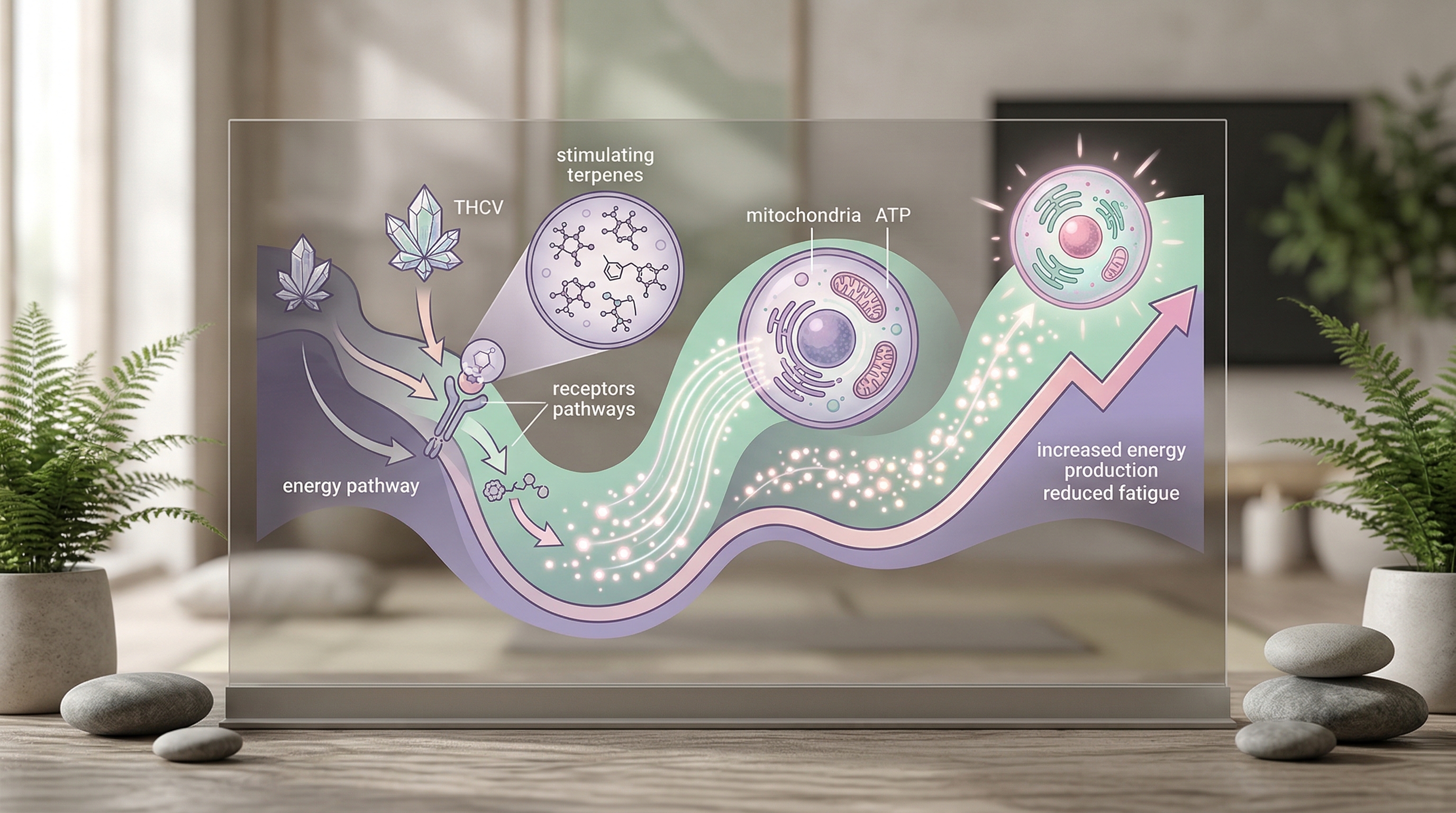
THCV as a potential energizing cannabinoid. Tetrahydrocannabivarin (THCV) is a minor cannabinoid that differs from THC structurally and pharmacologically. At moderate doses, THCV acts as a CB1 receptor antagonist—it does not produce the sedating effects associated with CB1 activation, and early research suggests it may actually promote alertness and suppress appetite [Wargent et al., 2013]. Strains with meaningful THCV content, such as Durban Poison and Doug’s Varin, are specifically associated with clear-headed, energizing effects that many ME/CFS patients find appealing.
CBD and neuroinflammation. Neuroinflammation has emerged as a significant driver of ME/CFS cognitive symptoms. CBD appears to modulate inflammatory cytokine production and may reduce central nervous system inflammation through multiple mechanisms, including serotonin receptor (5-HT1A) activation and indirect ECS signaling via FAAH inhibition [Nichols & Kaplan, 2020]. Anecdotally, many ME/CFS patients report that CBD-rich products help reduce brain fog without the sedation that comes with myrcene-dominant strains. CBD also lacks the rebound fatigue associated with stimulants—a critical advantage for a condition defined by energy fragility.
Terpenes and the entourage effect. Cannabinoids don’t operate in isolation. The terpene profile of a cannabis product shapes its effect character significantly—often more than whether the plant is technically “sativa” or “indica.” Research by Russo and others has described this as the entourage effect: terpenes modulate cannabinoid activity and contribute their own direct neurological effects [Russo, 2011].
For ME/CFS specifically, the following terpenes are worth understanding:
- Alpha-pinene: An acetylcholinesterase inhibitor, meaning it increases acetylcholine levels in the brain—a neurotransmitter associated with memory, alertness, and attention [Miyazawa & Yamafuji, 2005]. Pinene may also counteract some of THC’s cognitive fog-inducing effects, making it particularly valuable in the ME/CFS context.
- Limonene: Shows mood-elevating and anxiolytic effects in both animal models and human research, with evidence of serotonin and dopamine pathway modulation [Russo, 2011]. For ME/CFS patients whose fatigue is compounded by low mood or anxiety, limonene-dominant profiles address multiple symptoms simultaneously.
- Terpinolene: Consistently associated with uplifting, clear-headed effects in user reports. While some animal studies suggest mild sedative properties at high concentrations, it is a dominant terpene in many strains widely recognized for their energizing profiles, including Jack Herer, Ghost Train Haze, and Chernobyl.
- Beta-caryophyllene: The only terpene known to directly bind CB2 receptors, functioning as a dietary cannabinoid [Gertsch et al., 2008]. Its CB2 activity offers anti-inflammatory effects—potentially addressing the immune-mediated component of ME/CFS fatigue—without psychoactive effects or CB1-mediated sedation.
Practical Implications: Choosing Cannabis for ME/CFS
The most important reframing for anyone with ME/CFS approaching cannabis is this: move away from strain names and marketing labels toward terpene-profile-informed selection. This is precisely what our High Families system is designed to support—a terpene-first framework for predicting how a strain will actually make you feel.
High Families That May Support Sustainable Energy
Energy High: This is the starting point for ME/CFS energy support. Strains in this family are typically dominated by terpinolene and ocimene, and are associated with focused, functional alertness and mental clarity. The effect character is often described as a gentle forward momentum rather than a stimulant jolt—which maps well onto the conservative energy management that ME/CFS demands. If your primary goal is navigating a few productive hours without triggering PEM, this family warrants serious attention.
Notable strains in this family include Jack Herer (terpinolene-dominant, widely reported as clear-headed and focused), Ghost Train Haze (high terpinolene with some THCV content), and Chernobyl (terpinolene + limonene balance).
Uplifting profiles with limonene: Strains rich in limonene with moderate pinene content—such as Durban Poison, Super Lemon Haze, and Sour Diesel—address the emotional weight that compounds physical fatigue in ME/CFS. Durban Poison is particularly worth noting because it is one of the few strains with consistently measurable THCV content, making it a popular choice among ME/CFS patients seeking functional energy without sedation risk.
High Families to Use Carefully
Relaxing High: High-myrcene profiles. Myrcene is the most abundant terpene in cannabis overall, and it is associated with sedation, likely through GABA-A potentiation mechanisms [do Vale et al., 2002]. A myrcene-dominant strain is an excellent choice for ME/CFS-related insomnia at night—but the wrong choice when you are trying to sustain functional energy during the day.
The practical test: if a strain smells heavily of mango, earth, or cloves, it is likely myrcene-heavy. If it smells of citrus, pine, or fresh herbs, you are probably looking at a more energizing terpene profile.
Dosing Considerations: The Most Critical Variable
For ME/CFS, dosing is arguably more important than strain selection. The condition involves a fragile energy economy. Overshoot the dose and you may not just fail to achieve energy—you may trigger a significant symptom flare.
Microdosing is the starting framework. Research on THC’s biphasic dose-response suggests that 1–2.5mg THC is the zone where activating, alerting effects are most likely. Beyond approximately 5–7.5mg in most people, sedative mechanisms begin to dominate [Grotenhermen, 2003]. For context, a standard recreational dose is typically 10mg or more—far above the range that supports functional energy in a compromised system.
Practical guidance:
- Start at 1mg THC (or consider beginning with CBD-only products to assess baseline tolerance)
- Increase by no more than 0.5–1mg per session over several days
- Prioritize sublingual tinctures or low-temperature vaporization: both allow precise dose control and have predictable onset times, unlike edibles
- Track rigorously: note energy levels, brain fog, PEM frequency, and sleep quality in a journal for at least two weeks before evaluating results
- Consider a CBD-forward or balanced ratio: a 2:1 or 4:1 CBD:THC product may provide anti-inflammatory and fog-clearing benefit with reduced risk of the sedation and rebound fatigue that higher THC doses can bring
The PEM risk: Post-exertional malaise is uniquely vulnerable to misdosing. If you consume too much and feel initially stimulated, the subsequent fatigue wave can be severe. Always err on the side of less.
Consumption Timing and Method
Morning and early afternoon are generally better timing windows than evening for energy-focused use, both because of the alerting intent and because cannabis can affect sleep architecture when consumed too close to bedtime. Some ME/CFS patients find low-dose CBD taken upon waking—before significant activity—helps buffer the inflammatory response that often drives early-day fatigue.
For method: sublingual tinctures offer the most precise titration and a predictable 15–45 minute onset. Low-temperature vaporization (under 200°C) preserves terpene integrity and provides near-immediate onset feedback, which makes dose adjustment easier. Avoid high-temperature dabbing or combustion if respiratory sensitivity is a concern—ME/CFS patients often have autonomic nervous system dysregulation that can make harsh inhalation methods more uncomfortable.

Key Takeaways
- Clinical Endocannabinoid Deficiency is a compelling but still-hypothetical framework suggesting ME/CFS may involve an underperforming ECS—providing a biological rationale for why plant cannabinoids might help [Russo, 2016]
- THCV and alpha-pinene are the most targeted cannabinoid and terpene choices for ME/CFS energy support, with mechanisms that diverge from the sedating pathways that dominate most cannabis products
- Terpene profile matters far more than “sativa” or “indica”: look for terpinolene, limonene, and alpha-pinene as primary terpenes; actively avoid myrcene-dominant profiles during the day
- Microdosing (1–2.5mg THC) is the safe starting zone; higher doses risk triggering the very fatigue and sedation you are working to avoid
- The Energy High family and limonene-rich profiles are the most relevant starting points in the High Families framework for ME/CFS energy applications
- Large-scale ME/CFS-specific trials are still needed; current evidence is promising but entirely preliminary—work with a knowledgeable healthcare provider
FAQs
Can cannabis cure Chronic Fatigue Syndrome?
No. There is no known cure for ME/CFS, and no evidence that cannabis cures it. What the research and clinical experience suggest is that carefully selected cannabis—at appropriate doses and with attention to terpene profiles—may help manage specific symptoms: functional fatigue, brain fog, pain, and disordered sleep. Think of it as a potential tool within a broader symptom management strategy, not a standalone treatment.
Won’t cannabis just make my fatigue worse?
It can—and does, with the wrong product or dose. High-myrcene, high-THC products consumed at recreational doses are among the worst choices for anyone seeking functional energy with ME/CFS. But low-dose, terpinolene- or limonene-rich products from the Energy High family operate on different pharmacological pathways and are associated with alerting rather than sedating effects. The distinction lies entirely in terpene selection and dose discipline.
Is CBD or THC better for chronic fatigue?
They appear to work through complementary mechanisms, and neither is universally superior. CBD may address the neuroinflammation that drives brain fog and cognitive dysfunction, while low-dose THC supports dopamine-mediated motivation and alertness. THCV—a minor cannabinoid found in specific strains—is the most targeted option for energy without sedation. Many ME/CFS patients report the best results from balanced or CBD-forward ratios, which aligns with the full-spectrum, entourage effect philosophy.
What strains specifically do ME/CFS patients find helpful?
Durban Poison is the most consistently mentioned in ME/CFS patient communities—it is terpinolene-dominant with measurable THCV content and widely described as “functional” and clear-headed. Jack Herer and Harlequin (a CBD-rich, balanced strain) are also frequently cited. Individual responses vary significantly, and lab-tested terpene profiles are more reliable predictors than strain names alone.
How do I avoid triggering PEM from cannabis use itself?
The same principles that govern ME/CFS activity pacing apply to cannabis: start far below what you think you need, observe for 48–72 hours before adjusting, and never push through fatigue in hopes of “breaking through.” If a dose feels stimulating but then produces a significant energy valley, reduce the dose immediately. Track everything—the signal-to-noise ratio in ME/CFS management is low, and consistent data is your best navigation tool.
Sources
- Institute of Medicine (IOM). (2015). Beyond Myalgic Encephalomyelitis/Chronic Fatigue Syndrome: Redefining an Illness. National Academies Press.
- Russo, E.B. (2016). “Clinical Endocannabinoid Deficiency Reconsidered: Current Research Supports the Theory in Migraine, Fibromyalgia, Irritable Bowel, and Other Treatment-Resistant Syndromes.” Cannabis and Cannabinoid Research, 1(1), 154–165. DOI: 10.1089/can.2016.0009
- Huth, T.K., Eaton-Fitch, N., Staines, D., & Marshall-Gradisnik, S. (2021). “A systematic review of metabolomic dysregulation in Chronic Fatigue Syndrome/Myalgic Encephalomyelitis/Systemic Exertion Intolerance Disease.” Journal of Translational Medicine, 18, 198.
- Bloomfield, M.A.P., et al. (2016). “The effects of Δ9-tetrahydrocannabinol on the dopamine system.” Nature, 539, 369–377. DOI: 10.1038/nature20153
- Wargent, E.T., et al. (2013). “The cannabinoid Δ9-tetrahydrocannabivarin (THCV) ameliorates insulin sensitivity in two mouse models of obesity.” Nutrition and Diabetes, 3, e68.
- Nichols, J.M., & Kaplan, B.L.F. (2020). “Immune Responses Regulated by Cannabidiol.” Cannabis and Cannabinoid Research, 5(1), 12–31. DOI: 10.1089/can.2018.0073
- Russo, E.B. (2011). “Taming THC: potential cannabis synergy and phytocannabinoid-terpenoid entourage effects.” British Journal of Pharmacology, 163(7), 1344–1364. PMID: 21749363
- Gertsch, J., Leonti, M., Raduner, S., et al. (2008). “Beta-caryophyllene is a dietary cannabinoid.” Proceedings of the National Academy of Sciences, 105(26), 9099–9104. DOI: 10.1073/pnas.0803601105
- Miyazawa, M., & Yamafuji, C. (2005). “Inhibition of acetylcholinesterase activity by bicyclic monoterpenoids.” Journal of Agricultural and Food Chemistry, 53(5), 1765–1768.
- do Vale, T.G., et al. (2002). “Central effects of citral, myrcene and limonene, constituents of essential oil chemotypes from Lippia alba.” Phytomedicine, 9(8), 709–714.
- Grotenhermen, F. (2003). “Pharmacokinetics and pharmacodynamics of cannabinoids.” Clinical Pharmacokinetics, 42(4), 327–360.


