Cannabis Nutrients Guide: Feeding Your Plants for Maximum Yield
Learn how to feed cannabis plants the right nutrients at every growth stage. A step-by-step guide to NPK ratios, pH, EC, and feeding schedules.


Growing cannabis is equal parts art and science—and nowhere does the “science” part matter more than when it comes to feeding your plants. Get the nutrients right, and you’ll be rewarded with dense, trichome-covered buds bursting with terpenes. Get them wrong, and you’ll spend weeks troubleshooting yellowing leaves, burnt tips, and disappointing harvests.
This guide walks you through everything you need to know about cannabis nutrition: what nutrients your plants need, when they need them, and how to dial in a feeding schedule that maximizes both yield and quality. Whether you’re growing your first plant or looking to level up your garden game, you’ll walk away with a practical, repeatable system.
What you’ll accomplish: A complete understanding of cannabis nutrition, from seed to harvest, including how to mix nutrients, adjust pH, read your plants, and troubleshoot deficiencies.
Estimated time: 30 minutes to read and plan; ongoing application throughout your grow cycle (8-16 weeks depending on strain).
Difficulty level: Intermediate — some basic growing knowledge is helpful, but beginners can absolutely follow along.
What You’ll Need
Required
- Base nutrient system (2-part or 3-part liquid concentrate — brands like General Hydroponics Flora Series, Fox Farm Trio, or Advanced Nutrients Sensi are popular choices)
- pH meter or pH test drops (digital meters are more accurate; aim for one with ±0.1 accuracy)
- pH Up and pH Down solutions (phosphoric acid down, potassium hydroxide up)
- Measuring syringes or pipettes (1 mL and 10 mL sizes)
- Clean mixing container (1-gallon or 5-gallon bucket)
- EC/TDS meter (measures nutrient concentration in your water)
- Filtered or dechlorinated water (letting tap water sit 24 hours works in a pinch)
Optional
- Cal-Mag supplement (especially important for LED growers and those using RO water)
- Bloom boosters (PK supplements for flower phase)
- Silica supplement (strengthens stems and cell walls)
- Mycorrhizal inoculant (beneficial fungi that enhance root nutrient uptake)
- Foliar spray bottle (for micronutrient applications)
Safety Equipment
- Nitrile gloves (concentrated nutrients can irritate skin)
- Safety glasses (pH Down is an acid — protect your eyes)
- Well-ventilated workspace (some supplements have strong odors)

Understanding Cannabis Macronutrients and Micronutrients
Before we dive into the steps, let’s build a foundation. Cannabis plants need 17 essential elements to survive and thrive. These fall into three categories:
Primary Macronutrients (N-P-K)
These are the big three—the numbers you see on every fertilizer bottle:
- Nitrogen (N): The engine of vegetative growth. Nitrogen drives leaf and stem development, chlorophyll production, and amino acid synthesis. Plants are hungriest for nitrogen during the vegetative stage.
- Phosphorus (P): Critical for energy transfer (ATP), root development, and—most importantly for growers—flower formation. Phosphorus demand spikes during bloom.
- Potassium (K): The regulator. Potassium controls stomatal function (how plants breathe), water uptake, enzyme activation, and overall plant resilience. It’s important throughout the entire lifecycle.
Secondary Macronutrients
- Calcium (Ca): Cell wall structure and root health
- Magnesium (Mg): The central atom in chlorophyll; essential for photosynthesis
- Sulfur (S): Protein synthesis and enzyme function
Micronutrients
Needed in trace amounts but absolutely essential:
- Iron (Fe), Manganese (Mn), Zinc (Zn), Boron (B), Copper (Cu), Molybdenum (Mo), Chlorine (Cl)
Most quality base nutrient systems include all of these. The trick isn’t just having them—it’s delivering them in the right ratios at the right time.
Step-by-Step Instructions
Step 1: Test and Prepare Your Water Source
Time estimate: 10-15 minutes
Before you add a single drop of nutrients, you need to know what’s already in your water. Fill your mixing container with room-temperature water (65-72°F / 18-22°C) and test two things:
- pH: Measure with your pH meter. Tap water typically reads between 7.0-8.5.
- EC/TDS: Measure the baseline mineral content. Ideally, your starting water should be below 0.4 EC (200 ppm). If it’s above 0.6 EC (300 ppm), consider using filtered or reverse osmosis (RO) water.
Visual cue for success: Your pH meter reads a stable number within 5 seconds. If it keeps drifting, recalibrate.
Common error to avoid: Never mix nutrients into hot water. High temperatures can degrade chelated micronutrients and cause chemical reactions that lock out elements [Marschner, 2012].
Tip: If you’re using RO water (near 0 EC), you’ll almost certainly need a Cal-Mag supplement since reverse osmosis strips out calcium and magnesium.
Step 2: Choose the Right NPK Ratio for Your Growth Stage
Time estimate: 5 minutes (decision-making)
Cannabis has dramatically different nutritional needs depending on its life stage. Here’s the framework:
| Growth Stage | Duration | N-P-K Emphasis | EC Target Range |
|---|---|---|---|
| Seedling | Weeks 1-2 | Very light; 1/4 strength | 0.4-0.6 EC |
| Early Veg | Weeks 3-4 | High N, moderate P-K (3-1-2 ratio) | 0.8-1.2 EC |
| Late Veg | Weeks 5-6+ | High N, increasing P-K (3-1-3 ratio) | 1.2-1.6 EC |
| Transition (Stretch) | Week 1-2 of flower | Balanced, begin shifting to P-K | 1.2-1.6 EC |
| Mid Flower | Weeks 3-6 of flower | Low N, high P-K (1-3-2 ratio) | 1.4-1.8 EC |
| Late Flower/Ripen | Final 2 weeks | Minimal N, moderate P-K, then flush | 0.8-1.0 EC, then 0 |
Common error to avoid: Overfeeding during the seedling stage. Those tiny roots can’t handle full-strength nutrients. When in doubt, go lighter—you can always add more, but you can’t un-burn a root system.
Tip: The “transition” period (first 1-2 weeks after flipping to 12/12 light) is often overlooked. Plants still stretch and grow vegetatively, so don’t cut nitrogen too quickly.
Step 3: Mix Your Nutrients in the Correct Order
Time estimate: 5-10 minutes per batch
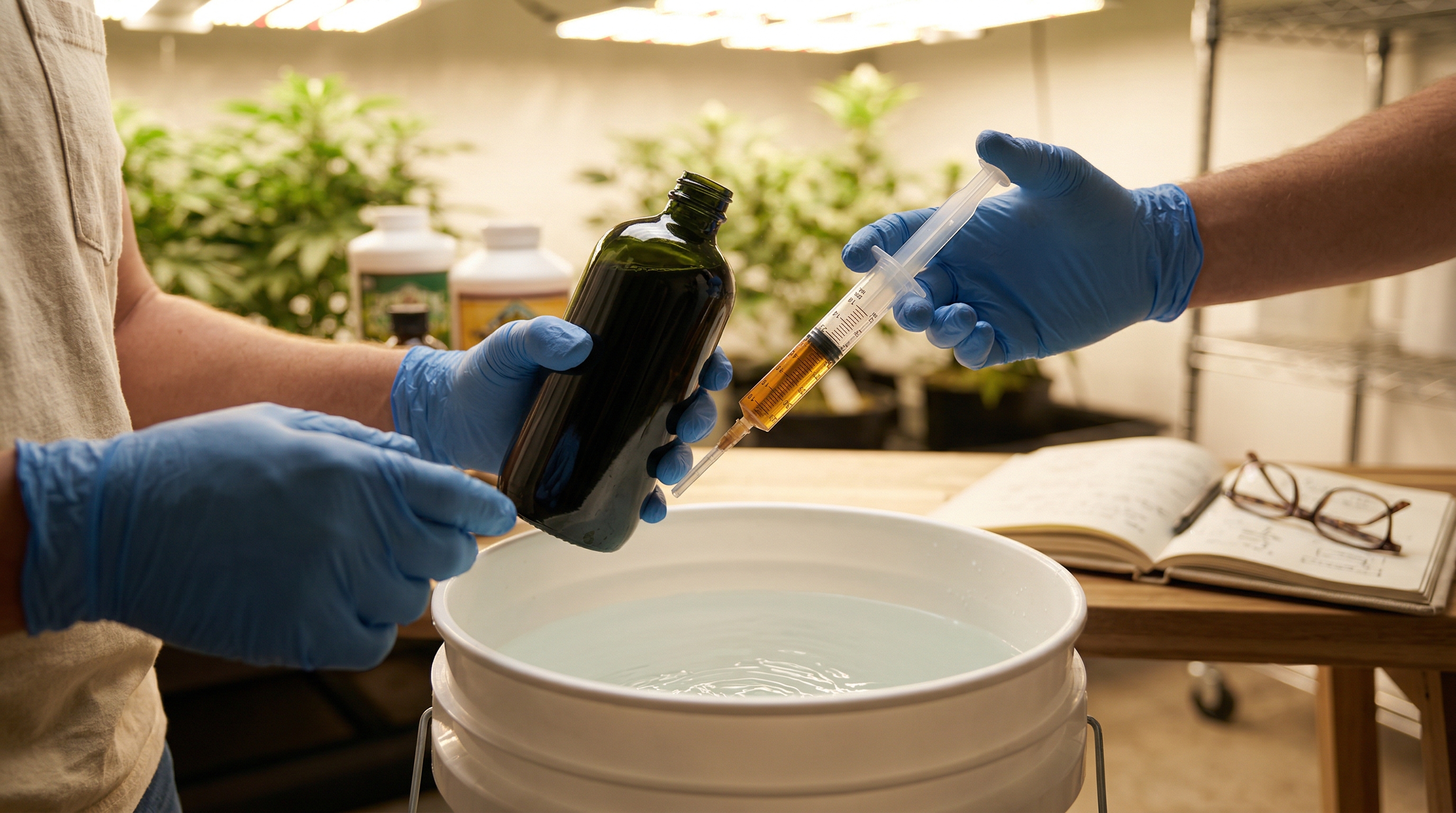
Mixing order matters. Adding concentrated nutrients in the wrong sequence can cause chemical reactions that create insoluble compounds—essentially locking out the nutrients you’re trying to deliver.
Follow this universal mixing order:
- Start with your full volume of water
- Silica (if using — always add first, stir, and wait 5 minutes)
- Cal-Mag (if using)
- Micro/base nutrients (Part A or “Micro” in 3-part systems)
- Grow or Bloom nutrients (Part B, then Part C)
- Supplements and boosters (PK boosters, enzymes, etc.)
- pH adjustment (always last)
Critical rule: Never mix concentrated nutrients together before diluting. Add each component to the water separately and stir between additions.
Visual cue for success: Your mixed solution should be clear to slightly tinted (amber, green, or brown depending on the brand). If it’s cloudy or has precipitate floating in it, something went wrong—dump it and start over.
Step 4: Adjust pH to the Sweet Spot
Time estimate: 5 minutes
This is arguably the most important step in the entire process. You could have the perfect nutrient ratio, but if your pH is off, your plants literally cannot absorb certain elements. This phenomenon is called nutrient lockout, and it’s the number one cause of deficiency symptoms in well-fed plants [Bugbee, 2004].
Target pH ranges:
- Soil/organic grows: 6.0-7.0 (sweet spot: 6.3-6.5)
- Coco coir: 5.5-6.5 (sweet spot: 5.8-6.2)
- Hydroponics (DWC, NFT, etc.): 5.5-6.5 (sweet spot: 5.5-5.8)
How to adjust:
- After mixing all nutrients, test pH
- Add pH Down (to lower) or pH Up (to raise) one drop at a time for small batches
- Stir thoroughly and retest
- Repeat until you hit your target range
Common error to avoid: Chasing a single exact number. It’s actually beneficial to let pH drift slightly within the acceptable range between feedings—different nutrients are most available at slightly different pH values, so a gentle swing ensures broader access [Bugbee, 2004].
Tip: pH your solution right before feeding, not hours in advance. pH can drift over time, especially in organic solutions where microbial activity changes the chemistry.
Step 5: Feed Your Plants and Monitor Runoff
Time estimate: 10-20 minutes depending on garden size
Now you’re ready to actually feed. How you do this depends on your growing medium:
For soil and coco coir:
- Water slowly and evenly until you see 10-20% runoff from the bottom of the pot
- Collect and test the runoff pH and EC
- Runoff EC should be within 0.2-0.5 of your input EC
- If runoff EC is significantly higher than input, salts are building up—time for a flush
For hydroponic systems:
- Replace your reservoir solution every 7-10 days
- Top off with half-strength solution between changes
- Monitor pH and EC daily (pH will drift upward as plants feed)
Feeding frequency:
- Soil: Every 2-3 days (water when the top inch of soil is dry; lift the pot—light means thirsty)
- Coco coir: Every 1-2 days (coco dries faster and has no inherent nutrient buffer)
- Hydro: Continuous, with reservoir monitoring
Visual cue for success: Healthy plants have vibrant green leaves (during veg), strong stems, and vigorous new growth. The first sign of overfeeding is usually burnt leaf tips—a thin brown or yellow crisp line at the very tips of the leaves.
Step 6: Adjust Throughout the Lifecycle
Time estimate: Ongoing (5 minutes per feeding)
Feeding isn’t a “set it and forget it” task. You’ll need to read your plants and adjust:
- Increase EC gradually as plants mature (never jump more than 0.2 EC between feedings)
- Shift NPK ratios when transitioning from veg to flower (reduce nitrogen, increase phosphorus and potassium)
- Watch for strain-specific sensitivities — some genetics are light feeders (many Relaxing High strains with high myrcene content tend to be less nutrient-hungry), while others are heavy feeders
- Flush before harvest — many growers run plain, pH’d water for the final 7-14 days to allow the plant to use up stored nutrients, which some believe improves flavor and smoothness
Tip: Keep a feeding journal. Log every feeding’s date, EC, pH, and any plant observations. After a few grows, you’ll have a personalized playbook that’s worth more than any generic feeding chart.

Pro Tips
The “Less Is More” Philosophy
Experienced growers almost universally agree: it’s better to underfeed than overfeed. Most nutrient manufacturers’ recommended dosages are aggressive—start at 50-75% of the label suggestion and only increase if your plants show they want more. A slightly hungry plant will stretch its roots seeking nutrition, building a stronger root system in the process.
The Terpene Connection
Here’s something many growers overlook: nutrition directly influences terpene production, which determines the flavor, aroma, and experience profile of your final product. Research suggests that moderate sulfur supplementation may enhance terpene synthesis, while excessive nitrogen during late flower can actually suppress terpene and cannabinoid production [Saloner & Bernstein, 2022]. If you’re growing strains in the Uplifting High family (rich in limonene and linalool) or the Entourage High family (complex multi-terpene profiles), dialing back nitrogen in the final weeks is especially important for preserving those nuanced terpene expressions.
Organic vs. Synthetic: A Quick Comparison
| Factor | Organic (Living Soil) | Synthetic (Salt-Based) |
|---|---|---|
| pH management | Less critical (soil biology buffers) | Essential (no microbial buffer) |
| Feeding precision | Lower (slow release) | Higher (immediate availability) |
| Flavor/terpene impact | Often praised for complexity | Can match with proper flushing |
| Learning curve | Moderate (build soil, then let it work) | Moderate (measure and mix regularly) |
| Cost | Higher upfront, lower ongoing | Lower upfront, ongoing purchases |
The “Fade” Is Your Friend
During the final 2-3 weeks of flower, it’s natural and desirable for fan leaves to yellow and fade. This means the plant is mobilizing stored nutrients into the flowers. Don’t panic and dump nitrogen on a plant that’s doing exactly what it should.
Troubleshooting
| Problem | Likely Cause | Solution |
|---|---|---|
| Yellow lower leaves (veg) | Nitrogen deficiency | Increase N in next feeding; check pH is in range |
| Burnt/crispy leaf tips | Nutrient burn (overfeeding) | Reduce EC by 20-30%; flush with plain pH’d water |
| Purple stems | Phosphorus deficiency or cold temps | Check root zone temp (>65°F); ensure pH allows P uptake |
| Interveinal yellowing (new growth) | Iron deficiency (usually pH-related) | Lower pH to 5.8-6.2; iron is locked out above 6.5 |
| Brown spots on leaves | Calcium deficiency | Add Cal-Mag; check pH isn’t too low (below 5.5) |
| Leaf edges curling up | Heat stress or potassium deficiency | Check environment first; if temps are fine, increase K |
| Slow growth, dark green leaves | Nitrogen toxicity (too much N) | Flush and reduce nitrogen; this is common in early flower |
| Runoff EC much higher than input | Salt buildup in medium | Flush with 2-3x pot volume of plain pH’d water |
| pH swings wildly in reservoir | Algae growth or root issues | Clean reservoir, check for root rot, block light from reaching water |
Variations
Beginner Approach: Single-Part Nutrients
If the multi-part mixing process feels overwhelming, start with a single-part nutrient system (like General Hydroponics FloraNova or Dyna-Gro Foliage-Pro/Bloom). These combine everything into one or two bottles. You’ll sacrifice some fine-tuning ability, but the simplicity is worth it for your first grow.
Living Soil / No-Till Approach
For growers who prefer a hands-off method: build a living soil with amendments like worm castings, bone meal, kelp meal, and rock dust. The microbial ecosystem in the soil breaks down organic matter and delivers nutrients to the plant on demand. Your main job becomes watering with plain, dechlorinated water and occasionally top-dressing with compost or dry amendments. This approach pairs beautifully with strains from the Relaxing High and Relieving High families, where the slow, steady nutrient delivery seems to support rich cannabinoid and terpene development.
Scaling Up
If you’re running a larger garden (10+ plants), invest in a dosing system or at minimum a large reservoir with a recirculating pump. Mixing individual batches for each plant isn’t sustainable at scale. Automated pH and EC monitors (like BlueLab Guardian or similar) pay for themselves in time saved and consistency gained.
Key Takeaways
- NPK ratios shift by stage: High nitrogen during veg (3-1-2), shift to high phosphorus and potassium in flower (1-3-2), then taper off before harvest.
- pH is everything: Even a perfect nutrient solution is useless if pH is off. Soil targets 6.0-7.0; coco and hydro target 5.5-6.5. Check it every feeding.
- Start at half strength: Most nutrient burn comes from following the label too closely. Begin at 50% and increase only when plants ask for more.
- Less is more in late flower: Excess nitrogen in the final weeks suppresses terpene and cannabinoid production. Let the plant fade naturally.
- Keep a feeding journal: Your notes from grow one become your personalized playbook for grow two. There is no substitute for recorded data.
- Medium matters: Soil buffers pH and feeds slowly. Coco is fast and precise but needs more attention. Hydro is the most demanding but most controllable.
Cannabis nutrition is not about memorizing a rigid formula — it is about understanding principles and learning to read your plants. The best feeding schedule is the one you refine over multiple grows.
Happy growing, and remember — healthy plants make for a much better high.
Sources
- Bugbee, B. (2004). “Nutrient Management in Recirculating Hydroponic Culture.” Acta Horticulturae, 648, 99-112.
- Marschner, P. (2012). Marschner’s Mineral Nutrition of Higher Plants. 3rd Edition. Academic Press.
- Saloner, A. & Bernstein, N. (2022). “Nitrogen supply affects cannabinoid and terpenoid profile in medical cannabis.” Industrial Crops and Products, 167, 113516.


