Why Do Dispensaries Scan Your ID—and What Do They Keep?
Does a dispensary keep your ID scan? Separate age checks, stored records, delivery details, and marketing consent in California, New York, and Massachusetts.

Professor High
Dispensaries check identification to establish that a customer is eligible to buy cannabis. Whether an electronic scan creates a stored customer record is a separate question. The answer depends on the jurisdiction, the kind of transaction, and the store’s actual system—not merely whether you hear a scanner beep.
California’s regulator requires retailers to check customer ID. New York expressly permits a transaction scan as a condition of sale. Massachusetts requires identification checks at entry and checkout while restricting additional personal-data retention. Those are three different instructions, not one nationwide scanner policy. California DCC retail guidance, New York adult-use regulations, §123.10(d), Massachusetts regulations, 935 CMR 500.140(2).
Here is the question worth asking before handing over your card: “Does this only verify my age, or does it save information—and which information?”
This guide concerns adult-use retail purchases. Medical-program enrollment and delivery can involve different records. Rules and regulator resources were checked September 7, 2026; use the linked authorities for later changes.
Three things that can look like one quick scan
At a busy entrance, verification, account creation, and promotional enrollment can happen within the same conversation. Treat them as separate questions:
| Action | What you want to establish | Useful question |
|---|---|---|
| Age or identity check | What the system reads to decide eligibility | “Which fields does the scanner read?” |
| Record retention | What remains after the check or purchase | “Does it save the card image, its details, or only a verification result?” |
| Marketing enrollment | Whether information is used for promotions | “Can I complete this transaction without signing up for texts or a loyalty account?” |
These are questions to investigate, not a claim that every retailer uses all three systems. A worker saying “we just scan it” has explained an action; they have not yet explained storage.
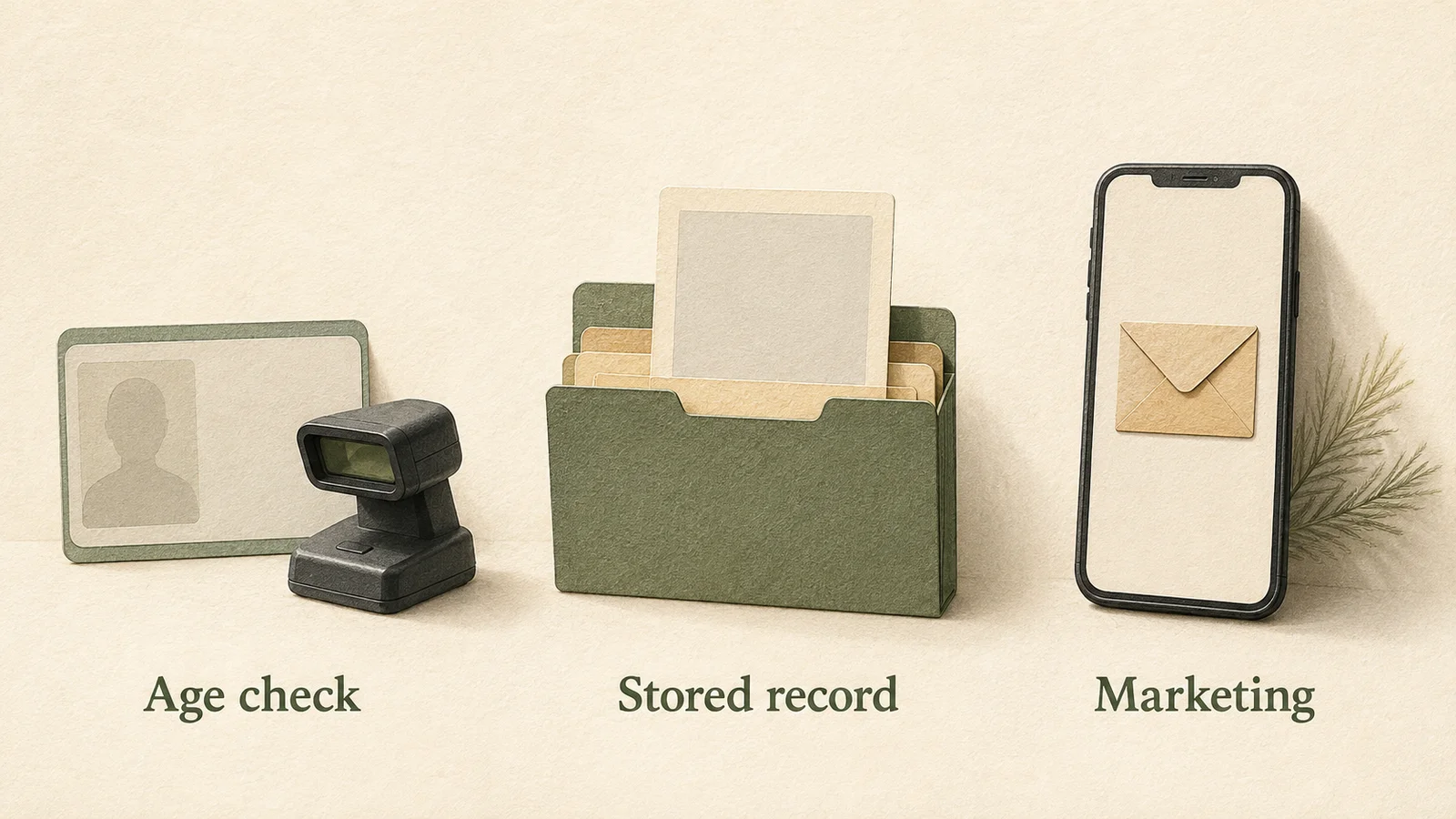
These are separate data uses, not an automatic sequence. Ask which apply to your transaction and which choices you have.
California: checking ID does not explain retention
The California Department of Cannabis Control identifies acceptable documents, including government-issued photo ID, military photo ID, and passports. Its retail guidance establishes the age-check requirement; that page does not establish how a particular scanner stores information. Ask the retailer to explain its verification method and retention policy separately. DCC retail guidance.
For California residents dealing with a business covered by the California Consumer Privacy Act, privacy rights can include learning what personal information is collected, requesting deletion, and opting out of sale or sharing. Coverage and exceptions matter: a deletion request does not override every legal recordkeeping obligation. Use the business’s designated privacy-request method and ask why any information must remain. California Attorney General’s CCPA guide.
A useful request is: “Please explain what you retain from ID verification, whether it connects to my purchase history, and where I can submit a privacy request.” That asks for an accountable answer without assuming every dispensary is covered by the same privacy provisions.
New York: scans are permitted; consent still matters
New York permits a transaction scan before a sale. Its rule also restricts recording personal information without consent. There is an exception for ordinary sales information, which can include age. Permission to scan does not settle every later use of that data. OCM regulations, §123.10(d)(3)–(5).
You can ask about alternatives or decline the purchase. But this rule does not give you a right to insist on a sale without scanning.
Ask the staff member to distinguish transaction information from a separate customer profile or promotional signup. If the answer is unclear, request the written policy or a manager rather than guessing what the scanner does.
Massachusetts: ordinary transaction data versus additional information
The Massachusetts rule requires checks at entry and point of sale. It distinguishes information normally required for a retail transaction, including age determination, from additional personal information. Recording or retaining that additional information generally requires voluntary written permission, with specified delivery exceptions. 935 CMR 500.140(2), current posted regulations effective June 18, 2026.
For a walk-in purchase, the practical follow-up is: “Which information is part of this transaction, and which information are you asking my written permission to keep?” Read the actual consent language. A form combining verification, account creation, and promotional preferences deserves more attention than its friendly title.
Do not generalize the walk-in rule to home delivery. Massachusetts expressly addresses delivery pre-verification and collection of the customer’s name, date of birth, address, primary phone number, and email. It restricts that collected information to the delivery purpose and confidential maintenance. 935 CMR 500.140(2)(d)–(f).
Delivery changes the privacy conversation
Delivering a regulated product to a named person at an address is different from checking a walk-in shopper’s age. Before ordering, ask what information the retailer and delivery provider each receive, where the upload goes, and how long required records remain.
For New York deliveries, when the orderer and recipient differ, both identities go into the point-of-sale system. This does not describe every walk-in purchase. OCM regulations, §123.10(d)(4).
Use the retailer’s verified ordering channel before uploading identification. Start with official directories: California DCC license search, New York dispensary verification, or Massachusetts Where to Buy. A license helps establish who the business is; it does not describe its scanner’s settings or substitute for its privacy policy.
Five questions to ask before the scan
You do not need to deliver a speech at the front desk. Start with the first question and follow the answer.
- What gets saved? Ask separately about the card image, name, address, birth date, document number, and verification result. Do not assume a stored image and extracted fields are the same thing.
- Where is it saved? Ask whether the retailer, its verification vendor, or its ordering platform holds the record.
- What is it connected to? Ask whether the record links to purchases or a customer account.
- What is optional? Separate required transaction information from loyalty enrollment and promotional messages.
- When is it deleted? Ask for the retention policy, applicable exceptions, and the contact for privacy requests.
A specific written answer is more useful than “totally private” or “the state makes us.” If a legal requirement is offered as the reason, ask which requirement applies to that field and transaction. Staff may need to look it up; that is better than improvising.
If you cannot get a clear answer, you can postpone the purchase. Avoid uploading extra identity documents simply to investigate a store’s policy.
What a scan cannot tell you by itself
An ID scan alone does not establish who can later access the information, how long it is held, or whether it goes to a government system. Equally, a reassurance that the store does not keep the ID image does not answer whether it retains extracted details.
Do not use a cashier’s guess to resolve questions about employment screening, immigration, professional licensing, or other consequential decisions. This article does not establish what an employer or agency can obtain in a particular case.
For ordinary shopping decisions, keep the focus concrete: the business, the specific transaction, the fields collected, the purposes, and the retention policy. Our first dispensary visit guide covers the rest of the visit; the dispensary red-flags guide covers seller and product checks.
Frequently asked questions
Does every dispensary keep a photo of my driver’s license?
Do not assume that. Ask whether the system stores an image, extracted information, or a verification result. The state requirements discussed above do not demonstrate the configuration of every retailer’s scanner.
Can I refuse to have my ID scanned?
You can decline to proceed, but that does not guarantee the retailer must complete the sale using another method. New York expressly permits a transaction scan as a sale condition. Ask about accepted alternatives before visiting.
Does paying cash make a dispensary purchase anonymous?
Cash does not answer what the ID system, ordering account, or delivery record retains. Ask about those systems separately; do not treat the payment method as a privacy guarantee.
Can I ask the dispensary to delete my information?
Yes, you can ask through its privacy contact. Whether it must comply depends on applicable law, business coverage, the information involved, and retention exceptions. California’s CCPA guide explains those qualifications for covered businesses; it is not a nationwide deletion promise.
Does opting out of promotional texts delete my ID record?
Do not assume so. Request an explanation of marketing preferences and retained transaction information separately. Ask for confirmation of what the business changed and what it continues to hold.
