Edible Dosing for Beginners: The 2-Hour Rule That Saves Sessions
New to cannabis edibles? Learn the 2-hour rule, proper dosing, and beginner tips to enjoy edibles safely and avoid common mistakes.

Why This Matters
So you’ve got a cannabis edible in your hand—maybe a gummy, a chocolate, or a cookie—and you’re wondering, “How much of this should I actually eat?” You’re asking exactly the right question, and I’m genuinely glad you’re here before you dive in.
Edibles are one of the most enjoyable ways to experience cannabis. They’re discreet, they don’t require any gear, and the effects can feel wonderfully full-bodied. But they also work very differently from smoking or vaping, and that difference catches a lot of people off guard.
The single biggest mistake beginners make? Eating more because they “don’t feel anything yet.” That’s exactly what the 2-hour rule is designed to prevent. By the end of this guide, you’ll know how to dose confidently, what to expect timeline-wise, and how to keep every session comfortable.
The Basics
What You Need to Know
When you smoke or vape cannabis, THC (the compound primarily responsible for the “high”) enters your bloodstream through your lungs. Effects hit within minutes. Edibles take a completely different route.
When you eat an edible, THC travels through your digestive system and gets processed by your liver. Your liver converts regular THC (delta-9-THC) into a metabolite called 11-hydroxy-THC, which is significantly more potent and longer-lasting than what you’d get from inhaling [Huestis, 2007]. This is why edible highs feel different—often more intense and more body-focused—even at the same milligram dose.
This liver processing takes time. A lot of time compared to smoking. Most people start feeling effects 30 minutes to 2 hours after eating an edible, but it can take even longer depending on your metabolism, what you’ve eaten that day, and your individual body chemistry.
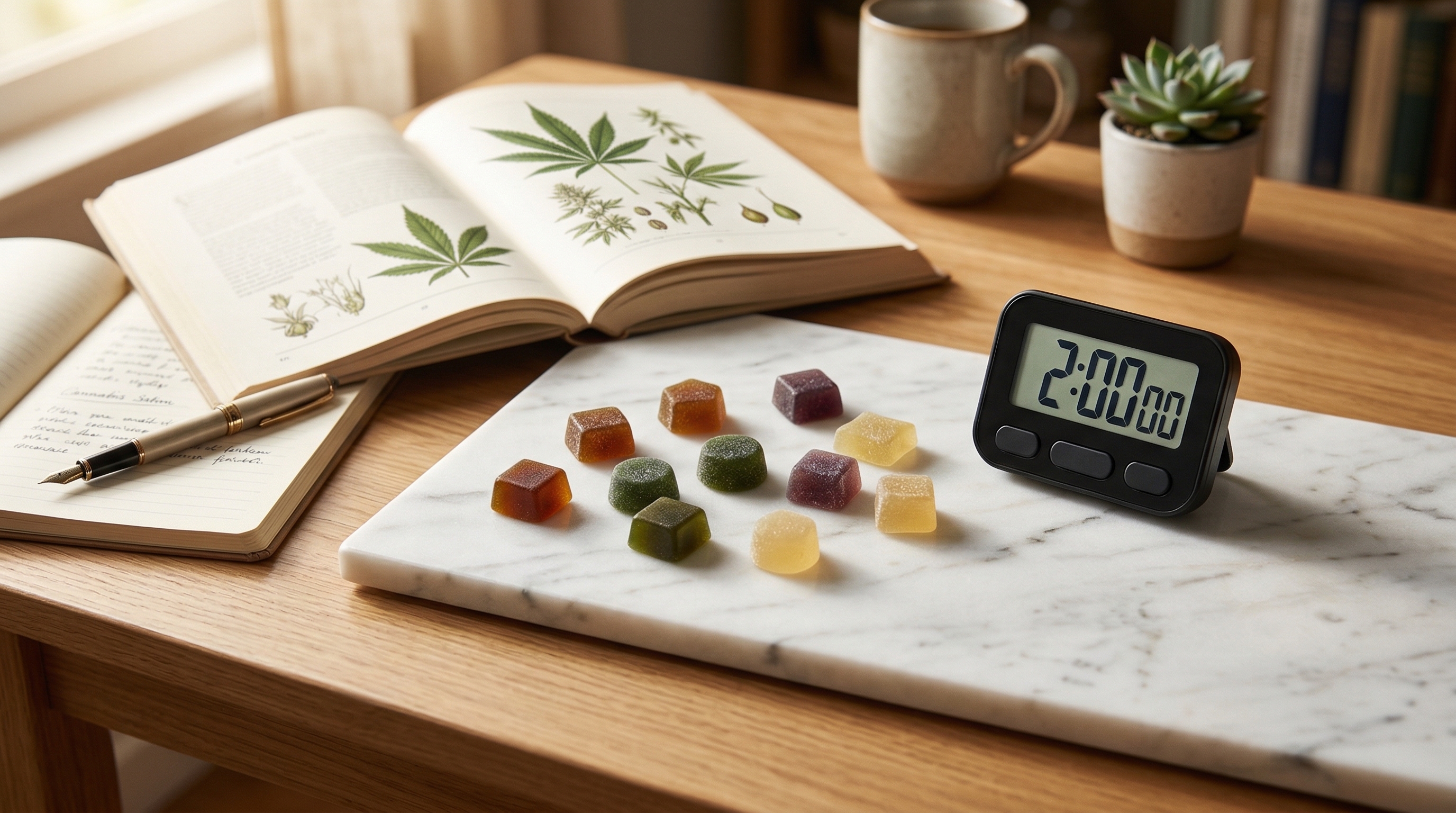
Here’s the key insight: the peak of an edible high doesn’t usually arrive until 2 to 3 hours after consumption [Barrus et al., 2016]. That means if you eat more at the 45-minute mark because “nothing is happening,” you may be doubling your dose right as the first one kicks in. That’s a recipe for an overwhelming experience.
How Edibles Relate to High Families
The experience you get from an edible depends heavily on the terpene and cannabinoid profile of the cannabis used to make it. A gummy made from a limonene-rich extract will land in the Uplifting High family—think mood elevation and social warmth. One made with myrcene-dominant flower leans toward the Relaxing High family—deep calm and sleep support.
If the packaging lists terpene info, check it. Our High Families system can help you predict the kind of experience you’re in for, which is far more useful than outdated “indica vs. sativa” labels on edible packaging.
Key Terms Glossary
| Term | Simple Definition |
|---|---|
| THC (delta-9-THC) | The main psychoactive compound in cannabis that produces the “high” |
| 11-hydroxy-THC | A more potent form of THC created by your liver when you eat edibles |
| Milligrams (mg) | The unit used to measure THC in edibles — lower mg = milder effects |
| Onset time | How long it takes to start feeling effects after eating an edible |
| Microdose | A very small dose (typically 1–2.5 mg THC), designed for subtle effects |
| Tolerance | Your body’s built-up familiarity with THC, which affects how much you need to feel effects |
| Full-spectrum | An edible made with whole-plant extract containing multiple cannabinoids and terpenes |
Beginner Dosing Chart
This chart covers the ranges you’ll actually encounter at a dispensary. If you’ve never tried cannabis at all, stay in the first two rows.
| THC Dose | Who It’s For | Typical Effects | Duration |
|---|---|---|---|
| 1–2.5 mg | First-timers, microdosers | Subtle relaxation, gentle mood lift | 3–5 hours |
| 2.5–5 mg | Beginners wanting noticeable effects | Light euphoria, mild body relaxation | 4–6 hours |
| 5–10 mg | Occasional cannabis users | Clear intoxication, altered perception | 5–8 hours |
| 10–20 mg | Regular users with established tolerance | Strong effects, not for beginners | 6–10 hours |
| 20 mg+ | Experienced consumers only | Very strong — skip this tier until you know your limits | 8+ hours |
Start at the lowest row that applies to you, and only move up after two or three comfortable sessions at your current dose.
Step-by-Step: Your First Edible Experience
Follow these steps for a comfortable, enjoyable first time.
1. Choose a low-dose edible (2.5–5 mg THC) Most regulated dispensaries sell products in clearly labeled doses. Look for 2.5 mg or 5 mg per serving. If you’ve never tried cannabis before, 2.5 mg is a smart starting point. You can always take more next time — you can never take less once it’s eaten.
2. Eat a light meal or snack first Taking an edible on a completely empty stomach can lead to faster, more unpredictable absorption. A light meal about 30–60 minutes beforehand helps create a more consistent experience. Something with a bit of healthy fat (avocado toast, nuts, cheese) may actually support THC absorption [Zgair et al., 2016].
3. Take your dose and start a timer This is where the 2-hour rule comes in. After you eat your edible, set a literal timer on your phone for 2 hours. Do not take any more until that timer goes off — no matter what.
4. Get comfortable and stay occupied Put on a movie, go for a gentle walk, hang out with a trusted friend, or work on a creative project. Having something enjoyable to do keeps you from obsessively checking whether you “feel it yet.”
5. Check in at the 2-hour mark When your timer goes off, honestly assess how you feel. If you feel good and want a bit more, you may take another 2.5 mg. If you feel nothing, you can try another small dose — but know that some people need a second session before edibles fully “click” for them.
6. Note your experience for next time Jot down what you took, when, what you ate beforehand, and how you felt. This simple log becomes incredibly valuable for dialing in your ideal dose over time. For more harm-reduction habits worth building, see our 100 Cannabis Tips.
Common Mistakes to Avoid
1. “I Don’t Feel Anything — Let Me Eat More”
This is the number one edible mistake. The onset can genuinely take 90 minutes or longer, especially on a full stomach. Trust the 2-hour rule. The stories you hear about people having a terrible time with edibles almost always start with this sentence.
2. Treating All Edibles the Same
A 10 mg gummy from a dispensary and a homemade brownie from a friend are very different things. Homemade edibles have wildly inconsistent dosing — one corner of the brownie might have 5 mg while another has 30 mg. If you’re a beginner, stick with lab-tested, clearly labeled products from a licensed dispensary.
3. Mixing with Alcohol
Alcohol can significantly amplify THC’s effects, and the combination is a common cause of nausea and dizziness for beginners [Hartman et al., 2015]. Keep your first several edible experiences alcohol-free so you can understand how cannabis affects you on its own.
4. Choosing the Wrong Setting
Your environment matters. A loud, unfamiliar party is not the ideal place to try edibles for the first time. Choose somewhere you feel safe and relaxed, ideally with someone you trust nearby — especially someone who’s experienced with cannabis.
5. Ignoring the “Per Serving” Label
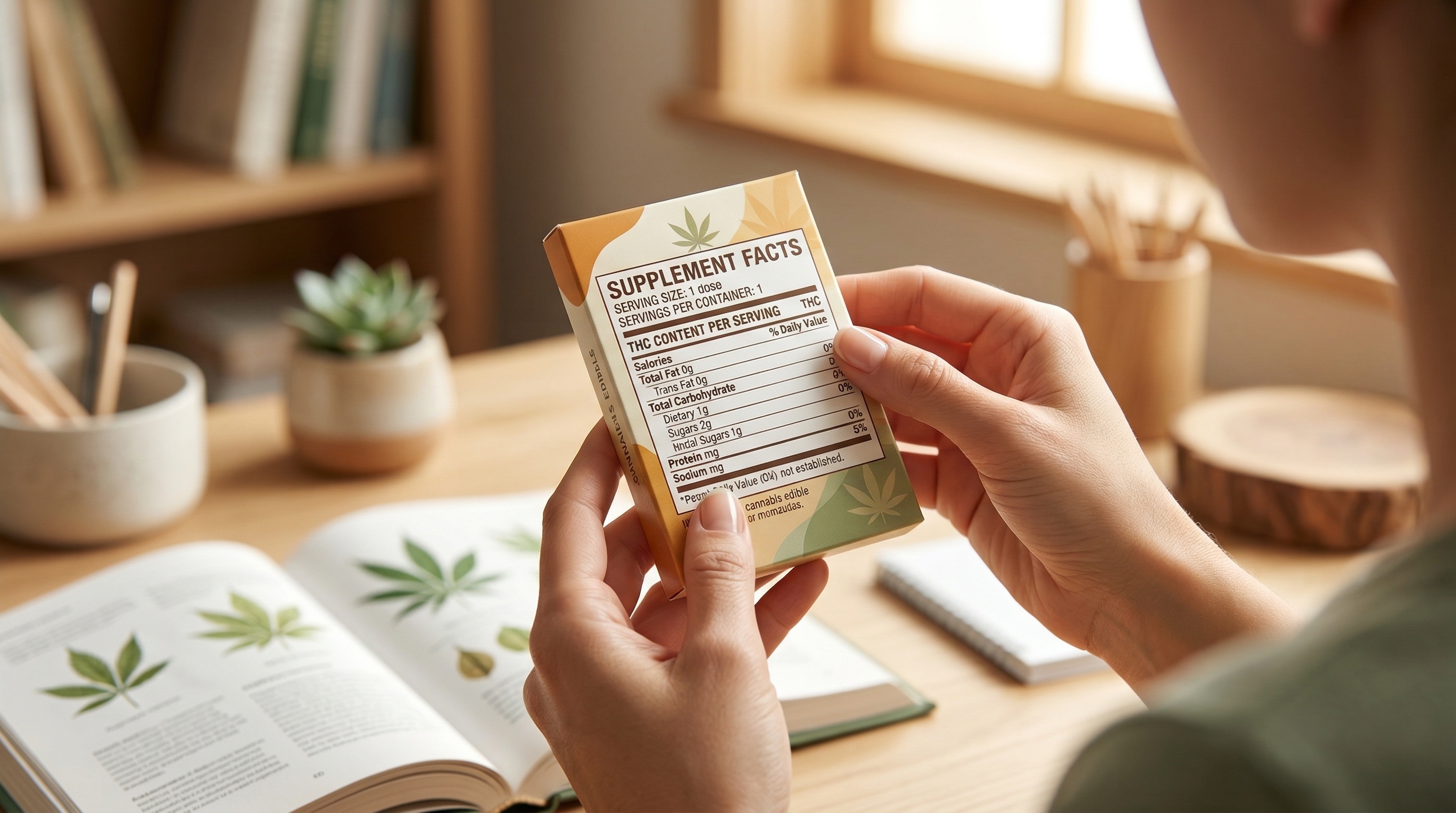
A chocolate bar might contain 100 mg total but be divided into 10 mg squares. Read the label carefully. You want the per-serving amount, not the total package amount.
Frequently Asked Questions
“What if I take too much and feel overwhelmed?”
First: you’re going to be okay. No one has ever fatally overdosed on THC. If you feel too high, find a calm, comfortable space. Drink water. Try chewing on a few black peppercorns — some people find the caryophyllene in black pepper helps take the edge off [Russo, 2011]. Remind yourself that the feeling is temporary and will pass, usually within a few hours. If you feel genuinely unwell, don’t hesitate to call a friend or a medical helpline.
“Why didn’t the edible work for me at all?”
This happens more often than you’d think. Some people have naturally higher tolerances, and a small percentage of people metabolize THC differently due to genetic variations in liver enzymes [Bland et al., 2005]. Try again another day with the same dose, ideally with a light fatty snack beforehand. If 5 mg still does nothing after two or three attempts, you can gradually try 7.5 mg or 10 mg.
“How long will the effects last?”
Edible effects typically last 4 to 8 hours, with the peak around hours 2–3. Some residual effects (mild grogginess or relaxation) can linger into the next morning, especially at higher doses. Plan accordingly — don’t take an edible at 9 PM if you need to be sharp at 6 AM.
“Can I drive after taking an edible?”
No. Do not drive or operate heavy machinery after consuming any cannabis product. The effects of edibles last much longer than smoking, and impairment can persist even after you feel “mostly normal.” Plan your transportation in advance.
“Are edibles stronger than smoking?”
Milligram for milligram, many people experience edibles as more intense due to the 11-hydroxy-THC conversion in the liver. The effects also last significantly longer. This doesn’t mean edibles are “dangerous” — it just means they deserve extra respect when it comes to dosing.
Key Takeaways
- Start with 2.5–5 mg THC for your first edible experience — this is the universally recommended beginner range.
- The 2-hour rule is non-negotiable: set a timer and take nothing more until it goes off, no matter how you feel.
- 11-hydroxy-THC is why edibles hit harder than smoking at equivalent doses — your liver creates a more potent version of THC during digestion.
- Onset takes 30 minutes to 2 hours and peaks around hours 2–3; plan your session around a block of free time.
- Lab-tested dispensary products are the only reliable choice for beginners — avoid homemade edibles until you know your tolerance.
- Eat a light meal with some fat beforehand for more consistent absorption; avoid alcohol entirely.
- If you take too much: stay calm, find a comfortable spot, drink water, and remind yourself it will pass.
- Keep a dosing journal — a few notes after each session is the fastest path to finding your ideal dose.
The Golden Rule of Edibles: You can always eat more later. You can never eat less.
Sources
- Huestis, M.A. (2007). “Human Cannabinoid Pharmacokinetics.” Chemistry & Biodiversity, 4(8), 1770–1804. PMID: 17712819
- Barrus, D.G. et al. (2016). “Tasty THC: Promises and Challenges of Cannabis Edibles.” Methods Report, RTI Press. DOI: 10.3768/rtipress.2016.op.0035.1611
- Zgair, A. et al. (2016). “Dietary fats and pharmaceutical lipid excipients increase systemic exposure to orally administered cannabis and cannabis-based medicines.” American Journal of Translational Research, 8(8), 3448–3459. PMID: 27648135
- Russo, E.B. (2011). “Taming THC: potential cannabis synergy and phytocannabinoid-terpenoid entourage effects.” British Journal of Pharmacology, 163(7), 1344–1364. PMID: 21749363
- Hartman, R.L. et al. (2015). “Cannabis Effects on Driving Lateral Control With and Without Alcohol.” Drug and Alcohol Dependence, 154, 25–37. PMID: 26190558
- Bland, T.M. et al. (2005). “CYP2C-catalyzed delta-9-tetrahydrocannabinol metabolism.” Biochemical and Biophysical Research Communications, 327(2), 631–636. PMID: 15629159


