Finding Your THC:CBD Sweet Spot: 1,400 Pain Patients Show the Way
A 2026 study of 1,400 chronic pain patients found balanced THC:CBD ratios outperform THC-dominant or CBD-dominant. The science of finding your sweet spot.

Professor High

The Question Every Pain Patient Asks
Walk into any dispensary with chronic pain and you’ll face a decision that feels deceptively simple: high THC or high CBD?
Budtenders will give you different answers depending on the day. Online forums argue it endlessly. Your rheumatologist, if they engage with the question at all, may tell you the evidence is weak and to proceed cautiously. And then you’re standing in front of a display wall of products, each one making some version of a promise.
The instinct for many pain patients is to go big: maximize THC for maximum relief, or maximize CBD to avoid the psychoactive effects entirely. Both of those instincts, it turns out, may be leading a significant number of patients away from what actually works best.
A 2026 study published in Arthritis Care & Research gives us the most granular real-world data yet on this question — data from 1,436 rheumatology patients who reported using cannabis and tracked which products they used and how those products affected them. The finding that stands out: balanced THC:CBD formulations were consistently associated with higher positive impact scores than either THC-dominant or CBD-dominant products alone.
This is a clinical guide to understanding what that means, why the biology supports it, and how you can use this knowledge to find your own ratio.
What the 1,400-Patient Study Found
The Zhang et al. study, published in Arthritis Care & Research in 2026, drew from an online survey distributed by Alberta Health Services between March and November 2022. Respondents were rheumatology patients in Alberta — people managing conditions including rheumatoid arthritis, osteoarthritis, lupus, and other inflammatory and musculoskeletal disorders that carry chronic pain as a central feature. From the broader survey pool, 1,436 respondents who reported cannabis use and provided specifics on cannabinoid content and formulation were included in the analysis.
The researchers used multivariable analysis to examine associations between product characteristics — cannabinoid ratio, formulation type, and delivery method — and two key outcome categories: positive perceived impacts (pain relief, improved sleep, better function) and side effects.
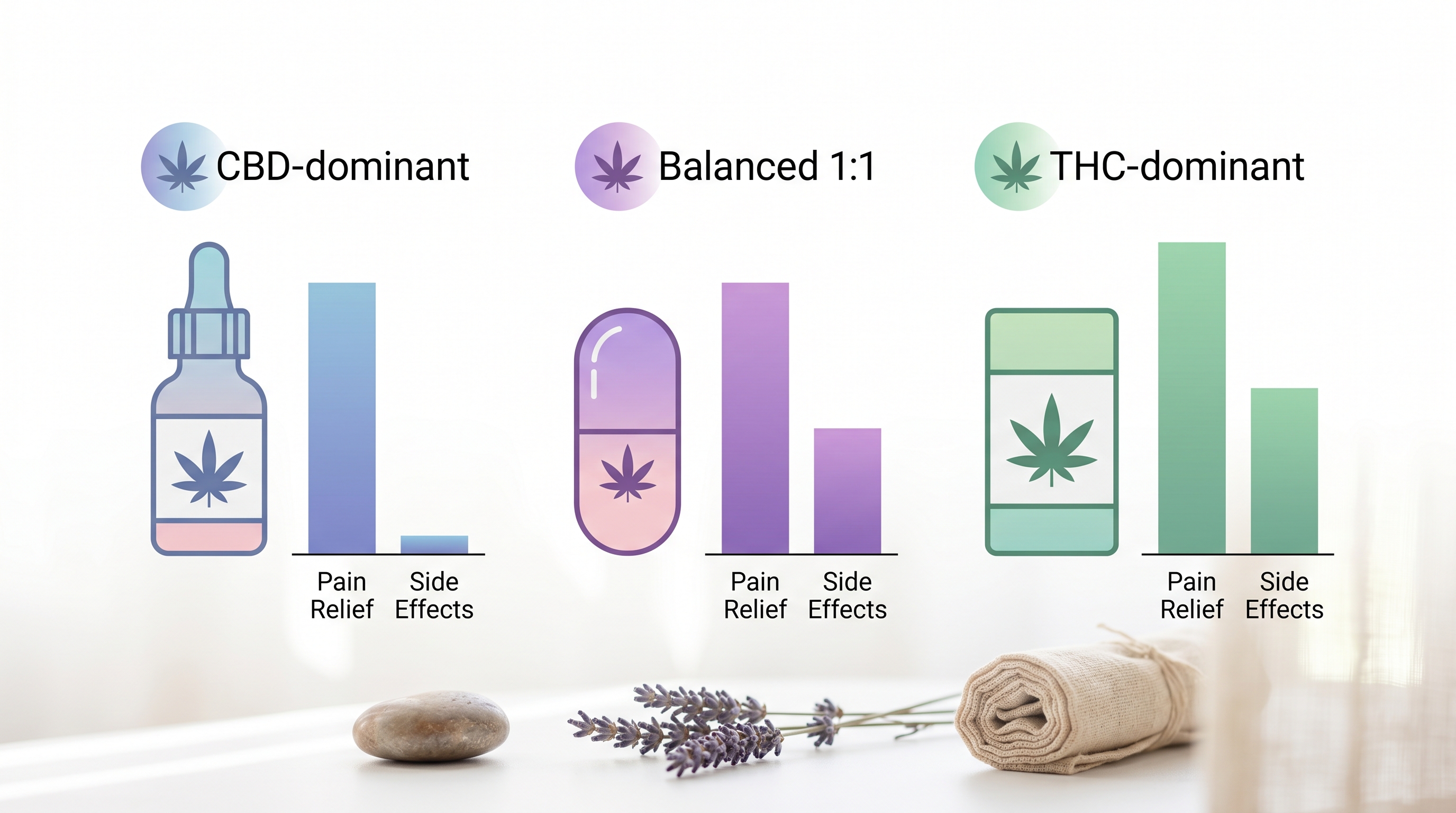
The headline finding: THC-CBD balanced products were associated with significantly higher positive impact scores. The researchers concluded that “balancing THC and CBD content may facilitate positive impact while lowering risk for side effects.” THC-dominant products were associated with stronger psychoactive (“high dampening”) and sensory effects, which some patients valued but others found limiting. CBD-dominant products showed more modest positive impact scores across the sample.
This is observational data — not a randomized controlled trial — so it cannot prove causation. Product choice was influenced by patient-specific factors including age, gender, comorbidities, prior cannabis experience, frequency of use, and source of cannabis information. The researchers controlled for these variables in multivariable analysis, but self-selection effects in survey data cannot be fully eliminated.
Still, 1,436 patients with documented rheumatologic conditions, product-level detail, and multivariable controls is a substantial real-world signal. It aligns with the mechanistic reasoning, the Sativex trial record, and the clinical consensus that is slowly forming around balanced formulations for pain.
What “Balanced” Actually Means
Ratio language in cannabis is imprecise in practice, and that imprecision matters clinically. Here is what the common ratio categories generally translate to:
CBD-dominant (high CBD): Ratios of 20:1 CBD:THC or higher. ACDC, a phenotype of Cannatonic, exemplifies this class — typically testing around 1:20 THC:CBD, meaning virtually no psychoactive effect. These products are often used for anxiety, inflammation modulation, and pediatric epilepsy. For pain, they are the safest starting point but frequently underperform as the primary analgesic for moderate-to-severe chronic pain.
Mildly balanced (CBD-leaning): Ratios in the 2:1 to 4:1 CBD:THC range. Harlequin is the iconic strain here, typically testing at roughly 5:2 CBD:THC — providing clear-headed relief with a gentle THC floor. A good entry point for cannabis-naive pain patients.
Truly balanced (1:1 to 2:1 THC:CBD): The category the Zhang study data points toward most strongly. Cannatonic often falls in this range. Sativex (nabiximols), the pharmaceutical 1:1 spray with 2.5 mg THC and 2.7 mg CBD per dose, has the most extensive clinical trial record of any cannabis product. A 2007 randomized controlled trial in peripheral neuropathic pain showed Sativex achieved a mean pain reduction of 1.48 points on a 0–10 scale versus 0.52 for placebo (p=0.004), with 26% of Sativex patients achieving greater than 30% pain improvement versus 15% on placebo [Nurmikko et al., Pain, 2007].
THC-dominant: Ratios above 2:1 THC:CBD, including most high-THC flower. Provides potent short-term analgesia but carries higher risks of anxiety, tolerance development, and dose-related side effects.
Why Pure THC Often Disappoints For Chronic Pain
There is a common arc: a pain patient tries cannabis for the first time with a high-THC product, experiences significant relief, and raises the dose over time. Over weeks to months, the relief requires more product, the psychoactive effects become intrusive, and the anxiety that was previously manageable now arrives reliably with each session.
This is not anecdote — it is mechanism.
THC’s analgesic effect is primarily mediated through CB1 receptors in the brain and spinal cord. At lower doses, this produces genuine pain modulation: altered perception of pain’s unpleasantness, reduced central sensitization, anti-nociceptive signaling in the dorsal horn. But CB1 agonism also drives tolerance through receptor internalization, requiring escalating doses for the same effect. And at higher doses, the same CB1 pathway that quiets pain signals also modulates the amygdala in ways that can amplify anxiety and dysphoria — the anxiogenic response that is dose-dependent and well-documented in preclinical and human studies.
High-THC products also provide relatively limited direct anti-inflammatory coverage compared to balanced formulations. CBD has demonstrated activity at TRPV1 channels, PPARγ receptors, and indirect anti-inflammatory pathways that THC does not robustly engage. For rheumatology patients — whose pain is often both nociceptive and inflammatory — leaving CBD out means leaving that anti-inflammatory coverage on the table.
For more on why THC percentage alone is a poor guide, see our piece on why THC percentage is a terrible way to choose cannabis.
Why Pure CBD Often Disappoints For Chronic Pain
CBD earned its reputation in epilepsy, anxiety, and sleep — and that reputation is largely deserved in those contexts. But the picture for direct pain analgesia is considerably more complicated.
The randomized controlled trial evidence for CBD as a primary analgesic is thin. A high-dose oral CBD trial in knee osteoarthritis (600 mg/day) showed no analgesic benefit and elevated liver enzymes. Multiple RCTs in musculoskeletal pain — hand osteoarthritis, psoriatic arthritis, acute low back pain, post-operative pain — have shown no significant analgesic effect versus placebo for oral CBD in isolation. Topical CBD shows more promise for localized joint pain, but that is a different delivery context.
The mechanism explains the limitation: CBD does not bind with meaningful affinity to CB1 receptors, which are the primary gateway for cannabis-mediated analgesia. CBD’s pain-relevant activity — TRPV1 modulation, adenosine signaling, anti-inflammatory effects — is real but indirect and requires either high doses or very specific delivery contexts to manifest as meaningful pain relief.
CBD’s greatest contribution to pain management may not be as a standalone analgesic at all. It is as a modulator of the THC experience — reducing anxiogenic side effects, extending the analgesic window, and providing anti-inflammatory coverage that complements THC’s central mechanisms.
See also: CBDA and THCA: Why Raw Cannabis Has Surprising Therapeutic Value for the acid-form context.
The Synergy: What Balance Actually Adds
When you combine THC and CBD at or near a 1:1 ratio, several things happen simultaneously that do not occur with either cannabinoid alone.
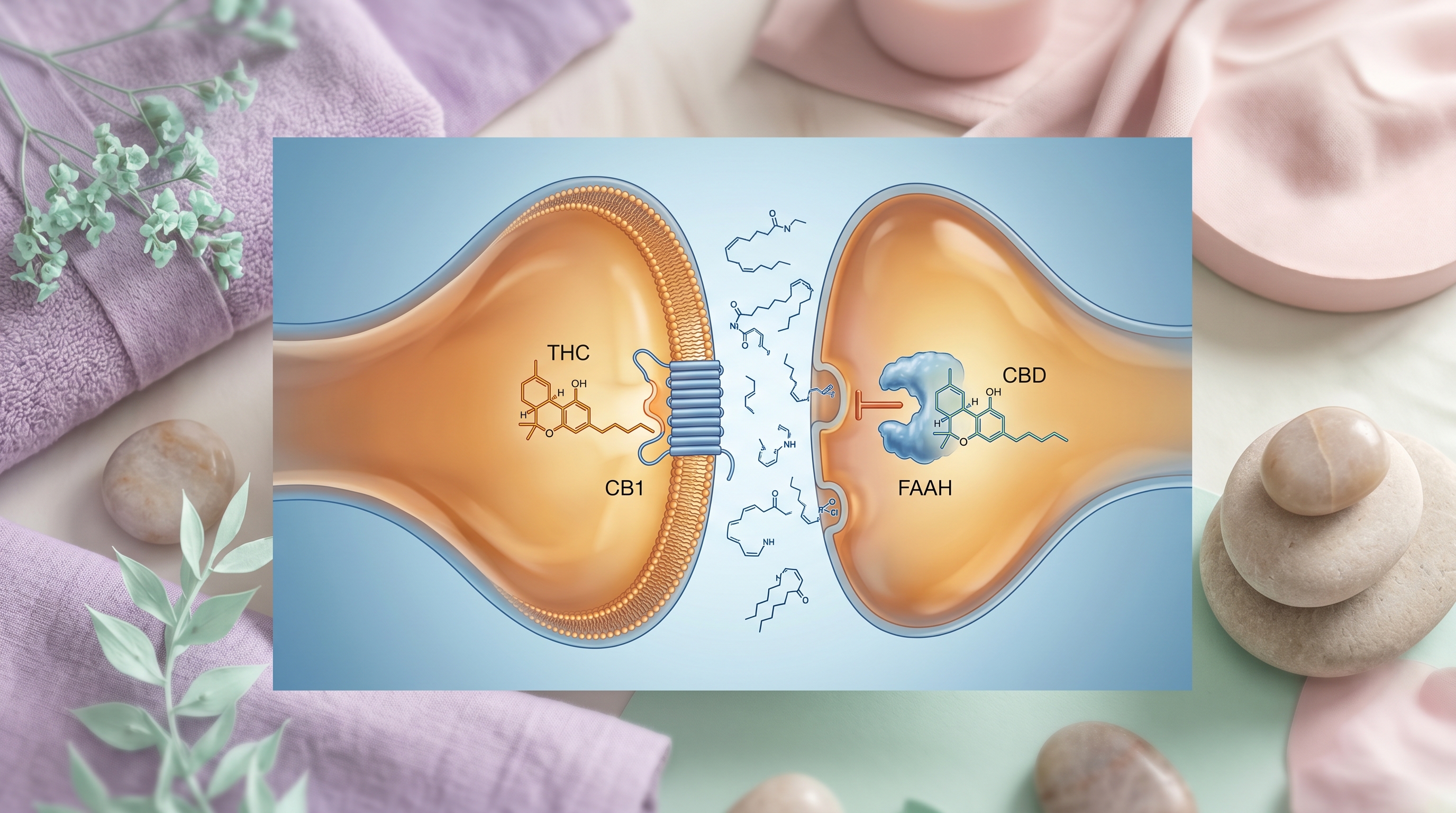
CBD damps THC’s anxiogenic ceiling. At the CB1 receptor level, CBD acts as a negative allosteric modulator of THC — it doesn’t block the receptor but changes its shape slightly, reducing the efficiency of THC binding. This attenuates THC’s dose-dependent anxiogenic effects without eliminating its analgesic action. Practically: patients can take a meaningful THC dose without the anxiety spiral that the same dose would produce without CBD.
CBD inhibits FAAH, extending anandamide activity. Fatty acid amide hydrolase (FAAH) is the enzyme that degrades anandamide, your body’s endogenous cannabinoid. CBD inhibits both FAAH directly and anandamide’s transporter-mediated uptake, meaning that with CBD present, your endocannabinoid system’s own pain-modulating signals persist longer. This is not a trivial effect — it means balanced formulations are leveraging both exogenous THC and your own endocannabinoid tone simultaneously.
Complementary receptor coverage. THC drives CB1 analgesia. CBD provides TRPV1, PPARγ, and adenosine receptor engagement. Caryophyllene, present in many balanced strains, adds CB2 agonism and NF-κB pathway inhibition — making the anti-inflammatory coverage more complete. Together, this multi-receptor profile addresses both the sensory and affective components of chronic pain, and the neuroinflammatory substrate that underlies conditions like rheumatoid arthritis.
Tolerance dynamics are more favorable. Preliminary evidence suggests CBD may attenuate CB1 receptor downregulation caused by THC, meaning tolerance may develop more slowly with balanced products than with THC-dominant ones. This has significant implications for long-term pain management, where tolerance-driven dose escalation is one of the central clinical problems.
For related reading on terpene-driven analgesic mechanisms, see Cannabis Terpenes Relieve Pain Through Adenosine Receptors.
How To Find YOUR Ratio
The clinical literature identifies your optimal ratio, not the optimal ratio. Age, sex, prior cannabis experience, specific pain type (neuropathic versus inflammatory versus nociceptive), concurrent medications, and genetics of the endocannabinoid system all influence your response. What follows is a structured approach derived from the MacCallum and Russo dosing protocol and the Delphi consensus recommendations on medical cannabis titration.
Step 1: Start with a CBD-leaning entry point. For cannabis-naive patients, begin with a product in the 4:1 or higher CBD:THC range. This establishes CBD as the foundation and introduces THC at a level unlikely to cause anxiety or impairment. Harlequin flower or a comparable CBD-rich tincture works well here. Run this for one to two weeks, tracking pain scores before and after each use.
Step 2: Titrate toward balance slowly. The MacCallum-Russo protocol recommends increasing THC by no more than 1–2.5 mg every two to three days. As you move from a 4:1 toward a 2:1 and then 1:1 CBD:THC ratio, you are finding the point at which analgesic coverage increases meaningfully without introducing anxiety or excessive sedation. Track both pain relief and side effects at each level.
Step 3: Use tinctures or capsules for the titration phase. Flower ratios are real — Cannatonic typically tests in the 1:1 to 1:2 range — but dose control with flower is imprecise. For finding your ratio, a tincture with clearly labeled THC and CBD mg per mL gives you the control you need. Once you’ve identified your ratio, translating back to flower or vape is easier.
Step 4: Separate daytime and evening protocols. Many patients find that a 1:2 or 1:1 CBD:THC tincture works well for daytime pain management — present but functional — while a 1:1 or 2:1 THC:CBD formulation in the evening provides deeper relief and supports sleep. The Balance family of strains tends to serve the daytime window; the Relief family often covers the evening.
Step 5: Hold steady and reassess at four weeks. Effects compound over time as the endocannabinoid system adapts. Do not adjust your ratio more frequently than every two to four weeks once you’ve reached a candidate range. Assess pain intensity, sleep quality, functional capacity, and any side effects at that point before making further changes.
Product Form Considerations
Ratio matters. So does how you consume it.
Tinctures offer the best balance of precision and onset speed (sublingual absorption: 15–45 minutes, 2–4 hours duration). For titration and consistent daily dosing, tinctures are the clinical gold standard. Label milligram counts per serving enable accurate ratio tracking.
Capsules and edibles convert a significant portion of THC to 11-OH-THC through first-pass liver metabolism — a metabolite roughly 3–5x more potent than inhaled THC. Onset is slow (45–90 minutes), duration is long (4–8 hours), and dose stacking (taking more before the first dose peaks) is the most common cause of unpleasant cannabis experiences. For pain patients who need overnight coverage or extended relief windows, edibles make sense — but the conversion effect means your effective ratio shifts toward higher THC potency than the label suggests.
Vaporized flower offers the fastest onset (2–10 minutes) and shortest duration (2–3 hours). For breakthrough pain, this is useful. The ratio you get depends on the strain tested — actual testing varies by batch, so treat vendor-stated ratios as directional, not precise.
Topicals deliver cannabinoids locally without meaningful systemic absorption. Useful for joint-specific pain (particularly hand, knee, and shoulder) as an adjunct to systemic dosing. Cannot provide the systemic anti-inflammatory or central analgesia that ratio-optimized oral or inhaled forms provide.
Important Caveats
Cannabis-naive patients are not the same as experienced patients. The Alberta rheumatology sample included patients across the experience spectrum. Cannabis-naive individuals tend to be more sensitive to THC and should start at lower THC absolute doses even within a 1:1 ratio. The ratio matters; so does the total milligram dose.
Comorbidities change the calculus. Patients with anxiety disorders should be conservative with THC even in balanced formulations. Those with liver conditions should avoid high-dose oral CBD. Patients with a personal or family history of psychosis should approach THC with significant caution — see Cannabis and Schizophrenia Risk: Who Should Avoid THC for the detail on this.
Drug interactions are real. CBD is a CYP450 inhibitor, particularly at the 3A4 and 2C19 isoforms. It can raise plasma levels of warfarin, some antiepileptics, and certain immunosuppressants. THC interacts with CNS depressants and blood pressure medications. If you are on a prescription medication regimen, discuss cannabis use with your prescriber before starting.
The evidence base is still maturing. The 2025 systematic review update in the Annals of Internal Medicine, which analyzed 25 short-term RCTs covering 2,303 participants, found that balanced and comparable THC:CBD products “probably slightly reduce pain severity by approximately 0.54 points on a 0–10 scale” — a modest but potentially meaningful effect for many patients. The trials are short (1–6 months), predominantly in neuropathic pain, and the long-term data remains thin. Cannabis is most appropriately positioned as an adjunct to, not replacement for, a comprehensive pain management plan.

Track the Numbers, Not Just the Feeling
The highest-value thing you can do as a chronic pain cannabis patient is track systematically. Not impressionistically — numerically.
Before each session, record your pain on a 0–10 scale. After, record the scale again, plus the product’s THC content (mg), CBD content (mg), the calculated ratio, the delivery method, and the onset-to-peak time. Do this for thirty days.
At the end of that period, you will have data. You will know which ratios correlate with your best relief. You will know which products generate side effects. You will know your optimal dose window. You will have something to show a clinician — and something to make your next dispensary visit a calibrated decision rather than an educated guess.
The High IQ app is built specifically for this kind of tracking: strain profiles with cannabinoid breakdowns, session logging with pain score capture, and trend views that surface your patterns across weeks and months. Download the app to turn your dosing experiments into a personal dataset.
For You: Chronic Pain Tracking Framework
Log the following with every cannabis session for pain:
| Field | What to Record |
|---|---|
| Product | Name, brand, or strain |
| THC (mg) | Per dose, from label |
| CBD (mg) | Per dose, from label |
| Ratio | Calculated (e.g., 1:1, 1:2) |
| Delivery | Tincture / flower / edible / vape / topical |
| Pre-session pain | 0–10 NRS |
| Post-session pain | 0–10 NRS (at peak effect) |
| Duration of relief | Hours |
| Side effects | None / mild anxiety / sedation / other |
This framework, applied consistently, will tell you something that no study of 1,400 patients can: what works for you, specifically.
Sources
-
Zhang et al. “Perceived Impacts and Predictors of Cannabis Products used by Rheumatology Patients in Alberta: A Multivariable Analysis of Cross-Sectional Survey Data.” Arthritis Care & Research, 2026. DOI: 10.1002/acr.80071
-
Nurmikko TJ et al. “Sativex successfully treats neuropathic pain characterised by allodynia: a randomised, double-blind, placebo-controlled clinical trial.” Pain, 2007;133(1-3):210-20. PMID: 17997224
-
MacCallum CA, Russo EB. “Practical considerations in medical cannabis administration and dosing.” European Journal of Internal Medicine, 2018. PMID: 29307505
-
Aviram J, Samuelly-Leichtag G. “Efficacy of Cannabis-Based Medicines for Pain Management: A Systematic Review and Meta-Analysis of Randomized Controlled Trials.” Pain Physician, 2017.
-
Whiting PF et al. “Cannabinoids for Medical Use: A Systematic Review and Meta-analysis.” JAMA, 2015;313(24):2456-2473.
-
Mücke M et al. “Cannabis-Based Medicines for Chronic Neuropathic Pain in Adults (Cochrane Review).” Cochrane Database of Systematic Reviews, 2018.
-
Bonn-Miller MO et al. “Cannabis-Based Products for Chronic Pain: An Updated Systematic Review.” Annals of Internal Medicine, 2026. DOI: 10.7326/ANNALS-25-03152
-
Russo EB. “Taming THC: potential cannabis synergy and phytocannabinoid-terpenoid entourage effects.” British Journal of Pharmacology, 2011;163(7):1344-64.
-
Laprairie RB et al. “Cannabidiol is a negative allosteric modulator of the cannabinoid CB1 receptor.” British Journal of Pharmacology, 2015;172(20):4790-805.
-
Bisogno T et al. “Molecular targets for cannabidiol and its synthetic analogues: effect on vanilloid VR1 receptors and on the cellular uptake and enzymatic hydrolysis of anandamide.” British Journal of Pharmacology, 2001;134(4):845-52.
