Understanding High Families: A Better Way to Choose Cannabis
Discover the High Families system—a terpene-based approach to choosing cannabis that goes beyond indica and sativa myths.


Why This Matters
If you’ve ever stood in a dispensary feeling completely overwhelmed by hundreds of strain names—wondering whether “Blue Dream” or “Granddaddy Purple” is right for you—you’re not alone. Most people are told to choose between indica (for relaxation) and sativa (for energy), but that old system is based more on how the plant looks than how it actually makes you feel.
There’s a better way. It’s called the High Families system, and it’s built on something far more reliable: the actual chemistry inside the plant. In this guide, you’ll learn what High Families are, how they work, and how to use them to find the cannabis experience you’re actually looking for—whether that’s creative energy, deep relaxation, or something in between.
No science degree required. No judgment. Let’s get into it.
The Basics
What You Need to Know
Here’s the core idea: the effects you feel from cannabis are shaped by chemical compounds called terpenes and cannabinoids, not by whether someone labeled the plant “indica” or “sativa.”
Cannabinoids are the compounds most people have heard of. THC (tetrahydrocannabinol) is the one that produces the “high,” while CBD (cannabidiol) is known for calming effects without intoxication. But cannabinoids are only part of the story.
Terpenes are aromatic compounds found in all plants—not just cannabis. They’re what give a lemon its citrusy zing, lavender its soothing scent, and pine trees their fresh smell. In cannabis, terpenes do more than create aroma. Research suggests they actively shape your experience by interacting with cannabinoids in what scientists call the entourage effect [Russo, 2011]. Think of it this way: if THC is the engine, terpenes are the steering wheel.
The High Families system groups cannabis strains into six families based on their dominant terpene profiles. Instead of asking “Is this indica or sativa?”—a question that modern genetics has made nearly meaningless [Watts et al., 2021]—you ask: “What kind of high do I want?”
Each High Family delivers a distinct type of experience. Some lean toward energy and focus. Others lean toward deep physical relaxation. And some offer a balanced, gentle introduction that’s perfect for first-timers.
The beauty of this approach is that it puts you in control. You’re not guessing based on a plant’s leaf shape or a budtender’s vague description. You’re choosing based on the chemistry that actually determines how you’ll feel.
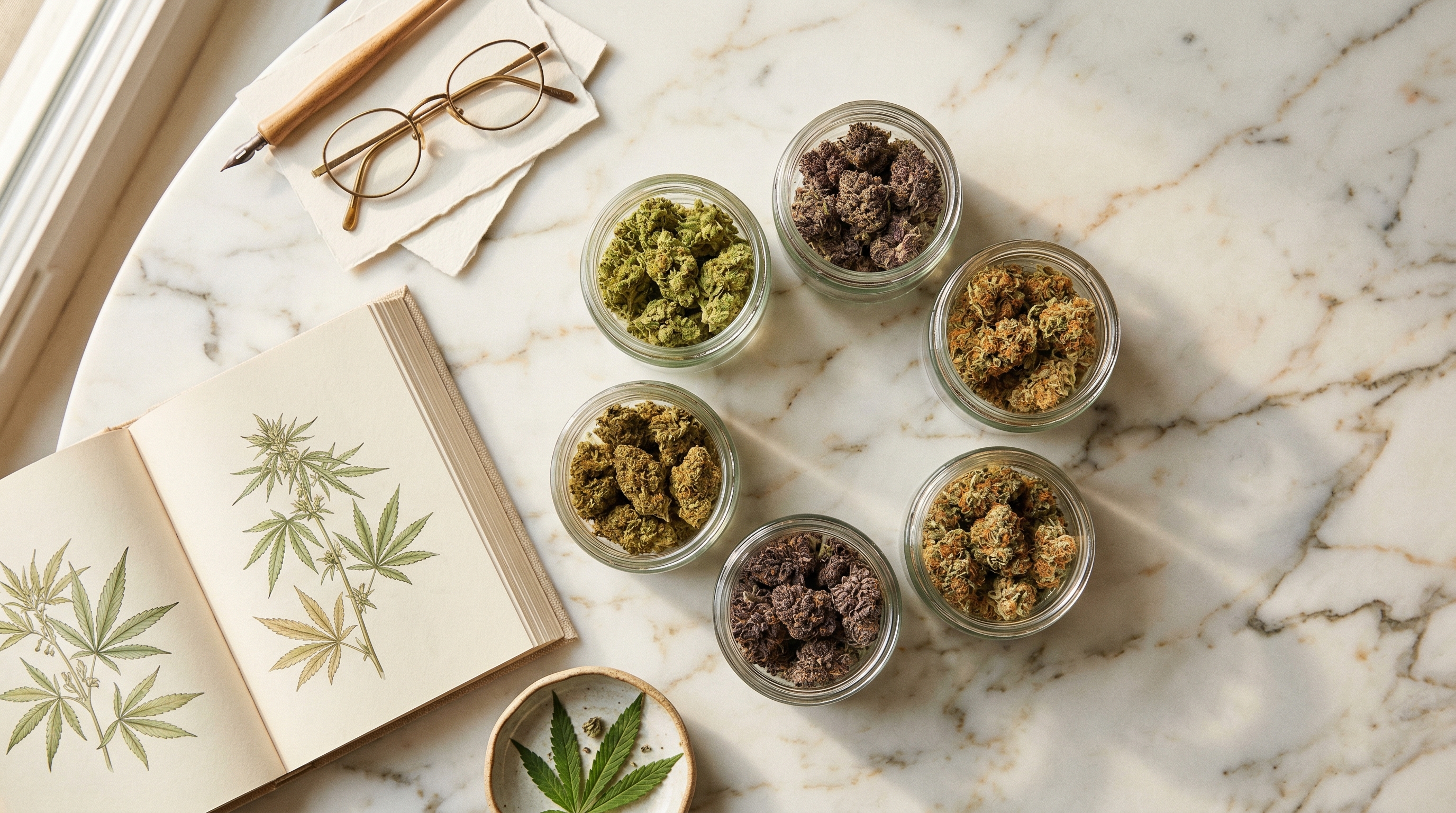
Key Terms Glossary
Before we go further, here’s a quick reference for the terms you’ll see throughout this guide:
| Term | Simple Definition |
|---|---|
| Terpene | An aromatic compound in plants that influences flavor, scent, and effects |
| Cannabinoid | A chemical compound in cannabis (like THC or CBD) that interacts with your body’s endocannabinoid system |
| THC | The primary cannabinoid responsible for the intoxicating “high” |
| CBD | A non-intoxicating cannabinoid associated with calming, soothing effects |
| Entourage effect | The theory that cannabis compounds work together to shape the overall experience |
| Terpene profile | The specific combination and concentration of terpenes in a given strain |
| High Family | A classification group based on terpene chemistry that predicts the type of experience a strain delivers |
| Strain | A specific variety of cannabis plant with a unique chemical and genetic profile |
Meet the Six High Families
Now let’s walk through each of the six High Families. Think of these as neighborhoods on a map—each one has a different vibe, and knowing the landscape helps you find where you belong.
1. Uplift High
Key terpenes: Limonene, Linalool The experience: Mood elevation, social energy, creativity
The Uplifting High family is your go-to when you want to feel lighter, brighter, and more socially engaged. Strains in this family tend to be rich in limonene (that citrusy, lemony scent) and linalool (the floral compound also found in lavender).
Best for: Social gatherings, creative projects, lifting your mood on a gray afternoon.
2. Energy High
Key terpenes: Terpinolene, Ocimene The experience: Focused productivity, mental clarity
If you want to get things done—clean the house, work on a project, go for a hike—the Energetic High family is worth exploring. Strains here feature terpinolene (herbal, slightly piney) and ocimene (sweet, woody), which some people find sharpens focus rather than scattering it.
Best for: Daytime use, creative work, physical activity.
3. Relax High
Key terpenes: Myrcene The experience: Deep relaxation, calm, sleep support
The Relaxing High family is what most people picture when they think “indica”—and for good reason. Myrcene, the most common terpene in cannabis, is associated with sedating, couch-lock-style effects [Surendran et al., 2021]. Research suggests myrcene may enhance the permeability of cell membranes to other cannabis compounds, potentially deepening the overall sedative character.
Best for: Evening wind-down, sleep support, stress relief.
4. Balance High
Key terpenes: Low terpene diversity The experience: Gentle effects, beginner-friendly
New to cannabis? The Balancing High family is a wonderful starting point. These strains have more subtle terpene profiles and typically deliver a mild, manageable experience. Nothing overwhelming—just a gentle shift.
Best for: First-timers, microdosing, anyone who wants a light touch.
5. Relief High
Key terpenes: Caryophyllene, Humulene The experience: Physical comfort, body focus
The Relieving High family centers on beta-caryophyllene, a unique terpene that also acts on the body’s CB2 receptors—the same system cannabinoids interact with [Gertsch et al., 2008]. Many people reach for these strains when they want physical comfort and body-centered relief.
Best for: Physical discomfort, body tension, winding down after exercise.
6. Entourage High
Key terpenes: Multi-terpene complex The experience: Full-spectrum, nuanced, layered
The Entourage High family is for those who want the full orchestra, not just a solo instrument. These strains contain complex, multi-terpene profiles where no single terpene dominates. The result is often a rich, layered experience that evolves over time.
Best for: Experienced consumers, those who enjoy complexity, connoisseurs.

Step-by-Step: How to Use High Families to Choose Cannabis
Ready to put this into practice? Here’s your step-by-step guide:
Step 1: Identify Your Desired Experience
Before you look at a single strain name, ask yourself: “What do I want to feel?” Not what strain is popular. Not what your friend recommended. What experience are you looking for right now?
- Want to feel social and upbeat? → Look at the Uplift High
- Need to focus and get things done? → Explore the Energy High
- Ready to melt into the couch and sleep? → Try the Relax High
- Brand new and want something gentle? → Start with the Balance High
- Looking for physical comfort? → Check out the Relief High
- Want a rich, complex experience? → Go for the Entourage High
Step 2: Check the Terpene Profile
When you’re at a dispensary or browsing online, look for terpene information on the label or product page. More and more producers now list the top terpenes alongside THC and CBD percentages.
Match the dominant terpenes to the High Family you identified in Step 1. For example, if you want an Uplift High, look for strains where limonene is listed as a top terpene.
Pro tip: If terpene data isn’t available, ask your budtender which strains are high in specific terpenes. A good budtender will know—or can look it up.
Step 3: Start Low, Go Slow
This is the golden rule of cannabis, especially for beginners. No matter which High Family you choose:
- Start with a low dose (2.5–5mg THC for edibles, one small puff for inhalation)
- Wait before taking more (15 minutes for smoking/vaping, 60–90 minutes for edibles)
- Pay attention to how you feel and take notes if it helps
Step 4: Track and Refine
Keep a simple journal—even just notes on your phone. Write down:
- The strain name
- The dominant terpenes (if listed)
- The High Family it belongs to
- How you felt (mood, body, energy, duration)
Over time, you’ll build a personal map of what works best for you. This is far more useful than memorizing strain names, because strains with similar terpene profiles will give you similar experiences.
Step 5: Explore Neighboring Families
Once you’ve found a High Family you love, try the one next door. If you enjoy the Uplift High, you might also appreciate the Energy High. If the Relax High is your home base, the Relief High might be a great complement. There’s no wrong answer—only exploration.
Common Mistakes to Avoid
Even with a great system, beginners can stumble. Here are the most common pitfalls—and how to sidestep them:
Mistake 1: Choosing Based on THC Percentage Alone
Higher THC doesn’t mean a better experience. It often just means a more intense one—and intensity without the right terpene profile can lead to anxiety or discomfort. Terpenes shape the quality of your high; THC determines the volume. A 18% THC strain with a terpene profile you love will likely feel better than a 30% THC strain that doesn’t match your desired experience.
Mistake 2: Trusting Indica/Sativa Labels Blindly
After decades of crossbreeding, almost every strain on the market is a genetic hybrid. The indica/sativa label tells you more about the plant’s growth pattern than its effects. Research has shown that these labels don’t reliably predict chemical composition [Watts et al., 2021]. High Families are a more reliable guide.
Mistake 3: Ignoring Your Own Body
Cannabis affects everyone differently based on your unique endocannabinoid system, tolerance, metabolism, and even what you’ve eaten that day. If a strain in the Energy High family makes you feel sleepy, that’s valid data. Trust your experience over any classification system—including this one.
Mistake 4: Skipping the “Start Low, Go Slow” Rule
This is especially critical with edibles, which can take 60–90 minutes to kick in. Many uncomfortable experiences happen because someone took a second dose before the first one hit. Patience is your best friend here.
Mistake 5: Not Asking Questions
Dispensary staff are there to help. There’s no such thing as a silly question. “What terpenes are dominant in this strain?” is a great one. “Which of your strains would you put in the Relax High family?” is even better.

Frequently Asked Questions
“Do I need to memorize all the terpene names?”
Not at all. Start with just one or two. If you know you like limonene (citrus, uplifting), that’s enough to start making better choices. You’ll naturally learn more over time as you explore. Think of it like learning to cook—you don’t need to know every spice on day one.
“What if a strain doesn’t fit neatly into one High Family?”
That happens, and it’s totally normal. Cannabis is a complex plant, and many strains contain multiple significant terpenes. If a strain has both high limonene and high myrcene, it might offer a blend of uplifting and relaxing effects. The Entourage High family exists precisely for these multi-layered strains. Use High Families as a compass, not a rigid rulebook.
“Is one High Family better than another?”
No—there’s no hierarchy. The “best” High Family is simply the one that matches what you need in a given moment. You might prefer the Energy High on a Saturday morning and the Relax High on a Sunday night. Many experienced consumers have favorites across multiple families.
“I tried a strain from the Uplift High family and it made me anxious. What went wrong?”
Several things could be at play. The dose may have been too high—THC can cause anxiety at higher doses regardless of the terpene profile. Your individual body chemistry matters too. And your environment (called set and setting) plays a huge role. Try the same family again at a lower dose, in a comfortable setting, and see if the experience changes. If anxiety persists, the Balance High family with its gentler effects may be a better fit.
“Can I use High Families for edibles and vapes, or just flower?”
High Families work for any cannabis product that preserves the plant’s terpene profile. Full-spectrum vape cartridges and concentrates retain terpenes and can be matched to High Families. Some edibles are made with strain-specific extracts that also preserve terpene character. However, many edibles use distillate (pure THC with terpenes stripped out), so the High Family concept applies less. Always check the label for terpene information.
Key Takeaways
Here’s the essential version of everything covered in this guide:
- Indica and sativa labels are unreliable. After decades of crossbreeding, these terms describe leaf shape—not effects.
- Terpenes are the steering wheel. They shape the quality and character of your experience far more than strain names do.
- High Families are six terpene-based groups that predict the type of experience a strain is likely to deliver.
- Start with the family that matches your goal: Uplift for mood, Energy for focus, Relax for sleep, Balance for gentle beginners, Relief for physical comfort, Entourage for complexity.
- Always start low and go slow. This rule matters regardless of which family you choose.
- Track your sessions. A few notes on strain, terpenes, and how you felt is worth more than any guide.
Next Steps
You now have a framework that puts you ahead of most cannabis consumers. Instead of guessing based on strain names or outdated indica/sativa labels, you can make choices rooted in actual plant chemistry.
Here’s where to go from here:
- Explore the full High Families page to dive deeper into each family
- On your next dispensary visit, ask about the top terpenes in two or three strains and match them to a High Family
- Start your cannabis journal with even just a few notes per session
- Share this guide with a friend who’s curious about cannabis but doesn’t know where to start
Sources
- Russo, E. B. (2011). Taming THC: potential cannabis synergy and phytocannabinoid-terpenoid entourage effects. British Journal of Pharmacology, 163(7), 1344–1364.
- Watts, S., et al. (2021). Cannabis Chemovar Nomenclature Misrepresents Chemical and Genetic Diversity. Cannabis and Cannabinoid Research, 6(2), 120–127.
- Surendran, S., et al. (2021). Myrcene—what are the potential health benefits of this flavouring and aroma agent? Frontiers in Nutrition, 8, 699666.
- Gertsch, J., et al. (2008). Beta-caryophyllene is a dietary cannabinoid. Proceedings of the National Academy of Sciences, 105(26), 9099–9104.
- Fischedick, J. T. (2017). Identification of terpenoid chemotypes among high-THC cannabis cultivars. Cannabis and Cannabinoid Research, 2(1), 34–47.


