Best Cannabis Strains for Art and Painting
Discover the best cannabis strains for artists and painters, with terpene science, High Family picks, and 15 top strains for visual creativity.

There’s a reason so many artists reach for cannabis before picking up a brush. From the beat painters of the 1950s to today’s digital muralists, cannabis and visual art have shared a long, complicated, and genuinely fascinating relationship. But here’s what most “best strains for creativity” guides miss: not all creative work is the same, and not all cannabis effects are equal.
Painting a tight hyperrealistic portrait demands different brain chemistry than pouring paint in an expressive abstract piece. The strain that helps one artist find a compositional breakthrough might send another into anxious overthinking. The science is real—but so is the nuance.
In this guide, you’ll get the neuroscience of cannabis and visual creativity, a breakdown of which terpenes actually matter for artists, and 15 specific strain recommendations organized by the High Families system. Whether you paint in oils, acrylics, or watercolors—whether you’re a Sunday afternoon hobbyist or a professional with a studio practice—there’s a strain here that can help you get into the zone.
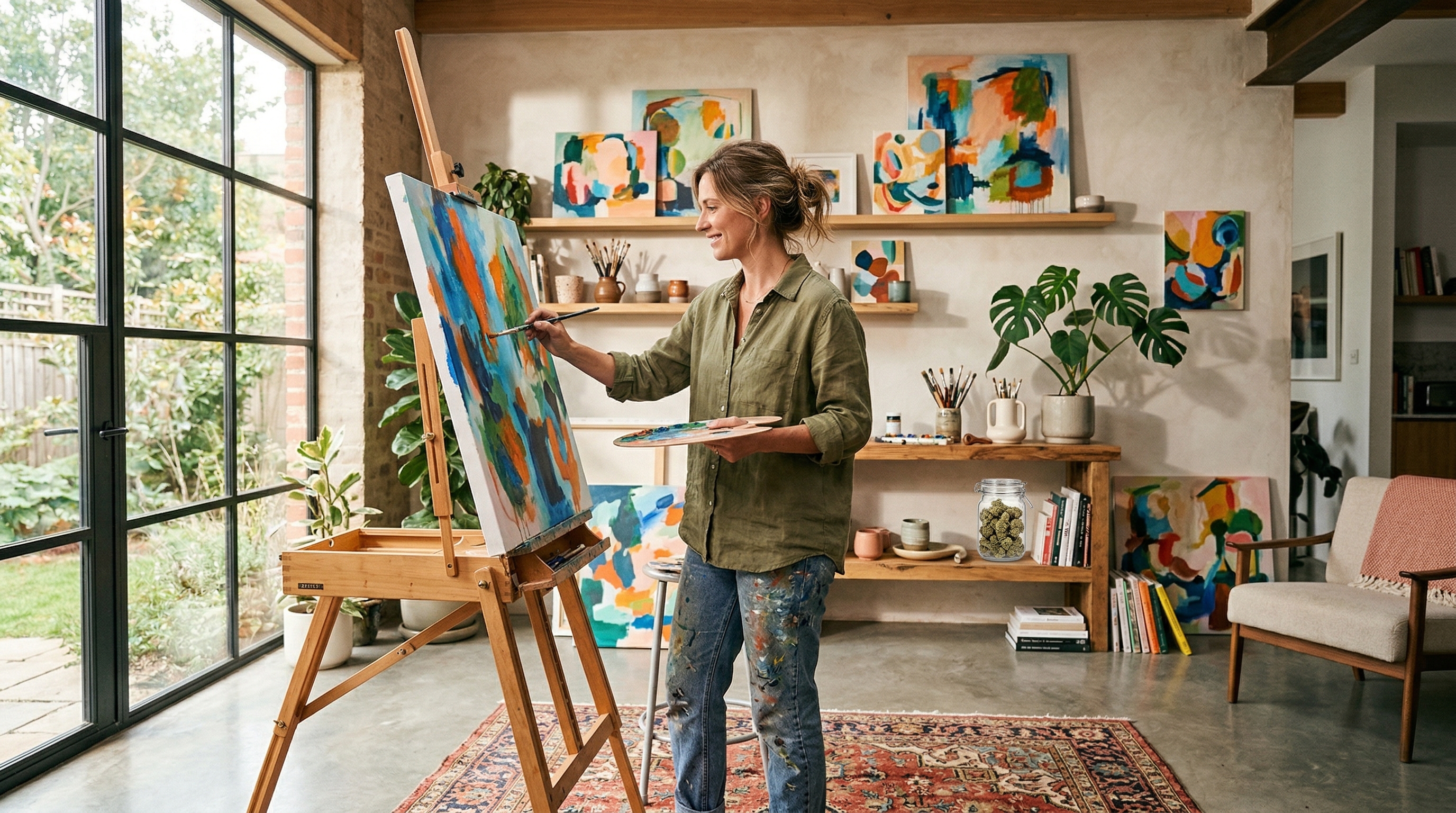
The Science: How Cannabis Affects the Creative Brain
Before we get into strain recommendations, let’s understand what’s actually happening in your brain when cannabis and creativity intersect. This isn’t stoner mythology—there’s a body of peer-reviewed research behind it.
Divergent Thinking: The Heart of Artistic Creativity
Creativity in visual art is largely an exercise in divergent thinking—the ability to generate many ideas from a single starting point, make unexpected connections, and see problems from multiple angles. This is the opposite of convergent thinking, which narrows options down to a single correct answer.
A landmark 2012 study published in Consciousness and Cognition by Schafer and colleagues found that cannabis users scored significantly higher on measures of divergent thinking—but with a crucial caveat: only at low to moderate doses. High doses actually impaired divergent thinking compared to placebo [Schafer et al., 2012]. This is the inverted-U dose-response curve that every artist using cannabis should tattoo somewhere memorable.
A 2015 study from Leiden University confirmed this: low-potency cannabis (5.5mg THC) showed no significant impairment on creativity tasks, while high-potency cannabis (22mg THC) actually decreased divergent thinking performance [Kowal et al., 2015]. The lesson is clear—more isn’t more when it comes to cannabis and art.
The Default Mode Network: Your Brain’s Creative Engine
The key neurological player here is the default mode network (DMN)—a set of interconnected brain regions that activates when you’re daydreaming, mind-wandering, and making spontaneous associative leaps. This is your creative free-association engine. Research using fMRI has shown that THC increases cerebral blood flow to the frontal lobe and anterior cingulate cortex, key nodes of the DMN [O’Leary et al., 2002].
This partly explains why, at the right dose, cannabis can feel like it expands your visual imagination. Colors seem more saturated, compositional ideas flow more freely, and your inner critic—that voice that says “that brushstroke is wrong”—gets quieter.
That last effect has a name in neuroscience: reduced latent inhibition. Your brain normally filters out most sensory information as “irrelevant.” Cannabis relaxes those filters, letting more raw perceptual data into conscious awareness [Carson et al., 2003]. For painters, that can mean noticing color relationships you’d normally skip past, or finding beauty in an unexpected texture.
Why Terpenes Matter More Than Indica vs. Sativa
Here’s where most cannabis guides go wrong: they recommend strains by their indica/sativa label, which tells you almost nothing about actual effects. What matters for artists is the terpene profile.
Terpenes are the aromatic compounds that give each strain its smell—and increasingly, research suggests they shape the subjective experience through the entourage effect: the synergistic interaction of cannabinoids and terpenes working together rather than in isolation [Russo, 2011].
For visual creativity, four terpenes stand out:
-
Limonene: The citrusy mood-elevator. Research suggests it reduces anxiety and elevates mood [Piccinelli et al., 2015]—key for artists who experience performance anxiety or creative blocks. When you’re relaxed but alert, creative output peaks.
-
Pinene (alpha-pinene): Perhaps the most underrated terpene for artists. Research indicates it may counteract some of THC’s short-term memory impairment [Russo, 2011], helping you hold a compositional vision in your mind while executing details. Think of it as the “intentionality terpene.”
-
Terpinolene: The unsung hero of creative flow. Associated with uplifting, cerebral effects, early research suggests mild stimulating properties [Ito & Ito, 2013]. Found in strains beloved by artists for sustained focus during long sessions.
-
Linalool: The floral terpene also found in lavender. Research shows it promotes calm without sedation [Guzmán-Gutiérrez et al., 2015]. Invaluable for artists who find cannabis tips them toward anxious overthinking rather than relaxed flow.
-
Caryophyllene: The spicy, peppery terpene that also acts as a CB2 receptor agonist. Can help ground a high that’s getting too cerebral, providing physical ease during long studio sessions.
Quick Reference: Strains by Art Style
Before diving into the full breakdowns, here’s the cheat sheet:
| Art Style | Best High Family | Key Terpenes | Top Pick |
|---|---|---|---|
| Abstract / Expressive | Uplift | Limonene, Linalool | Super Lemon Haze |
| Detailed / Realistic | Energize | Terpinolene, Pinene | Jack Herer |
| Portrait / Emotional | Uplift | Limonene, Caryophyllene | Strawberry Cough |
| Long Studio Sessions | Euphoria | Caryophyllene, Limonene, Linalool | Blue Dream |
| Plein Air / Landscape | Euphoria | Myrcene, Pinene | Pineapple Express |
| Digital / Graphic | Energize | Terpinolene, Ocimene | Durban Poison |
| Anxiety-Prone Artists | Calm | Linalool, CBD | ACDC |
The 15 Best Cannabis Strains for Art and Painting
Sativas and Uplift-Family Strains: For Expressive, Color-Forward Work
These strains are best when you want to work big, fast, and emotionally—when the painting is about feeling rather than precision.
1. Jack Herer
Jack Herer is the classic artist’s strain, named after the legendary cannabis activist. It’s a sativa-dominant hybrid with a terpene profile heavy in terpinolene and pinene, producing clear-headed cerebral stimulation without jitteriness. The terpinolene drives creative momentum; the pinene keeps you intentional. Painters consistently report heightened attention to light and shadow relationships. THC typically runs 18–23%.
Best for: Hyperrealism, architectural illustration, fine-line work, any art requiring sustained precision.
2. Durban Poison
Pure, clean, and almost laser-focused—Durban Poison is a landrace sativa from South Africa that delivers mental clarity without the scattered, racing-thoughts effect that sativa-heavy strains sometimes produce. Dominant in terpinolene and ocimene, it’s the strain that graphic designers and illustrators reach for when they need to get into technical detail work. THC 20–25%.
Best for: Digital art, graphic design, printmaking, technical drawing.
3. Super Lemon Haze
Super Lemon Haze is exactly what it sounds like: a citrus-forward, euphoric powerhouse with one of the highest limonene contents you’ll find. The mood elevation is immediate and pronounced—anxiety dissolves, color perception sharpens, and your emotional connection to the work intensifies. A multiple Cannabis Cup winner, it’s been a studio staple for expressive painters for decades. THC 20–25%.
Best for: Abstract expressionism, color-heavy work, emotional portraiture, bold brushwork.
4. Tangie
Tangie (a cross of California Orange and Skunk-1) delivers a bright, citrusy, almost giddy creative energy. Its dominant limonene profile produces what many artists describe as “color synesthesia light”—an enhanced sensitivity to warm tones and saturated hues. It’s particularly popular among painters who work with vibrant, non-naturalistic palettes. THC 19–22%.
Best for: Colorfield painting, expressionism, pop art, any work where your color instincts should lead.
5. Strawberry Cough
Strawberry Cough occupies the sweet spot between euphoric creativity and social ease. A sativa-dominant hybrid with balanced limonene and caryophyllene, it provides mood elevation without the laser-focus of Durban Poison or the intensity of Super Lemon Haze. Portrait painters love it for its ability to heighten empathy—you can really see a face when you’re in this headspace. THC 18–20%.
Best for: Portrait painting, figure drawing, any work that benefits from emotional attunement.
6. Sour Diesel
Sour Diesel is probably the most famous creative strain in cannabis culture, and it earned that reputation. Fast-acting, cerebral, and energizing, it’s the strain for when you need to break through creative blocks. Its dominant terpenes—limonene and caryophyllene—pair mood elevation with physical ease, preventing the tight, anxious body feeling that sometimes accompanies pure sativas. Countless artists credit Sour Diesel with their best work. THC 20–25%.
Best for: Overcoming creative blocks, brainstorming sessions, expressive work, long spontaneous painting sessions.
Balanced Hybrids: For Immersive, Long-Form Sessions
These are your marathon strain picks—complex enough to keep you interested for hours, balanced enough not to derail you.
7. Blue Dream
Blue Dream is the most universally recommended creative cannabis strain for good reason: its balanced hybrid genetics (Blueberry x Haze) produce a terpene profile that does nearly everything an artist needs. Dominant myrcene provides relaxed body comfort for long standing sessions; secondary pinene keeps the mind clear; trace caryophyllene grounds the experience. The result is a gentle, sustained creative flow that doesn’t peak and crash. THC 17–24%.
Best for: Oil painting, plein air work, mixed media, long immersive studio sessions.
8. Girl Scout Cookies (GSC)
Girl Scout Cookies is a three-terpene powerhouse: caryophyllene, limonene, and linalool in near-equal measure. That combination produces something unusual—euphoric creativity that doesn’t sacrifice physical ease, and mental expansiveness that doesn’t tip into anxiety. For artists who want to paint for 4-5 hours and feel genuinely good throughout, GSC is hard to beat. THC 19–28%.
Best for: Long studio sessions, large-format work, mixed media, creative exploration.
9. Wedding Cake
Wedding Cake (Triangle Kush x Animal Mints) delivers layered, evolving effects that mirror how a painting itself develops—starting with an energetic, idea-generating phase, then settling into a warm, immersive focus. Heavy in caryophyllene and limonene, it’s both physically comfortable and mentally engaged. Best for experienced consumers due to its high THC. THC 22–28%.
Best for: Multi-session work, complex compositions, artists who enjoy the full arc of a long creative day.
10. Pineapple Express
Pineapple Express became famous for the film, but it earned its reputation in studios. The tropical terpene profile—terpinolene, myrcene, caryophyllene—produces a distinctly sensory high that enhances texture perception and color relationships, particularly in outdoor settings. Plein air painters cite it frequently. The effects are sociable but not chatty, curious but not scattered. THC 19–24%.
Best for: Plein air painting, landscape work, watercolor, any art practice done outdoors.
11. Amnesia Haze
Amnesia Haze is a high-terpinolene, high-limonene sativa-dominant hybrid that produces one of the most cerebral and visually stimulating effects in cannabis. Multiple Cannabis Cup winner, it’s been a European artist community favorite for decades. The caveat: its name is earned—short-term memory is genuinely impacted at higher doses, which can actually be a feature for artists who want to paint without self-critical second-guessing. Low doses recommended. THC 20–25%.
Best for: Abstract work, visual exploration, artists who want to minimize their inner critic.
Indica-Leaning and CBD Strains: For Calm, Grounded Work
Not every painting session needs high energy. These strains are for the slow, contemplative work—layering glazes, working through a complex composition, or managing performance anxiety.
12. Granddaddy Purple
Granddaddy Purple is heavy in myrcene and caryophyllene, producing deep physical relaxation with a gently euphoric mental overlay. At low doses—key here—it supports a meditative, deliberate painting style. Think of it as the strain for slow impasto work, for layering, for the patient observation that realism demands. At higher doses it becomes couch-lock territory. THC 17–23%.
Best for: Realistic still life, glazing techniques, slow contemplative work, evening studio sessions.
13. Northern Lights
Northern Lights is one of the most celebrated indica strains in history, and at low doses it excels for calm, focused creative work. Its myrcene-dominant profile produces physical ease and mental quiet—a state that many artists describe as “peaceful presence.” Where energetic strains give you ideas, Northern Lights helps you execute on the ideas you already have. THC 16–21%.
Best for: Finishing work, detail refinement, artists who get distracted by new ideas before finishing existing ones.
14. ACDC
ACDC is a high-CBD, low-THC strain (typically 1:20 THC:CBD ratio) that produces zero intoxication while still providing the anxiolytic, creativity-supporting benefits of the cannabis plant. For artists who experience crippling performance anxiety, creative blocks rooted in self-criticism, or who simply can’t function with any level of intoxication, ACDC is the answer. CBD’s modulation of serotonin receptors appears to reduce anxiety without affecting cognitive function [Blessing et al., 2015].
Best for: Live painting events, gallery work, anxiety-prone artists, anyone who needs creative confidence without impairment.
15. Harlequin
Harlequin sits between ACDC and full-THC strains with a typical 5:2 CBD:THC ratio. The CBD takes the edge off the THC while allowing just enough psychoactive effect to shift perspective and loosen the inner critic. It’s the most forgiving creative strain on this list—harder to overconsume, gentler on anxiety, and still genuinely useful for breaking creative blocks. Dominant in myrcene and pinene. THC 6–10%, CBD 10–15%.
Best for: Beginners, anxiety-prone artists, daytime work, any situation where you need subtle creative support without significant impairment.
How to Use the High Families System for Art
The High Families system groups strains by their dominant terpene profiles and the experiences they produce. It’s far more useful for artists than the outdated indica/sativa binary, because it maps directly to creative needs.
Here’s how the families align with different artistic practices:
Uplift — Limonene and linalool-dominant. Mood elevation, emotional openness, enhanced color sensitivity. Best when you want to feel the work. Strains: Super Lemon Haze, Tangie, Strawberry Cough, Sour Diesel.
Energize — Terpinolene and ocimene-dominant. Mental clarity, sustained focus, cognitive precision. Best when you need to execute the work. Strains: Jack Herer, Durban Poison, Amnesia Haze.
Euphoria — Complex multi-terpene profiles balancing euphoria and comfort. Best for long immersive sessions. Strains: Blue Dream, GSC, Wedding Cake, Pineapple Express.
Calm — Myrcene-dominant or high-CBD. Physical ease, reduced anxiety, meditative focus. Best when you want to work slowly and deliberately. Strains: Granddaddy Purple, Northern Lights, ACDC, Harlequin.
Building Your Creative Cannabis Practice
The Cardinal Rule: Start Low
The research is unambiguous on this: low doses enhance creative thinking, high doses impair it. For inhalation, that means 1–2 small puffs and waiting 10 minutes. For edibles, 2.5–5mg and waiting a full hour. Many professional artists who use cannabis report their sweet spot is barely noticeable—just enough to shift perspective, not enough to affect motor control or memory.
Match the Strain to the Phase of Your Work
Different parts of the creative process benefit from different states:
| Creative Phase | Mental State Needed | Recommended Approach |
|---|---|---|
| Brainstorming / Sketching | Open, associative, uninhibited | Uplift family at low dose |
| Color blocking / Expressive work | Emotionally open, energized | Uplift family or Energize family |
| Detail work / Execution | Focused, patient, precise | Energize family at very low dose |
| Long immersive sessions | Comfortable, sustained, curious | Euphoria family |
| Evaluation / Critique | Clear-headed, analytical | Sober, or Calm family with CBD |
Keep a Strain Journal
This is the single most useful thing a cannabis-using artist can do. Track: the strain name, terpene profile, dose, time of day, what you created, and—critically—how you feel about the work when you evaluate it sober the next day. Patterns emerge quickly. You’ll discover which terpenes consistently produce your best work, which strains help you break blocks, and which to avoid before deadline-driven sessions.
Set Up Before You Consume
The reduced latent inhibition that cannabis produces only helps if your creative environment is already set up and ready. Lay out your palette, prep your canvas, put on music—then consume. Don’t try to set up mid-session when coordination and short-term memory may be slightly impaired.
Key Takeaways
- Low doses work; high doses don’t. Research shows low-dose cannabis boosts divergent thinking. High doses impair it. Start with 1–2 small puffs or 2.5–5mg in edibles [Schafer et al., 2012].
- Terpenes matter more than indica/sativa. Use limonene for emotional expressiveness, terpinolene for focus, pinene for memory and intention, and linalool for calm confidence.
- Use the High Families system. The Uplift family for expressive work, Energize family for detail work, Euphoria family for long sessions, and Calm family for slow, deliberate painting.
- Match your strain to your creative phase. Brainstorming, execution, and evaluation call for different terpene profiles—or no cannabis at all.
- Set up before you consume. Prep your canvas, palette, and workspace first. Cannabis works best when your environment is ready.
- Keep a strain journal. Track what you used, what you made, and how you feel about it sober the next day. Patterns emerge fast.
FAQs
Does cannabis actually improve art, or does it just feel that way?
Both effects are real. Research shows low-dose cannabis genuinely enhances divergent thinking [Schafer et al., 2012] and increases frontal lobe blood flow [O’Leary et al., 2002]. It also reduces self-criticism, which can make work feel better in the moment than it is. The professional approach: create while in a mild cannabis state, evaluate sober the next day. Keep the ideas, interrogate the execution.
Is sativa better than indica for painting?
No—and this is one of the most persistent myths in cannabis culture. Indica/sativa refers to plant morphology, not effects. A high-myrcene “sativa” might sedate you; a high-terpinolene “indica” might energize you. What matters is the terpene and cannabinoid profile. Use the High Families system instead.
What if cannabis makes me more anxious, not more creative?
Anxiety during cannabis use is almost always dose-related (too much), terpene-related (low linalool, high THC with no CBD), or environment-related (uncomfortable setting). Solutions in order of effectiveness: dramatically reduce dose, switch to a high-linalool or CBD-containing strain like Harlequin or ACDC, and ensure your studio feels genuinely safe and private before consuming.
Can cannabis help with art if I’m a beginner?
For beginner artists, cannabis can help reduce the performance anxiety and self-criticism that often stifles early creative development. CBD-dominant strains like ACDC or Harlequin are ideal starting points—they provide anxiety relief without meaningful impairment. If trying THC-containing strains, keep doses very low and choose strains from the Uplift family with significant linalool content.
What’s the best consumption method for studio work?
For most visual artists, vaporization offers the best control—effects are near-immediate, easier to dose precisely, and don’t affect lung capacity. Edibles can work well for long sessions but require careful low dosing and patience (effects take 45–90 minutes and last much longer). Smoking is workable but can affect the painting environment through smell. Whatever method you choose, always err significantly lower than you think you need.
Sources
- Schafer, G., Feilding, A., Morgan, C.J., et al. (2012). Investigating the interaction between schizotypy, divergent thinking and cannabis use. Consciousness and Cognition, 21(1), 292–298. PMID: 22056542
- Kowal, M.A., Hazekamp, A., Colzato, L.S., et al. (2015). Cannabis and creativity: highly potent cannabis impairs divergent thinking in regular cannabis users. Psychopharmacology, 232(6), 1123–1134. PMID: 25298171
- O’Leary, D.S., Block, R.I., Koeppel, J.A., et al. (2002). Effects of smoking marijuana on brain perfusion and cognition. Neuropsychopharmacology, 26(6), 802–816. PMID: 12007751
- Russo, E.B. (2011). Taming THC: potential cannabis synergy and phytocannabinoid-terpenoid entourage effects. British Journal of Pharmacology, 163(7), 1344–1364. PMID: 21749363
- Carson, S.H., Peterson, J.B., Higgins, D.M. (2003). Decreased latent inhibition is associated with increased creative achievement in high-functioning individuals. Journal of Personality and Social Psychology, 85(3), 499–506. PMID: 12916570
- Piccinelli, A.C., et al. (2015). Antihyperalgesic activity of limonene in the mouse. Basic & Clinical Pharmacology & Toxicology, 117(5), 335–341. PMID: 25899241
- Ito, K., & Ito, M. (2013). Sedative effects of vapor inhalation of the essential oil of Larix leptolepis and the terpene terpinolene. Natural Product Communications, 8(11), 1621–1624. PMID: 24427857
- Guzmán-Gutiérrez, S.L., et al. (2015). Linalool and β-pinene exert their antidepressant-like activity through the monoaminergic pathway. Life Sciences, 128, 24–29. PMID: 25701498
- Blessing, E.M., Steenkamp, M.M., Manzanares, J., & Marmar, C.R. (2015). Cannabidiol as a potential treatment for anxiety disorders. Neurotherapeutics, 12(4), 825–836. PMID: 26341731


