Cannabis and Meditation: Mindful Consumption Guide
Explore the science behind combining cannabis and meditation. Learn how mindful consumption enhances awareness, calm, and the overall experience.

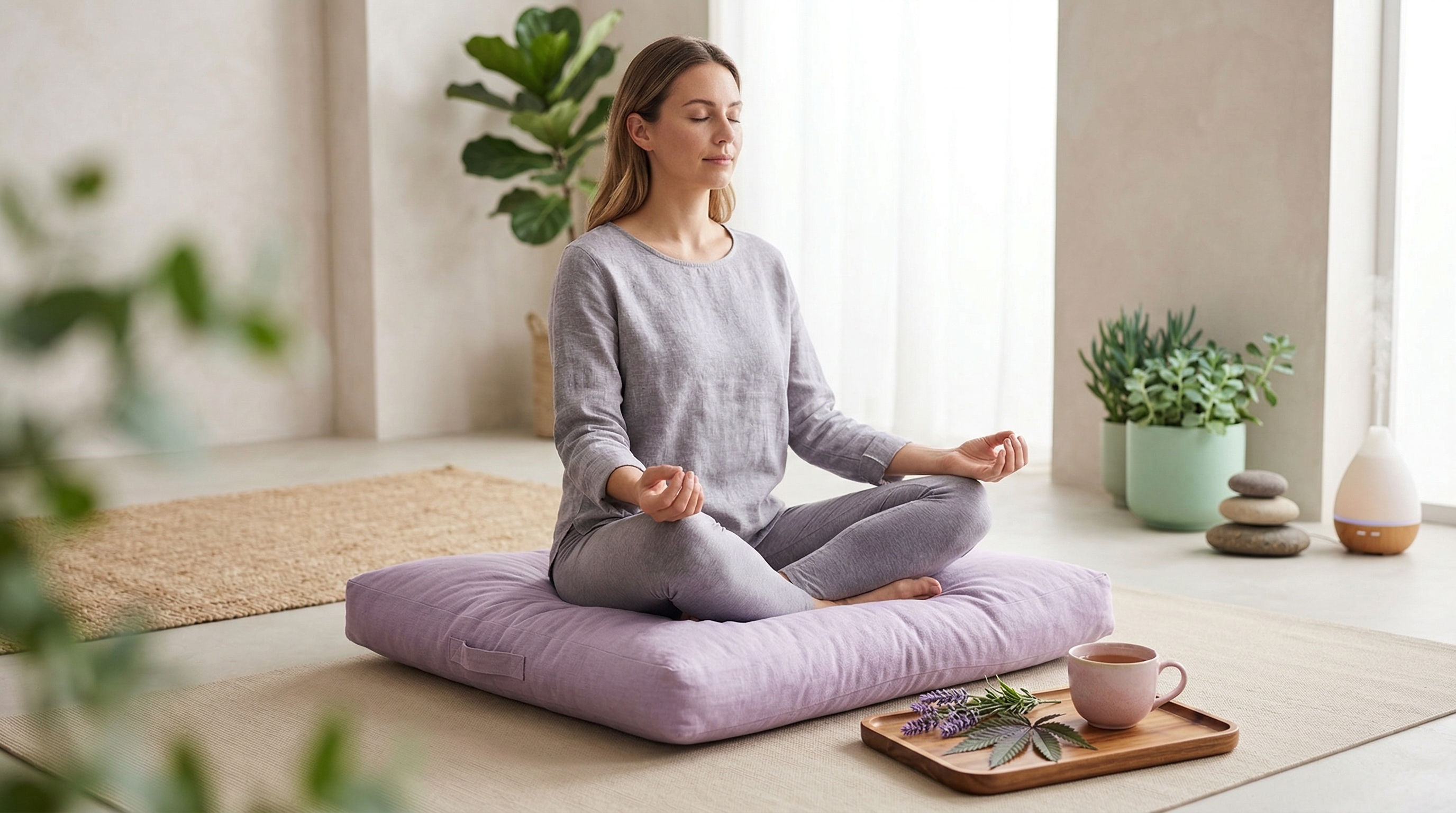
Updated July 2026: Added 2026 fMRI trial on mindfulness-based interventions and brain reward function. New internal links to GABA, ECS nutrition, and psychedelics research.
What If the Way You Consume Matters More Than What You Consume?
Here’s a surprising finding: in a 2020 study from the University of British Columbia, participants who combined cannabis with mindfulness practices reported significantly greater emotional well-being and reduced distress compared to those who used cannabis without any intentional framework [Earleywine et al., 2020]. In other words, how you approach your session may shape the experience as much as the strain, the dose, or the THC percentage on the label.
For thousands of years, cannabis and meditation have been intertwined. Ancient Hindu ascetics used bhang—a cannabis preparation—as a sacrament to deepen contemplative practice. Taoist texts reference cannabis as an aid to inner stillness. And today, a growing body of modern research is beginning to explain why these two practices seem to amplify each other in ways that neither achieves alone.
If you’ve ever noticed that your high feels different when you’re rushed and distracted versus calm and present, you’ve already experienced this phenomenon firsthand. The mental state you bring to cannabis consumption—your set (mindset) and setting (environment)—doesn’t just color the experience. It may fundamentally alter the neurochemistry of what happens next.
In this article, we’re going to explore the science behind this intersection. You’ll learn how cannabis interacts with the brain’s default mode network, why meditation appears to prime your endocannabinoid system for a different kind of high, and how you can use these insights to build a more intentional, rewarding relationship with cannabis. Whether you’re a seasoned meditator curious about cannabis or a regular consumer looking to deepen your experience, there’s something here for you.
Let’s breathe in and begin.
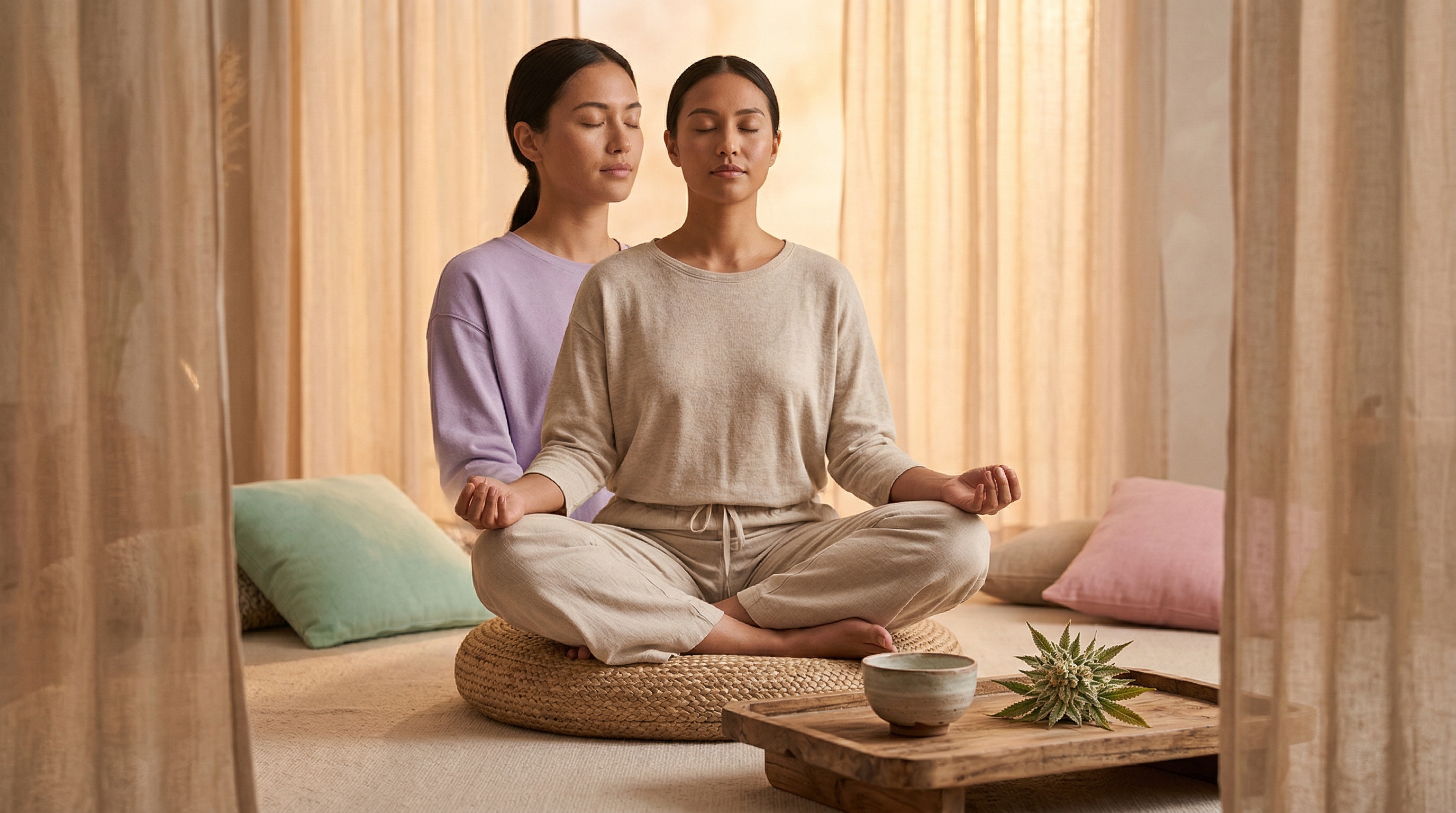
The Science Explained
How Cannabis Interacts with the Meditating Brain
To understand why cannabis and meditation work so well together, we need to talk about two things: the endocannabinoid system (ECS) and the default mode network (DMN).
Your endocannabinoid system is a vast signaling network that runs throughout your brain and body. Think of it as your internal balance-keeper—it helps regulate mood, pain perception, appetite, stress response, and much more. (Your diet can support ECS balance too, which matters for meditation practice.) Your body naturally produces its own cannabinoids, called endocannabinoids, the most studied being anandamide (named after the Sanskrit word ananda, meaning bliss). When you consume cannabis, plant cannabinoids like THC and CBD interact with the same receptors that anandamide uses—primarily CB1 receptors in the brain and CB2 receptors throughout the body [Lu & Mackie, 2016].
Now here’s where meditation enters the picture. Research suggests that meditation itself may increase endocannabinoid tone—meaning your body’s natural production and circulation of compounds like anandamide. A 2020 study found that experienced meditators showed elevated levels of endocannabinoids after a focused meditation session [Hanuš et al., 2020]. Imagine your endocannabinoid system as a garden: meditation appears to enrich the soil, and cannabis provides additional seeds. The result may be a more lush, nuanced experience than either practice alone.
The second key concept is the default mode network—a collection of interconnected brain regions that activates when you’re not focused on the outside world. The DMN is responsible for mind-wandering, self-referential thinking, rumination, and that endless inner monologue. When your DMN is overactive, you tend to get stuck in loops of worry, self-criticism, or distraction.
Both cannabis and meditation appear to modulate DMN activity, but in complementary ways. Neuroimaging studies show that experienced meditators exhibit reduced DMN activity during practice, correlating with decreased mind-wandering and a greater sense of present-moment awareness [Brewer et al., 2011]. Meanwhile, THC has been shown to disrupt normal DMN connectivity, which some researchers believe contributes to the altered sense of self and time that characterizes a cannabis high [Mason et al., 2021].
This alteration of self and time perception has parallels with psychedelic experiences, and some of the same integration practices apply. When you combine the two, something interesting may happen: meditation provides the framework for navigating the altered state that cannabis produces. Instead of the DMN disruption leading to scattered thoughts or anxiety (which can happen with cannabis alone, especially at higher doses), the meditative framework may channel that disruption into a focused, expansive awareness.
What the Research Shows
The formal research on cannabis-assisted meditation is still emerging, but several studies offer compelling clues.
A landmark survey study by Earleywine and colleagues (2020) found that participants who used cannabis in conjunction with mindfulness practices reported higher levels of mystical experience, greater emotional regulation, and reduced psychological distress compared to cannabis-only or meditation-only groups. Importantly, the effect was dose-dependent—lower doses combined with mindfulness produced the most positive outcomes, while higher doses sometimes undermined the meditative focus [Earleywine et al., 2020].
Research on microdosing adds another dimension. A 2021 study published in the Journal of Psychopharmacology found that very low doses of THC (2.5–5mg) enhanced aspects of creative thinking and introspective awareness without producing the cognitive impairment associated with higher doses [Kowal et al., 2015]. This aligns with what many mindful consumers report: a small amount of cannabis can lower the barrier to meditative states without overwhelming the capacity for focused attention.
There’s also intriguing research on terpenes and their role in this equation. Linalool, found in lavender and many cannabis cultivars, has demonstrated anxiolytic (anxiety-reducing) properties in animal models [Guzmán-Gutiérrez et al., 2015]—likely through its interaction with the GABA system, your brain’s primary calming pathway. Myrcene, the most common cannabis terpene, appears to have sedative and muscle-relaxant effects [do Vale et al., 2002]. These terpene profiles don’t just influence the type of high you experience—they may also determine how compatible a particular cultivar is with meditative practice.
A 2026 randomized controlled fMRI trial from the University of Bath explored how mindfulness affects cannabis users’ brains. Beyer and colleagues randomized 49 individuals with moderate-to-severe Cannabis Use Disorder to either a 2-week mindfulness-based intervention (MBI), an active relaxation control, or no intervention. Exploratory whole-brain analysis revealed that the MBI group showed decreased cerebellar activity during reward anticipation and distinct changes in parietal and frontal cortex activity during reward receipt. However, the a priori region-of-interest analysis—targeting the ventral striatum, caudate, and other reward-related areas—found no significant intervention-by-time effects. The authors concluded that MBI, relaxation, and no intervention “may share changes in partially overlapping brain regions in distinct directions” [Beyer et al., 2026]. While the results are preliminary and focused on CUD rather than recreational use, they represent early neuroimaging evidence that mindfulness-based frameworks may modulate how cannabinoid-affected reward circuits respond—a finding that warrants replication in larger samples.
Key insight: The research consistently suggests that less is more when combining cannabis and meditation. Lower doses appear to enhance mindfulness, while higher doses may compete with it.

Practical Implications: Building a Mindful Cannabis Practice
So how do you actually put this science into practice? Here’s where we bridge the gap between research and your real-world experience.
Choose Your High Family Intentionally
Not every cannabis experience is suited to meditation, and this is where the High Families framework becomes genuinely useful. Instead of relying on the outdated indica/sativa binary, consider matching your cultivar choice to your meditative intention:
| Meditation Goal | Recommended High Family | Why It Works |
|---|---|---|
| Deep body relaxation, body scan meditation | Relaxing High | Myrcene-dominant profiles promote physical calm and stillness |
| Creative visualization, open awareness | Uplifting High | Limonene and linalool support mood elevation and gentle mental expansion |
| Focused attention, breathwork | Energetic High | Terpinolene supports mental clarity without sedation |
| Gentle introduction, beginner-friendly | Balancing High | Low terpene profiles and balanced cannabinoid ratios offer subtle, manageable effects |
| Physical comfort, yoga or movement meditation | Relieving High | Caryophyllene and humulene may ease physical tension that distracts from practice |
| Full-spectrum, deep contemplative sessions | Entourage High | Multi-terpene complexity supports layered, evolving experiences |
The Mindful Consumption Protocol
Based on the available research and practitioner reports, here’s a framework for combining cannabis and meditation:
-
Set your intention before consuming. Before you take a single puff or bite, sit quietly for 2–3 minutes. Ask yourself: What am I hoping to explore today? This simple act activates your prefrontal cortex and establishes the mindful framework that the research suggests is so important.
-
Start with a low dose. The science points clearly toward lower doses for meditative enhancement. If you’re smoking or vaping, try one small inhalation and wait 10–15 minutes. For edibles, 2.5–5mg of THC is a reasonable starting point. You can always add more; you can’t take it back.
-
Begin your meditation as the effects onset. Rather than waiting until you’re fully “high,” start your practice as you feel the first subtle shifts in awareness. This transition period—where your default mode network is beginning to shift but hasn’t fully reorganized—may be the most fertile ground for mindful exploration.
-
Use the body as an anchor. Cannabis tends to enhance somatic (body-based) awareness. Use this to your advantage: body scan meditations, breath-focused practices, and yoga nidra (yogic sleep) all become particularly rich with mild cannabis enhancement.
-
Journal afterward. Insights that arise during cannabis-enhanced meditation can be vivid but fleeting. Keep a notebook nearby and spend 5–10 minutes writing after your session. This also helps you track which cultivars, doses, and practices work best for you over time.

What to Watch For
Combining cannabis and meditation isn’t universally positive, and intellectual honesty demands we address this. For some people—particularly those prone to anxiety or those with a history of dissociative experiences—cannabis can intensify uncomfortable mental states rather than soothe them. Meditation can do the same in rare cases, a phenomenon researchers call meditation-related adverse experiences [Schlosser et al., 2019].
If you find that cannabis makes your mind race rather than settle, or if meditation while high produces anxiety rather than calm, that’s valuable information. It doesn’t mean you’re doing it wrong—it may mean that this particular combination, at this particular dose, isn’t right for you. Consider trying a cultivar from the Balancing High family with a higher CBD-to-THC ratio, which some find moderates the intensity of the experience.
Important: This article is for educational purposes. If you’re managing a mental health condition, consult with a healthcare provider before combining cannabis with any mindfulness or therapeutic practice.
The Bigger Picture: Consumption as Practice
There’s a broader philosophical point worth making here. In our culture, cannabis consumption is often framed as purely recreational—something you do to yourself. Mindful consumption reframes it as something you do with yourself. It becomes a practice, in the same way that yoga, journaling, or cooking a meal with full attention can be a practice.
The research we’ve explored suggests that this reframing isn’t just philosophical hand-waving. The neurological evidence indicates that your mental state genuinely modulates how cannabinoids and terpenes interact with your brain. Intention changes chemistry. Set and setting aren’t just hippie wisdom—they’re descriptions of measurable neurological conditions that shape the downstream effects of every compound in the cannabis plant.
This is perhaps the most empowering takeaway: you have far more agency over your cannabis experience than you might think. The strain matters. The dose matters. But your state of mind when you consume? That might matter most of all.
Key Takeaways
- Your mindset shapes your high. Research suggests that the mental state you bring to cannabis consumption measurably influences the experience, potentially by modulating endocannabinoid tone and default mode network activity.
- Less is more for mindful sessions. Studies consistently show that lower doses (2.5–5mg THC) enhance introspective awareness and creative thinking, while higher doses may undermine meditative focus.
- Terpene profiles matter for meditation. Match your cultivar to your intention using the High Families system—linalool and limonene for uplifting awareness, myrcene for deep relaxation, terpinolene for focused attention.
- Meditation may prime your endocannabinoid system. Early research suggests that meditation increases natural endocannabinoid production, potentially creating a more receptive foundation for cannabis’s effects.
- Build a ritual, not just a habit. Setting intention, choosing your dose mindfully, and journaling afterward transforms consumption from passive to active—and the science suggests your brain responds differently as a result.
FAQs
Can cannabis replace meditation?
No—and the research suggests they work best as complements, not substitutes. Cannabis may lower the barrier to meditative states for some people, but it doesn’t build the sustained attention and equanimity that regular meditation practice develops over time. Think of cannabis as a tool that can occasionally deepen a practice you’re already building.
What’s the best strain for meditation?
There’s no single “best strain,” but the High Families framework can guide you. For most seated meditation, cultivars from the Relaxing High or Uplifting High families tend to work well. For movement-based practices like yoga, the Relieving High family may offer physical comfort that supports the practice. Start with low doses regardless of the cultivar.
Is it safe to meditate while high?
For most healthy adults, combining low-dose cannabis with meditation is generally well-tolerated. However, if you have a history of anxiety, psychosis, or dissociative disorders, proceed with caution and consult a healthcare provider. Start with very low doses and in a safe, comfortable environment. If the experience becomes uncomfortable, open your eyes, ground yourself with physical sensations (feel your feet on the floor), and remember that the effects are temporary.
Does CBD work for meditation too?
Some practitioners prefer CBD-dominant or balanced CBD:THC cultivars for meditation, as CBD may promote calm without the psychoactive intensity of THC. Research suggests CBD has anxiolytic properties and may modulate some of THC’s effects [Zuardi et al., 2012]. Cultivars from the Balancing High family, which often feature favorable CBD ratios, can be an excellent starting point for cannabis-curious meditators.
Sources
- Beyer, E. et al. (2026). “A mindfulness-based intervention to reduce altered brain reward function in cannabis use disorder: a double-blind, active and passive, randomised controlled fMRI trial.” Psychopharmacology. DOI: 10.1007/s00213-026-07073-0
- Brewer, J.A. et al. (2011). “Meditation experience is associated with differences in default mode network activity and connectivity.” Proceedings of the National Academy of Sciences, 108(50), 20254–20259. PMID: 22114193
- do Vale, T.G. et al. (2002). “Central effects of citral, myrcene and limonene, constituents of essential oil chemotypes from Lippia alba.” Phytomedicine, 9(8), 709–714. PMID: 12587690
- Earleywine, M. et al. (2020). “Cannabis, mindfulness, and psychological distress.” Journal of Cannabis Research, 2(1), 38. DOI: 10.1186/s42238-020-00046-8
- Guzmán-Gutiérrez, S.L. et al


