Cannabis Cooking 101: Your Beginner's Guide to Infused Meals
Learn to make cannabis-infused meals at home with our step-by-step guide covering decarboxylation, butter infusions, dosing, and beginner-friendly recipes.

So you want to cook with cannabis. Maybe you’re tired of the same old store-bought gummies. Maybe you love cooking and want to bring your two favorite hobbies together. Or maybe you just want to know what’s actually going into your edibles. Whatever brought you here, welcome — you’re about to unlock one of the most rewarding (and delicious) skills in the cannabis world.
But here’s the thing: cannabis cooking isn’t just about tossing some flower into brownie batter and hoping for the best. There’s real science behind it, and understanding a few key principles will mean the difference between a perfectly dosed, flavorful meal and a disappointing (or overwhelming) experience. This guide will walk you through everything from decarboxylation to your first infused dish, one step at a time.
Goal & Overview
What you’ll accomplish: By the end of this guide, you’ll know how to decarboxylate cannabis flower, create a basic cannabutter or infused oil, calculate approximate dosing, and use your infusion in a simple recipe.
Estimated total time: 3–4 hours (mostly passive waiting time)
Difficulty level: Beginner — no prior cannabis cooking experience needed
Important: Edibles affect everyone differently and take 30 minutes to 2 hours to kick in. Always start with a low dose (2.5–5 mg THC per serving), wait at least 2 hours before consuming more, and never cook with cannabis for someone without their knowledge and consent.
What You’ll Need
Required
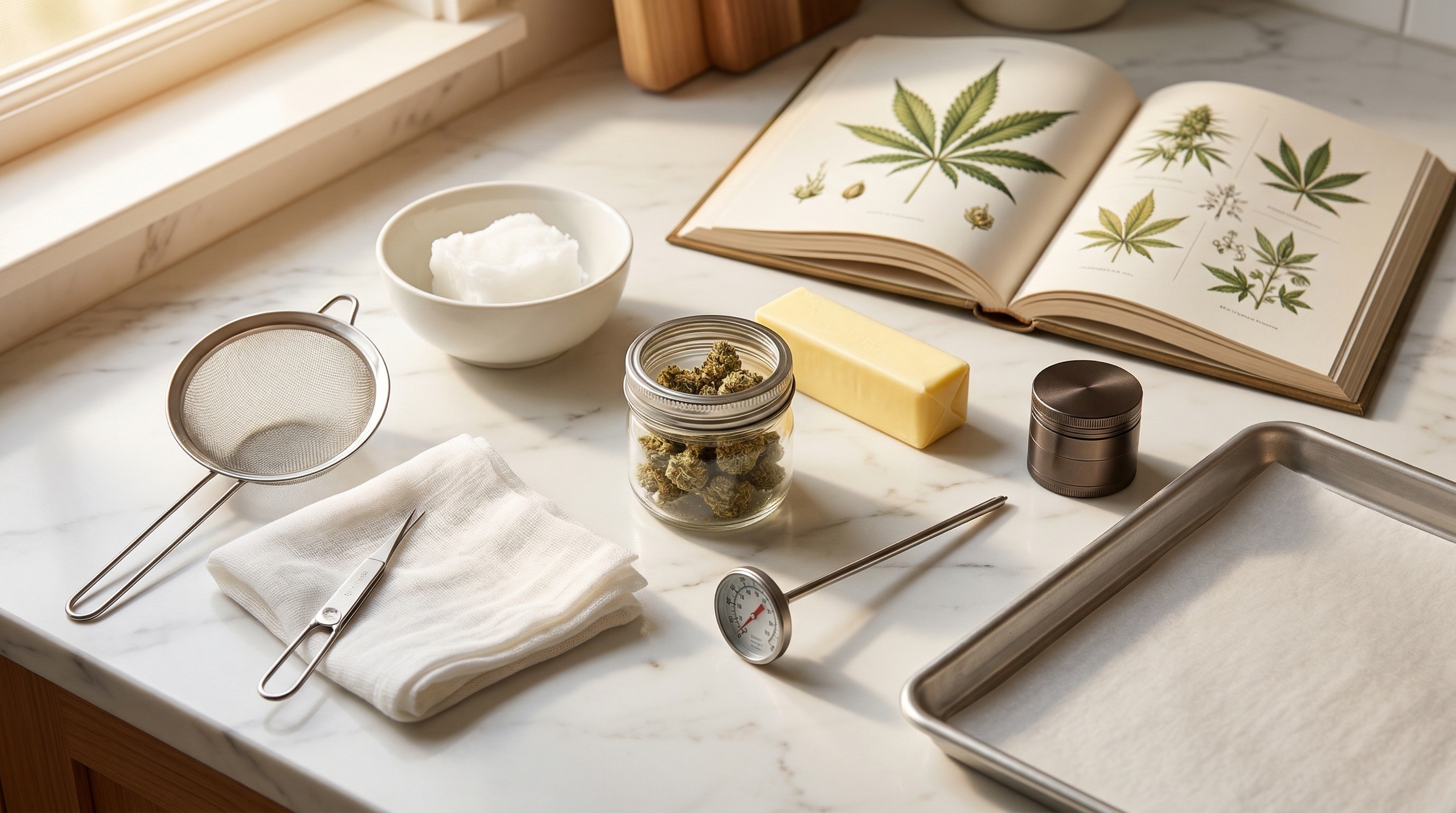
- Cannabis flower — 7 grams (¼ oz) of a strain you enjoy (see notes on strain selection below)
- Unsalted butter or coconut oil — 1 cup (THC is fat-soluble, so you need a fat base)
- Baking sheet lined with parchment paper
- Oven with reliable temperature control
- Medium saucepan or double boiler
- Fine mesh strainer or cheesecloth
- Glass jar with lid (mason jars work perfectly)
- Kitchen thermometer (candy or instant-read)
- Grinder (herb grinder or even scissors)
Optional
- Slow cooker or Instant Pot — for a more hands-off infusion process
- Purpose-built decarboxylation device (like the Ardent FX) — for precision and odor control
- Lecithin (sunflower or soy) — may help with emulsification and bioavailability
- Oven thermometer — most ovens run 10–25°F off from their displayed temperature
Safety Equipment
- Oven mitts — you’ll be handling hot trays and pots
- Well-ventilated kitchen — decarboxylation is aromatic (your neighbors will know)
- Labels and markers — clearly label ALL infused products to prevent accidental consumption
- Childproof storage containers — absolutely essential if children or pets are in the home
A Quick Note on Strain Selection and High Families
Before you fire up the oven, let’s talk about what you’re cooking with. The strain you choose will influence not just potency but also the flavor and character of your edible experience.
At This Is Why I’m High, we classify cannabis experiences using High Families — a terpene-based system that’s far more useful than the outdated indica/sativa divide.
For cooking, here are some things to consider:
- For a social dinner party vibe, look for strains in the Uplifting High family. Their limonene and linalool profiles tend to pair beautifully with citrus-forward dishes and can contribute bright, pleasant flavors.
- For a relaxing evening meal, strains from the Relaxing High family — rich in myrcene — may deliver the mellow, wind-down experience you’re after.
- For a balanced, gentle introduction, the Balancing High family offers lower-intensity options that are particularly forgiving for first-time edible makers.
Remember: terpenes do partially survive the cooking process, especially at lower temperatures, so your strain choice can genuinely influence the flavor profile of your final dish [Russo, 2011].
Step-by-Step Instructions
Step 1: Decarboxylate Your Cannabis (40–50 minutes)
This is the most important step in cannabis cooking, and it’s the one most beginners skip — to their disappointment. Raw cannabis contains THCA and CBDA, which are the acidic precursors to THC and CBD. These compounds aren’t psychoactive on their own. You need heat to convert them through a process called decarboxylation (or “decarb” for short).
Here’s how:
- Preheat your oven to 240°F (115°C). This is the sweet spot — hot enough to activate cannabinoids, cool enough to avoid destroying them. If you have an oven thermometer, use it. Many ovens fluctuate significantly.
- Break up your cannabis into roughly pea-sized pieces using a grinder or your fingers. Don’t grind it to powder — you want airflow, and a fine grind makes straining harder later.
- Spread the cannabis evenly on a parchment-lined baking sheet in a single layer.
- Bake for 40 minutes, gently shaking the tray at the 20-minute mark to ensure even heating.
- Check the color. Properly decarbed cannabis should look toasted — shifting from bright green to a golden-brown or dark olive green. It should feel dry and crumbly to the touch.
Tip: If you’re concerned about smell (and you should be — it gets fragrant), you can seal your cannabis in a mason jar before placing it in the oven. The jar method contains odor significantly, though it adds about 10 minutes to the process. Just be sure to let the jar cool before opening to avoid a terpene-scented steam blast.
Common error to avoid: Don’t crank the heat to speed things up. Temperatures above 300°F (150°C) rapidly degrade THC into CBN, which may make you sleepy but won’t deliver the experience you’re after [Wang et al., 2016].
Step 2: Infuse Your Fat (2–3 hours)
Now that your cannabis is activated, it’s time to bind those cannabinoids to fat. THC and CBD are lipophilic — they dissolve in fats and oils, not water. This is why cannabutter and infused coconut oil are the foundation of virtually every cannabis recipe.
Stovetop method (recommended for beginners):
- Add 1 cup of butter or coconut oil and 1 cup of water to a medium saucepan. The water helps regulate temperature and prevents the butter from scorching — it’ll separate out later.
- Melt on low heat until the butter is fully liquid.
- Add your decarboxylated cannabis and stir gently.
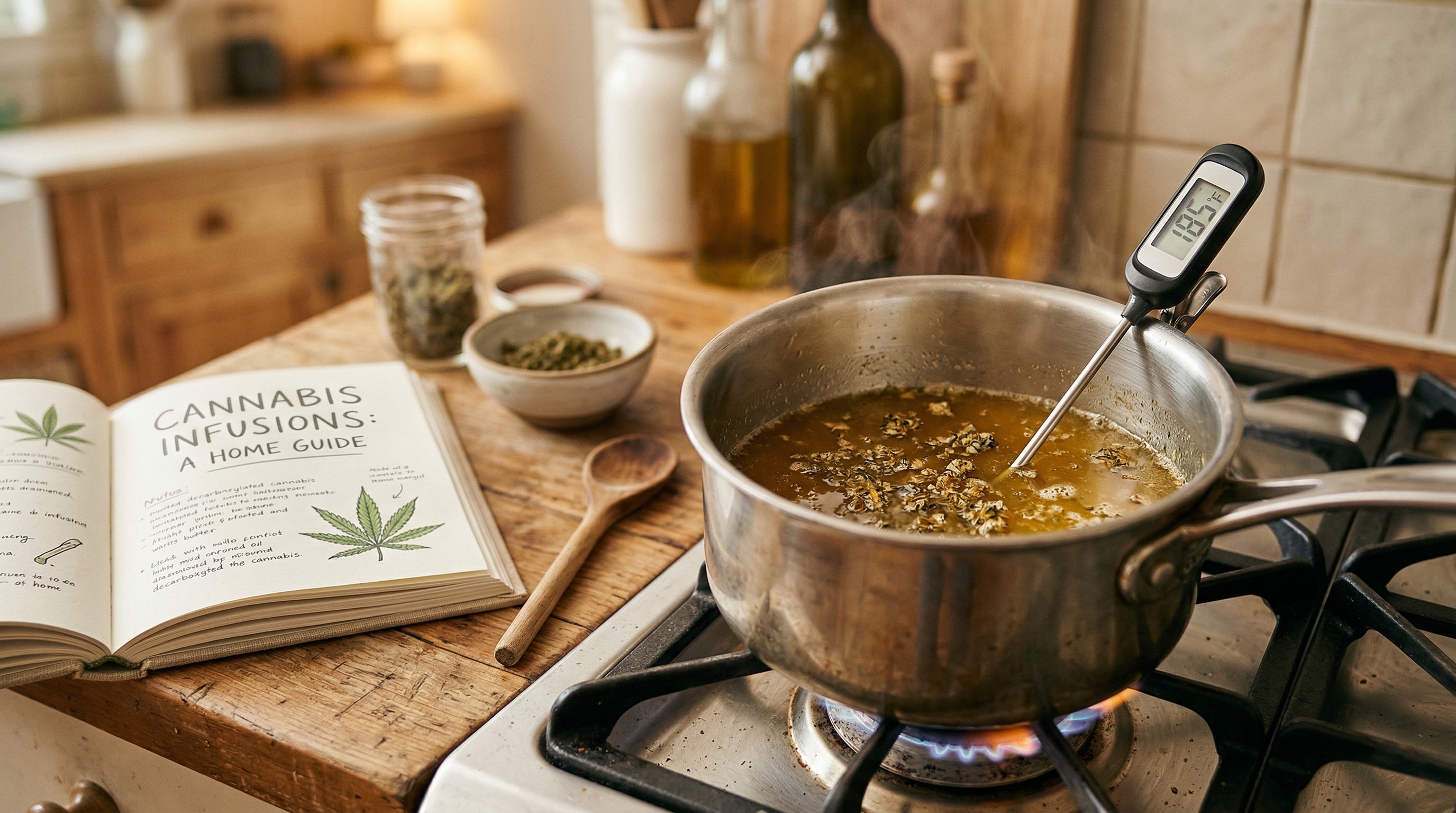
- Maintain a low simmer — the mixture should barely bubble. You’re targeting 160–200°F (70–93°C). Use your kitchen thermometer to check periodically. Never let it boil.
- Simmer for 2–3 hours, stirring occasionally. Longer infusion at low temperatures extracts more cannabinoids without degrading them.
Tip: A double boiler setup (a heat-safe bowl over a pot of simmering water) gives you even more temperature control and virtually eliminates the risk of scorching.
Slow cooker alternative: Combine all ingredients in a slow cooker on the “low” setting for 4–6 hours. This is the most hands-off method and maintains remarkably consistent temperatures.
Step 3: Strain and Store Your Infusion (15–20 minutes)
- Set a fine mesh strainer or cheesecloth over your glass jar or a heat-safe bowl.
- Carefully pour the hot mixture through the strainer. If using cheesecloth, you can gently squeeze to extract more liquid — but don’t press too hard, as this can push through plant material and add a bitter, grassy flavor.
- Discard the plant material. It’s done its job.
- If you used butter with water, place the jar in the refrigerator for several hours or overnight. The butter will solidify on top, and you can simply pour off the water underneath. This also removes some of the stronger plant flavors.
- Label your infusion clearly: “CANNABIS-INFUSED BUTTER — [date] — approx. [X] mg THC per tablespoon” (see dosing section below).
- Store in the refrigerator for up to 2 weeks, or in the freezer for up to 6 months.
Tip: Save your leftover plant material if you want — some cooks add it to smoothies or compost it. There’s minimal cannabinoid content left, but some people enjoy reducing waste.
Step 4: Calculate Your Approximate Dose
This is where many home cooks get nervous, and honestly, that’s a healthy instinct. Dosing is the most critical skill in cannabis cooking. Here’s a simplified calculation:
The math:
- Start with your flower’s THC percentage. For this example, let’s say you used 7 grams of flower testing at 20% THC.
- Total THC in milligrams: 7,000 mg (weight of flower) × 0.20 (THC percentage) = 1,400 mg THC (theoretical maximum)
- Account for extraction efficiency. Home infusions typically extract 40–70% of available cannabinoids. Using a conservative 50%: 1,400 × 0.50 = 700 mg THC in your entire batch.
- Divide by servings. If your cup of cannabutter yields about 16 tablespoons: 700 ÷ 16 = approximately 44 mg THC per tablespoon.
For beginners, a standard starting dose is 2.5–5 mg THC. That means you’d use roughly ½ teaspoon of this example cannabutter per serving. Yes, that’s a small amount. That’s the point. You can always eat more next time — you can’t un-eat an edible.
Important caveats:
- Home infusions are inherently less precise than lab-tested commercial products
- THC distribution may not be perfectly even throughout your butter
- If you don’t know your flower’s THC percentage, assume 15–20% and dose conservatively
- Individual tolerance varies enormously — body weight, metabolism, experience level, and even what you’ve eaten that day all play a role
Step 5: Cook Something Delicious (Time varies)
Now for the fun part. Your cannabutter or infused oil can substitute for regular butter or oil in virtually any recipe. But there are a few golden rules:
- Don’t cook your infusion at high heat. THC begins degrading above 320°F (160°C). This means deep frying and high-heat sautéing are out. Baking at 325–350°F is generally fine because the internal temperature of your food stays well below oven temperature.
- Mix thoroughly. Uneven distribution means one brownie hits like a freight train while the next does nothing. Stir your batter or dough extensively to distribute the infusion evenly.
- Start simple. For your first time, choose a recipe where butter or oil is already a key ingredient — brownies, cookies, pasta sauce, salad dressings, or compound butter for toast.
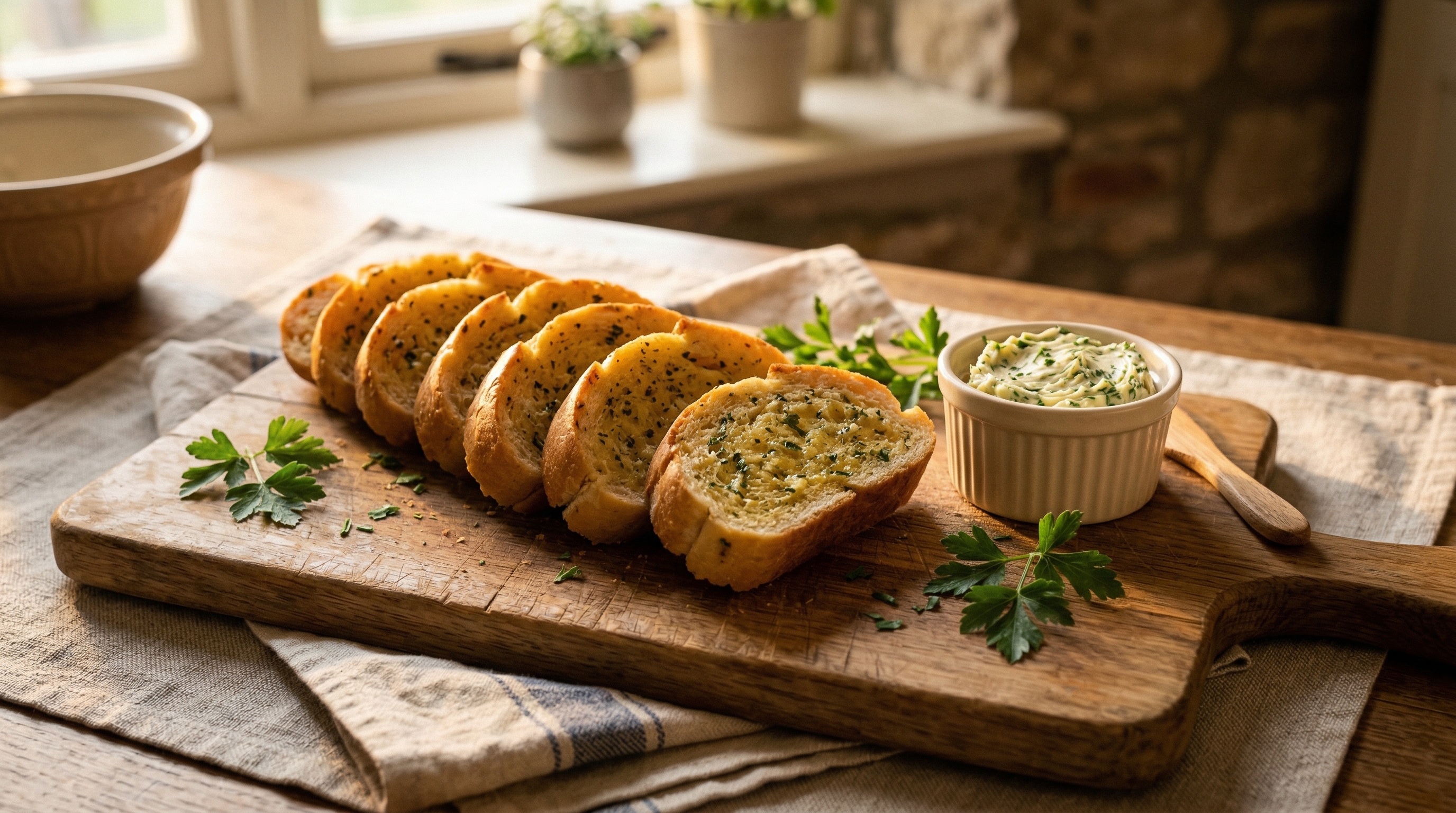
Beginner-friendly first recipe idea: Infused Garlic Bread
- Mix 2 tablespoons of your cannabutter with 2 tablespoons of regular butter, 2 minced garlic cloves, a pinch of salt, and fresh parsley.
- Spread on sliced French bread.
- Bake at 350°F for 10–12 minutes.
- This gives you roughly 4 servings at approximately 22 mg each (using our example butter) — which you can further adjust by using less cannabutter and more regular butter.
Tip: A great strategy for beginners is to make a “half-and-half” blend — mix your cannabutter 1:1 with regular butter. This effectively halves the potency per tablespoon, giving you more room for error in dosing.
Pro Tips
Taste management: Let’s be honest — cannabis butter has a distinctly herbal, sometimes bitter flavor. This isn’t necessarily bad, but it’s noticeable. Recipes with strong flavors (chocolate, garlic, spices, citrus, peanut butter) mask it best. Delicate dishes like sugar cookies or vanilla frosting will taste noticeably “green.”
Water curing your butter: If the flavor bothers you, try “water curing” your finished cannabutter. Place the solidified butter in a bowl of cold water, gently knead it for a minute, drain, and repeat 3–4 times. This pulls out water-soluble chlorophyll and plant compounds that contribute to the grassy taste without affecting the fat-soluble cannabinoids.
Coconut oil vs. butter: Coconut oil has a higher saturated fat content than butter, which may mean slightly better cannabinoid absorption. It’s also vegan, has a longer shelf life, and works beautifully in both sweet and savory applications. If you’re choosing between the two for your first infusion, coconut oil is arguably more versatile.
Lecithin as an emulsifier: Adding a teaspoon of sunflower lecithin to your infusion may help distribute cannabinoids more evenly and some users report it enhances bioavailability. While the research on this specific application is limited, it’s a common practice among experienced cannabis cooks.
Keep a cooking journal: Record your strain, amount used, infusion time, estimated potency, and — most importantly — how the final product affected you. This data is invaluable for dialing in your perfect dose over time.
Troubleshooting
| Problem | Likely Cause | Solution |
|---|---|---|
| Edibles had no effect | Skipped decarboxylation, or oven temperature was too low | Verify oven temp with a thermometer; ensure full 40-minute decarb at 240°F |
| Effects were |


