Cannabis for Arthritis and Joint Pain: CBD, THC, and Beyond
How CBD, THC, terpenes, and delivery method affect arthritis and joint pain relief. Science-backed deep dive into cannabinoids and inflammation.


More Than 50 Million People Are Looking for Relief
Here’s a number that might surprise you: over 54 million adults in the United States have been diagnosed with some form of arthritis, making it the leading cause of disability in the country [CDC, 2023]. And if you’re one of them—or you love someone who is—you already know that the standard toolkit of NSAIDs, corticosteroids, and biologics doesn’t always cut it. Side effects pile up. Relief fades. And the search for something better never really stops.
That search has led millions of people to cannabis. A 2022 survey found that roughly 20% of arthritis patients reported using cannabis or CBD products for symptom management [Boehnke et al., 2022]. They’re not just chasing a trend—they’re responding to a growing body of preclinical and clinical evidence suggesting that cannabinoids interact with the very biological systems that drive inflammation and pain perception.
But here’s where it gets complicated. The cannabis plant produces over 100 cannabinoids, dozens of terpenes, and a constellation of other compounds, each with potentially different effects on joint health. CBD oil from a dispensary shelf is not the same as a full-spectrum tincture, which is not the same as a THC-dominant topical. And the research, while genuinely exciting, is still catching up to the hype.
In this article, we’re going to walk through the science—carefully, honestly, and without making promises that the evidence can’t support. You’ll learn how cannabinoids interact with your body’s inflammation pathways, what the clinical research actually shows (and where the gaps are), which terpenes may add therapeutic value, and how to think about cannabis for joint pain in practical, real-world terms.
Let’s dig in.
The Science Explained
How Cannabis Interacts With Inflammation and Pain
To understand why cannabis might help with arthritis, you first need to meet your endocannabinoid system (ECS)—a vast network of receptors, enzymes, and signaling molecules that your body produces all on its own, no cannabis required.
Think of the ECS as your body’s internal balance manager. It helps regulate inflammation, pain signaling, immune response, mood, and more. The two primary receptors are:
- CB1 receptors, concentrated in the brain and central nervous system, heavily involved in pain perception and the experience of pain intensity
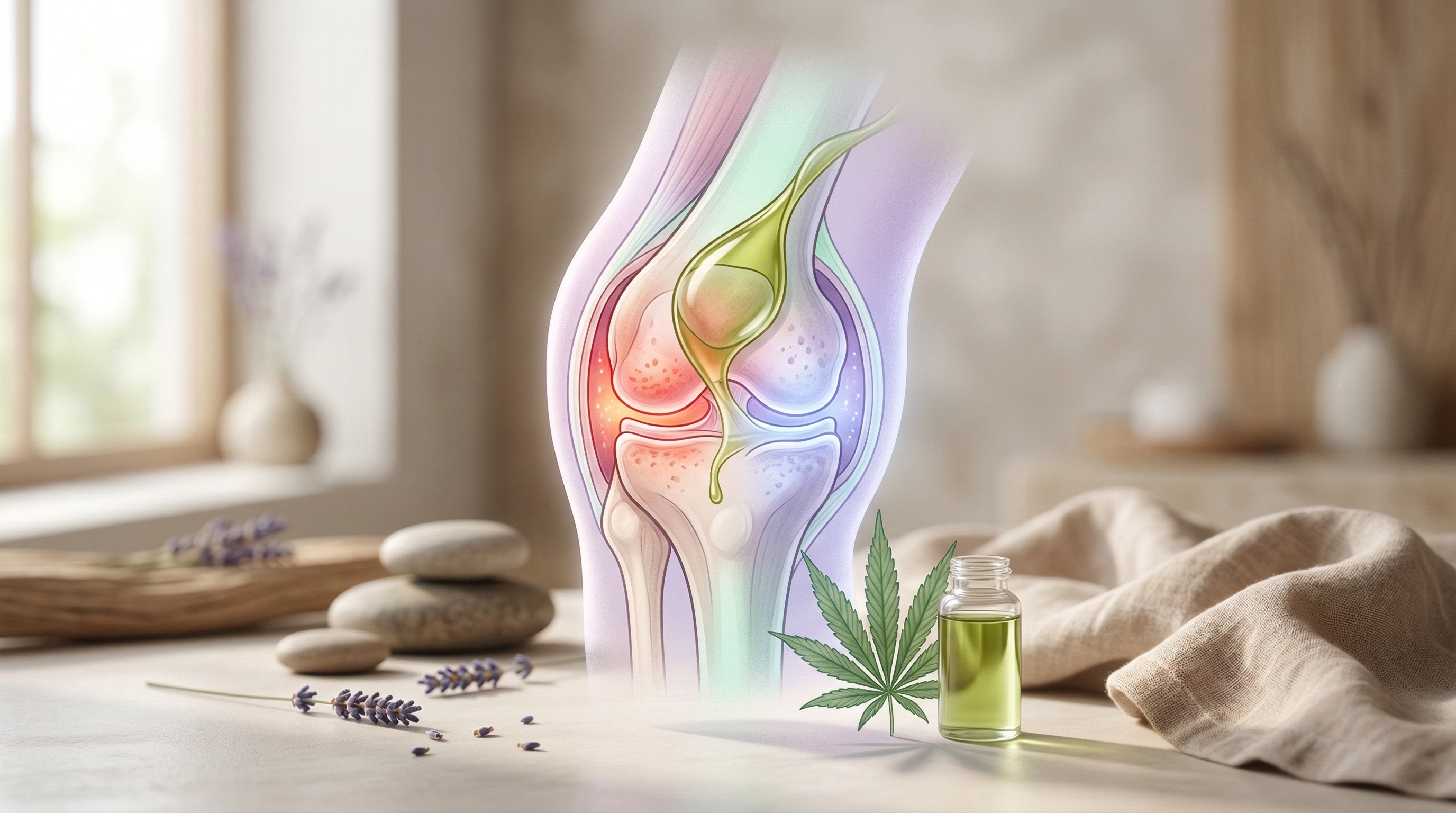
- CB2 receptors, found primarily on immune cells and in peripheral tissues—including the synovial tissue that lines your joints [Richardson et al., 2008]
That last point is critical. Research published in Arthritis Research & Therapy confirmed the presence of CB1 and CB2 receptors in the synovial fluid and tissue of both osteoarthritis (OA) and rheumatoid arthritis (RA) patients—and importantly, CB2 expression was significantly elevated in inflamed joints compared to healthy ones [Richardson et al., 2008]. Your inflamed joints are, in a very real sense, primed for cannabinoid interaction.
Your body naturally produces molecules called endocannabinoids (like anandamide and 2-AG) that bind to these receptors, dialing inflammation and pain up or down as needed. When you consume cannabis, plant-derived cannabinoids—phytocannabinoids like THC and CBD—interact with this same system, but in their own distinct ways.
THC (tetrahydrocannabinol) binds directly to CB1 and CB2 receptors. At CB1, it modulates pain signals in the brain and spinal cord. At CB2, it may help reduce the inflammatory immune response that drives joint damage in conditions like rheumatoid arthritis [Lowin et al., 2020]. A 2008 study found that cannabinoid-mediated antinociception (pain blocking) was significantly enhanced in rat osteoarthritic knees compared to healthy knees—suggesting the inflamed joint environment actually amplifies cannabinoid effectiveness [Schuelert & McDougall, 2008].
CBD (cannabidiol) takes a more indirect approach. Rather than binding tightly to CB1 or CB2, it influences the ECS by inhibiting the enzyme FAAH that breaks down anandamide, effectively boosting your body’s own anti-inflammatory signaling [Hammell et al., 2016]. CBD also interacts with non-ECS targets like TRPV1 receptors (pain perception), PPARγ receptors (inflammation regulation), and 5-HT1A receptors (mood and pain), giving it multiple potential pathways of action. A 2024 systematic review in Pharmaceuticals confirmed CBD’s analgesic and anti-inflammatory properties operate through TRPV1 and 5-HT1A as primary mechanisms, with particular relevance for OA and chronic pain [Cásedas et al., 2024].
What the Research Shows: CBD
Let’s start with CBD, since it’s the cannabinoid most widely available and most heavily marketed for pain and inflammation.
The preclinical evidence is genuinely compelling. A landmark 2016 study by Hammell et al. applied transdermal CBD gel to rats with experimentally induced arthritis. The results showed significant reductions in joint swelling, pain-related behaviors, and pro-inflammatory biomarkers—without any apparent systemic side effects [Hammell et al., 2016]. Critically, the researchers observed a dose-dependent response up to a plateau, and the effects reversed during washout, confirming the CBD was driving the improvement.
Another preclinical study found that CBD reduced the production of TNF-α and IL-6—two key inflammatory cytokines elevated in both RA and OA—in human synovial cell cultures [Lowin et al., 2020]. These are the same molecules targeted by expensive biologic drugs like adalimumab (Humira). CBD also demonstrated direct effects on osteoclast activity in one in vitro model, suggesting potential for slowing joint destruction, not just masking pain.
But human clinical trials remain limited and mixed. Here’s an honest accounting of what the evidence shows:
-
A 2022 randomized controlled trial in Pain tested pharmaceutical-grade oral CBD in patients with hand osteoarthritis and psoriatic arthritis. CBD did not outperform placebo for pain reduction [Vela et al., 2022]. The authors attributed this partly to the very low dose used (20–30 mg/day) and the known bioavailability limitations of oral CBD.
-
A 2024 open-label feasibility trial published in Scientific Reports (University of Sydney / Lambert Initiative) applied a 4% transdermal CBD gel to participants with symptomatic hand OA, three times daily for four weeks. Pain, grip strength, and quality-of-life measures all improved significantly over time—and improvements reversed during washout, confirming the relationship [Bawa et al., 2024]. The authors called for a full randomized controlled trial.
-
A Phase 1B randomized controlled trial presented at ACR Convergence 2024 (UCLA Center for Cannabis and Cannabinoids) tested oral CBD at 200 mg and 400 mg twice daily in RA patients with moderate-to-severe disease. Neither dose significantly reduced objective disease activity scores (DAS28), though the 200 mg group showed a numerically higher pain reduction than placebo. High-dose CBD (400 mg twice daily) showed tolerability concerns [Ranganath et al., 2024].
-
A 2025 double-blind, randomized, placebo-controlled trial (the CANOA trial) tested CBD-rich full-spectrum cannabis oil (45 mg CBD daily) in knee OA patients for 60 days. The primary pain outcome (WOMAC scale) did not differ significantly from placebo [Haider et al., 2025].
-
A 2022 randomized controlled trial of topical CBD (10 mg) applied twice daily for six weeks to patients with thumb basal joint arthritis showed statistically significant improvements in pain and disability compared to placebo [Heineman et al., 2022].
Key nuance: The pattern here isn’t “CBD doesn’t work.” It’s “oral CBD at low doses doesn’t appear to work, but topical CBD and higher-dose transdermal formats show more consistent promise.” Delivery method and dose appear to be decisive variables that many trials have not yet optimized.
What the Research Shows: THC
THC has a longer history in pain research, though studying it remains complicated by legal restrictions. Several lines of evidence suggest meaningful benefits for arthritis pain.
A 2006 randomized controlled trial tested Sativex (a 1:1 THC:CBD oromucosal spray, approved in several countries) in patients with rheumatoid arthritis. Over five weeks, patients receiving Sativex showed statistically significant improvements in pain during movement, pain at rest, and sleep quality—with no progression of joint disease [Blake et al., 2006]. This remains the most rigorously designed clinical trial in the cannabis-RA space.
Mechanistically, THC’s action at CB2 receptors on immune cells is particularly relevant for RA, which is fundamentally an autoimmune condition. Preclinical work has shown that THC can suppress the proliferation of T-cells, reduce pro-inflammatory cytokine production, and inhibit the synovial fibroblast activity that drives joint erosion in RA [Lowin et al., 2020]. An oral THC delivery study presented at EULAR 2023 found symptom and disease modification in two knee OA animal models—a result that, if replicated in humans, would be significant.
A 2024 scoping review in Clinical Rheumatology examined 10 studies on cannabis-based medicines in OA. It found that 60% reported statistically significant pain improvements, and several noted potential reductions in opioid use—a clinically important benefit given the opioid epidemic’s overlap with chronic pain populations [Xiao et al., 2024].
THC’s psychoactive effects are a practical consideration. For some patients, the mood elevation and distraction from pain are welcome benefits—especially during flares. For others, particularly older adults or those with anxiety, intoxication is a genuine barrier. This is why ratio products combining THC and CBD in proportions like 1:1, 1:3, or 1:20 have become central to medical cannabis programs worldwide.
Beyond CBD and THC: The Terpene Connection
Here’s where things get especially interesting for anyone serious about using cannabis for arthritis.
Cannabis produces dozens of terpenes—aromatic compounds responsible for the plant’s distinctive smell and, increasingly, recognized as active contributors to its therapeutic profile. Several terpenes have demonstrated independent anti-inflammatory and analgesic properties that are directly relevant to joint health:
Beta-caryophyllene is the standout. It is the only terpene known to directly activate CB2 receptors—the same immune-system receptors that THC targets and that are upregulated in inflamed joints [Gertsch et al., 2008]. Multiple animal studies show BCP reduces inflammatory markers (IL-1β, TNF-α, IL-6) and pain behavior. A 2023 study found that hemp seed oil combined with beta-caryophyllene and myrcene produced nutraceutical anti-inflammatory benefits in joint conditions [Farì et al., 2023]. It’s found in high concentrations in black pepper, cloves, and many cannabis cultivars, and—crucially—it’s classed as a dietary supplement in the US because it’s already consumed regularly via food.
Humulene is structurally related to caryophyllene and similarly present in many cannabis cultivars. Animal studies have shown its anti-inflammatory effects to be comparable to dexamethasone (a corticosteroid) at certain doses [Fernandes et al., 2007]. It’s also found in hops and ginger.
Myrcene is the most abundant terpene in most cannabis cultivars. It has demonstrated analgesic and muscle-relaxant properties in preclinical studies, likely mediated by opioid receptor pathways [Rao et al., 1990]. It may also enhance the transdermal absorption of cannabinoids, potentially improving topical product efficacy.
Linalool, with its calming lavender-adjacent aroma, has shown anti-inflammatory and analgesic effects in multiple animal models, including mechanisms that appear distinct from classical cannabinoid pathways [Peana et al., 2003].
This is the biological basis of the entourage effect—the hypothesis that cannabis compounds work more effectively together than in isolation. A CBD isolate may behave very differently from a full-spectrum extract rich in caryophyllene, humulene, and myrcene. The debate continues in the literature, but the weight of evidence supports whole-plant preparations offering advantages over isolated cannabinoids for complex inflammatory conditions [Russo, 2011].
In our High Families system, strains in the Relief High Family tend to be rich in caryophyllene and humulene—the terpenes with the strongest direct anti-inflammatory evidence. Thinking through High Families when selecting a cultivar for joint discomfort gives you a more biologically grounded framework than the outdated indica/sativa distinction, which carries no consistent terpene or cannabinoid profile guarantee.

Practical Implications
Delivery Methods and What the Evidence Supports
One of the most important practical considerations for arthritis is how you consume cannabis, not just what you consume. The clinical evidence is clearest for formats that maximize local concentration at the joint or that achieve adequate systemic bioavailability.
Topicals and transdermals are the most evidence-supported starting point for localized joint pain (a sore knee, aching hands, finger joints). The Hammell et al. animal study, the 2024 Sydney hand OA trial, and the Heineman et al. thumb arthritis RCT all used topical or transdermal formats—and all showed the most positive results in the literature. Topicals deliver cannabinoids to the local tissue without significant psychoactive effects. Look for products with meaningful concentrations of CBD (not just a few milligrams), and ideally caryophyllene-rich terpene profiles. For deeper tissue penetration, transdermal patches or gels designed to cross the skin barrier offer greater bioavailability than surface-level creams. You can read more about how these products work in our cannabis topicals guide.
Sublingual tinctures placed under the tongue bypass first-pass liver metabolism and offer substantially better bioavailability than swallowed capsules or edibles. Onset is typically 15–45 minutes. Ratio products (e.g., 1:1 or 3:1 CBD:THC) allow calibration of effect—CBD for daytime inflammation management, adding moderate THC for evening pain and sleep support. The Sativex oromucosal spray used in the 2006 Blake RA trial is essentially this format.
Edibles and capsules face significant bioavailability challenges for CBD specifically, which is highly lipophilic and poorly absorbed without adequate fat co-administration. However, oral THC has better bioavailability relative to oral CBD and may be appropriate for systemic inflammatory conditions like RA or psoriatic arthritis. Effects last 4–8 hours, valuable for sustained overnight relief.
Inhalation (vaping specifically, not smoking) provides the fastest onset (minutes) for breakthrough pain episodes. Effects are shorter-lived (2–3 hours) and the delivery is less precise, but vaporized cannabis avoids the combustion byproducts associated with smoking while maintaining rapid uptake. Not recommended as a primary long-term modality for lung health considerations—see our vaping vs. smoking comparison for the full picture.
A Mindful Approach to Dosing
The consensus recommendation from researchers studying cannabinoids in chronic pain is start low and go slow—with systematic dose titration over weeks, not days [Bhaskar et al., 2021]. This is especially important for arthritis patients who are older, taking multiple medications, or new to cannabis.
A practical starting framework:
- Topical CBD: Apply a pea-sized amount to the affected joint 2–3 times daily for at least two weeks before assessing effect. Because topicals don’t produce systemic effects, there is more flexibility in dose.
- Oral or sublingual CBD: Start at 10–25 mg daily. Increase by 10 mg every 3–5 days until you notice benefit or side effects. Most arthritis-relevant trials used daily doses of 150 mg or higher for systemic effects—far above most retail product servings.
- Introducing THC: If you are in a legal jurisdiction and considering THC, start at 1–2.5 mg and increase gradually. The goal for pain management is typically the minimum dose that provides relief without meaningful intoxication.
- Track your experience: Keep a simple log of dose, delivery method, time of day, and symptom response. Arthritis symptoms fluctuate; without tracking, it’s almost impossible to distinguish cannabis effects from natural variation.
- Consult your provider: CBD inhibits certain CYP450 liver enzymes that metabolize common medications, including some NSAIDs, blood thinners (warfarin), and immunosuppressants [Nasrin et al., 2021]. Anyone on these medications should discuss cannabinoid use with their prescribing physician before starting.
Important: Cannabis is not a replacement for your current arthritis treatment plan. It may function as a complementary tool, but decisions about medication changes should always involve your rheumatologist or primary care provider.
Connecting to High Families
When selecting cannabis products specifically for joint discomfort, the Relief High Family is the most directly relevant starting point—these cultivars are characterized by elevated caryophyllene and humulene, the terpenes with the strongest direct CB2-mediated anti-inflammatory evidence.
| Goal | High Family | Key Compounds |
|---|---|---|
| Daytime inflammation support | Relief | Caryophyllene, Humulene, CBD |
| Nighttime pain and sleep | Relaxation | Myrcene, CBD, moderate THC |
| Mood support with gentle relief | Euphoria | Limonene, Linalool, balanced THC:CBD |
| Full-spectrum entourage approach | Multi-terpene whole-plant extract | Caryophyllene + Myrcene + Humulene |

What the Research Gap Means for You
It’s worth being honest about the state of arthritis cannabis research: the evidence base is promising but genuinely incomplete. Most positive human trials are small and short-term. Many studies use doses or delivery methods now understood to be suboptimal. The 2024 scoping review in Clinical Rheumatology noted that “studies with larger sample sizes and longer durations of treatment tended to find greater benefit”—which suggests the existing evidence may actually be underestimating the effect [Xiao et al., 2024].
What this means practically:
- Don’t dismiss it because a trial was negative. An oral CBD trial at 20 mg/day failing says something about that dose and format—not about cannabis and arthritis broadly.
- Don’t overclaim it because an animal study was positive. Rodent arthritis models have repeatedly failed to translate to human benefit for many compounds.
- The most actionable evidence points toward topical/transdermal CBD for localized OA joint pain, and THC-containing oromucosal or sublingual formats for systemic inflammatory arthritis like RA.
- Terpene-rich, whole-plant products may offer advantages over isolates—though this remains difficult to study rigorously.
The ongoing research is substantive: multiple large-scale trials are actively enrolling as of 2024–2025, including full randomized controlled trials following up on the Sydney hand OA pilot and ongoing work through the UCLA Center for Cannabis and Cannabinoids. The evidence landscape will look meaningfully different in 3–5 years.
Key Takeaways
- CB2 receptors are concentrated in inflamed joint tissue, and their expression increases with inflammation severity—making arthritic joints biologically primed for cannabinoid therapy.
- Preclinical evidence for CBD and THC is consistently positive, but human clinical trials remain limited and mixed. Delivery method, dose, and bioavailability are the critical variables separating successful trials from unsuccessful ones.
- Topical and transdermal CBD shows the most consistent clinical benefit for localized OA joint pain; oral CBD at low doses has largely failed to outperform placebo.
- THC-containing formats (especially oromucosal/sublingual) showed significant benefits for RA pain, sleep, and function in the most rigorously designed human trial to date.
- Beta-caryophyllene activates CB2 directly and may be the most arthritis-relevant terpene in cannabis—look for it in the Relief High Family.
- Start low, go slow, track your results, and consult your healthcare provider—especially if you take medications metabolized by CYP450 enzymes.
FAQs
Is CBD oil proven to help with arthritis?
Not definitively—yet. Animal studies show strong anti-inflammatory and pain-reducing effects. Human clinical trials are more mixed, but the pattern points toward delivery method as the critical factor: oral CBD at low doses has largely not outperformed placebo, while topical and transdermal CBD has shown meaningful benefit for localized OA pain in multiple trials. More large-scale human studies are underway.
Can I use cannabis alongside my arthritis medication?
Possibly, but always consult your doctor first. CBD inhibits certain CYP450 liver enzymes (specifically CYP2C9 and CYP3A4) that metabolize common medications including warfarin, some NSAIDs, and immunosuppressants used in RA [Nasrin et al., 2021]. Your healthcare provider can assess specific interaction risks based on your medication list.
What’s better for arthritis: CBD alone or CBD with THC?
The limited clinical evidence favors combinations. The most rigorously designed human trial (Blake et al., 2006) used a 1:1 THC:CBD spray and showed significant benefits across pain, sleep, and function. Mechanistically, THC’s direct CB2 activity complements CBD’s indirect ECS modulation and TRPV1 effects. That said, individual responses vary considerably, and many patients—particularly older adults—prefer to avoid psychoactive effects. Starting with CBD-dominant products or topicals and introducing THC incrementally is a reasonable approach.
Why do some CBD studies show no benefit?
Primarily because of dose and delivery method. Oral CBD has poor and variable bioavailability—as little as 6% in fasted individuals. Many trials used doses (20–30 mg/day) now recognized as too low for systemic anti-inflammatory effects. Studies using higher doses or topical/transdermal formats have tended to show more positive results. A 2024 commentary in PMC specifically called out dose optimization as the central unresolved question in OA cannabinoid research [Miles et al., 2024].
Are there cannabis strains specifically good for arthritis?
No strain is clinically proven for arthritis, but from a terpene-profile standpoint, cultivars high in beta-caryophyllene and humulene have the strongest mechanistic rationale—caryophyllene directly activates CB2 receptors, which are upregulated in arthritic tissue. In our High Families framework, the Relief family captures these terpene profiles. Adding myrcene for muscle relaxation and analgesic support (the Relaxation family) may complement daytime caryophyllene-forward choices at night.
Does cannabis help with rheumatoid arthritis specifically?
The 2006 Sativex trial (Blake et al.) is the strongest clinical evidence for RA specifically—it was randomized, placebo-controlled, and showed significant improvements in pain on movement, pain at rest, and sleep over five weeks. Mechanistically, THC’s CB2-mediated suppression of T-cell proliferation and pro-inflammatory cytokine production is particularly relevant to RA’s autoimmune pathology. CBD’s preclinical data on synovial fibroblast activity and TNF-α suppression is also promising. However, cannabis has not been shown to slow joint destruction in humans, and it should not replace disease-modifying antirheumatic drugs (DMARDs) in RA management.


