Cannabis for Couples: Navigating Different Tolerance Levels
Learn how couples can enjoy cannabis together even with mismatched tolerances. A step-by-step guide to dosing, strains, and shared experiences.


Goal & Overview
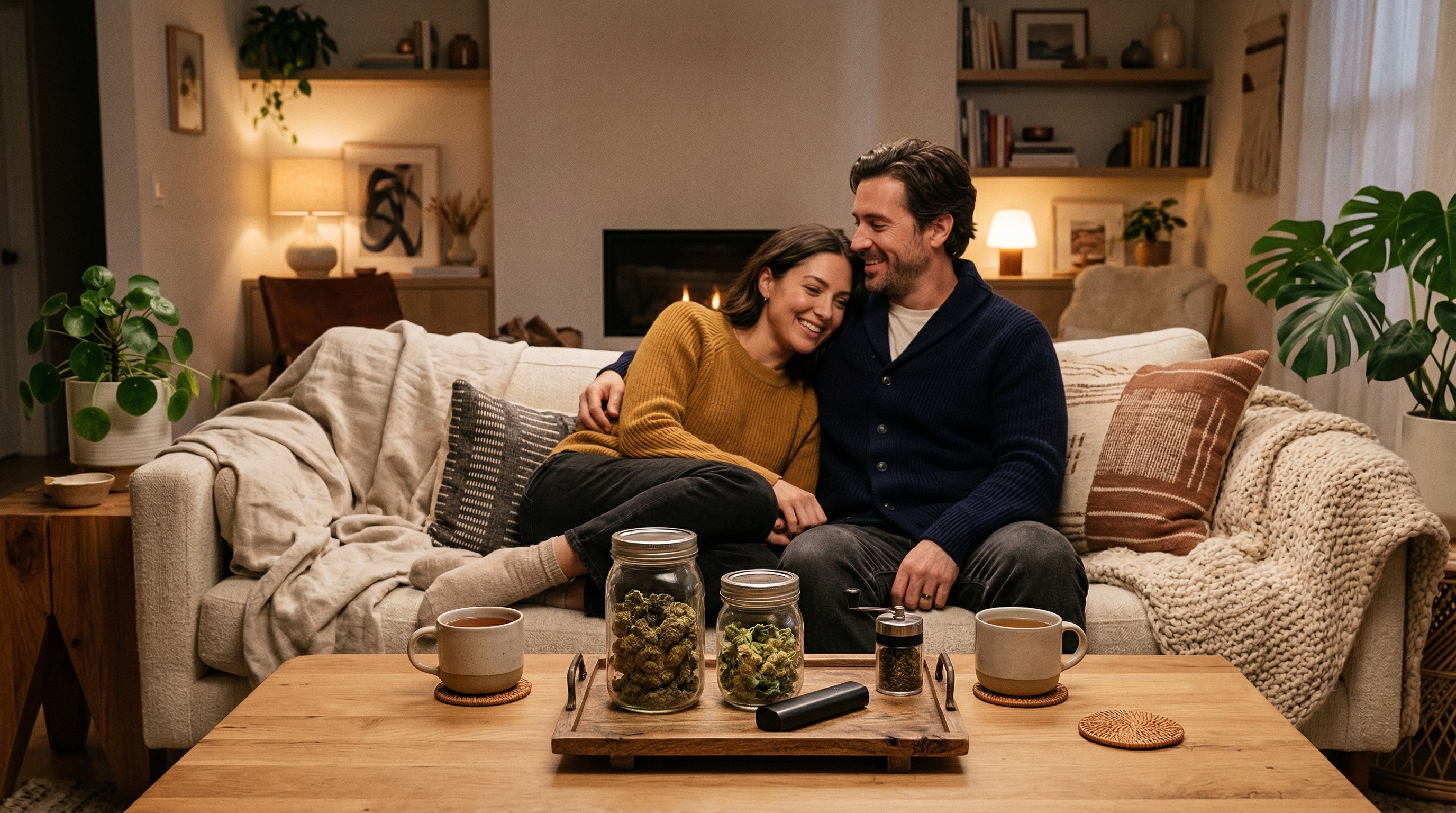
You and your partner both enjoy cannabis—but one of you floats off after a single puff while the other barely feels a whole joint. Sound familiar? Mismatched tolerance is one of the most common friction points for couples who consume together, and it can turn a cozy Friday night into an awkward balancing act.
This guide walks you through a practical, step-by-step approach to finding your shared sweet spot. You’ll learn how to assess each partner’s tolerance honestly, choose the right products and consumption methods, dose intentionally, and build rituals that feel good for both of you—not just the person with the higher tolerance calling the shots.
Difficulty level: Beginner-friendly Time needed: About 30 minutes for the initial conversation and planning, then ongoing fine-tuning over a few sessions
What You’ll Need
Required
- Two or more cannabis products at different potency levels (e.g., a lower-THC flower at 10–15% and a higher-THC option at 20%+, or a 2.5 mg edible alongside a 10 mg edible)
- A milligram scale or pre-dosed products for accurate dosing
- A journal or notes app to track each partner’s experience
- An honest, judgment-free conversation (the most important ingredient)
Optional
- A dry herb vaporizer with temperature control — allows micro-dosing and session sharing
- CBD flower or CBD tincture — useful for the lower-tolerance partner to moderate effects
- A curated playlist, snack spread, or activity — shared rituals make the experience about connection, not just consumption
Safety Considerations
- Water and comfortable seating readily available
- Neither partner should drive after consuming
- A safe word or signal that means “I’ve had enough” without needing to explain or justify
Step-by-Step Instructions
Step 1: Have the Tolerance Talk (10 minutes)
Before you touch any product, sit down together and talk honestly about where each of you stands. This isn’t about who can “handle more”—it’s about understanding your individual endocannabinoid systems, which genuinely differ from person to person [Zou & Kumar, 2018].
Ask each other:
- How often do you consume? (Daily, weekly, occasionally?)
- What’s your typical dose? (One hit, a full bowl, 5 mg edible, 25 mg edible?)
- What does “too much” feel like for you? (Anxiety, couch-lock, racing thoughts?)
- What’s your ideal experience? (Giggly and social? Calm and cuddly? Creative and talkative?)
Write down each person’s answers. This baseline is everything—you can’t navigate the gap if you don’t know how wide it is.
Tip: Frame this as a fun compatibility exercise, not an interrogation. You’re building a shared language around cannabis, which is genuinely intimate.
Step 2: Choose Your Products by High Family
This is where the High Families system becomes your best friend. Instead of arguing over “indica vs. sativa” (which tells you almost nothing about effects), choose products based on the experience you both want to share.
Here’s a quick decision framework:
| Shared Goal | Recommended High Family | Why It Works for Mismatched Couples |
|---|---|---|
| Movie night, cuddling | Relaxing High | Myrcene-forward strains ease both partners into calm without requiring high doses |
| Date night, conversation | Uplifting High | Limonene and linalool promote mood elevation at any dose |
| Creative projects together | Energetic High | Terpinolene offers focused energy without heavy sedation |
| First time consuming together | Balancing High | Low terpene profiles and gentle effects reduce the risk of overconsumption |
The key insight: choosing the right type of high matters more than choosing the right amount. When both partners are on the same wavelength experientially, small differences in intensity feel much less disruptive.
Step 3: Dose Separately, Experience Together (5 minutes)
Here’s the golden rule: you don’t have to consume the same amount to consume together.
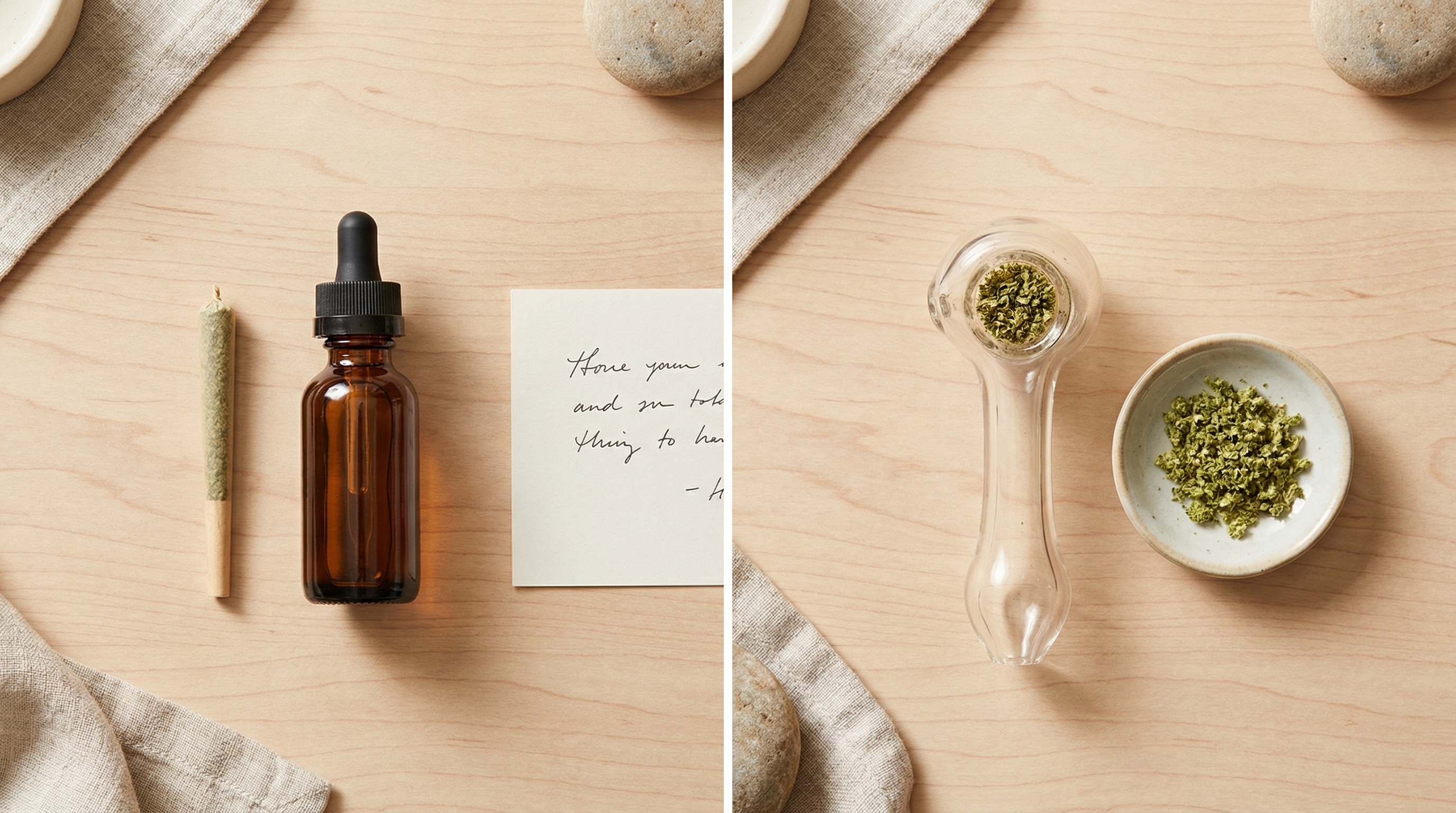
The lower-tolerance partner should dose first and at their own pace. The higher-tolerance partner doses to their own level. Specific strategies:
- For flower: The lower-tolerance partner takes one small hit and waits 10 minutes. The higher-tolerance partner can take their usual amount from a separate piece or a higher-potency strain.
- For edibles: Use different milligram products. Start the lower-tolerance partner at 2.5 mg and the higher-tolerance partner at their known comfortable dose. Take them at the same time so onset syncs up.
- For vaporizers: A temperature-controlled vaporizer is ideal. The lower-tolerance partner can take a draw at a lower temperature (around 340°F/170°C for lighter effects), while the higher-tolerance partner cranks it up (380°F/193°C+) for fuller extraction.
Tip: The lower-tolerance partner can also add CBD to their routine. A 1:1 THC:CBD ratio may help moderate the psychoactive intensity while still allowing both partners to share the moment [Russo, 2011].
Step 4: Check In at the 20-Minute Mark
Set a gentle timer. At the 20-minute mark (or after onset for edibles, which can take 45–90 minutes), check in with each other:
- “How are you feeling on a scale of 1–10?”
- “Do you want more, less, or are you in a good spot?”
- “Is this the vibe we were going for?”
This isn’t clinical—it’s caring. You’re co-creating an experience. The higher-tolerance partner should resist the urge to say “you should take more.” The lower-tolerance partner should feel zero pressure to keep up.
Step 5: Build Your Shared Ritual
The best couples’ cannabis experiences aren’t about the cannabis—they’re about what you do while elevated. Anchor your sessions to a shared activity:
- Cook a meal together
- Go for a sunset walk
- Play a board game or video game
- Listen to a full album start to finish
- Give each other massages
When the activity is the focus, tolerance differences fade into the background. You’re both present, connected, and enjoying the same moment—just at your own altitude.

Pro Tips
Rotate who chooses the strain. If one partner always picks the product, the other may feel like a passenger. Take turns selecting the High Family and specific strain for your sessions. This keeps things fresh and gives both partners agency.
Keep a shared cannabis journal. Track what you consumed, the dose, and how each of you felt. After 4–5 sessions, patterns emerge. You’ll start to see which terpene profiles and dosing ratios create the best shared experiences. This data is more valuable than any budtender recommendation.
Tolerance breaks are a team sport. If the gap between your tolerances is growing, consider a joint T-break (even a short 48-hour reset). Research suggests that CB1 receptor availability can begin recovering in as little as two days [D’Souza et al., 2016]. Doing it together builds solidarity and can actually reset the dynamic.
Don’t underestimate the power of CBD. The higher-tolerance partner might dismiss CBD, but adding a CBD-rich product to the mix can create a more Entourage High experience that both partners enjoy—fuller, more nuanced, and less about raw THC intensity.
Troubleshooting
| Problem | Likely Cause | Solution |
|---|---|---|
| Lower-tolerance partner feels anxious or overwhelmed | Dose too high, or strain too THC-forward | Have CBD tincture on hand for immediate moderation. Switch to a Balancing High strain next time. Black peppercorns (chewing 2–3) may also help [Russo, 2011]. |
| Higher-tolerance partner feels “nothing” from the shared product | Product potency too low for their tolerance | Let them supplement with their own higher-potency product while the lower-tolerance partner sticks to the shared one. |
| One partner feels pressured to consume more | Social dynamics, not cannabis | Revisit Step 1. Reaffirm that different doses are not just okay—they’re the whole point. |
| Edible onset times don’t sync up | Different metabolisms and digestion speeds | The faster-metabolizing partner can take their edible 15–20 minutes after the other. Experiment to find your sync window. |
| Sessions feel routine or boring | Lack of variety in products or activities | Rotate High Families, try a new consumption method, or plan a novel shared activity. |
Variations
- The Microdose Date: Both partners take 2.5 mg edibles regardless of tolerance. The goal isn’t to get high—it’s to share a subtle, equal shift in awareness. Great for daytime activities.
- The Solo-Then-Together Approach: Each partner consumes separately in their own way, then comes together for the shared activity once both are at their ideal level. Removes all dosing pressure.
- The Terpene Tasting: Get 3–4 strains from different High Families and take tiny amounts of each together, comparing notes like a wine tasting. Educational, fun, and naturally self-limiting on dose.
The bottom line: Mismatched tolerance isn’t a problem to solve—it’s a difference to respect. When you stop trying to match each other hit-for-hit and start designing experiences around connection, cannabis becomes something that brings you closer together rather than pulling you apart.
Key Takeaways
- Mismatched tolerance is normal — your endocannabinoid systems are biologically unique, and the gap isn’t a problem to fix.
- Dose separately, experience together — you don’t need to consume the same amount to share the same moment.
- Choose by High Family, not THC percentage — picking the right type of experience matters more than matching potency levels.
- CBD is a practical tool — the lower-tolerance partner can use CBD to moderate intensity without sitting out the session.
- Check in at the 20-minute mark — a simple “how are you feeling?” builds trust and keeps the experience collaborative.
- Build the ritual around an activity — when connection is the goal, tolerance differences become background noise.
- Keep a shared journal — 4–5 sessions of notes will reveal patterns that no budtender recommendation can match.
- T-breaks are better together — if the tolerance gap is growing, resetting as a team reinforces the partnership.
Sources
- Russo, E.B. (2011). “Taming THC: potential cannabis synergy and phytocannabinoid-terpenoid entourage effects.” British Journal of Pharmacology, 163(7), 1344–1364. PMID: 21749363
- Zou, S. & Kumar, U. (2018). “Cannabinoid Receptors and the Endocannabinoid System: Signaling and Function in the Central Nervous System.” International Journal of Molecular Sciences, 19(3), 833. PMID: 29533978
- D’Souza, D.C. et al. (2016). “Rapid Changes in Cannabinoid 1 Receptor Availability in Cannabis-Dependent Male Subjects After Abstinence from Cannabis.” Biological Psychiatry: Cognitive Neuroscience and Neuroimaging, 1(1), 60–67. PMID: 27162929


