Cannabis for IBS and Digestive Disorders: A Science-Backed Guide
How cannabinoids interact with your gut's endocannabinoid system, what research shows about IBS relief, and how to approach cannabis for digestive wellness.


Your Gut Has Its Own Cannabis System — And That Changes Everything
Here’s a fact that might rearrange how you think about cannabis: your digestive tract contains one of the highest concentrations of cannabinoid receptors in your entire body. Long before humans ever cultivated cannabis, your gut evolved an intricate signaling network — the endocannabinoid system (ECS) — that uses molecules structurally similar to the compounds in the cannabis plant.
Now consider the scale of the problem this might intersect with. An estimated 25 to 45 million people in the United States live with irritable bowel syndrome (IBS), according to the International Foundation for Gastrointestinal Disorders. Globally, it affects roughly 10–15% of the population. Millions more cope with inflammatory bowel disease (IBD), functional dyspepsia, and other chronic digestive conditions that conventional medicine often struggles to fully resolve. Many cycle through medications with mixed results and significant side effects, searching for consistent relief.
So when a growing body of research suggests that cannabinoids may interact directly with the system your gut already uses to regulate motility, inflammation, pain signaling, and the gut-brain connection, it demands careful attention. A 2024 systematic review protocol published in PMC identified the ECS as “a prime target for alleviation of visceral pain, given its important role in both gastrointestinal physiology and pain” — and that framing matters.
In this guide, we’ll break down the science in plain language. You’ll understand exactly how cannabinoids and terpenes interact with your digestive system, what the current research actually shows (and where it falls short), and how to approach cannabis mindfully if you’re exploring it for digestive wellness. We’ll also connect these findings to our High Families classification system so you can identify which types of cannabis experiences may be most relevant to your needs.
For a deeper foundation on how the ECS and gut bacteria interact at the microbiome level, see our companion piece: Cannabis and Gut Health: The Endocannabinoid-Microbiome Link.
Important disclaimer: This article is for educational purposes only and does not constitute medical advice. Cannabis is not a proven treatment for IBS or any digestive disorder. Always consult a qualified healthcare provider before using cannabis for any health condition, especially if you are taking existing medications.
The Science Explained
How the Endocannabinoid System Works in Your Gut
To understand why cannabis may influence digestive health, you first need a clear picture of what the endocannabinoid system (ECS) actually does — especially in the gut.
Think of the ECS as a dimmer switch for biological processes. When something in your body gets too high or too low — inflammation, pain signaling, muscle contractions — the ECS produces its own cannabinoid molecules (called endocannabinoids) that bind to receptors and dial things back toward balance. Scientists call this process homeostasis.
The ECS has three core components:
- Endocannabinoids: Molecules your body makes naturally, primarily anandamide (AEA) and 2-arachidonoylglycerol (2-AG)
- Receptors: Lock-and-key protein sites on cells, mainly CB1 and CB2 receptors
- Enzymes: Proteins (FAAH, MAGL) that break down endocannabinoids after they’ve completed their signaling work
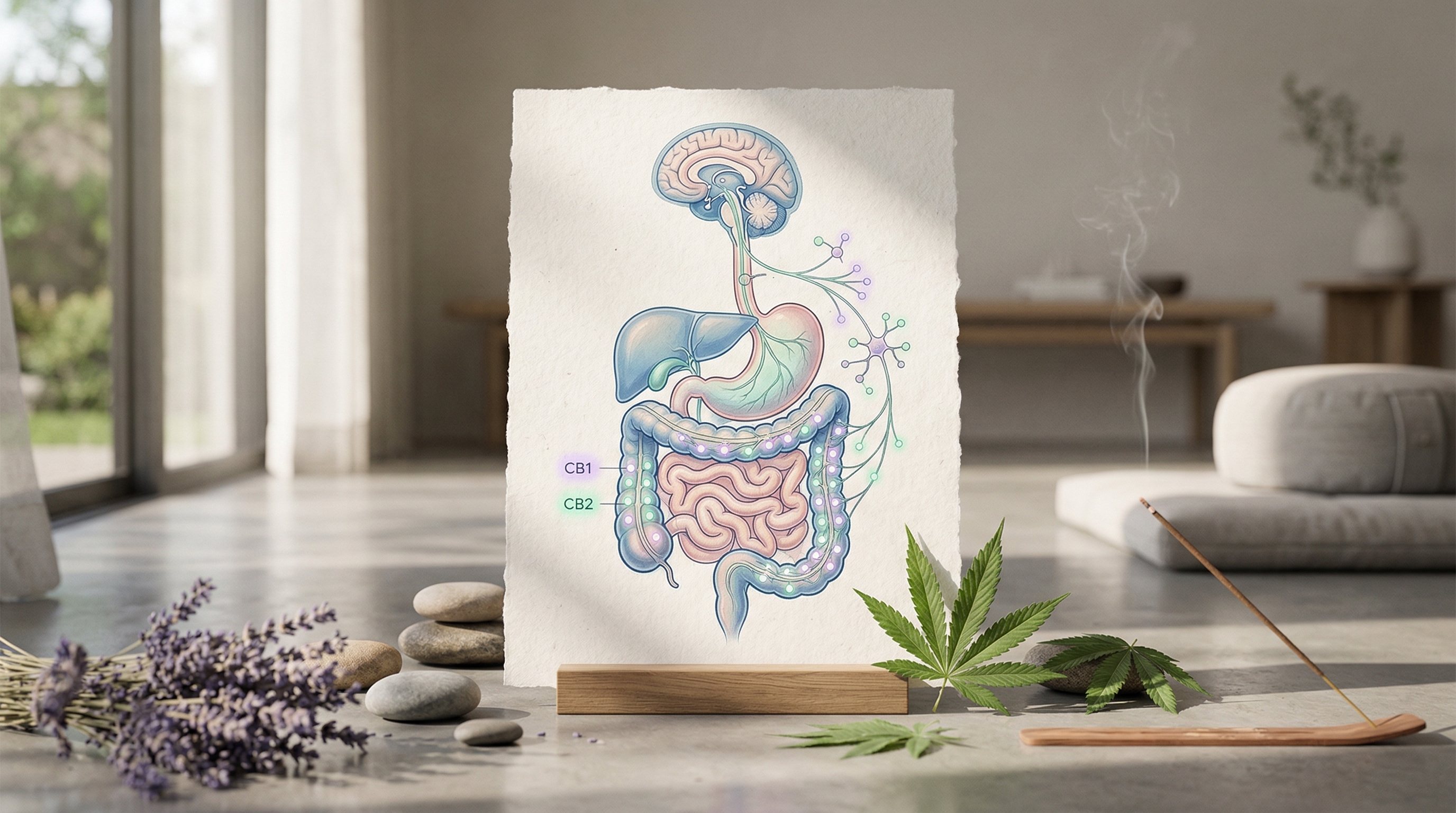
Your gastrointestinal tract is densely populated with both CB1 and CB2 receptors [Izzo & Sharkey, 2010]. CB1 receptors line the enteric nervous system — the vast neural network embedded in the gut wall, sometimes called your “second brain” — where they control motility (how food moves through you), secretion, and visceral sensation. CB2 receptors are concentrated in gut-associated immune tissue, which accounts for roughly 70% of your entire immune system, and appear to play a primary role in modulating inflammation [Wright et al., 2005; Sharkey & Wiley, 2016].
Imagine your gut as a busy highway. CB1 receptors act like traffic controllers, managing the speed and rhythm of movement. CB2 receptors are the road maintenance crew, repairing damage and tamping down inflammatory responses. When this system functions well, traffic flows smoothly. When it’s disrupted, you get the digestive equivalent of gridlock — cramping, diarrhea, constipation, bloating, and pain.
Clinical Endocannabinoid Deficiency: A Compelling Hypothesis
This is where the concept of Clinical Endocannabinoid Deficiency (CED) enters the picture. First proposed by neurologist Dr. Ethan Russo, this theory suggests that some people produce insufficient endocannabinoids, and that this deficiency may underlie conditions like IBS, migraines, and fibromyalgia [Russo, 2016]. Several lines of evidence lend it credibility:
- IBS patients show lower anandamide levels than healthy controls
- Patients with functional GI disorders exhibit abnormal CB1 and CB2 receptor expression in gut tissue
- The three conditions Russo associated with CED — IBS, migraines, and fibromyalgia — frequently co-occur in the same individuals, suggesting a shared underlying mechanism
While CED remains a hypothesis awaiting larger clinical validation, it provides a coherent biological rationale for why cannabinoids might interface meaningfully with digestive disorders.

What the Research Shows: Key Findings
Let’s look at what the science actually demonstrates — and be clear about what it doesn’t.
Cannabinoids and Gut Motility
One of the most consistent findings in cannabis-gut research is that THC slows gastrointestinal motility by activating CB1 receptors in the enteric nervous system. A randomized controlled trial found that dronabinol (synthetic THC) significantly reduced colonic motility in healthy volunteers [Esfandyari et al., 2007]. For people with IBS-D (diarrhea-predominant IBS), this slowing effect may be therapeutically relevant.
The flip side: this same mechanism explains why regular cannabis use causes constipation in some people — and could theoretically worsen IBS-C (constipation-predominant IBS). The effect is bidirectional depending on the predominant symptom pattern.
A 2024 observational study of 7,163 IBS patients found that cannabis users had significantly lower rates of hospitalization and reduced hospital costs compared to non-users, suggesting real-world symptomatic benefit — though observational data cannot establish causation [NuggMD, 2024].
Visceral Pain and Hypersensitivity
A defining feature of IBS is visceral hypersensitivity — gut nerves with the volume turned up too high, making normal sensations feel genuinely painful. Research suggests cannabinoids may help modulate this. Sharkey & Wiley (2016) found that both endocannabinoids and plant-derived cannabinoids reduced visceral pain in animal models via CB1 receptor activity in the gut-brain axis.
A human study found that THC increased the pain threshold for rectal distension in IBS patients [Wong et al., 2011]. Critically, the effect was more pronounced in individuals carrying a specific genetic variant of the CB1 receptor gene (CNR1). This is a key finding: cannabis may not work equally for everyone, and individual genetics likely play a significant role in how much benefit you experience. It’s one reason why the same strain can feel dramatically different for two people with the same diagnosis.
CBD, Inflammation, and the Indirect Pathway
CBD doesn’t bind strongly to CB1 or CB2 receptors directly. Instead, it modulates the ECS through an indirect route — by inhibiting FAAH, the enzyme that breaks down anandamide, CBD effectively raises your body’s own endocannabinoid levels [Leweke et al., 2012]. It also interacts with TRPV1 receptors (involved in visceral pain signaling) and PPARγ receptors (involved in inflammation regulation).
Preclinical research has shown anti-inflammatory and gut-protective effects of CBD in models of colitis [De Filippis et al., 2011]. A 2024 review in Cells noted that CBD may help restore intestinal barrier function in inflammatory conditions — a finding with direct relevance to “leaky gut” mechanisms implicated in IBS [Brown et al., 2024]. That said, the bulk of this evidence still comes from animal studies and cell culture models. We do not yet have the large-scale human trials needed to make clinical claims.
The Gut-Brain Axis: Where Cannabis Gets Interesting
Perhaps the most compelling area of IBS-cannabis intersection involves the gut-brain axis — the bidirectional communication network connecting your digestive system to your central nervous system via the vagus nerve, enteric nervous system, and neuroendocrine signaling.
Stress and anxiety are well-established IBS triggers. The ECS modulates this connection at multiple levels [Storr & Sharkey, 2007]. Cannabis’s ability to simultaneously influence mood and gut function may explain why some people report benefits that feel qualitatively different from conventional antispasmodics or antidiarrheals — addressing both the psychological and physiological dimensions of their condition at once. This remains a preclinical hypothesis, but it’s one with strong mechanistic support.
A 2025 systematic review protocol from researchers at Galway University Hospital specifically targeted this overlap, noting that ECS modulation represents “a novel avenue for management of pain and negative affective comorbidities in IBS and IBD” — highlighting the anxiety-gut connection as a key research priority [PMC, 2025].
IBS vs. IBD: An Important Distinction
It’s worth being precise here. IBS (irritable bowel syndrome) is a functional disorder — the gut doesn’t look abnormal under a microscope, but it behaves abnormally. IBD (inflammatory bowel disease, including Crohn’s disease and ulcerative colitis) involves measurable structural inflammation and tissue damage.
The cannabis research base differs between them. For IBD, there is human trial data — including a small randomized trial in Crohn’s disease patients showing significant symptom reduction with cannabis use — though remission rates (actual healing of tissue) were not clearly improved [Naftali et al., 2013]. For IBS, the evidence base is primarily preclinical and observational. Both conditions involve the ECS, but the mechanisms and the quality of evidence differ.
Practical Implications
Which High Families May Be Most Relevant?
Using our High Families classification system — which organizes cannabis by terpene chemistry and experience type rather than the outdated indica/sativa binary — here’s how different families may relate to digestive wellness:
| High Family | Why It May Be Relevant | Key Considerations |
|---|---|---|
| Relieving High | Rich in caryophyllene (the only terpene that directly binds CB2 receptors) and humulene, this family focuses on physical comfort and body-centered effects | Likely the most directly relevant entry point for gut inflammation and visceral discomfort |
| Relaxing High | High in myrcene, often with meaningful CBD content, this family supports deep physical and mental calm | May address the anxiety-gut connection; useful for stress-triggered IBS flares |
| Balancing High | Gentle, low-intensity profiles with measured THC:CBD ratios | Ideal for beginners or those sensitive to THC, with lower risk of overconsumption triggering symptoms |
| Uplifting High | Rich in limonene, which has shown gastroprotective properties in preclinical research [d’Alessio et al., 2013] | May support mood while offering secondary digestive benefits via the gut-brain axis |
Terpenes Worth Understanding
Beyond cannabinoids, the terpenes in cannabis — the aromatic compounds that give each strain its character — may make a meaningful difference for digestive applications:
- Beta-caryophyllene: The only dietary terpene known to directly activate CB2 receptors, which concentrate in gut immune tissue [Gertsch et al., 2008]. Preclinical research shows anti-inflammatory effects specifically in the GI tract [Bento et al., 2011]. Found in the Relieving High family. Look for strains like GSC (Girl Scout Cookies) and Sour Diesel.
- Limonene: Associated with gastroprotective and stress-reducing effects in animal models [d’Alessio et al., 2013]. Common in the Uplifting High family. Dominant in strains like Super Lemon Haze.
- Myrcene: Shown to enhance cannabinoid absorption and has demonstrated anti-inflammatory potential in preclinical work [Russo, 2011]. The signature terpene of the Relaxing High family, present in strains like Blue Dream and OG Kush.
- Humulene: Found alongside caryophyllene in many Relieving High strains, with its own anti-inflammatory preclinical profile. May contribute to the physical comfort associated with this family.
Consumption Method Matters More Than You Might Think
How you consume cannabis has significant implications for digestive applications:
- Sublingual tinctures and oils: Allow for precise dosing and deliver cannabinoids relatively quickly without requiring GI absorption first. The 15–30 minute onset is faster than edibles while still offering 2–4 hours of effect duration. This makes tinctures a strong starting option for gut-related use.
- Vaporizing flower or concentrate: The fastest onset (minutes), useful for acute nausea or sudden flare-ups. Effects are shorter-lived (1–2 hours). Less direct interaction with the GI tract compared to oral routes.
- Edibles and capsules: Must pass through the full digestive system, which is unpredictable if your digestion is already irregular. THC is converted to the more potent 11-hydroxy-THC in the liver, which can cause unexpectedly strong effects. Start extremely low (2.5mg THC or less) and wait at least 2 hours before considering more.
- Smoking: Not recommended for digestive wellness applications given respiratory drawbacks and the difficulty of consistent dosing.
A Mindful Dosing Framework
For digestive wellness, “start low, go slow” is not a cliché — it’s a safety principle grounded in the highly individual nature of cannabis-gut interactions:
- Begin with CBD-dominant products (high CBD:THC ratio of 10:1 or higher) to establish baseline tolerance
- Keep a detailed symptom journal tracking: dose, timing, consumption method, strain, and digestive response
- Introduce THC gradually if desired, at increments of 2.5mg or less
- Track your IBS subtype — diarrhea-predominant, constipation-predominant, or mixed — since THC’s motility-slowing effect is a double-edged sword
- Be aware of cannabinoid hyperemesis syndrome (CHS): In rare cases, chronic high-dose cannabis use triggers paradoxical severe nausea and vomiting. It resolves with cannabis cessation [Sorensen et al., 2017]. If you develop worsening nausea with increased cannabis use, this is a red flag.
Medication interactions: CBD is metabolized by cytochrome P450 enzymes (particularly CYP3A4 and CYP2C19), which also metabolize many common medications including proton pump inhibitors, antispasmodics, and antidepressants often prescribed for IBS. This can raise or lower medication blood levels unpredictably. Always discuss cannabis use with your prescriber.

Key Takeaways
- Your gut is an ECS hotspot: The GI tract has dense concentrations of both CB1 and CB2 receptors, making digestive function one of the most cannabinoid-responsive systems in the body [Izzo & Sharkey, 2010].
- The evidence is promising but still early: Most cannabis-gut research comes from animal studies and small human trials. Observational human data is encouraging, but large-scale randomized controlled trials specific to IBS remain limited.
- THC slows gut motility — a double-edged finding: This may help IBS-D (diarrhea-predominant) but could worsen IBS-C (constipation-predominant). Knowing your IBS subtype matters before experimenting.
- CBD works through indirect pathways: By raising anandamide levels and interacting with TRPV1 and PPARγ receptors, CBD may reduce gut inflammation and improve barrier function without directly activating cannabinoid receptors.
- Terpenes are part of the picture: Beta-caryophyllene (CB2 agonist), limonene (gastroprotective), and myrcene (anti-inflammatory, absorption-enhancing) may all contribute to digestive effects. The Relieving High and Relaxing High families are logical starting points.
- Consumption method shapes the experience: Sublingual tinctures offer the best balance of precision dosing and onset for gut-related applications. Edibles are unpredictable for people with irregular digestion.
- Work with your healthcare provider: Cannabis can interact with common IBS medications. It’s a potential complement to — not a replacement for — medical care.
FAQs
Can cannabis cure IBS?
No. There is no current evidence that cannabis cures IBS. What research suggests is that certain cannabinoids may help manage specific symptoms — visceral pain, motility dysregulation, inflammation, and anxiety — for some people. IBS is a complex, multifactorial condition that typically requires a comprehensive approach including dietary modification, stress management, and sometimes prescription therapy. Cannabis may be a useful complementary tool, not a standalone cure.
Is CBD or THC better for digestive issues?
It depends on the symptom. THC has stronger direct effects on gut motility and visceral pain through CB1 receptor activation — potentially more useful for diarrhea-predominant IBS and acute cramping. CBD may offer anti-inflammatory and gut-barrier benefits through indirect ECS modulation — potentially more relevant for IBD-adjacent inflammation and general gut comfort. Many people find that a combination of both — leveraging the entourage effect via whole-plant preparations — works better than either compound in isolation, though this hasn’t been confirmed in clinical trials specific to digestive disorders.
Can cannabis make digestive problems worse?
Yes, it can for some people. THC’s motility-slowing effects could worsen constipation-predominant IBS. In rare cases, chronic high-dose cannabis use causes cannabinoid hyperemesis syndrome (CHS) — paradoxical severe nausea that resolves only with cessation [Sorensen et al., 2017]. Some people also experience increased appetite that leads to consumption of IBS trigger foods. High doses of THC can heighten anxiety in susceptible individuals, which may worsen stress-driven gut symptoms. This is precisely why careful, low-dose, symptom-tracked experimentation matters.
What’s the best way to try cannabis for gut health?
Start with a high-CBD tincture or oil taken sublingually — begin at 5–10mg CBD and assess how your digestive symptoms respond over 1–2 weeks before adjusting. If you want to introduce THC, add 2.5mg in the evening and track results. Use a strain from the Relieving High family for gut inflammation focus, or Relaxing High if stress is a major IBS trigger for you. Keep a detailed journal, involve your doctor, and give each change at least one full week before evaluating.
Does my IBS subtype matter for cannabis selection?
Yes, significantly. IBS-D patients may benefit more from THC’s motility-slowing effects and may do better with CB1-active strains from the Relaxing High family. IBS-C patients should approach THC with more caution given its constipating potential, and may find CBD-dominant, caryophyllene-rich options from the Relieving High family more suitable. Mixed-type IBS (IBS-M) requires careful titration and especially close symptom tracking.
How does this relate to cannabis and the microbiome?
The relationship between cannabis and gut bacteria is a closely related but distinct layer of this story. Cannabinoids appear to reshape gut microbiome composition, and the microbiome in turn modulates your endocannabinoid tone — the baseline level of ECS activity. For a full exploration of this feedback loop, see our companion article: Cannabis and Gut Health: The Endocannabinoid-Microbiome Link.
Sources
- Bento, A.F., Marcon, R., Dutra, R.C., et al. (2011). “Beta-caryophyllene inhibits dextran sulfate sodium-induced colitis in mice through CB2 receptor activation and PPARγ pathway.” The American Journal of Pathology, 178(3), 1153–1166.
- Brown, K., Funk, K., Figueroa Barrientos, A., Bailey, A., et al. (2024). “The Modulatory Effects and Therapeutic Potential of Cannabidiol in the Gut.” Cells, 13(19), 1618. https://doi.org/10.3390/cells13191618
- d’Alessio, P.A., Ostan, R., Bisson, J.F., et al. (2013). “Oral administration of D-limonene controls inflammation in rat colitis and displays anti-inflammatory properties as diet supplementation in humans.” Life Sciences, 92(24–26), 1151–1156.
- De Filippis, D., Esposito, G., Cirillo, C., et al. (2011). “Cannabidiol reduces intestinal inflammation through the control of neuroimmune axis.” PLOS ONE, 6(12), e28159.
- Esfandyari, T., Camilleri, M., Busciglio, I., et al. (2007). “Effects of a cannabinoid receptor agonist on colonic motor and sensory functions in humans: a randomized, placebo-controlled study.” American Journal of Physiology — Gastrointestinal and Liver Physiology, 293(1), G137–G145.
- Gertsch, J., Leonti, M., Raduner, S., et al. (2008). “Beta-caryophyllene is a dietary cannabinoid.” PNAS, 105(26), 9099–9104.
- Izzo, A.A. & Sharkey, K.A. (2010). “Cannabinoids and the gut: new developments and emerging concepts.” Pharmacology & Therapeutics, 126(1), 21–38.
- Leweke, F.M., Piomelli, D., Pahlisch, F., et al. (2012). “Cannabidiol enhances anandamide signaling and alleviates psychotic symptoms of schizophrenia.” Translational Psychiatry, 2(3), e94.
- Naftali, T., Bar-Lev Schleider, L., Dotan, I., et al. (2013). “Cannabis induces a clinical response in patients with Crohn’s disease: a prospective placebo-controlled study.” Clinical Gastroenterology and Hepatology, 11(10), 1276–1280.
- PMC/Galway University Hospital (2025). “Endocannabinoid system modulation for visceral abdominal pain in inflammatory bowel disease and irritable bowel syndrome.” Systematic review protocol. https://pmc.ncbi.nlm.nih.gov/articles/PMC12375179/
- Russo, E.B. (2016). “Clinical Endocannabinoid Deficiency Reconsidered: Current Research Supports the Theory in Migraine, Fibromyalgia, Irritable Bowel, and Other Treatment-Resistant Syndromes.” Cannabis and Cannabinoid Research, 1(1), 154–165.
- Russo, E.B. (2011). “Taming THC: potential cannabis synergy and phytocannabinoid-terpenoid entourage effects.” British Journal of Pharmacology, 163(7), 1344–1364.
- Sharkey, K.A. & Wiley, J.W. (2016). “The role of the endocannabinoid system in the brain-gut axis.” Gastroenterology, 151(2), 252–266.
- Sorensen, C.J., DeSanto, K., Borgelt, L., et al. (2017). “Cannabinoid Hyperemesis Syndrome: Diagnosis, Pathophysiology, and Treatment.” Journal of Medical Toxicology, 13(1), 71–87.
- Storr, M.A. & Sharkey, K.A. (2007). “The endocannabinoid system and gut-brain signalling.” Current Opinion in Pharmacology, 7(6), 575–582.
- Wong, B.S., Camilleri, M., Eckert, D., et al. (2011). “Randomized pharmacodynamic and pharmacogenetic trial of dronabinol effects on colon transit in irritable bowel syndrome-diarrhea.” Neurogastroenterology & Motility, 24(4), 358–e169.
- Wright, K., Rooney, N., Feeney, M., et al. (2005). “Differential expression of cannabinoid receptors in the human colon: cannabinoids promote epithelial wound healing.” Gastroenterology, 129(2), 437–453.


