How Much THC Is in a Joint? Weight and Label Math
A half-gram joint at 20% total THC contains about 100 mg of potential THC. Learn the label math, pack-size trap, and why content is not absorbed dose.

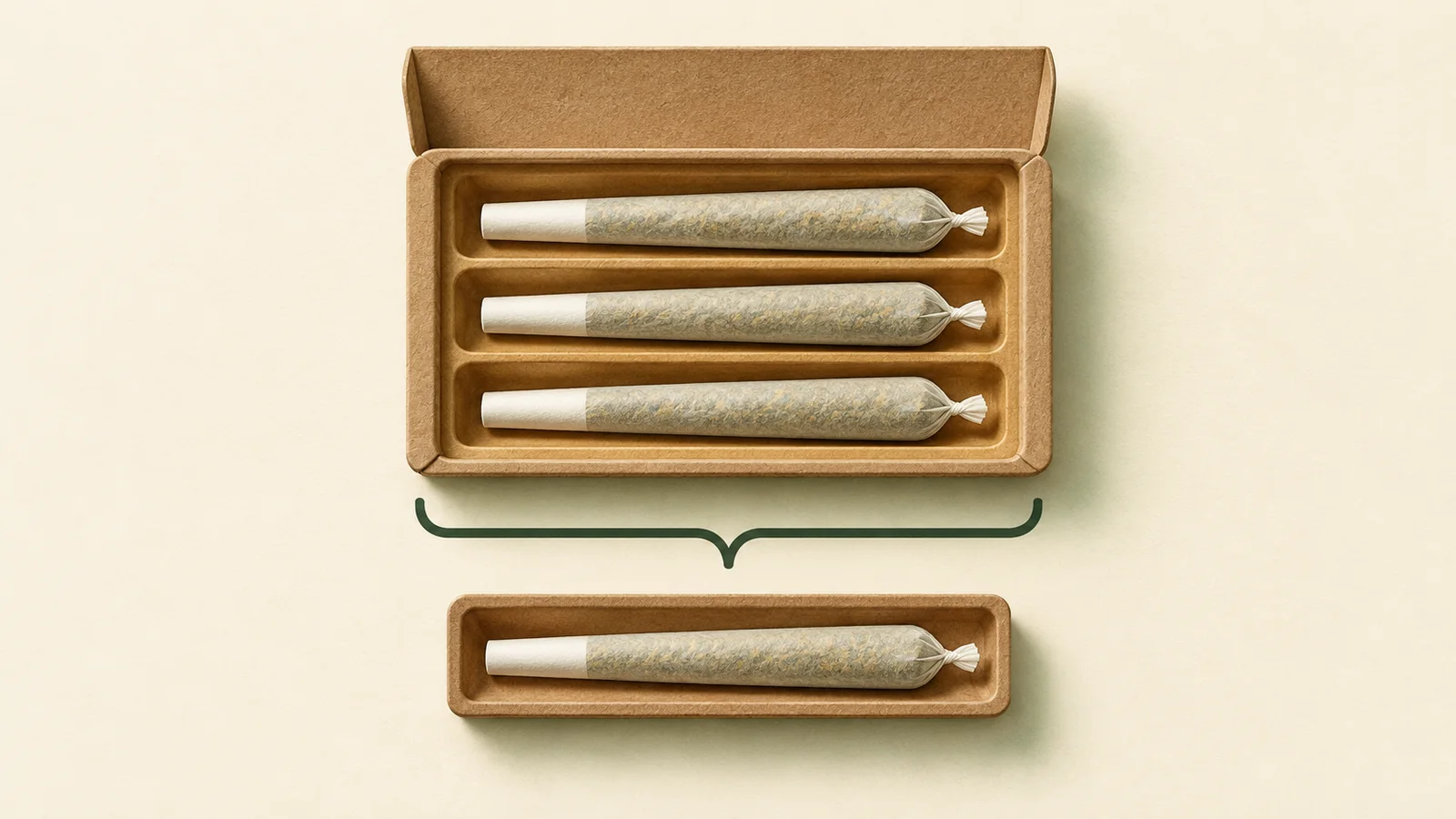
A 0.5-gram joint labeled 20% total THC contains about 100 mg of potential THC in its flower—not 100 mg delivered to your bloodstream. For another weight or strength, multiply grams × total THC percentage × 10. Use the percentage as the printed number: enter 20 for 20%.
The arithmetic is straightforward. The easy mistake is using a whole-pack weight for one joint, or treating the result as a personal dose. Here is how to keep those numbers separate.
How do you calculate THC in a joint?
You need two matching inputs: the net cannabis weight in that joint and the total THC concentration for that material. Our cannabis quantities guide explains weight units; this calculation adds the concentration.
Potential THC in mg = flower weight in g × 1,000 × total THC percentage ÷ 100
For the half-gram example:
0.5 g × 1,000 mg/g × 20 ÷ 100 = 100 mg potential THC
These are hypothetical content estimates. They do not recommend an amount to use.
| Flower in one joint | 15% total THC | 20% total THC | 25% total THC |
|---|---|---|---|
| 0.25 g | 37.5 mg | 50 mg | 62.5 mg |
| 0.5 g | 75 mg | 100 mg | 125 mg |
| 0.75 g | 112.5 mg | 150 mg | 187.5 mg |
| 1 g | 150 mg | 200 mg | 250 mg |
There is no single “THC per joint” number. Both weight and concentration change the answer. The table describes the starting material, before burning, smoke loss, inhalation, or absorption.
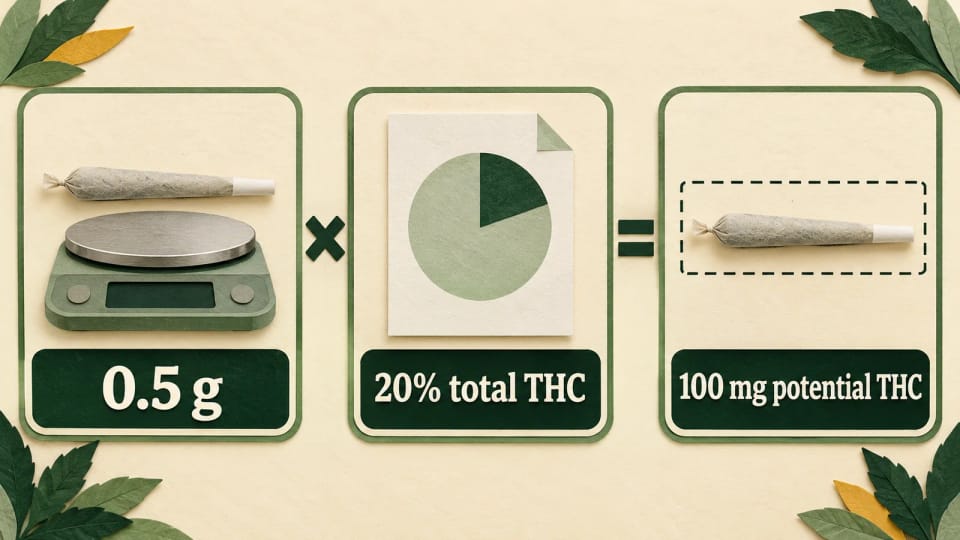
An invented label example, not a real product or a suggested dose. The result describes potential THC in the material.
What if the label uses mg/g instead of a percentage?
Multiply grams × milligrams per gram. No extra percentage conversion is needed.
A concentration of 200 mg/g equals 20% by weight. Half a gram at 200 mg/g contains 0.5 × 200 = 100 mg of labeled total THC. Do not multiply that answer by ten again.
Health Canada’s label guide distinguishes concentration by weight from amounts per unit or package. It gives a worked example in which 30 g at 180 mg/g contains 5,400 mg across the package. Those are Canadian label conventions; other places may arrange the same information differently. Health Canada label guide.
| What the field says | What you still need |
|---|---|
| Total THC: 20% | Net grams of the matching cannabis material |
| Total THC: 200 mg/g | Net grams; multiply directly |
| Total THC: 100 mg per unit | Confirm what the label calls one unit |
| Total THC: 300 mg per package | Confirm how many units the package contains |
Keep the units beside the numbers. “200 mg/g” and “200 mg in this package” are different statements.
Is the listed weight for one pre-roll or the whole pack?
Check before calculating. Imagine a pack labeled three pre-rolls, 1.5 g net weight, 20% total THC.
The whole pack represents 1.5 × 10 × 20 = 300 mg potential THC. If the three units contain equal weights of that material, each is 0.5 g and represents about 100 mg. Applying the 1.5 g pack weight to each joint would triple the estimate.
The same care applies when sharing. Half of a 0.5 g joint at 22% represents 0.25 g of flower containing about 55 mg potential THC. It does not represent 55 mg of flower, and it does not establish that either person absorbs 55 mg of THC. Equal turns are not a measured split of smoke.
An infused pre-roll needs its own product information. A flower-only percentage cannot account for added extract. Health Canada lists infused pre-rolls under cannabis extracts, separately from ordinary dried-cannabis pre-rolls. Use the finished product’s relevant label or ask the seller which material a result describes. Product classes and net quantities.
Should you use THC, THCA, or total THC?
Use the field labeled total THC when it describes the product you are calculating. Do not apply the THCA factor to an already calculated total.
For ordinary flower with THC and THCA reported separately in the same units, a common calculation is:
Total potential THC = THC + (THCA × 0.877)
Connecticut publishes this equation, and researchers use it when THC and THCA are measured separately. The factor helps express potential THC after conversion. It is not an absorption percentage. Connecticut DCP, Schwabe et al., methods.
For example, 1% THC plus 22% THCA gives 1 + (22 × 0.877) = 20.294% total potential THC. Half a gram would therefore represent about 101 mg. The long decimal is arithmetic precision, not proof that the individual joint contains exactly that amount.
Check the field names and units on the actual report. Our guide to matching a COA to the package’s batch helps establish whether the result belongs to that product at all.
How much of that THC reaches your body?
The label calculation cannot answer that for an individual session. It stops at the material in the joint.
A laboratory study illustrates why even the phrase “available to the lungs” needs a definition. Hädener and colleagues used a smoking apparatus and measured THC recovered in smoke condensate. Flower results were around 19–27% under those conditions, with further losses expected from the smoke escaping a real joint. This was apparatus recovery, not a measurement of THC absorbed by human participants. Hädener et al., 2019.
Those figures do not supply a personal conversion factor. Neither does dividing a joint’s content by its puff count. In an inpatient study of 20 heavy users, puff volume and duration were greater at the start of a cannabis cigarette and declined across later puffs. Cognitive testing took place before cannabis access; associations with smoking measures were generally not significant. It measured patterns in that group, not a universal milligrams-per-puff rule. McClure et al., 2012.
Content, smoke delivery, blood exposure, and felt effects answer different questions. Our THC percentage guide explains why strength also cannot predict exactly how an experience will feel.
How much should you trust the label number?
Treat it as useful product information with limits, rather than a perfect measurement of each joint.
A 2023 study retested 23 flower samples from ten Colorado dispensaries. Eighteen measured below the lowest THC value printed on their labels; sixteen were more than 15% below that value. This small regional sample does not establish that every label is inflated, or supply a correction factor for your purchase. Schwabe et al., 2023.
The paper disclosed commercial ties: two authors worked for the testing company during data collection, and a sensory company helped fund sample purchases. The researchers could not determine the exact source of the discrepancies. The useful conclusion here is modest: accurate multiplication cannot make uncertain inputs exact.
Can you compare the answer with an edible dose?
You can compare labeled content as content. You cannot turn it into an equivalent experience or an oral dosing instruction.
NIH’s 5 mg standard THC unit is a research reporting unit. Its notice explicitly recognizes that equal THC quantities can have different effects depending on route, product constituents, prior exposure, and other individual factors. It does not prescribe how much a person should use. NIH research notice.
Thus, 100 mg of potential THC in flower equals twenty of those reporting units on paper. It does not mean twenty units reach a person’s blood, and it does not make that joint equivalent to an edible labeled 100 mg. Our edible timing guide covers the separate oral-use question.
Use the calculation to understand the package. Follow product directions and warnings, and do not use a content estimate to judge whether you are fit to drive. Our cannabis and driving guide explains why a number on a label cannot clear that decision.
FAQ
How much THC is in a half-gram joint?
At 20% total THC, about 100 mg of potential THC is in the flower. At 15%, it is 75 mg; at 25%, it is 125 mg. These are content estimates before smoking losses.
How much THC is in a one-gram joint?
Multiply the total THC percentage by ten. One gram at 20% represents 200 mg potential THC. Check that the gram refers to one joint and that the concentration describes its contents.
Should I multiply total THC by 0.877?
No. Use an already reported total THC value directly. The 0.877 factor belongs in the calculation when THCA and THC are listed separately in matching units.
Can I calculate THC per puff by dividing by puff count?
That gives an equal-share assumption, not a measured dose. Puff size and duration can change, and the joint also burns between puffs. It does not establish how much is inhaled or absorbed.
Does a joint labeled 100 mg equal a 100 mg edible?
No equivalent effect follows from matching the numbers. The product, route, losses, absorption, and person matter. Do not use joint-content math to choose an edible dose.
Key takeaways
- Grams × printed total THC percentage × 10 estimates potential milligrams in the material.
- For mg/g, multiply by grams directly.
- Check per joint versus per pack, and do not convert total THC twice.
- The result describes contents, not an absorbed dose or a promised high.
Sources
- Hädener, M., Vieten, S., Weinmann, W., and Mahler, H. (2019). A preliminary investigation of lung availability of cannabinoids by smoking marijuana or dabbing BHO and decarboxylation rate of THC- and CBD-acids. Forensic Science International, 295, 207–212. PMID: 30638755.
- McClure, E. A., Stitzer, M. L., and Vandrey, R. (2012). Characterizing smoking topography of cannabis in heavy users. Psychopharmacology, 220(2), 309–318. DOI.
- Schwabe, A. L., Johnson, V., Harrelson, J., and McGlaughlin, M. E. (2023). Uncomfortably high: Testing reveals inflated THC potency on retail Cannabis labels. PLOS ONE, 18(4), e0282396. DOI.
- Health Canada. How to read and understand a cannabis product label.
- Connecticut Department of Consumer Protection. How is total THC calculated, October 5, 2023.
- National Institutes of Health. Establishment of a Standard THC Unit to be used in Research, May 7, 2021.