How to Roll the Perfect Joint: A Step-by-Step Guide for Beginners
Learn to roll a joint from scratch with this easy step-by-step guide. Covers materials, technique, troubleshooting, and pro tips for beginners.

So you’ve got some flower, a pack of papers, and a dream. Rolling a joint is one of those foundational cannabis skills that feels impossibly tricky the first few times—and then one day it just clicks. Think of it like learning to tie your shoes: awkward at first, second nature forever.
This guide will walk you through rolling a clean, smokeable joint from scratch. No pre-roll cones, no machines—just you, your hands, and a little patience.
Estimated time: 5–15 minutes (your first few attempts); under 2 minutes once you’ve got it down
Difficulty level: Beginner
What You’ll Need
Required
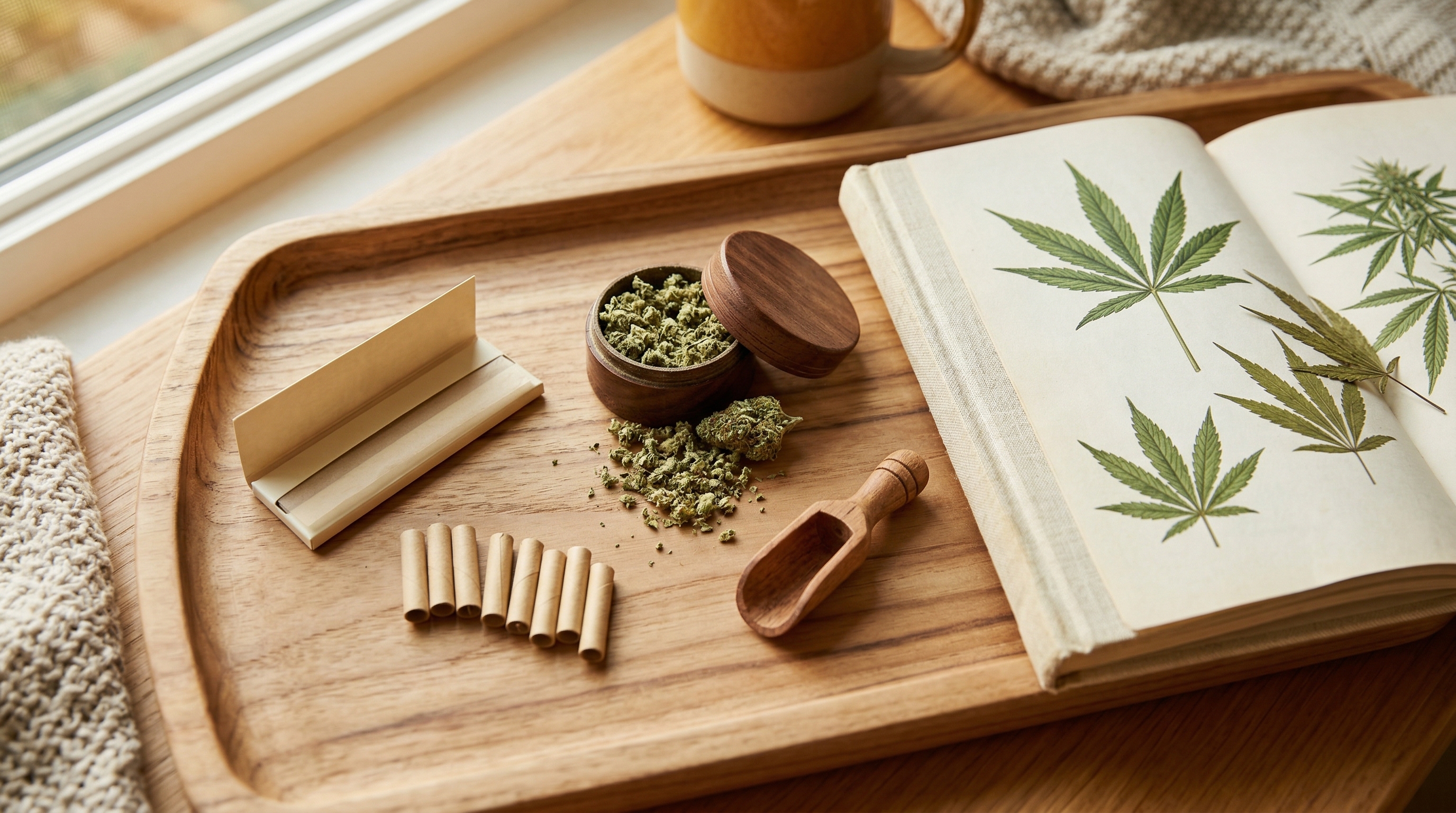
- Rolling papers — 1¼” size is the standard starter size (brands like RAW, Elements, or OCB are popular choices)
- Cannabis flower — about 0.5–0.75 grams for a standard joint
- Grinder — a two- or four-piece herb grinder
- Filter tip / crutch — a small piece of stiff paper or a pre-cut filter tip (most rolling paper packs include them)
Optional
- Rolling tray — keeps your workspace tidy and catches stray herb
- Poker tool — a pen, chopstick, or the drawstring from your hoodie works great for packing
- Extra papers — because your first attempt might become a learning experience (and that’s perfectly fine)
A note on flower choice: The grind consistency matters more than the strain here. That said, if you’re new to cannabis, you might enjoy starting with something from the Balancing High family—these strains may offer gentler, beginner-friendly effects that let you focus on enjoying the experience rather than managing intensity.
Step-by-Step Instructions
Step 1: Grind Your Flower
Break your flower into smaller pieces by hand first, removing any stems. Then place the pieces into your grinder and twist 8–10 times until you have an even, fluffy consistency—roughly the texture of dried oregano.
Visual cue: You want uniform, small pieces. If it’s powdery, you’ve over-ground it. If there are still chunky nuggets, give it a few more twists.
Common error: Grinding too fine turns your herb into powder that restricts airflow. You want it fluffy, not dusty.
Tip: If you don’t have a grinder, you can break the flower apart with your fingers. Just take your time and aim for even-sized pieces.
Step 2: Make Your Filter Tip (Crutch)
Take your filter paper (or tear a small strip about 2.5cm × 6cm from thin cardboard like a business card). Make 3–4 small accordion folds at one end, then roll the remaining paper around those folds to form a small cylinder.
Visual cue: Your finished crutch should be about the diameter of a pencil—roughly 5–7mm wide.
Why this matters: The crutch gives your joint structure, keeps herb out of your mouth, and gives you something to hold so you can smoke the whole thing without burning your fingers.
Step 3: Fill the Paper
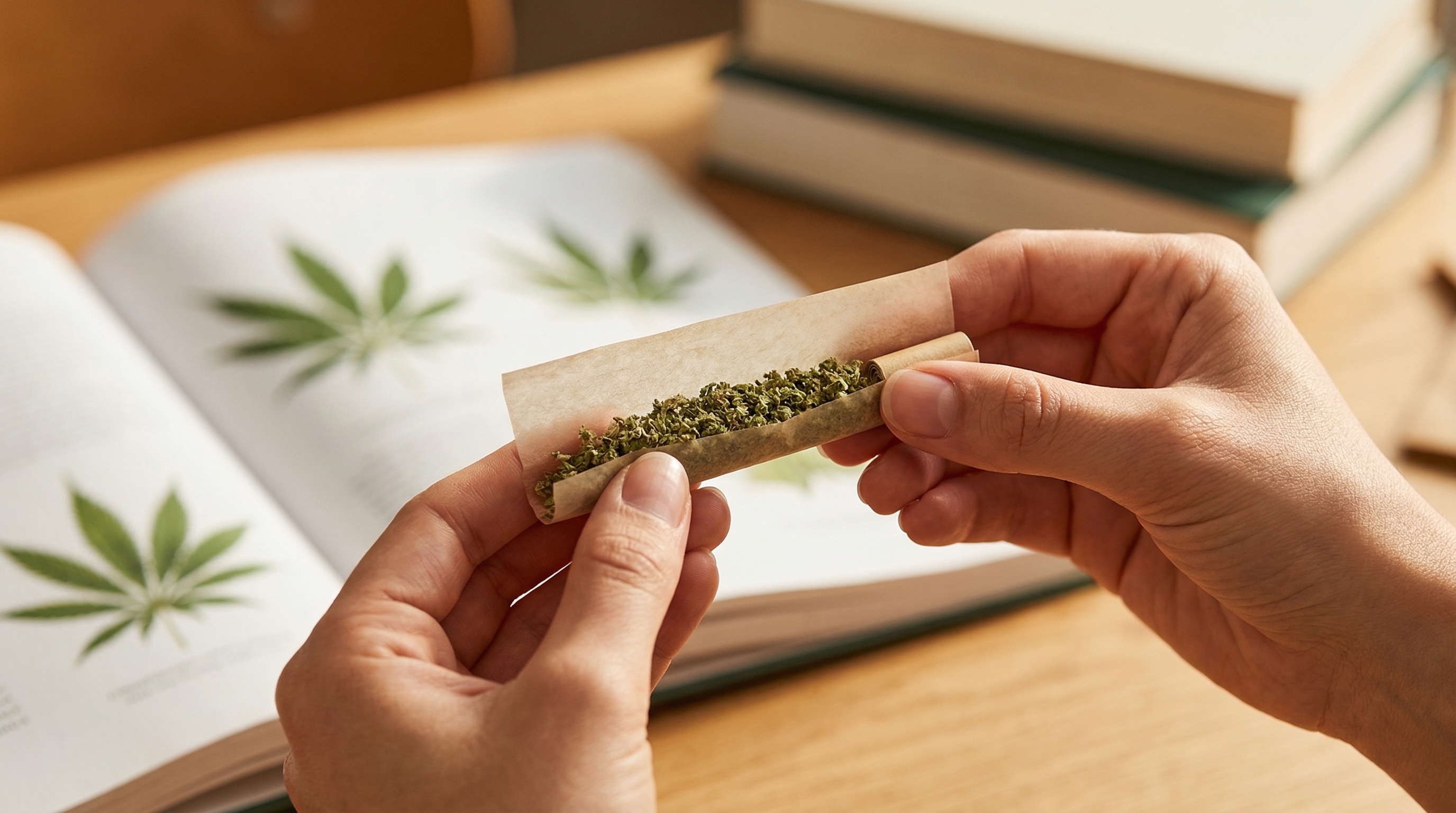
Hold a rolling paper between your fingers with the adhesive strip (the shiny, gummed edge) facing you at the top, away from you. The sticky side should be on the inside of the paper, facing you.
Place your filter tip at one end of the paper. Then sprinkle your ground flower evenly along the length of the paper in a line, using roughly 0.5–0.75 grams. Distribute it slightly thicker in the middle and tapering toward the filter end for a gentle cone shape.
Common error: Overstuffing. Less is more for your first rolls. A loosely packed joint smokes better than one that’s crammed tight.
Step 4: Shape and Tuck
This is the step that takes practice. Hold the paper between your thumbs and index fingers, and gently roll the flower back and forth to shape it into an even cylinder. You’re not sealing it yet—you’re just forming the cannabis into a uniform shape inside the paper.
Once it feels evenly distributed, tuck the non-adhesive (front) edge of the paper down and around the flower, starting at the filter end. Use the filter as an anchor point—tuck the paper around it first, then work your way up.
Tip: The tuck at the filter end is everything. If you can get that first tuck tight around the crutch, the rest of the roll practically guides itself.
Step 5: Roll and Seal
With the front edge tucked, roll upward with your thumbs, wrapping the paper snugly around the flower. When you reach the adhesive strip, lick it lightly (just enough moisture to activate the glue) and press it down to seal.
Visual cue: The paper should be smooth and snug, not wrinkled or baggy. A few small creases are totally normal—this isn’t a machine-rolled cigarette, and it doesn’t need to be.
Time estimate: Steps 3–5 combined will take 2–5 minutes as a beginner.
Step 6: Pack and Twist
Use your poker tool (pen, chopstick, etc.) to gently press the herb down from the open end of the joint. This ensures even density and a smoother burn. Add a tiny pinch more ground flower if there’s space at the top.
Finally, twist the excess paper at the tip to close it off. This gives you a wick to light and may help prevent flower from falling out during your session.
Your joint is ready.
Pro Tips
The “boat” technique: If tucking is frustrating, try folding the paper into a V-shape (like a tiny boat or taco) first, filling it with herb, and then rolling. This gives you more control during the shaping phase.
Humidity matters: If your flower is too dry, it’ll crumble to dust and burn hot. If it’s too sticky, it won’t grind evenly. Flower stored with a humidity pack (around 58–62% relative humidity) may roll more consistently.
Practice with tea: Seriously. If you want to build muscle memory without using cannabis, buy a cheap bag of loose-leaf herbal tea and practice rolling with that. It has a similar texture and weight.
Lick lightly: You only need the faintest bit of moisture on the adhesive strip. Soaking it will make the paper soggy and prone to tearing.
Even density = even burn: If your joint burns unevenly (called “canoeing”), it’s almost always because the flower is packed tighter on one side. Take an extra moment during Step 4 to distribute evenly.
Troubleshooting
| Problem | Likely Cause | Solution |
|---|---|---|
| Joint is too loose / falls apart | Not enough flower, or paper wasn’t tucked tightly | Add more herb and focus on a snug tuck at the filter end |
| Joint is too tight / hard to draw | Overpacked or flower ground too fine | Use less flower and grind more coarsely |
| Burns unevenly (canoeing) | Uneven packing or uneven lighting | Distribute flower more evenly; light the tip by rotating it slowly |
| Paper tears while rolling | Too much moisture or aggressive handling | Use a lighter touch; lick the glue strip gently |
| Filter tip falls out | Crutch rolled too small or not secured during tuck | Make a slightly wider crutch and tuck the paper firmly around it first |
| Herb falls out the end | Open end not twisted or packed | Use a poker to pack gently, then twist the tip closed |
Variations to Try
- Cone joint: Use more flower at the tip than the filter end for a wider, cone-shaped joint. This is how most pre-rolls are shaped and gives you a slightly stronger start that mellows as you smoke.
- Inside-out roll (Dutch style): Roll with the paper flipped so the adhesive faces outward. Seal it, then tear or burn away the excess paper. This minimizes paper taste for a cleaner flavor.
- Pre-roll cones: If hand-rolling feels too frustrating at first, buy pre-made cones and simply pack them with ground flower using a poker. There’s absolutely no shame in this—it’s how many people prefer to roll.
Key Takeaways
Rolling a joint is a skill built through repetition, not talent. Here’s the short version to keep in mind:
- Grind medium-fine — fluffy, not powdery
- Always use a crutch — it anchors the roll and improves airflow
- Tuck at the filter first — this is the move that makes everything else click
- Don’t overpack — a slightly loose joint smokes better than a tight one
- Practice on tea — build muscle memory without any cost
Your first joint might look like a crumpled caterpillar, and that’s completely fine. If it smokes, it counts. Check out our Best Cannabis Strains for Beginners guide to find the right flower to pair with your newly rolled creation.
Happy rolling!


