DIY Cannabis Mints for Microdosing on the Go
Make DIY cannabis mints for microdosing: precise tincture dosing, the mg-per-mint math, molds, fast sublingual onset, and labeling tips.

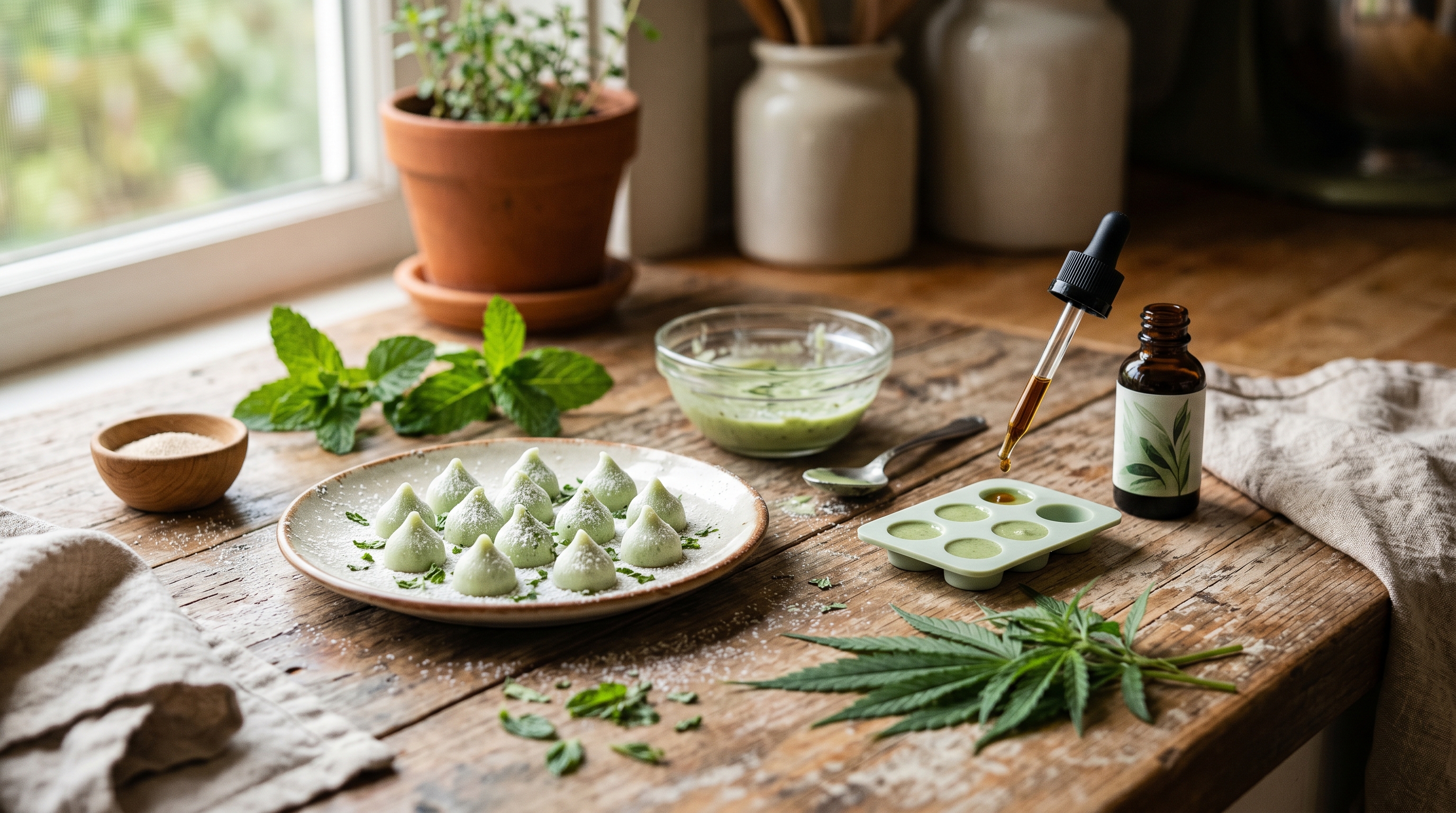
If you have ever popped what you thought was a “low-dose” gummy and spent the next four hours pinned to the couch, you already understand the core problem with edibles: the dose is usually too big and the timing is unforgiving. The fix is not to swear off edibles forever. The fix is to make something small, predictable, and portable that you actually control. That is exactly what a homemade cannabis mint is built for.
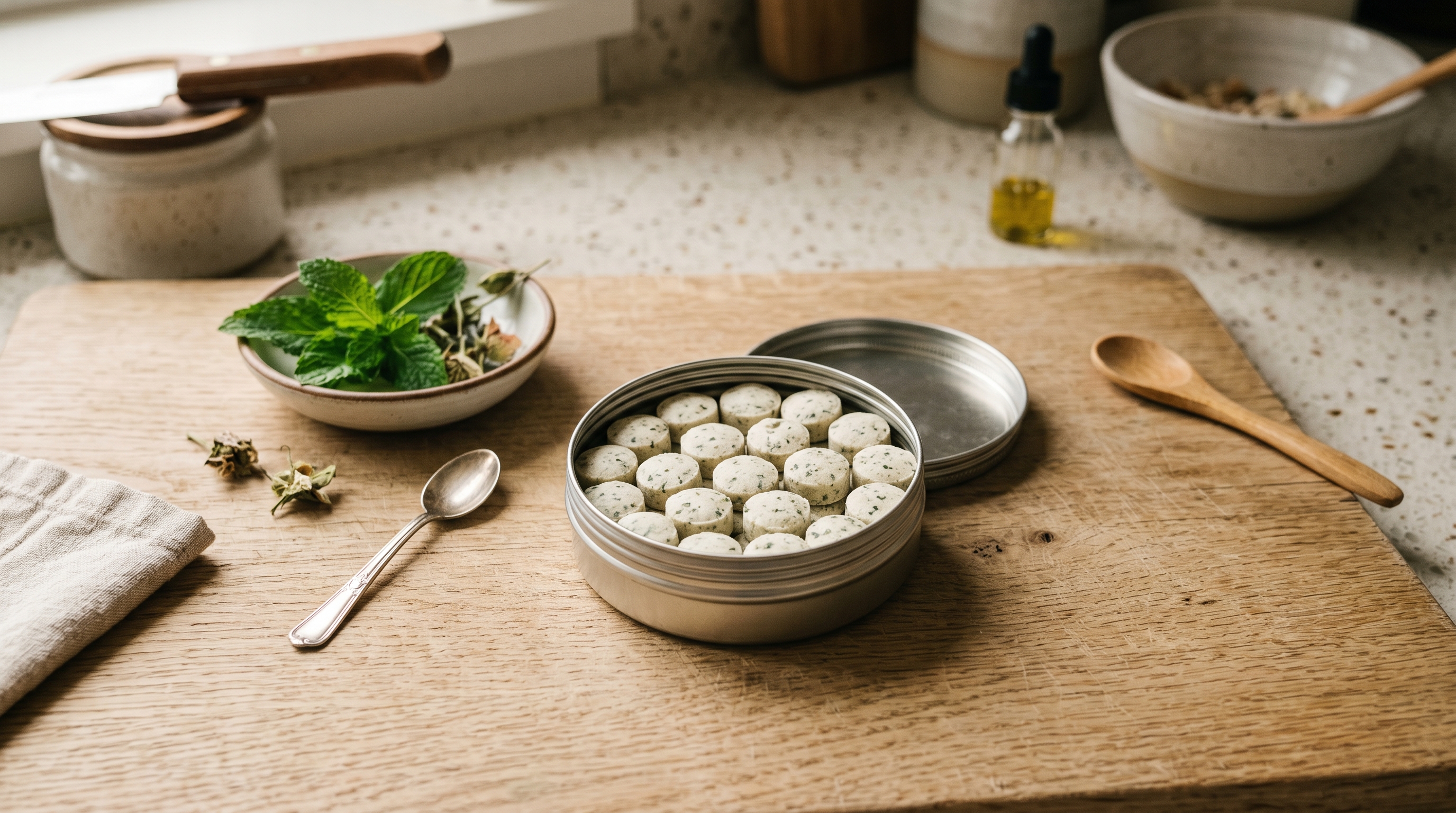
These little discs are my favorite at-home project for microdosing — the practice of taking a dose so small it nudges your mood, focus, or comfort without dropping you into a full, obvious “high.” Done right, a tray of mints gives you dozens of nearly identical, ~2 mg pieces you can slip into a tin and carry like any other breath mint. Done carelessly, they become a roulette wheel. The difference between those two outcomes is precision, and precision is the whole reason this recipe exists.
Why microdosing appeals (and why mints are the perfect vehicle)
Microdosing usually means somewhere in the 1 to 2.5 mg THC range per serving — a dose low enough that most people stay functional, clear-headed, and in control. The research literature is still young and individual responses vary widely, so treat any number you read (including mine) as a starting point rather than a promise. That said, the appeal is consistent across the people who gravitate to it:
- Functional and daytime-friendly. A true microdose is meant to take the edge off without taking over your afternoon. People reach for it for a calmer workday, a creative baseline, or low-key social ease.
- Gentle on tolerance. Smaller, less frequent doses tend to keep your tolerance lower than daily high-dose use, which means the dose keeps working instead of constantly creeping upward.
- Subtle, not stupefying. The goal is “slightly better,” not “obviously altered.” If you can feel it strongly, you have probably wandered out of microdose territory.
Mints are the ideal delivery format for this because they solve the two biggest edible problems at once. First, a tray-molded mint is a fixed, repeatable serving — no guessing where the “edge” of a brownie is. Second, a mint that you let dissolve under your tongue gives you a partial sublingual route, which tends to come on faster than something you simply chew and swallow. More on that below, because it changes how you should use them.
If the whole “labels lied to me” frustration sounds familiar, you might enjoy our breakdown of why strain marketing so often misses in understanding cannabis effects and how the entourage effect shapes what you actually feel.
A quick word on potency and what drives the “feel”
The dose is the headline, but it is not the whole story. The plant material or extract you start with carries a cannabinoid and terpene profile that colors the experience. A mint built from a relaxing, myrcene-forward source will land differently than one built around bright, mood-lifting limonene or focus-leaning terpinolene. If you want calm-comfort character, sources rich in caryophyllene or soothing linalool tend to read that way for a lot of people.
That is the same logic behind our High Families system. For a gentle, even-keeled microdose, the Balance family is a sensible target, while Relax leans toward winding down and Uplift toward a brighter mood. If you are chasing daytime function, you might look at sources that trend energizing or focused; for evening mints, something more relaxed or calm fits better. None of this is a guarantee — it is a tendency, and your body gets the final vote.
The dosing math (read this before you touch a mold)
This is the part people skip and then regret. At microdose scale, small errors are huge in percentage terms: if you are aiming for 2 mg and you are off by 1 mg, you are off by 50%. So we do the arithmetic first.
The clean way to make precisely dosed mints is to start from a lab-tested tincture or distillate with a known milligrams-per-milliliter (or per-drop) figure. Decarbed flower works too, but its potency is an estimate; a tested liquid removes most of the guesswork, which is why I recommend it for anything in the microdose range.
Worked example — targeting ~2 mg THC per mint:
- Decide your batch size from your mold. Say your silicone tray makes 40 mints.
- Pick your per-piece target: 2 mg THC.
- Total THC needed for the batch:
40 mints × 2 mg = 80 mg THC. - Check your tincture’s potency. Suppose the label says 20 mg THC per mL.
- Tincture required:
80 mg ÷ 20 mg per mL = 4 mLof tincture for the entire batch.
That 4 mL gets blended evenly through the whole mixture, then divided across 40 identical cavities — which is the only reason each mint lands near 2 mg. If your tincture is stronger, say 50 mg/mL, you would need only 80 ÷ 50 = 1.6 mL, and you would make up the lost liquid volume with a neutral carrier (a little extra water or glycerin) so the dough still behaves. If you change the tincture amount to fix texture, you have changed the dose — redo the math. The total cannabinoids scale with the tincture, not the sugar.
For a deeper walk-through of edible arithmetic, see our guide to edible dosing math, and if tinctures themselves are new to you, start with how to make a cannabis tincture.
Ingredients
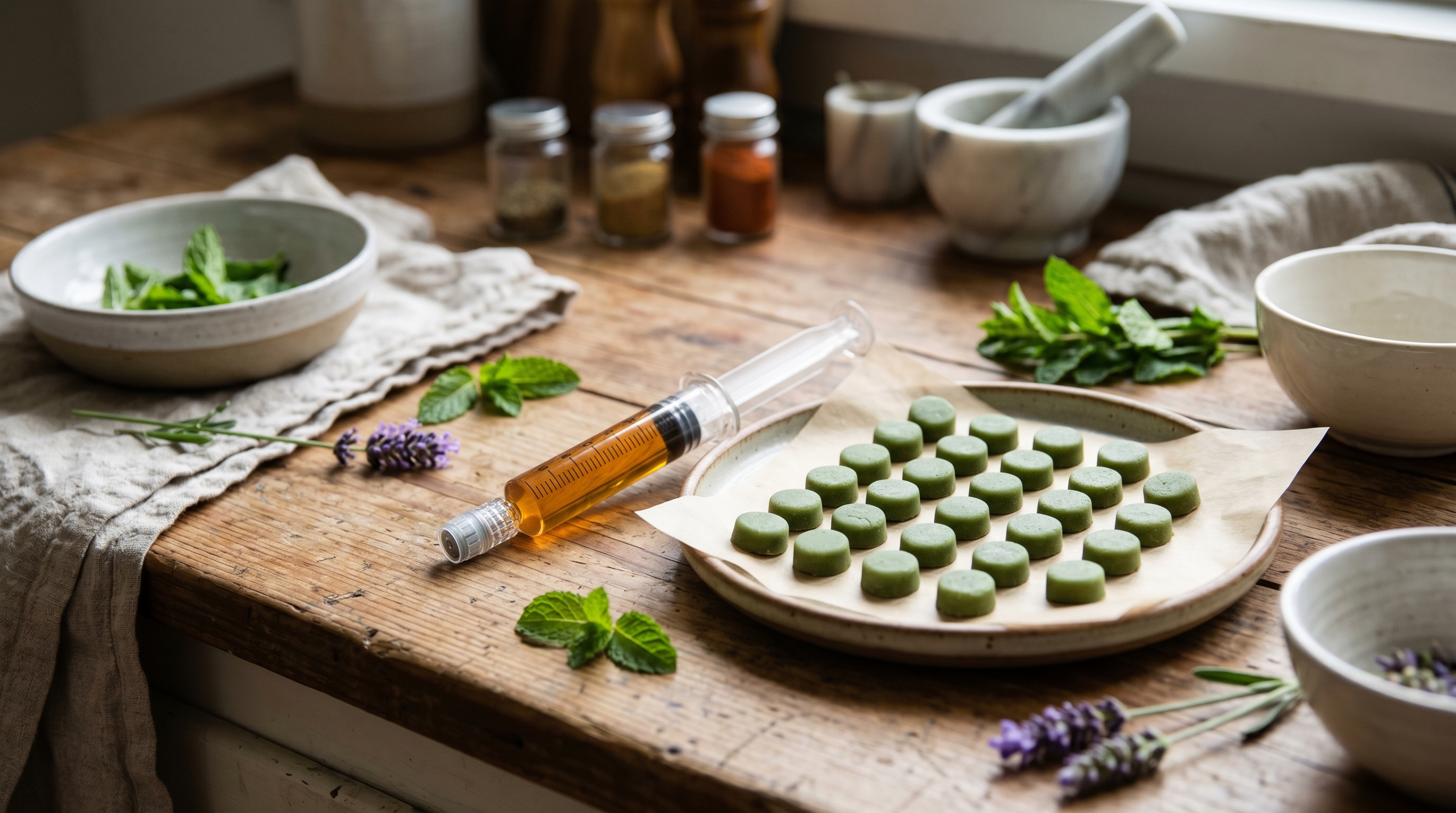
This makes roughly 40 mints at ~2 mg THC each (adjust per the math above for your potency and batch size). It is a no-bake sugar-pastillage style mint, which keeps cannabinoids away from high heat.
- 4 mL lab-tested cannabis tincture (20 mg THC/mL in this example — substitute your tested value and recompute)
- 2½ cups powdered (confectioners’) sugar
- 2 tablespoons water
- ¾ tablespoon corn syrup (helps bind)
- ½ teaspoon peppermint extract (or spearmint)
- ⅛ teaspoon cream of tartar
- 1 packet gelatin or, for a vegan version, agar agar
- Optional: a drop of food coloring
Equipment: a small silicone mold with uniform cavities (mini cube or disc trays are ideal), a milliliter syringe or precise dropper for the tincture, a mixing bowl, and an airtight tin for storage.
Steps
- Bloom your binder. Dissolve the gelatin or agar in the 2 tablespoons of warm (not boiling) water and let it sit a minute. Keep the temperature gentle — you are binding, not cooking off your cannabinoids.
- Measure the tincture precisely. Using your syringe, draw exactly the amount your math called for (4 mL here). This is the single most important measurement in the whole recipe, so do not eyeball it.
- Combine wet ingredients. Stir the tincture, corn syrup, peppermint extract, and optional coloring into the bloomed binder until fully blended. Even distribution now is what gives you even dosing later.
- Add the dry ingredients. Sift in the powdered sugar and cream of tartar a little at a time, mixing until you get a stiff, pliable dough. If it is too sticky, add powdered sugar (this does not change your total dose). Resist adding more tincture — that would raise the dose.
- Mix thoroughly — then mix again. Knead until the cannabinoids are uniformly worked through. Any pockets of tincture become hot-spot mints, which defeats the entire purpose.
- Press into the mold. Fill each identical cavity level and equal. Uniform cavities are doing your portioning for you, so do not overfill some and underfill others.
- Dry and set. Let the mints firm up for 24+ hours at room temperature, or speed it along in a dehydrator around 90°F (32°C). They should release cleanly and feel dry to the touch.
- Unmold, label, and store. Pop them out into your airtight tin (see labeling below).
The sublingual angle — why you let it dissolve
Here is the technique that makes a mint better than a gummy for microdosing: let it dissolve slowly under your tongue instead of chewing and swallowing it like candy. The thin tissue under the tongue can absorb some cannabinoids more directly, which tends to mean a faster, often gentler onset — many people report something in the 15 to 45 minute window for the sublingual portion, versus the 60-to-120-minute crawl of a classic stomach-digested edible.
A few honest caveats. The absorption is partial, not total — whatever you eventually swallow still goes the slow digestive route, so you may feel an early sublingual lift followed by a second, slower wave. Individual onset varies a lot. And the golden rule of all edibles still applies, even at microdose scale: start low, wait, and do not redose early. Give a single mint a full 60 to 90 minutes before deciding whether to take another. For more on timing pitfalls, our edible dosing guide and tolerance and microdosing primers are worth a read.
Labeling and storage (do not skip this)
Homemade mints look exactly like ordinary breath mints — which is precisely the danger. A clearly labeled tin is non-negotiable.
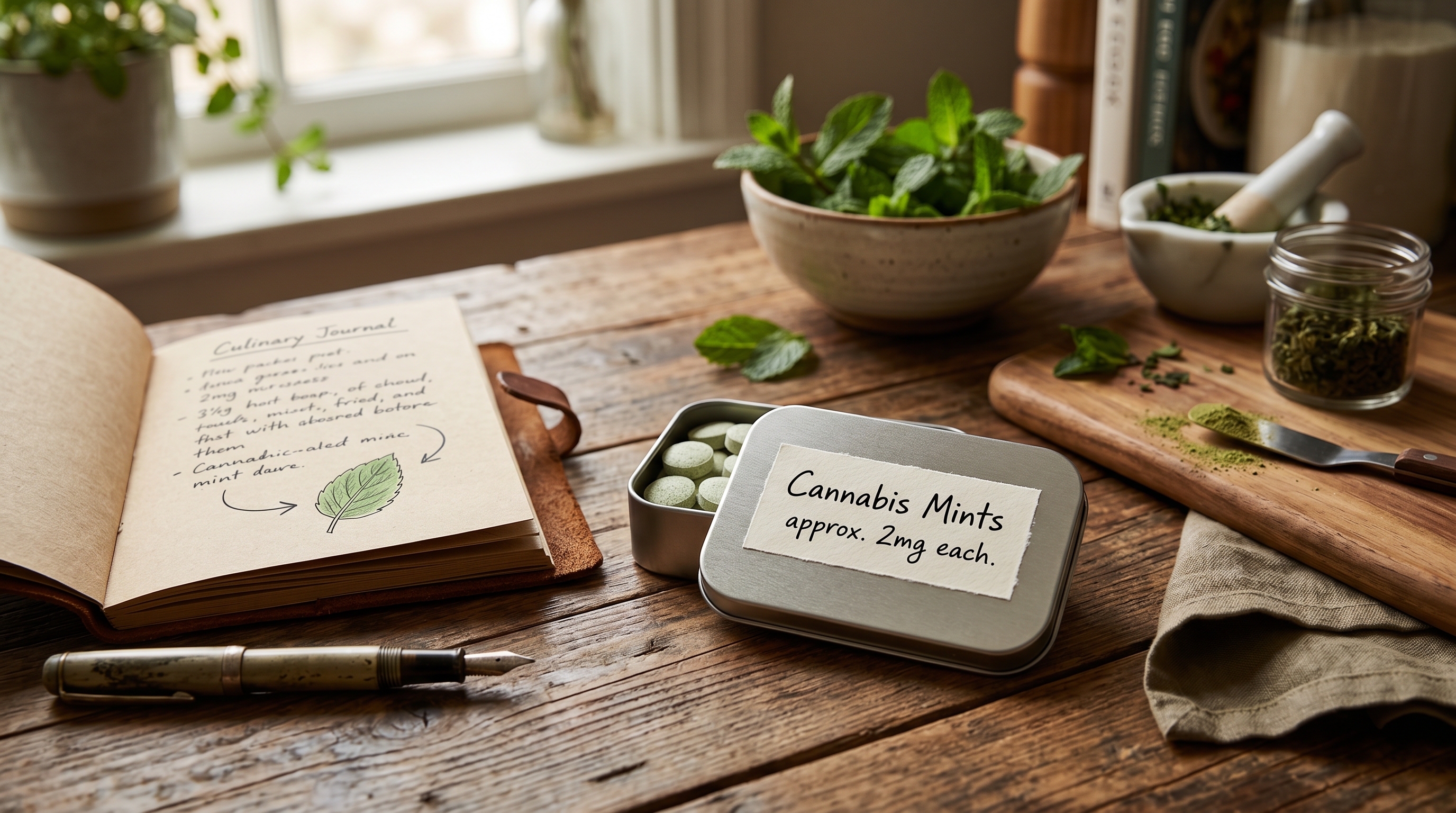
- Label every container with the contents, the per-piece dose (“~2 mg THC each”), the batch date, and a clear “CANNABIS — NOT CANDY” warning.
- Keep them locked away from children, pets, and unsuspecting guests. An unlabeled tin of “mints” is how accidents happen.
- Store airtight, cool, and dark. Light and heat degrade cannabinoids over time, so a closed tin in a cupboard beats a clear jar on the counter.
- Know your local laws. Making infused products at home is legal in some places and not others; this is an educational recipe, not legal advice.
Track what actually works for you
The real payoff of a precise, repeatable mint is that it turns vague vibes into usable data. Once every piece is ~2 mg, you can finally notice patterns: maybe a Balance-style source at 2 mg is your sweet spot for focused afternoons, while a Relax-leaning batch at the same dose is strictly an evening thing. That is the kind of self-knowledge that makes cannabis predictable instead of hit-or-miss.
This is exactly why we built the High IQ app — to log what you took, the dose, the source’s terpene profile, and how it actually felt, so your patterns become obvious over time. The strain (or source) matters less than how you respond to its profile, and the only way to learn that is to pay attention. If you want to keep experimenting, our cannabis edibles starter guide and terpenes explained are good next stops for some gentle research.
Make a small batch. Do the math. Label the tin. Start with one mint, and let your own notes — not the package copy — tell you what works.
Key Takeaways
- Microdosing means small on purpose — usually 1 to 2.5 mg THC per piece, aimed at subtle, functional, daytime-friendly effects. Responses vary, so any number is a starting point, not a promise.
- Precision is everything at this scale. Start from a lab-tested tincture or distillate, and do the math first: total THC = mints × target dose; tincture volume = total THC ÷ potency per mL.
- Mints win on control and onset. Uniform mold cavities portion the dose for you, and letting a mint dissolve sublingually may bring on effects faster than a swallowed edible — though absorption is partial and individual.
- Label and lock up every tin. Homemade mints look exactly like candy, so clear labeling and child- and pet-safe storage are non-negotiable.
- Track what works. Once each piece is consistent, you can finally learn your own patterns instead of trusting package copy.
Sources
- BATCH — THC Micro Mints (1 mg THC + 1 mg CBD)
- King Harvest — Microdosing Cannabis: Benefits, Dosing Guide, and Safety FAQs
- Union Chill — Cannabis Microdosing Guide: Functional Doses
- Destiny Recovery Center — What Is a Microdose of THC? (1mg vs 2.5mg vs 5mg Explained)
- MunchMakers — Complete Guide to Microdosing Cannabis: Benefits, Methods & Dosing
- Fruit & Flower — Recipe: Curiously Stoned Mints (tincture dosing + silicone mold method)
Educational content only. This is not medical or legal advice. Cannabis affects everyone differently; start low, go slow, and follow the laws where you live.


