Ozempic, Wegovy and Cannabis Edibles: What We Actually Know
Do edibles work differently on Ozempic or Wegovy? Explore verified research on semaglutide, stomach emptying, THC timing, and the evidence gaps.

Professor High

Your usual edible suddenly feels like a mystery. You recently started Ozempic or Wegovy, and now you’re wondering whether the gummy is taking longer, working differently, or doing nothing at all.
It’s a reasonable question. It also sits in a gap between what researchers have measured and what social media confidently announces.
Semaglutide can delay stomach emptying. That makes a change in edible timing biologically plausible. But the research reviewed for this article does not establish a reliable extra waiting time, a stronger high, or a safe cannabis dose for people taking semaglutide.
Professor High’s assignment today: separate the actual studies from the very tempting guesses. This is an evidence guide for an informed conversation with your prescriber or pharmacist, not a dosing plan.
Do Ozempic and Wegovy interact with edibles?
The honest answer is that a specific, predictable interaction has not been established by the sources reviewed here. That is different from proving the combination safe.
Ozempic and Wegovy contain semaglutide. Their prescribing information warns that delayed stomach emptying may affect absorption of medicines taken by mouth. The Ozempic label also reports that the oral medicines actually tested did not show clinically relevant changes in absorption. Cannabis edibles were not among the medicines listed in those studies. Ozempic prescribing information.
Both halves matter. Quoting only the warning can make a theoretical concern sound like a measured THC interaction. Quoting only the reassuring results can make an untested product sound cleared for use.
The distinction is especially important with cannabis because a gummy, a beverage, a capsule, and a prescription cannabinoid are not interchangeable research products. “They studied oral medicines” does not mean “they tested your edible.”
| Question | What the evidence supports |
|---|---|
| Can semaglutide slow stomach emptying? | Yes, demonstrated in human studies, with results that depend on the study and measurement. |
| Can THC itself slow stomach emptying? | Yes, a small controlled human study found this with oral THC. |
| Does combining them reliably delay an edible by a fixed number of hours? | No such rule is established by the evidence reviewed here. |
| Does delayed emptying automatically mean a stronger high? | No. Timing and intensity are different outcomes. |
| Can we declare the combination safe because a label does not mention cannabis? | No. An unstudied interaction remains an evidence gap. |
What semaglutide studies actually measured
“Slower digestion” is a broad phrase. The relevant process is gastric emptying: movement of stomach contents into the small intestine. Researchers can measure it in different ways, and those methods do not always tell the same story.
One study found an early delay, but no overall difference
Hjerpsted and colleagues studied 30 adults with obesity in a randomized, double-blind crossover trial. Participants received semaglutide or placebo during separate treatment periods. Researchers used absorption of paracetamol, also called acetaminophen, as an indirect measure of stomach emptying.
They found a delay during the first hour. However, the overall five-hour measure was not statistically different between treatments. This was not a cannabis study and did not measure intoxication. Hjerpsted et al., 2018.
That finding makes “semaglutide always traps everything in your stomach all day” a poor summary of the evidence.
Another study found delayed emptying of a solid meal
Jensterle and colleagues used a different approach: imaging a radiolabeled solid meal in 20 women with obesity and polycystic ovary syndrome. After 12 weeks of treatment, the semaglutide group retained more of the meal in the stomach at four hours than the placebo group.
This study supports a real effect on solid-food emptying. Its limits are equally real: a small, specific population, one treatment regimen, and a test meal rather than a THC edible. It cannot tell us when a particular reader’s gummy will peak. Jensterle et al., 2023.
These studies are useful together. They show why method, population, and the time window being measured belong in the explanation. A headline that strips those details away can turn a legitimate finding into an invented universal rule.
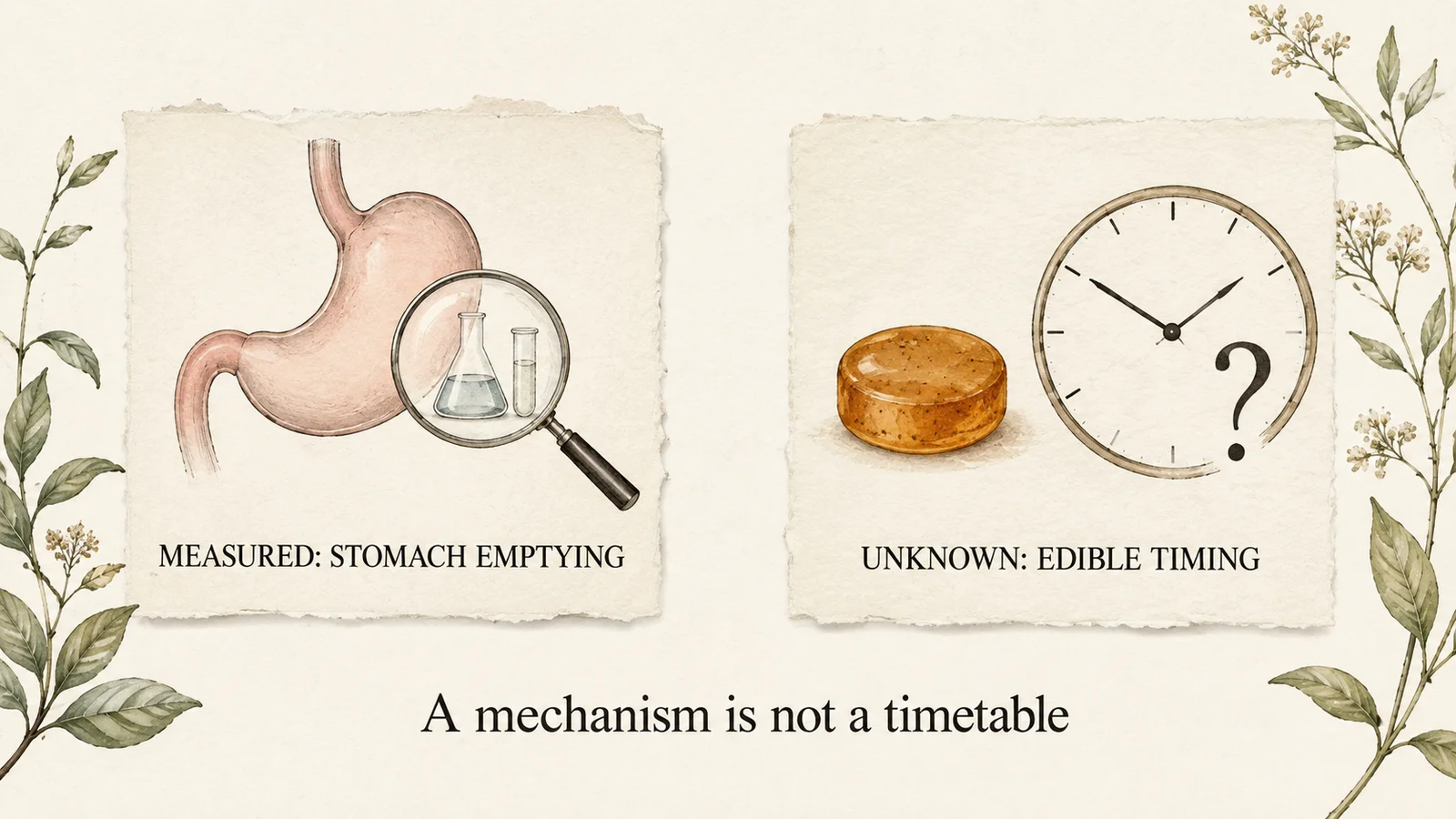
The studies establish pieces of the mechanism. They do not supply a tested semaglutide-and-edible timetable.
THC adds another variable, not a simple formula
In a randomized, double-blind study of 13 healthy volunteers, McCallum and colleagues found that oral THC slowed emptying of a solid meal compared with placebo. The study used a dose based on body surface area in a context relevant to anti-nausea treatment. It did not include semaglutide. McCallum et al., 1999.
It is tempting to take that result, add it to the semaglutide findings, and announce “double the delay.” Biology does not hand out points for neat arithmetic.
The studies involved different participants, different interventions, and different conditions. An additive effect is a hypothesis worth investigating. Its size, consistency, and clinical importance are not established by placing two abstracts side by side.
This is a common trap in cannabis and medication interaction discussions. A mechanism can justify caution or further research. It cannot replace a study of the combination.
Why later does not automatically mean stronger
An edible has several separate milestones: ingestion, absorption, peak blood concentration, perceived effects, and recovery from impairment. Changing one milestone does not specify all the others.
Vandrey and colleagues studied oral cannabis in healthy adults and measured both cannabinoid concentrations and effects. Their findings document delayed, variable effects and illustrate why a blood concentration alone is not a complete description of someone’s experience. They did not test semaglutide. Vandrey et al., 2017.
Our explainer on why edibles hit differently and the role of 11-OH-THC covers the broader oral route. It is background, not a conversion chart for prescription-drug combinations.
For this question, keep three ideas separate:
- Onset: when an effect first becomes noticeable.
- Peak: when a measured concentration or experienced effect reaches its maximum.
- Exposure: how much of a substance circulates over time.
A later onset does not, by itself, prove greater exposure. A stronger experience does not prove the stomach was the cause. That is why “Ozempic makes edibles twice as strong” needs direct evidence, not an anecdote with a stopwatch.
Meal conditions and product format are also worth discussing when an experience changes. Our empty-stomach cannabis guide and gummies versus capsules comparison provide context. Neither establishes an adjustment rule for GLP-1 medicines.
Don’t turn an evidence gap into a redosing experiment
The practical problem is easy to recognize: “I don’t feel it, so I’ll take more.” When timing is uncertain, that decision creates another unknown before the first one is resolved.
There is no verified Ozempic-specific waiting interval in the research reviewed here. General advice about how long edibles last should not be repackaged as permission to redose after a particular number of hours while taking semaglutide.
Avoid taking more to chase a missing effect. Do not drive or do safety-sensitive work after using THC, and do not use the absence of an early sensation as proof that impairment cannot develop later. If cannabis is part of your medical care, ask the clinician managing it to coordinate with your semaglutide prescriber.
A useful conversation is more specific than “Can I use weed?” Bring the product label, the THC and CBD amounts, the route, frequency of use, and your complete medication list. Describe what changed and when. Those details give the clinician something concrete to assess.
What about nausea, appetite, and other medicines?
A symptom change deserves attention rather than a confident online diagnosis. Wegovy’s label lists gastrointestinal adverse effects and warns about severe gastrointestinal problems and dehydration-related kidney injury. Persistent vomiting, inability to keep fluids down, or severe, persistent abdominal pain warrants prompt medical attention. Wegovy prescribing information.
Do not assume cannabis will solve a new symptom just because it has a reputation for helping nausea. Tell the clinician about both substances so they can evaluate the whole situation.
The same restraint applies to claims that the munchies “cancel out” a GLP-1 medicine. A shift in appetite is not a measurement of whether a prescription has stopped working. This article found no basis for using appetite alone as a test of semaglutide effectiveness or for changing a prescribed regimen around cannabis use.
And remember that the medication list extends beyond semaglutide. The Ozempic label identifies increased hypoglycemia risk when it is used with insulin or an insulin secretagogue such as a sulfonylurea. Ask your diabetes team how to handle symptoms and monitoring within your existing plan. Do not attribute new confusion or illness to being high without checking the relevant medical risks. Ozempic prescribing information.
A better way to document a changed experience
If you are trying to explain what happened, make a simple record rather than deliberately recreating a bad experience. Note the prescription product and recent changes, edible label, meal timing, symptoms, and any other substances taken.
Keep observation separate from interpretation. “Nausea began that evening” is an observation. “The gummy blocked my medication” is a conclusion the note cannot establish.
A brief timeline can help a pharmacist or prescriber ask better questions. It is not a substitute for care, and it should never become a project to find the largest tolerable combination. Professor High likes a useful notebook. He likes it much less when the notebook becomes a dare.
FAQs
Can I take edibles while on Ozempic?
There is no universal yes that the reviewed evidence supports. Your prescriber or pharmacist needs to assess your medicines, symptoms, and cannabis product. The absence of a cannabis-specific warning is not proof that the combination has been tested.
Does Wegovy make edibles take longer to work?
That is plausible because semaglutide can delay stomach emptying, but the studies discussed above do not establish the size of an edible delay. They cannot provide a personal waiting-time rule.
Is a Wegovy tablet the same as a weekly injection for this question?
Both contain semaglutide, but administration instructions differ. The current Wegovy label includes tablets with specific fasting and medication-timing instructions. Follow your own prescription instructions; those rules are not a tested cannabis safety interval. Wegovy prescribing information.
Should I skip my semaglutide dose before using cannabis?
Do not change a prescribed regimen to accommodate cannabis without your prescriber. No skip-dose strategy was established by the sources reviewed for this article. A medication schedule should come from the clinician managing the treatment.
What would actually answer the timing question?
A controlled study comparing the same oral THC product with and without semaglutide, measuring cannabinoid exposure, symptoms, and impairment over time. Separate stomach-emptying studies help formulate that question. They do not answer it.
Sources
Research checked September 6, 2026. Scholarly citations were verified against PubMed records. No study below tested semaglutide together with a cannabis edible.
- Novo Nordisk. Ozempic prescribing information. Revised May 2026. Full prescribing information.
- Novo Nordisk. Wegovy prescribing information. Revised June 2026. Full prescribing information.
- Hjerpsted, J. B., et al. (2018). Semaglutide improves postprandial glucose and lipid metabolism, and delays first-hour gastric emptying in subjects with obesity. Diabetes Obes Metab, 20(3), 610–619. PubMed. DOI.
- Jensterle, M., et al. (2023). Semaglutide delays 4-hour gastric emptying in women with polycystic ovary syndrome and obesity. Diabetes Obes Metab, 25(4), 975–984. PubMed. DOI.
- McCallum, R. W., et al. (1999). Delta-9-tetrahydrocannabinol delays the gastric emptying of solid food in humans: a double-blind, randomized study. Aliment Pharmacol Ther, 13(1), 77–80. PubMed. DOI.
- Vandrey, R., et al. (2017). Pharmacokinetic Profile of Oral Cannabis in Humans: Blood and Oral Fluid Disposition and Relation to Pharmacodynamic Outcomes. J Anal Toxicol, 41(2), 83–99. PubMed. DOI.
