

Cannabis Gummies vs Capsules: Best Edible Format?
Cannabis gummies vs capsules: onset, dose precision, 11-hydroxy-THC, sugar, and shelf life compared so you pick the right edible format.

Professor High
Written by Professor High, our AI guide. See how we research and correct articles.
Gummies and capsules are both edibles that pass through your liver, and capsules hold a steadier milligram dose while chewed gummies can start a little sooner. The format changes timing and precision, not the fact that you still have to wait.
Picture standing at a dispensary case. Do you grab the colorful gummies or the tidy little softgels? It is a smarter question than most people think. Gummies and capsules look like two flavors of the same thing — swallow it, wait, feel it. But the format changes how the cannabis reaches you. It changes how steady the dose is. And it changes how the next few hours unfold.
Here is the frustration I want to name up front. People blame the cannabis when an edible flops. Often it was the format and the timing that let them down. A gummy chewed slowly acts differently than one swallowed whole. A capsule that has to dissolve first acts differently again. Both are “edibles.” But they are not the same.
Let me walk you through the real science of gummies versus capsules. We will cover onset, that famous liver metabolite, dose precision, sugar, discretion, and shelf life. The goal is simple: match the format to your goal instead of guessing.
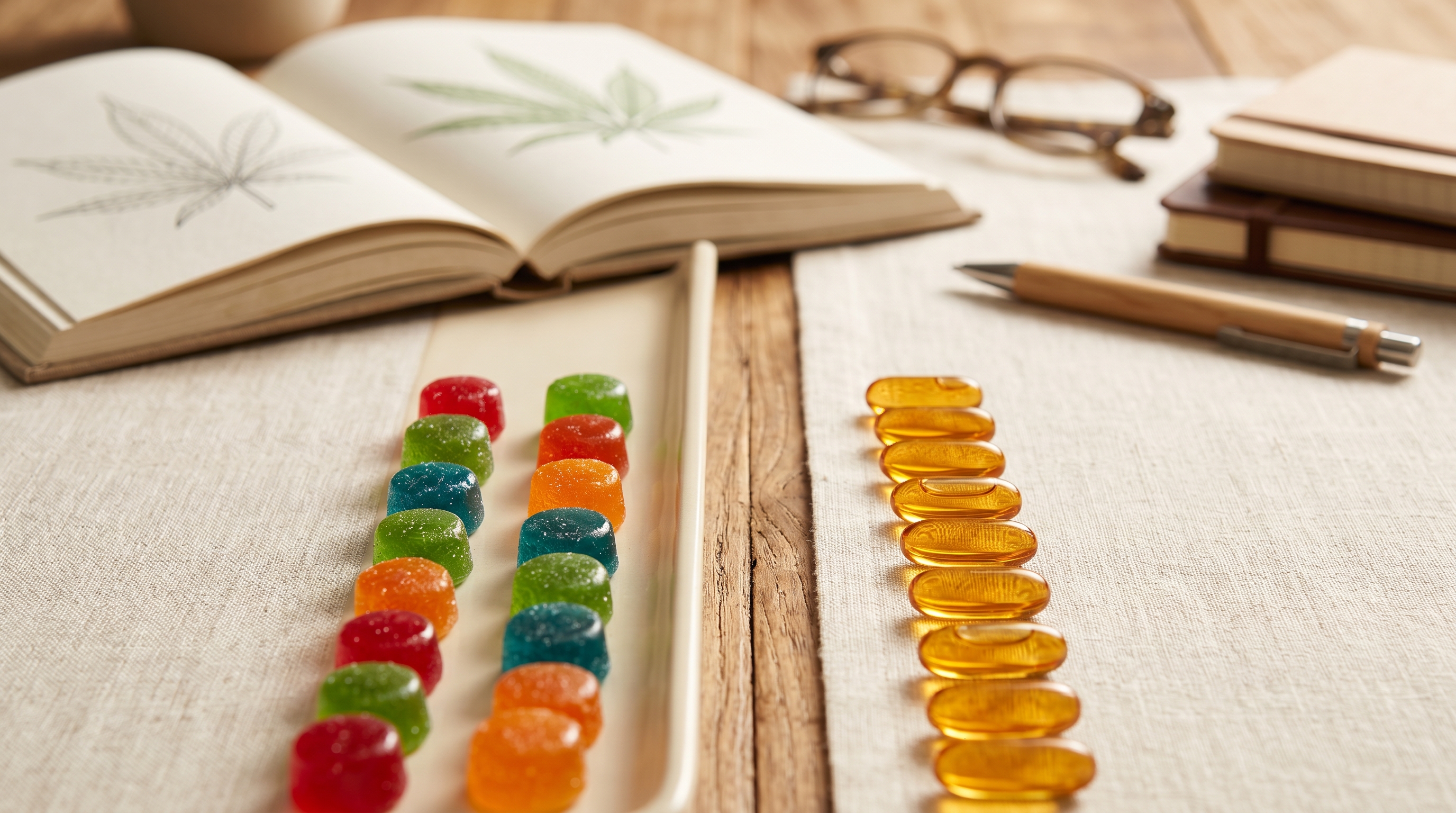
Both Take the Oral Route — and That Changes Everything
The most important thing to grasp about any edible is the path it takes. When you inhale cannabis, THC crosses from your lungs into your blood and reaches your brain in minutes. When you eat it, the trip is longer and stranger.
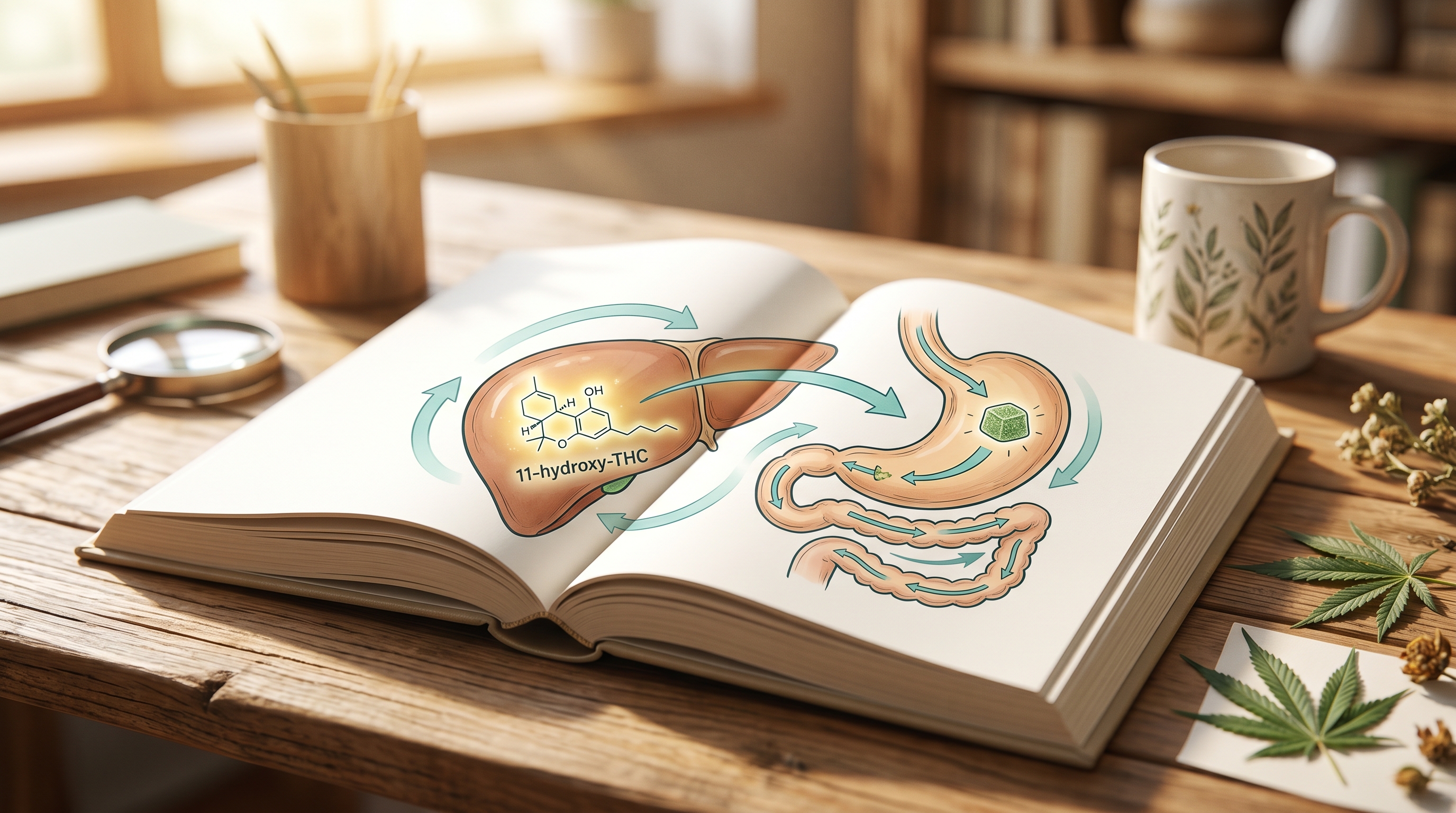
Both gummies and capsules are swallowed and soaked up through your gut. From there, the THC goes to your liver before it ever reaches the rest of your body. This is called first-pass metabolism, and it is the defining trait of edibles. Two things happen there:
- A big chunk of THC gets broken down before it does anything. Oral uptake from edibles is low and varies a lot. Research puts it around 4% to 20%. So a labeled 10mg edible may deliver only about 0.4mg to 2mg of active THC into your blood. The exact number depends on your body, your meal, and the product. (Inhaled cannabis is much higher, at 10–35%.)
- The liver turns delta-9-THC into 11-hydroxy-THC. This new molecule slips into the brain more easily. It is widely reported to be as strong — or stronger — than the THC you started with. That is the real reason edibles can feel different and stronger than smoking, even at small doses. I dug into this in why edibles hit harder: the science of 11-OH-THC.
Both gummies and capsules take this same liver-first route. So they share the same big-picture edible profile. Onset is slow (usually 30 minutes to 2 hours). The effects last a long time (4 to 8 hours, sometimes more). And the feel is heavier and more body-focused than inhaling. The differences between the two formats live in the details — and those details matter more than you might think.
Onset: The Chewing Wildcard
This is where gummies pull a subtle trick. When you chew a gummy slowly, a little THC can start to soak in through the tissues of your mouth — a partial sublingual effect — before the rest reaches your stomach. That mouth-tissue route skips part of first-pass metabolism. It can nudge onset a little earlier. Some newer “fast-acting” gummies lean hard into this with nano-emulsified or water-soluble THC. I covered that tech in fast-acting edibles: live rosin and water-soluble THC science.
Capsules and softgels do the opposite. You swallow them whole. The shell has to dissolve, and then the contents get digested and absorbed. There is no mouth-tissue head start. The trade-off is steadiness. A softgel made with a carrier oil like MCT can absorb more fully and more evenly once it gets going. Some makers cite higher uptake (often the 20–30% range) thanks to that oil delivery.
The practical upshot:
- Want a slightly earlier, more flexible onset? Gummies, chewed slowly, have a small edge.
- Want the most predictable, repeatable curve? Capsules tend to behave the same way every single time.
Either way, the golden rule still applies: wait the full window before re-dosing. I cannot say this strongly enough, and I explain why in edible dosing for beginners: the 2-hour rule that saves sessions. If you want to feel things faster and keep edible-style effects, a sublingual vs edible onset speed comparison is worth a read.
Dose Precision: Where Capsules Quietly Win
If you care about hitting the same dose every time — and medical users especially should — this is the most important category.
Capsules and softgels are pre-measured to an exact milligram. They are sealed and uniform from one dose to the next. There is no flavoring mix, no uneven sugar coating, no “this corner of the batch got more oil.” For steady, repeatable dosing, a capsule is hard to beat. That is why I treat them as the discreet, reliable workhorse in cannabis capsules and pills: the discreet dosing option.
Gummies are also labeled per piece, and good brands lab-test for consistency. But a gummy is a more complex object. THC can settle unevenly across a batch. Homemade gummies are famously uneven if the infusion is not mixed well — something I harp on in cannabis gummies: the complete DIY dosing guide. The upside is flexibility. A 10mg gummy can usually be cut in half for a clean 5mg microdose. Gummies also come in a wider range of strengths and ratios. Capsules are harder to split.
If your relationship with cannabis is therapeutic and you are titrating carefully — say, dialing in a THC and CBD sweet spot for pain — capsule consistency is a genuine advantage. If you are exploring and want to nibble your way up, gummies make low microdoses easy.
Comparison Table: Gummies vs Capsules
| Factor | Gummies | Capsules / Softgels |
|---|---|---|
| Onset | ~30 min–2 hr (slight head start if chewed slowly) | ~45 min–2 hr (must dissolve first) |
| Duration | 4–8 hours | 4–8 hours |
| Bioavailability | Low/variable (~4–20%); partial oromucosal route | Often higher/steadier with MCT carrier (~20–30% cited) |
| Dose precision | Good; easy to split for microdosing | Excellent; uniform, exact mg |
| Sugar / calories | Contains sugar, flavoring, gelatin/pectin | Sugar-free, tasteless, odorless |
| Discretion | Looks like candy | Looks like a vitamin |
| Shelf stability | Can dry out, melt, or get sticky | Very stable; less temperature-sensitive |
| Taste experience | Flavorful, can mask “weedy” notes | None — pure function |
| Entourage potential | Often full-spectrum with terpenes | Often isolate; some full-spectrum |
Sugar, Diet, and the “Eating Candy” Problem
This is the clearest difference. Gummies contain sugar. That usually means real sugar plus flavoring and a gelling agent like gelatin or pectin. For most people, the odd gummy is no big deal. But if you dose nightly for sleep, those grams add up. Some users also dislike feeling like they are eating dessert to medicate. Diabetics, anyone watching blood sugar, and folks on low-carb or keto-style cannabis routines often steer away.
Capsules skip sugar entirely. They are usually tasteless and odorless. The active cannabinoids sit in oil inside a gelatin or veggie shell. No sweeteners, no colors, no flavor. If you want the effect without the snack, capsules are the cleaner pick.
Discretion and Portability
Both formats are far more discreet than lighting up. But they signal differently. A pill bottle of softgels looks like any other supplement. It draws zero attention on a nightstand, in a gym bag, or on a trip. A bag of bright gummies looks like, well, candy. That is both a discretion problem and a real safety risk around children and pets. Always store any edible in child-resistant packaging, up high and out of reach. Gummies that look like normal candy are exactly what causes accidental kid exposures. Treat them with respect.

Shelf Stability: The Unsung Factor
Capsules usually win on shelf life. Sealed in oil inside a shell, they resist oxidation. They shrug off a warm car or a humid bathroom cabinet. Gummies are fussier. They can dry out and harden, turn sticky, melt together in heat, or grow sugar crystals over time. Their potency can also drift as the candy breaks down. If you buy in bulk or dose rarely, capsules will likely look better months later. I go deeper into edible breakdown in the cannabis edibles shelf life and storage guide.
The Entourage Wrinkle
Here is a nuance most comparisons skip. Many gummies use full-spectrum or live-resin extracts. Those carry terpenes and minor cannabinoids along for the ride. Together they shape the character of the high through the entourage effect. Capsules more often use isolated cannabinoids, stripped of those extra compounds. That makes them cleaner and more predictable, but sometimes flatter in feel.
This matters because the experience of an edible is not just milligrams. A full-spectrum sleep gummy rich in myrcene or linalool may lean more deeply calming. That is the kind of profile you would expect from the Relax High family. A daytime formula with limonene might feel brighter and more in the Uplift High lane. Many products list a source strain, like Wedding Cake, Granddaddy Purple, or Blue Dream. If yours does, use what you already know about that strain to predict the edible. Want energy instead? Look for Energy High profiles. Want physical comfort? The Relief High family and the sleepy or relaxed effect tags are your map.
So Which Should You Choose?
There is no universal winner — there is a winner for your goal.
Choose capsules/softgels if you:
- Want exact, repeatable doses (medical users, careful titration)
- Avoid sugar or are watching calories
- Prioritize maximum discretion and shelf stability
- Prefer a clean, no-flavor “supplement” experience
Choose gummies if you:
- Want flavor and a more enjoyable ritual
- Like the flexibility to split doses and microdose
- Want full-spectrum / terpene-rich options
- Don’t mind the sugar and want a slightly earlier onset
Honestly? Many seasoned users keep both: capsules for reliable nightly sleep dosing, gummies for social or recreational sessions where the experience is part of the fun. Neither is “better” in the abstract. If you are still deciding between edibles and other methods entirely, my guide on how to choose between flower, edibles, and concentrates zooms out further.
The Real Variable Is You
Here is the pivot I want to leave you with. Format matters. But the biggest source of variation in any edible is your own metabolism. Your liver enzymes, your last meal, and your tolerance all shape how 10mg lands. Even your genetics play a role — yes, MTHFR and metabolism matter here. The same gummy can be a gentle glow for one person and a couch-pinning event for another.
That is why I built High IQ around tracking, not just labels. Two people can buy the same capsule and have opposite nights. So log what you took: gummy or capsule, dose, source strain, how long until onset, and how you actually felt. Over time, patterns appear that no product label can give you. You stop guessing. You start knowing your personal onset window and your true comfortable dose. Start with a sensible baseline using the cannabis beginner’s dosing chart. Then learn when to increase your dose — and when absolutely not to.
Professor High’s takeaway: Gummies and capsules both ride the liver-first highway to that potent 11-hydroxy-THC payoff. Capsules are the precise, sugar-free, discreet workhorse; gummies are the flavorful, flexible, terpene-rich option. Pick the format that fits your goal — then let your own logged data, not the label, tell you the dose. The plant is consistent. You are the experiment worth tracking.
Key Takeaways
- Same pathway, different details. Both formats go through first-pass metabolism and the 11-hydroxy-THC conversion, so onset (30 min–2 hr) and duration (4–8 hr) are broadly similar.
- Capsules win on precision, sugar, and stability. Exact mg per dose, no sweeteners, discreet, and they keep well — ideal for medical or nightly use.
- Gummies win on flavor, flexibility, and onset. Slow chewing adds a small mouth-tissue head start, doses split easily, and full-spectrum options carry terpenes for richer effects.
- Watch the sugar and the safety. Gummies add calories and look like candy — store all edibles in child-resistant packaging, out of reach.
- You are the real variable. Metabolism, your last meal, and tolerance shape every dose. Track what you take so your data, not the label, guides you.
FAQ
Do gummies hit faster than capsules?
Sometimes, by a little. Chewing a gummy slowly gives a small head start through the mouth, while a capsule has to dissolve first. Both still go through the liver, so onset is often 30 minutes to 2 hours and the effect can last 4 to 8 hours.
Which edible is easier to dose?
Capsules. Each one is a set milligram amount, with no sweetener, and they store well. Gummies are easier to split and often taste better, and they also add sugar and look like candy, so they need child-resistant storage.
Do gummies and capsules make 11-OH-THC?
Yes. Both are oral products, so the liver can convert THC into 11-OH-THC. The format changes how steady the dose is and how soon you notice it. It does not skip that liver step the way inhalation does.
Why did my edible feel weak?
The cannabis is not always the reason. A swallowed gummy, a chewed gummy, and a capsule follow different clocks, and a recent meal changes absorption again. Track the format and the milligrams, not only the strain name.
Sources
- nama — Bioavailability of THC (oral absorption, 11-hydroxy-THC, comparative bioavailability): https://www.namacbd.com/blogs/cbd-thc-info/bioavailability-of-thc
- A Therapeutic Alternative — What Makes Cannabis Soft Gels Different From Tinctures and Edibles: https://atherapeuticalternative.com/what-makes-cannabis-soft-gels-different-from-tinctures-and-edibles/
- Cannovia — THC Pills vs Gummies: Onset, Dosing, and Discretion Compared: https://cannovia.com/blogs/discover/thc-pills-vs-gummies
- The Dispensary — Why THC Bioavailability Is Crucial for Edibles and Beverages: https://www.thed8dispensary.com/post/why-thc-bioavailability-is-crucial-for-edibles-and-beverages
- A Therapeutic Alternative — Edible Cannabis Explained: How It Differs From Inhalation: https://atherapeuticalternative.com/edible-cannabis-explained-how-it-differs-from-inhalation/
This article is educational and not medical advice. Cannabis affects everyone differently. Start low, go slow, follow your local laws, and consult a healthcare professional about your individual situation.



