How Long Do Edibles Last? An Hour-by-Hour Timeline
Edibles often take 30 minutes to 2 hours to start and may last 4–8 hours. See the full timeline, peak window, and next-day safety notes.

Most swallowed THC edibles begin to feel noticeable in about 30 minutes to 2 hours, feel strongest around 2 to 4 hours, and produce noticeable effects for roughly 4 to 8 hours. A strong dose can last 12 hours, while drowsiness or other residual effects may linger into the next day—sometimes up to 24 hours [Health Canada, 2026].
That is the useful answer, but it is not a countdown clock. A gummy can follow a different curve than a brownie. The same product can feel different after dinner than it did on an empty stomach. Dose, tolerance, food, medications, product formulation, and individual metabolism all move the timeline.
This guide maps the usual arc of a swallowed, THC-containing edible from hour zero through the following morning. It focuses on duration, not on choosing a dose. For that separate question, use our beginner edible dosing guide.
Key Takeaways
- Onset is usually delayed: effects often begin within 30 minutes to 2 hours, but full effects can take up to 4 hours.
- The strongest period commonly arrives later than people expect: controlled studies found peak subjective effects around 1.5 to 3 hours; Health Canada gives a broader 2-to-4-hour window.
- The main experience often lasts 4 to 8 hours: stronger or slower-moving experiences may last up to 12 hours.
- The next morning is not automatically clear: drowsiness and other residual effects can persist for as long as 24 hours.
- Feeling “not that high” is not a driving test: do not drive or operate machinery while impaired, and make transportation plans before consuming.
- The classic edible mistake is adding more during the quiet opening act: the first serving may still be climbing when a second one is swallowed.
The Edible Timeline at a Glance
| Time after eating | What may be happening | Best safety move |
|---|---|---|
| 0–30 minutes | Digestion has started; many people feel no clear THC effect | Record the time and leave the package alone |
| 30–60 minutes | Early effects may appear, but many people still feel little | Do not assume the edible failed |
| 1–2 hours | Effects often become more obvious and continue rising | Stay in a familiar place; avoid alcohol |
| 2–4 hours | Common strongest-effects window | Treat this as an impaired period; do not drive |
| 4–6 hours | Many experiences begin a gradual comedown | Keep plans simple and low-risk |
| 6–8 hours | Main effects often fade, though some people remain clearly affected | Reassess honestly; “less high” can still mean impaired |
| 8–12 hours | A long tail is possible, especially after more THC | Rest, hydrate normally, and avoid safety-sensitive tasks |
| 12–24 hours | Residual drowsiness or fogginess may remain | If you do not feel fully normal, do not drive or work with hazards |
These ranges synthesize public-health guidance and controlled human research; they are not promises. In one controlled brownie study, effects began at 30 to 60 minutes, peaked from 1.5 to 3 hours, and gradually declined through the eight-hour observation period [Vandrey et al., 2017]. Health Canada advises that full effects can take up to four hours, effects can last up to 12 hours, and some residual effects can last up to 24 hours [Health Canada, 2026].
Hour 0 to 1: The Quiet Window
You eat the edible. Your digestive system begins breaking down its food matrix, and THC starts moving toward the small intestine, where much of its absorption occurs. It then travels through the portal circulation to the liver before reaching the rest of the body.
That detour is why swallowing THC is so different from inhaling it. Your liver converts some delta-9-THC into the active metabolite 11-hydroxy-THC. Our explainer on why edibles can hit harder covers that pathway in detail.
During the first 30 minutes, feeling nothing is ordinary. Between 30 and 60 minutes, subtle changes may begin: a shift in attention, altered time perception, dry mouth, relaxation, or a sense that sound and light feel different. But plenty of people still feel no obvious change.
This quiet period causes the most preventable problem in edible use: the effect is delayed, but the decision to eat more is immediate. The CDC notes that this 30-minute-to-2-hour delay can lead people to consume too much, increasing the risk of poisoning or injury [CDC, 2024]. Even the familiar “two-hour rule” can be too aggressive for some products and people because public-health guidance says full effects may take four hours.
If you want the mechanics of pacing rather than this timeline, read when to increase a cannabis dose—and when not to. The duration lesson is simpler: silence in hour one does not predict the rest of the night.
Hours 1 to 2: The Climb
For many people, the edible declares itself somewhere in this window. Effects may build gradually enough that there is no single “kick-in” moment. Others experience a more abrupt change.
In a controlled study of 17 adults who had not used cannabis for at least 60 days, active oral-cannabis effects did not appear until 30 to 60 minutes, and the strongest effects occurred 1.5 to 3 hours after ingestion [Schlienz et al., 2020]. That study used brownies containing 10, 25, or 50 milligrams of THC under laboratory conditions. It shows the shape of the curve—not what any specific retail gummy will do for you.
This is also when two swallowed servings can begin overlapping. If a second serving was added because the first seemed inactive, it does not replace the first; it joins it. That stacking can turn a manageable climb into an unexpectedly intense peak. Our high-dose versus microdose edible comparison explains why dose changes the experience, but the timeline rule remains: more THC can make the curve taller, longer, or both.
Keep the environment boring in the best possible way. Do not drive. Do not cook over an open flame, swim alone, bike in traffic, or make decisions that depend on quick reactions. Mixing cannabis with alcohol can increase impairment, so the safer choice is not to combine them; see our guide to what happens when cannabis and alcohol mix.
Hours 2 to 4: The Likely Peak Window
This is the center of gravity for a conventional swallowed edible. Health Canada says the strongest effects may occur two to four hours after eating or drinking cannabis [Health Canada, 2026]. Controlled laboratory work has found a somewhat tighter 1.5-to-3-hour peak under specific conditions [Vandrey et al., 2017; Schlienz et al., 2020]. Both can be true: a study average is narrower than the range needed for public guidance.
At the peak, desirable and undesirable effects can both become more noticeable. Relaxation, altered sensory perception, laughter, appetite, and time distortion may intensify. So can sleepiness, anxiety, a racing heartbeat, poor coordination, dizziness, nausea, or confusion.
The peak is not always a sharp summit. It may feel like a plateau that holds for an hour or more. And a blood THC number cannot function like a blood-alcohol number for this purpose. In the Vandrey study, oral cannabis produced strong subjective effects despite comparatively low blood THC concentrations, and relationships between cannabinoid levels and performance were not orderly enough to turn a blood level into a personal impairment meter [Vandrey et al., 2017].
If the experience becomes uncomfortable, stop consuming cannabis, move to a calm place, and ask a trusted sober person to stay nearby. Our guide to feeling too high focuses on supportive steps, while the science of greening out explains common symptoms. Neither is a substitute for urgent help when warning signs are present.
Hours 4 to 6: The Long Plateau or Early Comedown
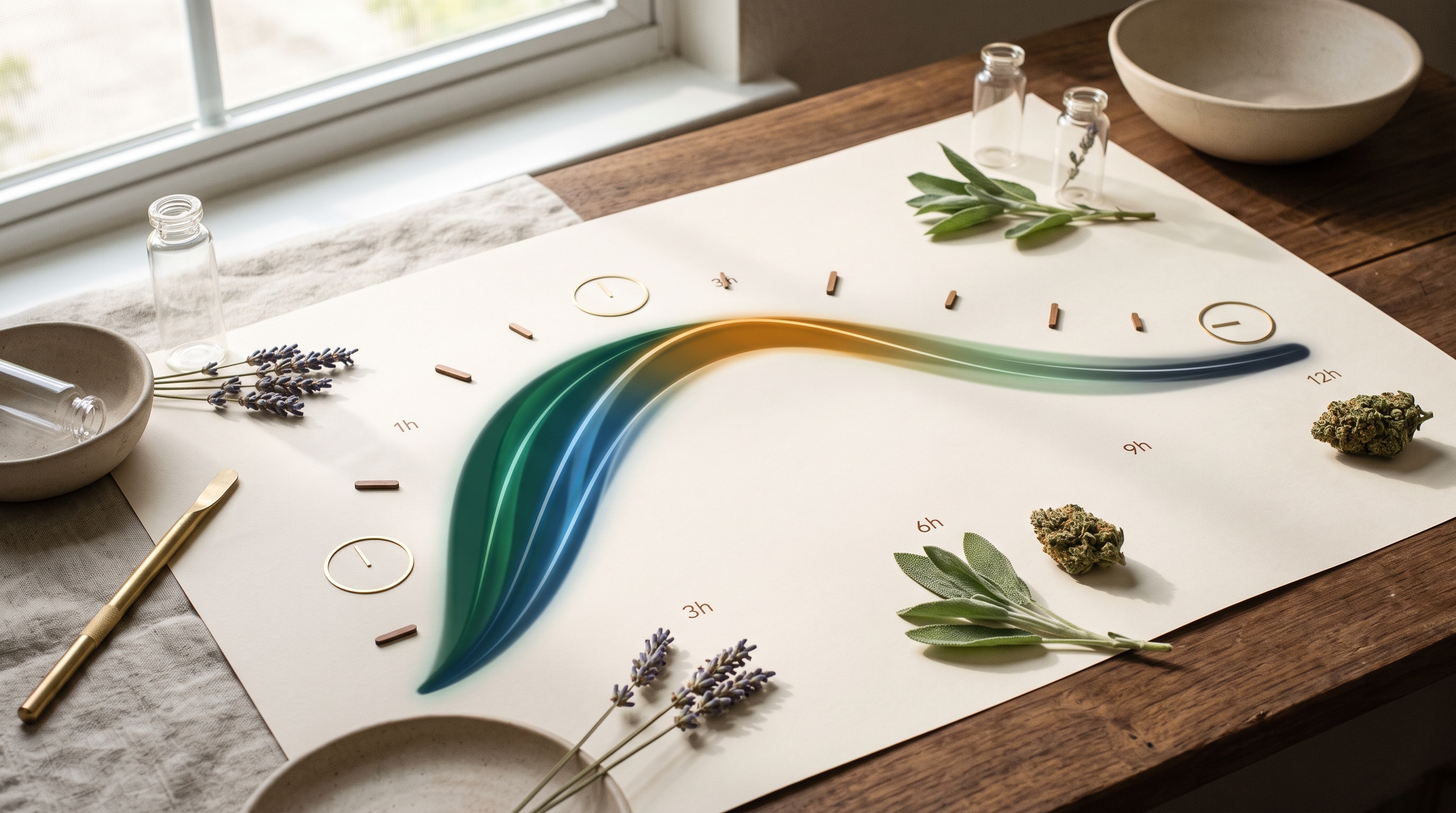
By hour four, some people are clearly descending. Others remain near the peak, particularly after a larger amount, a slow-digesting meal, or a product with a delayed formulation. “I am past the peak” should mean the effect is becoming less intense, not “I am sober.”
In the controlled research, subjective and cognitive effects commonly persisted for six to eight hours [Vandrey et al., 2017]. The 25- and 50-milligram conditions in the Schlienz study markedly impaired cognitive and psychomotor performance compared with placebo, while the 10-milligram condition caused noticeable subjective effects and elevated heart rate without significant impairment on the tested tasks [Schlienz et al., 2020]. That does not establish 10 milligrams as safe for driving, work, or every person. It describes a small study of a particular product, participants, and task battery.
If you swallowed a capsule rather than food, the experience may still overlap with this general curve. Our gummies-versus-capsules comparison explains the formulation differences, and the cannabis capsules guide covers that format specifically.
Hours 6 to 8: Fading Does Not Always Mean Finished
For many people, the obvious high is much lighter by hours six to eight. Attention and coordination may feel closer to normal. Sleepiness, dry mouth, appetite changes, or mental fog can remain.
This is where self-assessment becomes unreliable. You are comparing yourself with how you felt at the peak, not necessarily with your sober baseline. A person who feels “80% better” can still be impaired.
NHTSA warns that cannabis can slow coordination, judgment, and reaction time, and that impaired drivers cannot accurately judge their own impairment [NHTSA, 2026]. There is no edible stopwatch that certifies driving readiness. Arrange a sober ride or stay where you are. If the edible was taken late in the evening, assume the experience may occupy the rest of the night.
For a comparison across smoking, vaping, tinctures, and oral products, see how long a cannabis high lasts by method. This page is intentionally narrower: it follows the long curve of swallowed THC instead of averaging all consumption routes together.
Hours 8 to 12: The Tail
The classic laboratory window often ends around eight hours, but real life does not. Health Canada says ingested effects can last up to 12 hours [Health Canada, 2026]. A long tail is more plausible when more THC was consumed, the product absorbed slowly, the person has low tolerance, or other substances or medications are involved.
At this stage, the experience may look less like euphoria and more like fatigue. Some people notice grogginess, muted attention, or a lingering body-heavy feeling. That is still an effect. Do not “balance it out” with alcohol, more cannabis, or an unplanned medication. If you take prescriptions or have a serious health condition, a clinician or pharmacist is the right person to ask about interactions.
This long duration also makes secure storage essential. A half-finished gummy on a nightstand remains an exposure risk to children and pets. Return products to child-resistant packaging and lock them away. Our edible shelf-life and storage guide covers storage quality; safety comes first regardless of freshness.
Hours 12 to 24: The Next-Day Question
Most people will not feel actively high for an entire day after a typical experience. But some residual effects—especially drowsiness—can last up to 24 hours, according to Health Canada [Health Canada, 2026]. That upper bound is a warning about variability, not a prediction that everyone will have a 24-hour high.
The next morning, check function rather than the clock:
- Do you feel fully alert, coordinated, and mentally clear?
- Did you sleep normally, or are you unusually groggy?
- Are you still noticing altered perception, dizziness, anxiety, or slowed thinking?
- Would a sober observer agree that you seem back to normal?
If the answer is uncertain, postpone driving, climbing, power-tool use, childcare tasks that require fast reactions, and other safety-sensitive work. Detection is a separate issue: metabolites can remain measurable after the noticeable high ends, and a positive test does not map neatly to the moment impairment ended.
Why the Same Edible Can Follow a Different Timeline
Food can delay the peak and change total exposure
In a randomized crossover study of 28 adults taking 5- or 10-milligram THC capsules, a high-fat meal delayed the time to peak THC concentration by about 3.5 times and increased total 24-hour exposure compared with fasting [Lunn et al., 2019]. That does not mean everyone should eat or avoid fat. It means food can reshape the curve in more than one direction: slower arrival does not necessarily mean weaker overall exposure.
Product format matters
A brownie, chocolate, gummy, beverage, capsule, and “fast-acting” formulation are not interchangeable delivery systems. A systematic review of 26 oral-THC pharmacokinetic studies found high variability across formulations, with baked goods and oils appearing especially variable [Poyatos et al., 2020]. Our fast-acting edibles explainer examines products designed to depart from the conventional timeline. Follow the regulated product’s label rather than borrowing timing from a different format.
Sublingual products also deserve their own category. Some material held under the tongue may absorb through oral tissues, while the swallowed portion follows the edible route. A tincture swallowed immediately is more edible-like than one used as directed for sublingual absorption.
Dose and tolerance change the felt curve
More THC tends to produce stronger effects and can extend the uncomfortable portion of an experience, but duration does not rise with perfect mathematical neatness. Regular use can reduce some subjective effects through tolerance, yet tolerance is not protection from impaired driving or accidental overconsumption. If your response has changed over time, read our science-backed tolerance break guide.
Bodies and circumstances differ
Digestion, liver metabolism, medications, alcohol or other substances, recent meals, experience with cannabis, and product consistency all contribute. The Lunn study found one sex-related difference in one fasting condition but not a universal male-versus-female rule [Lunn et al., 2019]. The responsible conclusion is variability—not a body-type calculator.
Even expectations and surroundings can shape how an experience is noticed. If this is your first cannabis experience, use the broader first-time cannabis guide to plan a safe setting and sober transportation before consuming.
When to Get Help
An unpleasant edible experience often improves with time and a calm, safe environment, but do not dismiss serious symptoms as “just weed.” In the United States, call 911 immediately if someone has difficulty breathing, is unresponsive or cannot be awakened, or has a seizure. America’s Poison Centers gives the same emergency triggers and recommends calling Poison Help at 1-800-222-1222 when the person is breathing and responsive but there is concern about an edible exposure [America’s Poison Centers, 2026]. Outside the United States, use your local emergency or poison-information service.
Also seek urgent help for chest pain, a serious injury, or any situation that feels medically unsafe. If a child may have eaten an edible, call Poison Control promptly even if symptoms have not appeared; delayed onset applies to accidental exposures too. Contact a veterinarian or animal poison service immediately for a pet exposure.
While waiting for guidance, do not induce vomiting or give someone another intoxicating substance. Keep the package so responders know the labeled ingredients and amount. Stay with the person and follow the poison specialist’s instructions.
Frequently Asked Questions
Can an edible last 12 hours?
Yes. Although many people experience the main effects for about four to eight hours, Health Canada says ingested effects can last up to 12 hours. Larger amounts, slow absorption, low tolerance, product format, food, medications, and individual biology can all contribute.
Can an edible still affect me the next morning?
Yes. Drowsiness, fogginess, or other residual effects may persist for up to 24 hours. If you do not feel completely back to baseline, do not drive or perform safety-sensitive work.
Why did my edible take three hours to kick in?
Three hours is later than the common 30-minute-to-2-hour onset range, but it can happen. Full effects may take up to four hours, and food or formulation can delay the peak. A high-fat meal significantly delayed peak concentrations in one controlled capsule study [Lunn et al., 2019].
Does the peak always happen at two hours?
No. Controlled studies commonly found peak subjective effects around 1.5 to 3 hours, while public guidance allows two to four hours for the strongest effects. Those are ranges across people and conditions, not a deadline.
Do fast-acting gummies follow this same timeline?
Not necessarily. Some beverages and emulsified products are designed for faster absorption. Treat the conventional timeline as a baseline, then follow the product label. Do not assume a faster start guarantees a shorter finish.
How long should I wait before driving after an edible?
There is no universal number of hours that proves a person is safe to drive. Do not drive while impaired, and do not rely on feeling less high than you did at the peak. Plan a sober ride before consuming and wait until you are fully back to baseline; local laws may impose additional rules.
Is a long edible high the same as a cannabis drug-test window?
No. Noticeable effects, functional impairment, and biological detection are different timelines. THC metabolites may remain detectable long after the felt high has ended, while blood THC after oral use does not map cleanly to impairment [Vandrey et al., 2017].
The Bottom Line
For a conventional swallowed THC edible, plan around a 30-minute-to-2-hour onset, a 2-to-4-hour strongest period, and 4 to 8 hours of noticeable effects. Leave room for a 12-hour experience and possible next-day residual effects. The best clock is conservative: mark when you consumed, do not stack servings during the delayed climb, and keep driving and hazardous tasks off the schedule until you are genuinely sober.
The edible is not late because it ignored the clock. It is following digestion, metabolism, and a body-specific route that was never built for precise appointment times.
Sources
- Vandrey, R., Herrmann, E. S., Mitchell, J. M., Bigelow, G. E., Flegel, R., LoDico, C., & Cone, E. J. (2017). Pharmacokinetic Profile of Oral Cannabis in Humans: Blood and Oral Fluid Disposition and Relation to Pharmacodynamic Outcomes. Journal of Analytical Toxicology, 41(2), 83–99. PubMed | DOI
- Schlienz, N. J., Spindle, T. R., Cone, E. J., Herrmann, E. S., Bigelow, G. E., Mitchell, J. M., Flegel, R., LoDico, C., & Vandrey, R. (2020). Pharmacodynamic dose effects of oral cannabis ingestion in healthy adults who infrequently use cannabis. Drug and Alcohol Dependence, 211, 107969. PubMed | DOI
- Lunn, S., Diaz, P., O’Hearn, S., Cahill, S. P., Blake, A., Narine, K., & Dyck, J. R. B. (2019). Human Pharmacokinetic Parameters of Orally Administered Δ9-Tetrahydrocannabinol Capsules Are Altered by Fed Versus Fasted Conditions and Sex Differences. Cannabis and Cannabinoid Research, 4(4), 255–264. PubMed | DOI
- Poyatos, L., Pérez-Acevedo, A. P., Papaseit, E., Pérez-Mañá, C., Martin, S., Hladun, O., Siles, A., Torrens, M., Busardò, F. P., & Farré, M. (2020). Oral Administration of Cannabis and Δ-9-tetrahydrocannabinol (THC) Preparations: A Systematic Review. Medicina, 56(6), 309. PubMed | DOI
- Health Canada. Cannabis for medical purposes: Using a cannabis product. Government of Canada. Accessed August 20, 2026.
- Centers for Disease Control and Prevention. Cannabis and Poisoning. CDC. Updated February 26, 2024.
- Drug-Impaired Driving. National Highway Traffic Safety Administration. Accessed August 20, 2026.
- America’s Poison Centers. Edible Cannabis. Poison Help. Accessed August 20, 2026.

