Psychedelic Mushrooms and Cannabis: How They Interact
Psilocybin mushrooms and cannabis act on different receptors. Professor High breaks down the co-use science, risks, and harm reduction.

Let me say this clearly before we go a single sentence further: this is an educational article about pharmacology, not a how-to guide, and definitely not medical advice. Psilocybin mushrooms are a Schedule I substance under U.S. federal law. Combining any two psychoactive compounds raises your risk, and the honest scientific answer to “what happens when you mix cannabis and mushrooms?” is mostly we don’t really know yet. What we do have is a thin layer of survey data, a handful of mechanistic clues, and a lot of anecdote. So we’re going to walk through it carefully, hedge heavily where the evidence is thin, and spend a good chunk of our time on harm reduction.
If you want the wider story of why these two substance classes get talked about together at all — the shared neuroscience, the receptor cross-talk, the bigger picture of co-use — I wrote a separate deep-dive on that: Cannabis and Psychedelics: Shared Biology and Co-Use. This article zooms in on one specific pairing: psilocybin mushrooms plus cannabis. Different mechanism, different risks, its own small body of evidence.
Two compounds, two completely different doorways into the brain
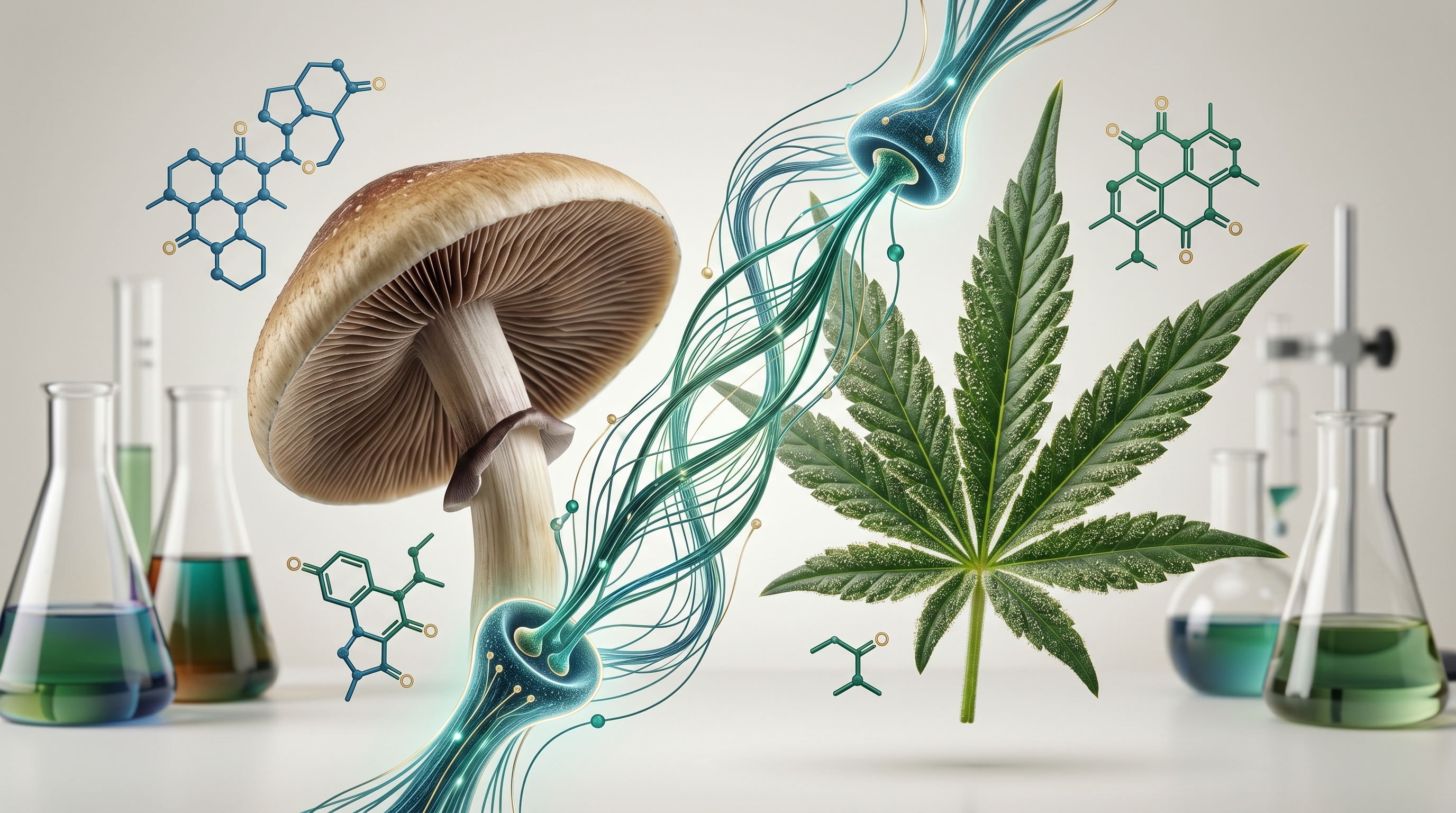
The first thing to understand is that cannabis and psilocybin are not doing the same job in your nervous system. They knock on different doors.
Psilocybin is technically a prodrug — biologically inert until your body converts it. After you eat mushrooms, psilocybin is rapidly metabolized (largely in the gut) into psilocin, the molecule that actually does the work [Adebo et al., 2025]. Psilocin is a non-selective agonist at the serotonin 5-HT2A receptor, and that 5-HT2A agonism is the consensus driver of the classic psychedelic experience. The cleanest evidence for this comes from blockade studies: when researchers pre-treat people with ketanserin, a 5-HT2A antagonist, the psychedelic effects of psilocybin are largely prevented, and the intensity of the experience tracks with both 5-HT2A receptor occupancy and plasma psilocin levels [Madsen et al., 2019]. Psilocin also touches 5-HT2C and 5-HT1A receptors, but 5-HT2A is the headline act.
Cannabis works through an entirely separate network — the endocannabinoid system. THC, the main intoxicating compound, is a partial agonist at the CB1 receptor, which is densely expressed in brain regions governing mood, memory, time perception, and threat appraisal. That last one matters a lot for our story: CB1 activity in the amygdala and prefrontal cortex is part of why high THC doses can tip some people into anxiety and paranoia.
So we have two drugs reaching for two different receptor families — 5-HT2A serotonergic versus CB1 cannabinoid. They are not competing for the same lock and key. That’s the crucial point: any interaction between them is indirect and downstream, not a tidy “this molecule blocks that molecule” story. The serotonin and endocannabinoid systems do talk to each other in the brain (I cover that cross-talk in the shared-biology article), but the practical upshot for co-use is that the result is hard to predict and varies enormously between people.
What the (thin) research actually says about co-use
Here is where I have to be candid with you. There are no large, randomized, placebo-controlled trials of “cannabis plus psilocybin” in humans. The direct evidence base is essentially two things: prospective survey data and retrospective survey data, both self-reported, both from people who chose to combine the two. That’s it. Treat every finding below as a signal, not a fact.
The prospective survey: cannabis may dial the experience up
The most-cited study here is a 2021 prospective online survey published in Psychopharmacology [Kuc et al., 2021]. Researchers recruited 321 people planning a psychedelic experience and surveyed them seven days before and one day after, sorting them by how much cannabis they used during the trip: none (n=195), low (n=53), medium (n=45), or high (n=28).
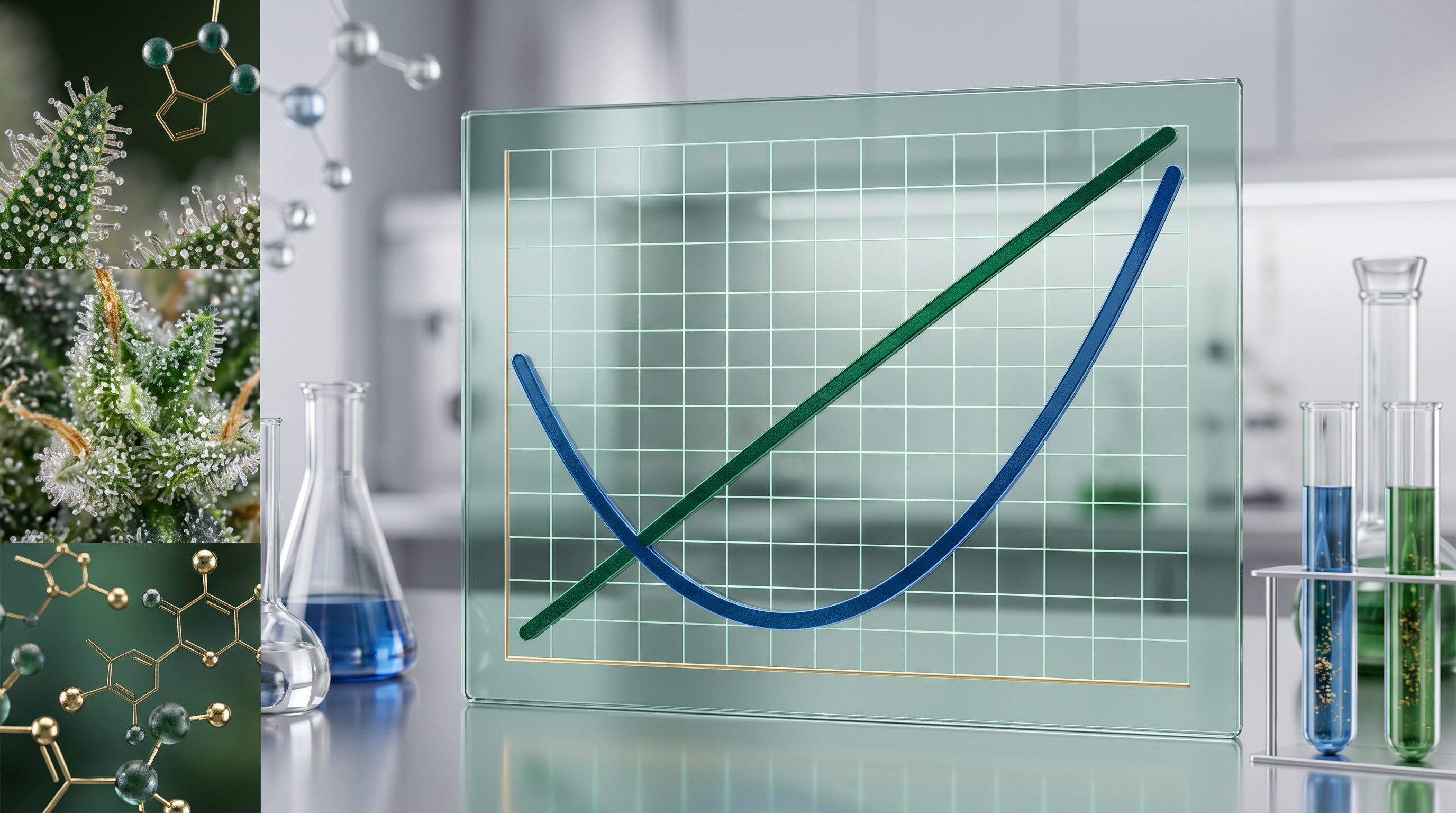
The pattern they found was dose-dependent. People who used cannabis alongside their psychedelic reported more intense experiences across several validated scales. As cannabis dose climbed, scores rose in a roughly linear fashion on the Mystical Experience Questionnaire, the visual subscale of the Altered States of Consciousness questionnaire, and the Ego Dissolution Inventory. In plain terms: more cannabis, more visual intensity, more “mystical,” more ego dissolution.
But — and this is the part the headlines skip — the Challenging Experience Questionnaire (the scale that measures fear, grief, paranoia, the bad-trip stuff) followed a quadratic curve, not a straight line. That means challenging experiences didn’t just rise with more cannabis; the relationship was non-linear, consistent with the idea that cannabis can sweeten or sour a trip depending on dose and person. The authors were explicit about the limits: this is correlational, self-selected, observational. It cannot establish that cannabis caused anything [Kuc et al., 2021].
The retrospective survey: enhancement for most, trouble for some
A 2024 mixed-methods study in the Journal of Cannabis Research looked at festival and concert attendees in Colorado [Piercey et al., 2024]. Of 128 people surveyed, 63 reported lifetime cannabis-psychedelic co-use, and 54 gave open-ended descriptions of their most recent simultaneous experience.
When the researchers coded those write-ups, the themes were telling:
- Tension reduction / balancing the experience — about 50% described cannabis as taking the edge off or smoothing things out
- Intensified psychedelic effects — about 22%
- Enhanced psychological processing — about 20%
- Smoother come-down — about 15%
Adverse reactions were reported by a smaller slice — roughly 11% — and those descriptions clustered around increased anxiety, increased intensity that tipped into discomfort, dissociation, confusion, reduced sociability, and sleepiness [Piercey et al., 2024].
So the survey snapshot is something like: most co-users in these self-selected samples describe cannabis as enhancing or softening the experience, but a real minority describe it making things worse — more anxious, more disorienting, harder to handle. Both studies’ authors landed in the same place: we need controlled research before anyone makes public-health claims.
Why cannabis can cut both ways
If you’ve read my work on cannabis and anxiety, the next part will feel familiar, because the same biphasic logic applies.
THC has a well-documented biphasic dose response for anxiety. Low doses tend to be calming for many people; higher doses tend to be anxiogenic — they push toward anxiety and, in susceptible folks, paranoia. Now drop that into the middle of a psilocybin experience, where your sense of time, your emotional reactivity, and your grip on “is this normal?” are already loosened by 5-HT2A activation. A wave of THC-driven anxiety in that state doesn’t stay contained the way it might on an ordinary day. It can get amplified by the psychedelic’s tendency to magnify whatever’s already in the room, mentally speaking.
That’s the most plausible mechanistic read of why the surveys show both “it relaxed me” and “it spun me out.” At a low THC dose, in a calm person, cannabis may genuinely take the edge off. At a higher dose, or in someone already prone to cannabis-induced paranoia, it may light a fuse. The terpene and cannabinoid makeup of what you’re using matters too — a high-THC, myrcene-heavy Relax High flower behaves very differently in the body than a balanced, CBD-forward option, and “I smoked weed” tells you almost nothing about which one someone actually had.
I want to be honest that this is a mechanistically reasonable story, not a proven one. We don’t have controlled data showing THC dose flips a psilocybin trip from good to bad. We have biphasic anxiety data for cannabis alone, survey data showing both outcomes during co-use, and a plausible bridge between them. That’s an informed hypothesis, not a finding.
Set and setting still rule everything
In psychedelic research there’s an old phrase — set and setting — that does more predictive work than almost any pharmacology. “Set” is your mindset: your mood, expectations, mental state walking in. “Setting” is the physical and social environment around you [Hartogsohn, 2017].
Decades of observation suggest the experience is shaped enormously by these non-drug factors. A calm, trusted environment with relaxing music tends toward positive experiences; a chaotic party setting is associated with a higher chance of a difficult one. Add cannabis to a psilocybin experience and you’ve added a second variable on top of a system that’s already exquisitely sensitive to context. If your set is anxious and your setting is loud, cannabis is more likely to be the thing that tips you over. The drugs don’t override your circumstances; they turn the volume up on them.
Harm reduction: the part that actually matters
I am not here to tell you to combine these substances. The lowest-risk choice is not to, and the legal reality (more on that below) is that possession of psilocybin is a federal crime. But people do experiment, and an educator who refuses to discuss harm reduction is just leaving people less safe. So, drawing on established psychedelic harm-reduction practice [Kruger et al., 2022], here’s the honest framing:
- Get to know each substance alone first. Layering an unfamiliar psilocybin experience with cannabis means you can’t tell which drug is responsible for what you’re feeling. If you don’t know how you respond to psilocybin by itself, adding a second variable is the opposite of careful.
- If cannabis enters the picture at all, less is the rule. The survey signals and the biphasic anxiety data both point the same way: high THC doses are where the trouble lives. A small amount of a low-intensity, balanced product is a categorically different thing from a fat dab of high-THC concentrate. Timing matters too — many harm-reduction guides suggest, if anything, cannabis on the come-down rather than at peak.
- Have a sober, trusted sitter. A trip sitter who stays sober and calm is one of the most consistent recommendations in the harm-reduction literature [Kruger et al., 2022]. Notably, research suggests it’s trust and familiarity with the experience that matter most — a sitter you trust beats a stranger who happens to be sober.
- Mind your set and setting before you mind your dose. Anxious headspace, unfamiliar or chaotic environment, or unresolved stress are all reasons to postpone, not power through.
- Know your own anxiety profile. If cannabis alone reliably makes you paranoid, it is very unlikely to behave better during a psychedelic experience. The thing that magnifies emotion will magnify that, too.
- Screen for real contraindications. Personal or family history of psychosis, certain heart conditions, and a number of medications (especially anything serotonergic) are genuine red flags that no harm-reduction tip can wave away. This is a “talk to a clinician” situation, not a “read a blog” one.
None of this makes combining the two safe. It makes it less risky than doing it blind. Those are different statements, and I won’t pretend otherwise.

The legal landscape: still firmly federal Schedule I
Whatever the science says, the law is unambiguous at the federal level. Psilocybin is a Schedule I controlled substance under the U.S. Controlled Substances Act — the same category that says “no accepted medical use and high potential for abuse.” That classification applies nationwide, including in states that have built their own programs [DEA].
Two states have created narrow, regulated frameworks, and it’s worth understanding how limited they are:
- Oregon passed Measure 109 in 2020, becoming the first state to legalize supervised, non-medical psilocybin use. Adults 21+ can consume psilocybin only at licensed service centers under a trained facilitator’s supervision; the program began licensing in 2023 [Oregon Health Authority]. It does not legalize buying mushrooms at a shop or using them at home.
- Colorado passed Proposition 122 (the Natural Medicine Health Act) in 2022, decriminalizing personal use for adults 21+ and directing the creation of licensed “healing centers,” which began coming online in 2024–2025 [Colorado General Assembly].
Cannabis sits in its own separate, state-by-state patchwork, legal for adults in many states but also still federally Schedule I. So co-use, in most of the country, means combining two federally illegal substances — and even in Oregon’s and Colorado’s frameworks, mixing cannabis into a supervised psilocybin session is not part of the sanctioned model. I cover the broader policy picture in the shared-biology deep-dive.
Where this leaves us
Strip away the hype in both directions and the picture is modest. Psilocybin and cannabis work through different receptor systems — 5-HT2A versus CB1 — so any interaction is indirect and individual. Survey data hints that cannabis often intensifies or smooths a psilocybin experience for self-selected co-users, while a meaningful minority report it making things more anxious or disorienting, in line with what we already know about THC’s biphasic anxiety effect. There are no controlled trials. Set, setting, and a trusted sitter matter more than any dosing trick. And the legal exposure is real.
If you take one thing from this: the responsible move with any psychoactive compound is to understand how your body responds — and that starts with paying attention to your patterns rather than chasing someone else’s anecdote. That’s the whole philosophy behind High IQ. We help you track what actually happens for you with cannabis: which terpene profiles, which effects, which High Families line up with how you actually feel. If you’re curious about the lighter end of the dose spectrum, our guide to microdosing cannabis for focus walks through the same track-your-own-response logic. The strain matters less than how you respond to it — and the only way to know your response is to track it.
Key Takeaways
- Different doorways. Psilocin acts on the serotonin 5-HT2A receptor; THC acts on the CB1 receptor of the endocannabinoid system. Any interaction is indirect, not a direct chemical block.
- The evidence is thin. No controlled trials exist — only self-selected survey data. Read every claim as a signal, not a fact.
- Cannabis can cut both ways. Surveys suggest it often intensifies or smooths a psilocybin experience, but a real minority report more anxiety and paranoia, in line with THC’s biphasic anxiety response.
- Harm reduction first. Learn each substance alone, keep THC low if at all, lean toward calming Relax-profile, myrcene-forward options over high-THC concentrates, and have a trusted sober sitter.
- Set and setting outrank dose. Mindset and environment shape the experience more than any pharmacology trick.
- The law is firm. Psilocybin is federally Schedule I nationwide; Oregon and Colorado frameworks are narrow and do not sanction cannabis co-use.
Sources
- Adebo, O. T. et al. (2025). Psilocybin as Transformative Fast-Acting Antidepressant: Pharmacological Properties and Molecular Mechanisms. Fundamental & Clinical Pharmacology. DOI: 10.1111/fcp.70038
- Kuc, J., Kettner, H., Rosas, F. et al. (2021). Psychedelic experience dose-dependently modulated by cannabis: results of a prospective online survey. Psychopharmacology, 239, 1425–1440. DOI: 10.1007/s00213-021-05999-1
- Piercey, C. J., Hetelekides, E. M., & Karoly, H. C. (2024). Simultaneous cannabis and psychedelic use among festival and concert attendees in Colorado: characterizing enhancement and adverse reactions using mixed methods. Journal of Cannabis Research, 6, 31. DOI: 10.1186/s42238-024-00235-x
- Madsen, M. K. et al. (2019). Psychedelic effects of psilocybin correlate with serotonin 2A receptor occupancy and plasma psilocin levels. Neuropsychopharmacology, 44, 1328–1334. DOI: 10.1038/s41386-019-0324-9
- Kruger, D. J. et al. (2022). Are you tripping comfortably? Investigating the relationship between harm reduction and the psychedelic experience. Harm Reduction Journal, 19, 81. DOI: 10.1186/s12954-022-00662-0
- Hartogsohn, I. (2017). Constructing drug effects: A history of set and setting. Drug Science, Policy and Law, 3. DOI: 10.1177/2050324516683325
- U.S. Drug Enforcement Administration. Controlled Substances Act — Schedule I. https://www.dea.gov/drug-information/drug-scheduling
- Oregon Health Authority. Oregon Psilocybin Services (Measure 109). https://www.oregon.gov/oha/ph/preventionwellness/pages/oregon-psilocybin-services.aspx
- Colorado General Assembly. Proposition 122 — Natural Medicine Health Act (2022). https://leg.colorado.gov
This article is for educational purposes only and is not medical, legal, or therapeutic advice. Psilocybin is a Schedule I substance under U.S. federal law. Nothing here should be read as encouragement to obtain, possess, or combine controlled substances.


