Cannabis and Psychedelics: Shared Biology and Co-Use
Cannabis and psychedelics share surprising biology. Explore CB1 and 5-HT2A cross-talk, co-use science, and harm reduction with Professor High.

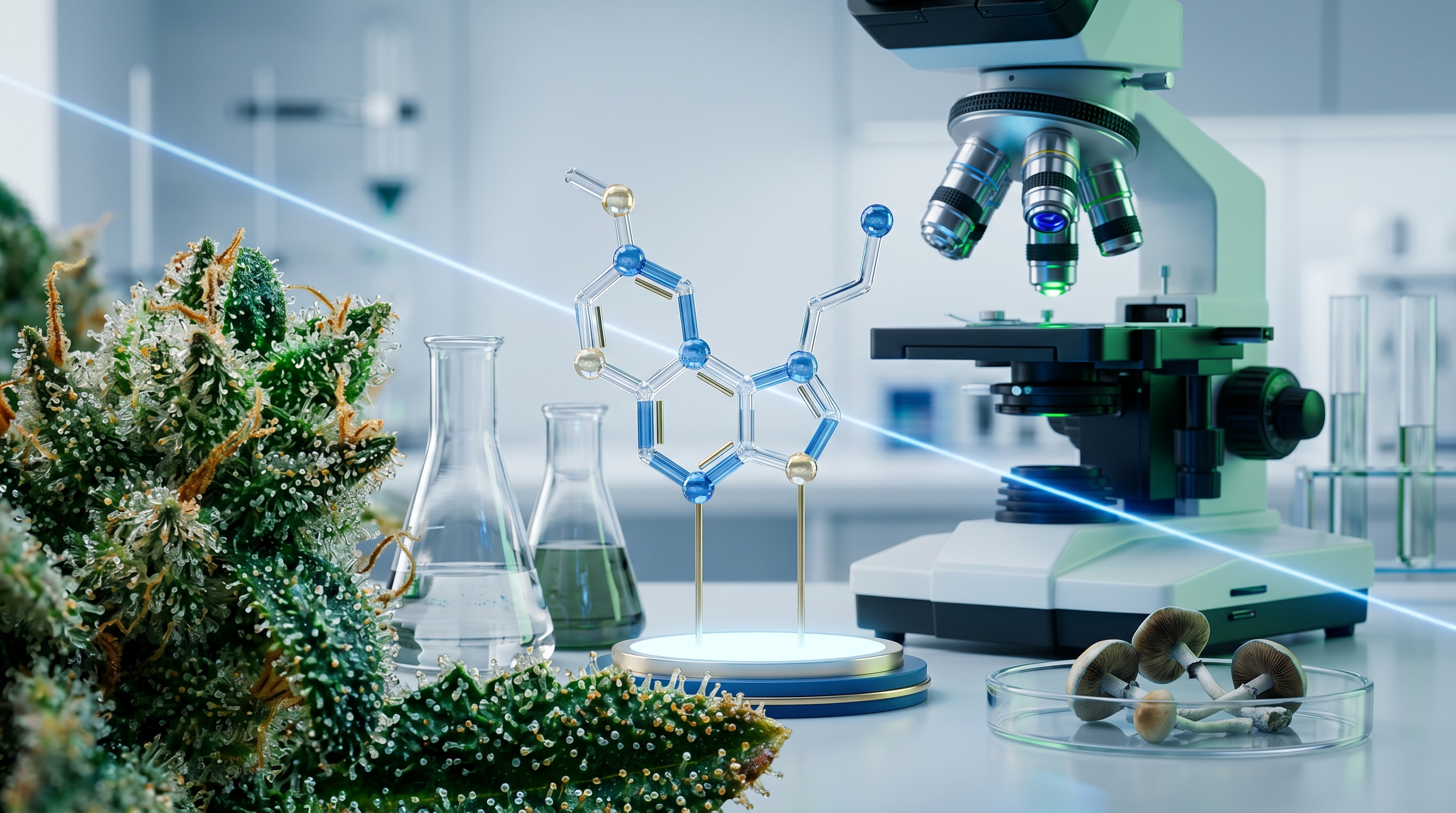
Let me start with a confession that should reassure you: when people ask me whether cannabis and psychedelics “work on the same part of the brain,” the honest answer is sort of, in places, and we are still figuring out exactly how. That uncertainty is not a dodge. It is the most accurate thing I can say, and this entire article is an exercise in saying interesting things while staying honest about how thin the evidence actually is.
Cannabis acts mainly through the endocannabinoid system (ECS). Classic psychedelics like psilocybin and LSD act mainly through one serotonin receptor, 5-HT2A. These look like two separate worlds. But molecular biology has a habit of refusing to respect tidy boundaries, and over the last decade a small body of research has shown that these two systems physically touch, talk to each other, and sometimes change what each other does. That biology is fascinating. The growing trend of combining the two — what people online call “candy flipping” cannabis into a trip — is where fascination has to be tempered with caution.
Nothing here is medical or legal advice. Psychedelics are Schedule I substances in most of the United States, combining drugs raises real risks, and I am a cartoon professor, not your physician. Read this as a biology lesson, not a how-to.
Two systems, two starting points
To understand where cannabis and psychedelics meet, you first have to understand where they begin — and they begin in genuinely different places.
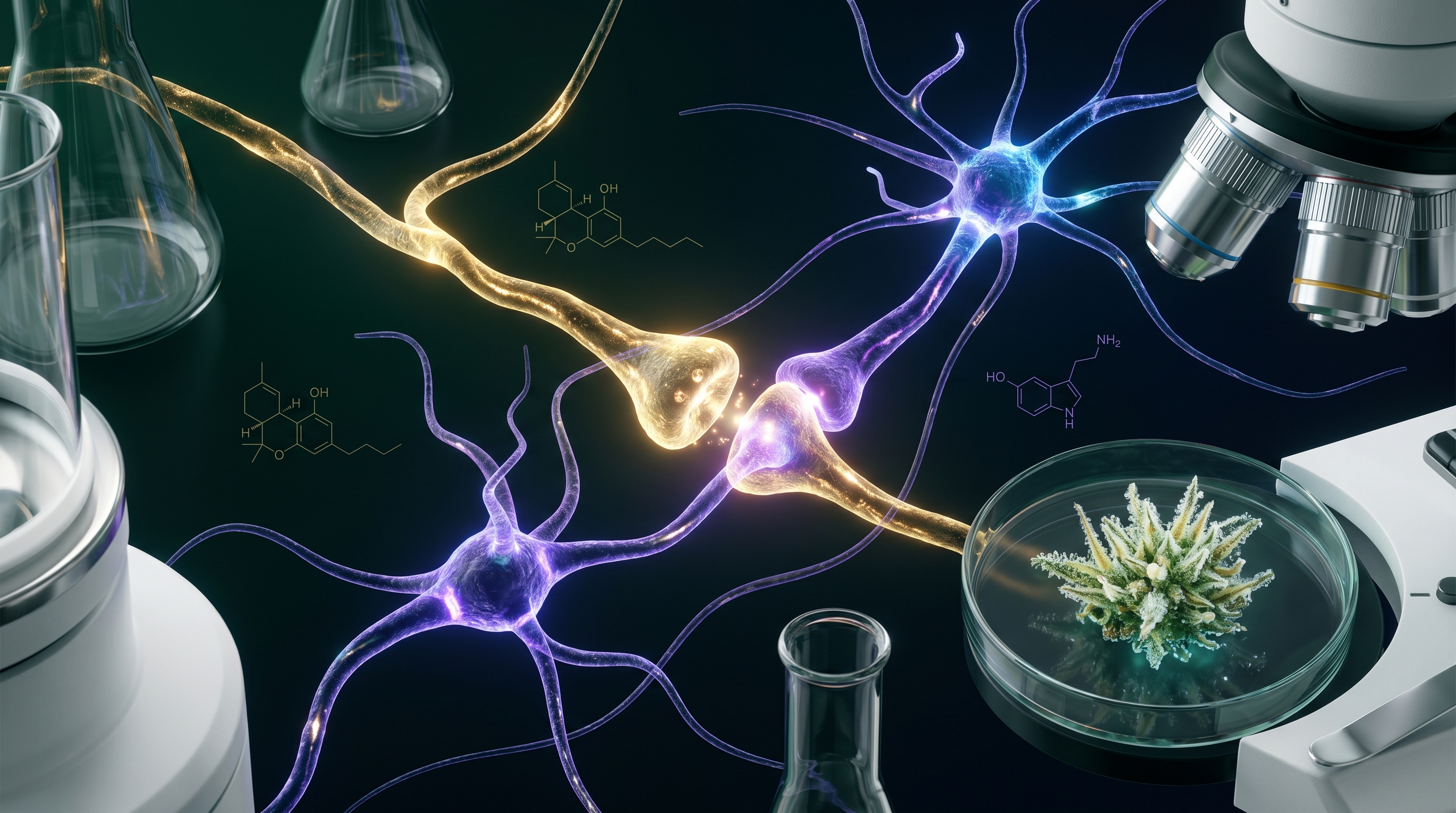
The ECS is a regulatory network: it does not so much drive signaling as tune it. Your body makes its own cannabinoids (endocannabinoids like anandamide and 2-AG), which act mostly at CB1 receptors in the brain and CB2 receptors in the periphery and immune system. CB1 is one of the most abundant receptors in the central nervous system, and it generally works by dialing down the release of other neurotransmitters. If you want the full primer, our endocannabinoid system guide walks through it step by step, and anandamide, your body’s natural THC covers the signaling molecule that started it all. THC works because it mimics those endocannabinoids well enough to bind CB1 — clumsily, persistently, and in every region at once.
Classic psychedelics start somewhere else entirely. Psilocybin (after your liver converts it to psilocin), LSD, DMT, and mescaline are serotonergic — their headline effects come from activating the 5-HT2A receptor, a serotonin receptor concentrated in the cortex. Strong 5-HT2A activation is the molecular signature researchers point to when they try to explain visuals, ego dissolution, and the famous “mystical-type” experience. Cannabis touches serotonin too, though far more gently and indirectly; I dug into that in cannabis and serotonin: the mood connection beyond THC.
So at the thirty-thousand-foot view: cannabis is a broad regulatory dimmer switch acting through CB1, and psychedelics are a focused cortical accelerant acting through 5-HT2A. Different receptors, different families, different stories. The interesting part is what happens when those stories collide at the molecular level.
Where the two systems physically meet: the CB1–5-HT2A heteromer
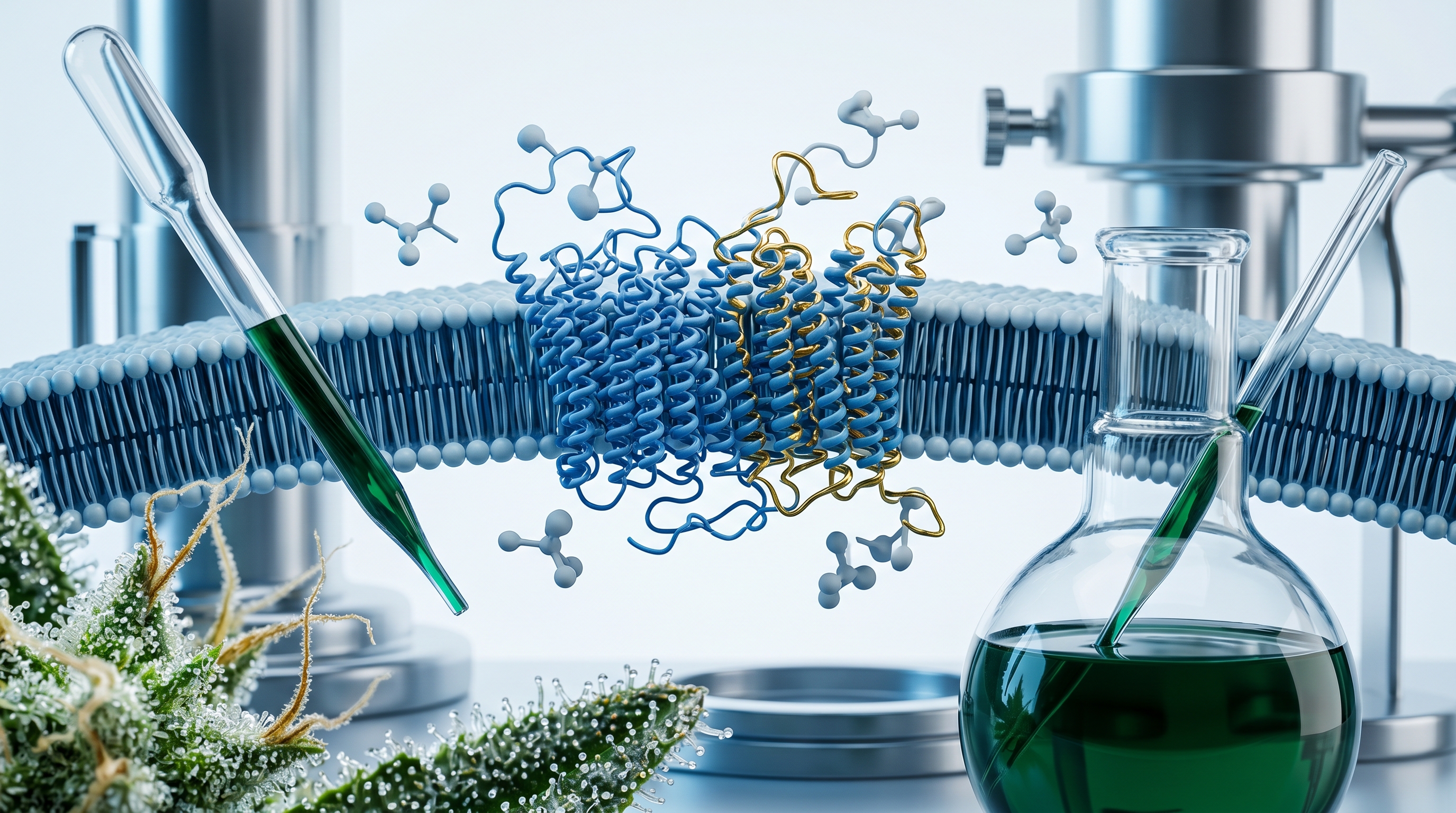
Here is the finding that made me sit up. Receptors are not always solitary. Sometimes two different receptor types physically dock together and form a single functional unit called a heteromer, and the combined unit behaves differently than either receptor alone.
In a careful 2015 PLoS Biology paper, [Viñals et al., 2015] showed that CB1 and 5-HT2A receptors form heteromers that are expressed and functionally active in brain regions involved in memory. This was cellular and mouse work — not human, and that distinction matters enormously — but the mechanistic detail is striking. When the two receptors pair up, 5-HT2A’s signaling switches its G-protein coupling (the team described a shift from the usual Gq pathway toward Gi). Co-stimulating both receptors did not produce additive effects; instead it produced reduced signaling, and blocking one receptor blocked signaling through its partner — a phenomenon called cross-antagonism [Viñals et al., 2015].
The behavioral punchline was even more interesting. The researchers found that THC’s memory-impairing effects appeared to depend on this heteromer, while THC’s pain-relieving effects did not. When they used a synthetic peptide to physically pry the two receptors apart in mice, they selectively abolished the memory deficits caused by THC without touching its analgesia [Viñals et al., 2015].
Read that carefully, because it is easy to over-extrapolate. This does not mean cannabis and psilocybin “cancel out,” and it does not tell us what a human on both substances will experience. What it does establish is a concrete, physical point of contact between the cannabinoid and serotonergic systems — proof that they are not the sealed-off silos the textbook diagrams suggest. That is a genuinely new piece of neuroscience, and it is the scaffolding everything else in this article hangs from.
Neuroplasticity, BDNF, and the default mode network
There is a second place the two systems brush up against each other: the brain’s capacity to rewire itself.
Psychedelics have become famous as “psychoplastogens” — compounds that rapidly promote structural plasticity. Preclinical work suggests psilocybin’s 5-HT2A activation raises cortical glutamate, which engages AMPA receptors and drives release of BDNF (brain-derived neurotrophic factor), feeding into TrkB and mTOR signaling that grows new dendritic spines in the frontal cortex — changes that, in mice, lasted at least a month after a single dose [Shao et al., 2021]. On the network level, the REBUS model [Carhart-Harris & Friston, 2019] proposes that strong 5-HT2A activation temporarily loosens the rigid, self-referential circuitry of the default mode network, relaxing entrenched patterns of thought.
Cannabinoids touch plasticity too — though, as usual, in a quieter and more bidirectional way. The ECS is deeply involved in synaptic remodeling, neurogenesis, and learning, which is exactly why I devoted a whole piece to cannabis and neuroplasticity and another to cannabis and neuroinflammation. The honest caveat: cannabis is not a clean psychoplastogen the way psilocybin appears to be. Chronic heavy THC use is associated with blunted plasticity in some contexts, especially in the developing brain — see cannabis and the teenage brain. So while both systems can modulate plasticity, it is a serious mistake to assume the effects simply add up.
The takeaway is not “combine them for double the rewiring.” It is that two superficially unrelated drug classes both have fingers on the same plasticity levers — and we do not yet know whether those fingers cooperate or interfere when present at once.
The co-use trend: what people actually report
People do not wait for the science to settle. The practice of taking cannabis alongside a classic psychedelic is common, and it has finally started attracting formal study.
The most-cited data point comes from a prospective online survey out of Imperial College London. Tracking people before and during real-world psychedelic experiences, the researchers reported that co-using cannabis with a psychedelic was associated, in a dose-dependent way, with higher scores on measures of mystical-type experience, ego dissolution, and visual alterations [Kuc et al., 2021]. In plain language: people who added cannabis tended to report a more intense trip, and more cannabis tracked with more intensity.
This is suggestive, not a recommendation, and the limitations are large. This was a correlational, self-selected, self-reported survey, not a controlled trial. People who choose to add cannabis to a trip may differ systematically from those who do not — in dose, experience, expectations, and setting. “More intense” is also not the same as “better” or “safer”; intensity cuts both ways, and a more intense experience can mean a more difficult one.
The MDMA-with-classic-psychedelic literature (the original sense of “candy flipping,” and “hippy flipping” for psilocybin) shows exactly that ambiguity. A large retrospective survey suggested that co-using a low dose of MDMA with psilocybin or LSD was associated with fewer challenging experiences and more positive ones [Zeifman et al., 2023]. Yet when a separate team tested MDMA plus LSD in a controlled, double-blind laboratory setting, they found no clear enhancement of subjective effects versus LSD alone [Holze et al., 2023]. The most likely reconciliation is unglamorous: the survey participants were probably benefiting from set and setting — a relaxed, intentional context — at least as much as from any drug interaction.

Blunt or amplify? Why cannabis can do both
If you read the survey data and the receptor data together, you arrive at an apparent contradiction. The heteromer work hints at cannabis dampening certain serotonergic signaling, while the co-use surveys report cannabis amplifying the subjective trip. How can both be true?
The likeliest answer is that “cannabis” is not one thing, and neither is “the experience.” Several factors plausibly pull in opposite directions:
- Dose and timing. A small amount of cannabis taken at the peak of a trip is a different intervention than a heavy dose taken at onset. Direction of effect almost certainly depends on both.
- Anxiety as a hinge. Cannabis can be anxiolytic at low doses and anxiogenic at higher ones — a biphasic pattern I cover in cannabis anxiety: the complete science-backed guide. During an already-vulnerable psychedelic state, tipping toward anxiety can spiral fast.
- Terpene and cannabinoid profile. A CBD-forward, linalool- or myrcene-rich chemovar leans calming, while a THC-dominant, limonene-heavy one can lean stimulating. This is the same logic behind our High Families framework — effect tracks chemistry, not the indica/sativa label.
- Individual neurobiology. Tolerance, genetics, and baseline state all shift the outcome. There is no universal response, which is the entire reason we built High IQ around tracking your patterns rather than averages.
So “does cannabis blunt or amplify psychedelics?” is the wrong question. The defensible answer is: it depends, in ways we cannot yet predict for an individual, and that unpredictability is itself a risk factor when you are already in an altered, suggestible state.
Harm reduction: the part I care about most
If you take only one section seriously, make it this one. Combining psychedelics with cannabis is not a casual decision, and the science gives me no basis to call it safe.
A few principles that the evidence and the broader harm-reduction community consistently support:
- Set and setting outrank chemistry. Every honest reading of the co-use literature points back to context. A safe, familiar environment and a calm headspace matter more than any clever combination.
- Cannabis can intensify the unpredictable. Because it can amplify a trip dose-dependently [Kuc et al., 2021] and can flip toward anxiety at higher doses, adding cannabis can convert a manageable experience into an overwhelming one with little warning.
- Start far lower than you think. If cannabis amplifies, then a “normal” dose is no longer normal in this context. Less is the conservative default.
- Drug interactions are real and underexplored. Combining substances multiplies unknowns. People taking psychiatric medications — SSRIs, MAOIs, lithium — face especially serious interaction risks that go well beyond cannabis, and that is a conversation for a physician, not a blog.
- Some people should abstain entirely. Anyone with a personal or family history of psychosis or schizophrenia should treat both psychedelics and high-THC cannabis with extreme caution, separately and together.
Harm reduction is not encouragement. It is the recognition that telling the truth about risk does more good than pretending the practice does not exist.
The legal and research landscape (as of 2026)
The science is moving, and so is the law — though neither as fast nor as cleanly as the headlines suggest.
On the clinical side, psilocybin-assisted therapy for treatment-resistant depression continues to generate encouraging randomized data, with several trials reporting meaningful antidepressant effects and acceptable safety in supervised settings [Goodwin et al., 2022]. But the field also absorbed a hard lesson: in 2024 the FDA declined to approve MDMA-assisted therapy for PTSD, issuing a complete response letter and requesting an additional Phase 3 study, citing concerns about trial design and the near-impossibility of blinding a powerful psychoactive substance. That decision is a useful reminder that promising mechanisms and glowing surveys are not the same as regulatory-grade proof.
Legally, the picture is a patchwork. Psilocybin remains federally Schedule I in the United States. Oregon established the first state-regulated psilocybin services framework, Colorado has followed with its own model, and a scattering of cities have decriminalized — even as some Oregon localities have voted to opt out. Cannabis sits on its own separate and equally messy state-by-state map. Combining two controlled substances does not become legal because each is tolerated somewhere; if anything, it compounds the legal exposure.
For research, the bottom line is humility. We have a real molecular intersection (the heteromer), a plausible shared lever (plasticity), and suggestive but soft human data (the co-use surveys). What we do not have is a single controlled human trial of cannabis-plus-classic-psychedelic co-use that would let me tell you what actually happens, to whom, and at what dose. Until that exists, treat confident claims in either direction — “cannabis ruins trips” or “cannabis supercharges healing” — as marketing, not science.
Where High IQ fits
None of this is a reason to experiment. It is a reason to pay closer attention to how your own body responds to cannabis in ordinary, legal use. The single most reproducible finding across all of this research is how much individual variation there is — the same chemovar that relaxes one person agitates another, and the only way to know your pattern is to track it.
That is what High IQ is built for: logging which strains, terpene profiles, and doses actually produce the effects you want, so your decisions come from your data instead of someone else’s anecdote. Whether you are exploring a calming relax-focused profile or a brighter uplift one, the science says the same thing — pay attention to chemistry and to yourself.
Frequently asked questions
Do cannabis and psychedelics work on the same receptor? Not the same one, but their systems physically intersect. Cannabis acts mainly through CB1 in the endocannabinoid system; classic psychedelics act mainly through the serotonin 5-HT2A receptor. The two receptors can form a heteromer that behaves differently than either alone [Viñals et al., 2015] — though that work is cellular and animal, not human.
Does cannabis make a psychedelic trip stronger? Survey data suggests it can, in a dose-dependent way, increasing reported mystical experience, ego dissolution, and visuals [Kuc et al., 2021]. But this is correlational self-report, “stronger” is not “better,” and cannabis can just as easily tip an experience toward anxiety.
Is combining them safe? There is no good evidence that it is safe, and meaningful risks exist — amplified unpredictability, anxiety, and drug interactions. People with a history of psychosis should be especially cautious. This article is education, not medical or legal advice.
Is any of this legal? Psilocybin is federally Schedule I in the US, with limited state programs in places like Oregon and Colorado. Combining controlled substances does not inherit the narrow legality of either one.
The honest bottom line
Cannabis and psychedelics are not the same drug, but they are not strangers either. They share a real molecular handshake in the CB1–5-HT2A heteromer, they both pull on the brain’s plasticity machinery, and people are already combining them faster than science can characterize what that combination does. The most rigorous thing I can tell you is that the biology is real and the human evidence is thin — and that in a state as suggestible as a psychedelic experience, “we don’t fully know” is a reason for caution, not curiosity unleashed.
Stay rigorous, stay safe, and as always, track what actually works for you.
Key takeaways
- Cannabis works mainly through CB1 in the endocannabinoid system; classic psychedelics work mainly through the serotonin 5-HT2A receptor — different starting points.
- The two systems physically intersect at the CB1–5-HT2A heteromer, but that evidence is cellular and animal, not human [Viñals et al., 2015].
- Both can influence neuroplasticity, yet their effects do not simply add up and may even oppose one another.
- Survey data suggests cannabis may intensify a psychedelic experience dose-dependently, but it is correlational and “more intense” is not “better” [Kuc et al., 2021].
- Set and setting consistently outweigh any drug interaction, and combining substances raises real, underexplored risks.
- There is no controlled human trial of cannabis-plus-classic-psychedelic co-use, so confident claims in either direction are premature.
Sources
- Viñals, X., Moreno, E., Lanfumey, L., et al. (2015). Cognitive Impairment Induced by Delta9-tetrahydrocannabinol Occurs through Heteromers between Cannabinoid CB1 and Serotonin 5-HT2A Receptors. PLoS Biology, 13(7): e1002194. DOI: 10.1371/journal.pbio.1002194
- Kuc, J., Kettner, H., Rosas, F., et al. (2021). Psychedelic experience dose-dependently modulated by cannabis: results of a prospective online survey. Psychopharmacology, 239: 1425–1440. DOI: 10.1007/s00213-021-05999-1
- Zeifman, R. J., Spriggs, M. J., Kettner, H., et al. (2023). Co-use of MDMA with psilocybin/LSD may buffer against challenging experiences and enhance positive experiences. Scientific Reports, 13: 13645. DOI: 10.1038/s41598-023-40856-5
- Holze, F., Vizeli, P., Müller, F., et al. (2023). Acute effects of MDMA and LSD co-administration in a double-blind placebo-controlled study in healthy participants. Neuropsychopharmacology, 48: 1398–1408. DOI: 10.1038/s41386-023-01609-0
- Shao, L.-X., Liao, C., Gregg, I., et al. (2021). Psilocybin induces rapid and persistent growth of dendritic spines in frontal cortex in vivo. Neuron, 109(16): 2535–2544. DOI: 10.1016/j.neuron.2021.06.008
- Carhart-Harris, R. L., & Friston, K. J. (2019). REBUS and the Anarchic Brain: Toward a Unified Model of the Brain Action of Psychedelics. Pharmacological Reviews, 71(3): 316–344. DOI: 10.1124/pr.118.017160
- Goodwin, G. M., Aaronson, S. T., Alvarez, O., et al. (2022). Single-Dose Psilocybin for a Treatment-Resistant Episode of Major Depression. New England Journal of Medicine, 387: 1637–1648. DOI: 10.1056/NEJMoa2206443
This article is for educational purposes only and is not medical or legal advice. Psychedelics are controlled substances; combining drugs carries real risks. Consult a qualified healthcare professional before making any decisions about cannabis or any other substance.


