Cannabis Concentrates Guide: Wax, Shatter, Rosin & More
Learn about cannabis concentrates including wax, shatter, rosin, and live resin. A beginner-friendly guide to types, potency, and safe consumption.

Why This Matters
If you’ve walked into a dispensary recently and felt overwhelmed by the wall of golden, glassy, crumbly, and gooey products behind the counter, you’re not alone. Cannabis concentrates have exploded in popularity, and the sheer variety of textures, names, and potency levels can make anyone’s head spin — even before consuming anything.
Here’s the thing: concentrates aren’t just for experienced consumers. Understanding them gives you more control over your experience, whether you’re looking for fast-acting relief, cleaner consumption methods, or simply want to know what your friends are talking about. In this guide, you’ll learn exactly what concentrates are, how each type differs, how to consume them safely, and the mistakes most beginners make. No judgment, no jargon overload — just clear, practical knowledge so you can explore with confidence.
The Basics
What Are Cannabis Concentrates?
At the simplest level, a cannabis concentrate is any product made by extracting the most desirable compounds — cannabinoids (like THC and CBD) and terpenes (the aromatic compounds that shape your experience) — from the cannabis plant, while leaving behind plant material like leaves, stems, and chlorophyll.
Think of it like orange juice concentrate versus a whole orange. You’re getting the essential stuff in a much more potent, compact form.
Flower typically contains 15-30% THC. Concentrates? They can range from 50% to over 90% THC. That’s a big difference, which is exactly why understanding them matters — especially for beginners.
The two big variables that separate one concentrate from another are:
- Extraction method — How the good stuff is pulled from the plant (using solvents like butane, or solventless methods like heat and pressure)
- Post-processing — How the extracted material is handled afterward (whipped, purged, cured, etc.), which determines the final texture and name
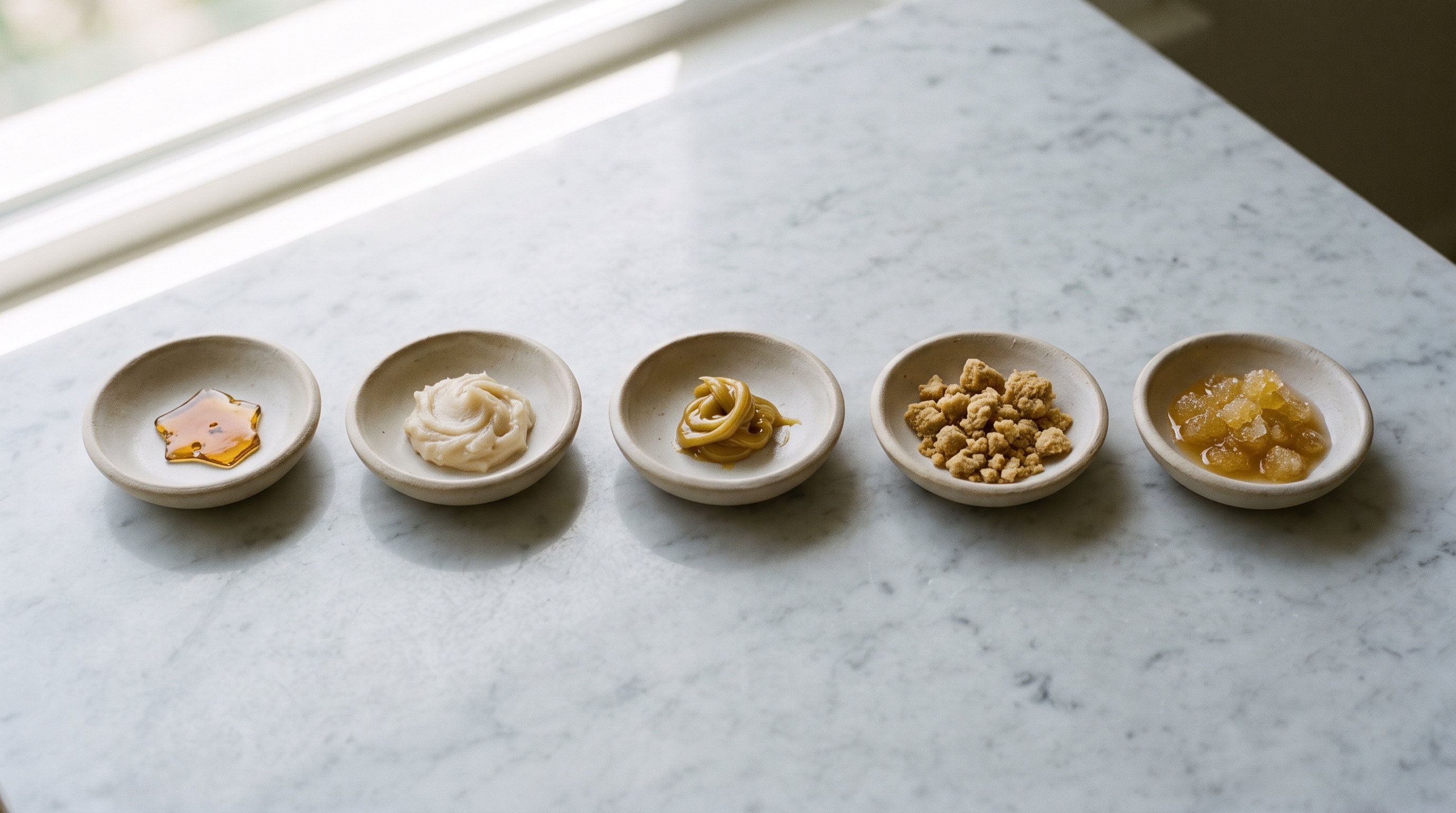
That’s really it. Wax, shatter, rosin, budder — these are mostly different textures of concentrated cannabis, not fundamentally different products. Once you understand that, the whole category becomes much less scary.
How Terpenes Factor In
One of the most important things about concentrates is how the extraction process affects terpene preservation. Terpenes are volatile — they evaporate easily with heat. Some extraction methods preserve them beautifully (like live resin), while others strip most of them away.
Why does this matter? Because terpenes don’t just create flavor and aroma — they actively shape your experience. This is the foundation of our High Families classification system. A concentrate rich in limonene and linalool may deliver an Uplifting High — mood elevation and social energy. One loaded with myrcene tends toward a Relaxing High — deep calm and potential sleep support.
So when choosing a concentrate, don’t just look at THC percentage. Ask about the terpene profile. It tells you far more about how you’ll actually feel.
Key Terms Glossary
Before we dive deeper, here’s your cheat sheet. Bookmark this — you’ll want it at the dispensary.
| Term | Simple Definition |
|---|---|
| Concentrate | Any cannabis product where cannabinoids and terpenes have been extracted into a potent form |
| Solvent-based extraction | Using a chemical (butane, CO2, ethanol) to dissolve and separate cannabinoids from plant material |
| Solventless extraction | Using only heat, pressure, ice, or water — no chemicals involved |
| Dabbing | Vaporizing a small amount of concentrate on a heated surface and inhaling the vapor |
| Dab rig | A specialized water pipe designed for vaporizing concentrates |
| Nail/Banger | The heated surface on a dab rig where concentrate is placed |
| BHO | Butane Hash Oil — concentrates made using butane as a solvent |
| Terpene profile | The specific combination and ratio of terpenes in a product, which influences effects and flavor |
| Purging | The process of removing residual solvents from a concentrate after extraction |
| Full-spectrum | A concentrate that retains a wide range of cannabinoids and terpenes from the original plant |
| Decarboxylation | The heat-activated chemical process that converts THCA into psychoactive THC |
Types of Cannabis Concentrates
Now let’s break down the most common types you’ll encounter. We’ll organize them by extraction method, since that’s the most meaningful distinction.
Solvent-Based Concentrates
These use a chemical solvent to strip cannabinoids and terpenes from plant material. When produced by licensed professionals in regulated facilities, residual solvents are purged to safe levels. Never attempt solvent-based extraction at home — it’s dangerous and illegal in most places.
Shatter
Appearance: Translucent, glass-like sheets ranging from light amber to dark gold.
Shatter gets its name because it literally shatters like glass when broken. It’s one of the purest-looking concentrates, with a smooth, stable molecular structure. That stability comes from minimal agitation during processing — the molecules align in neat rows, creating that see-through quality.
- Potency: Typically 70-90% THC
- Texture: Hard, brittle, snaps cleanly
- Best for: Experienced consumers who want high potency and clean flavor
- Terpene retention: Moderate — some terpenes are lost during processing
Wax
Appearance: Opaque, soft, and pliable — like earwax or candle wax.
Wax is essentially shatter that’s been agitated (whipped or stirred) during the purging process. This disrupts the molecular structure, creating an opaque, easier-to-handle texture. Some people prefer wax because it’s simpler to scoop onto a dab tool.
- Potency: Typically 60-80% THC
- Texture: Soft, sticky, malleable
- Best for: Beginners to dabbing who want something easy to handle
- Terpene retention: Moderate
Budder / Badder
Appearance: Creamy, cake-batter consistency with a golden-to-amber hue.
Budder (sometimes spelled “badder”) is whipped more aggressively than wax, incorporating air to create that smooth, spreadable texture. Many consumers love budder for its rich flavor, as the whipping process can help distribute terpenes evenly.
- Potency: Typically 60-80% THC
- Texture: Creamy, smooth, easy to work with
- Best for: Flavor-focused consumers; great entry point for dabbing
- Terpene retention: Good
Crumble
Appearance: Dry, crumbly, honeycomb-like texture.
Crumble is processed at lower temperatures for a longer period, resulting in a drier product that breaks apart easily. It’s one of the most versatile concentrates — you can dab it, sprinkle it on flower, or load it into a vaporizer.
- Potency: Typically 60-80% THC
- Texture: Dry, crumbly, easy to portion
- Best for: Versatility; great for topping bowls or joints
- Terpene retention: Moderate
Live Resin
Appearance: Wet, saucy, golden-amber with a strong aroma.
This is where things get exciting for terpene lovers. Live resin is made from cannabis that was flash-frozen right after harvest — before drying and curing. This preserves the plant’s full terpene profile, resulting in concentrates that taste and smell remarkably like the living plant.
Because of its exceptional terpene content, live resin is a great way to experience the Entourage High — that full-spectrum, nuanced effect that comes from cannabinoids and terpenes working together. Research suggests this combination of compounds may produce more balanced effects than isolated cannabinoids alone [Russo, 2011].
- Potency: Typically 65-85% THC
- Texture: Wet, saucy, sometimes with crystalline structures
- Best for: Flavor chasers and anyone wanting a full-spectrum experience
- Terpene retention: Excellent
Distillate
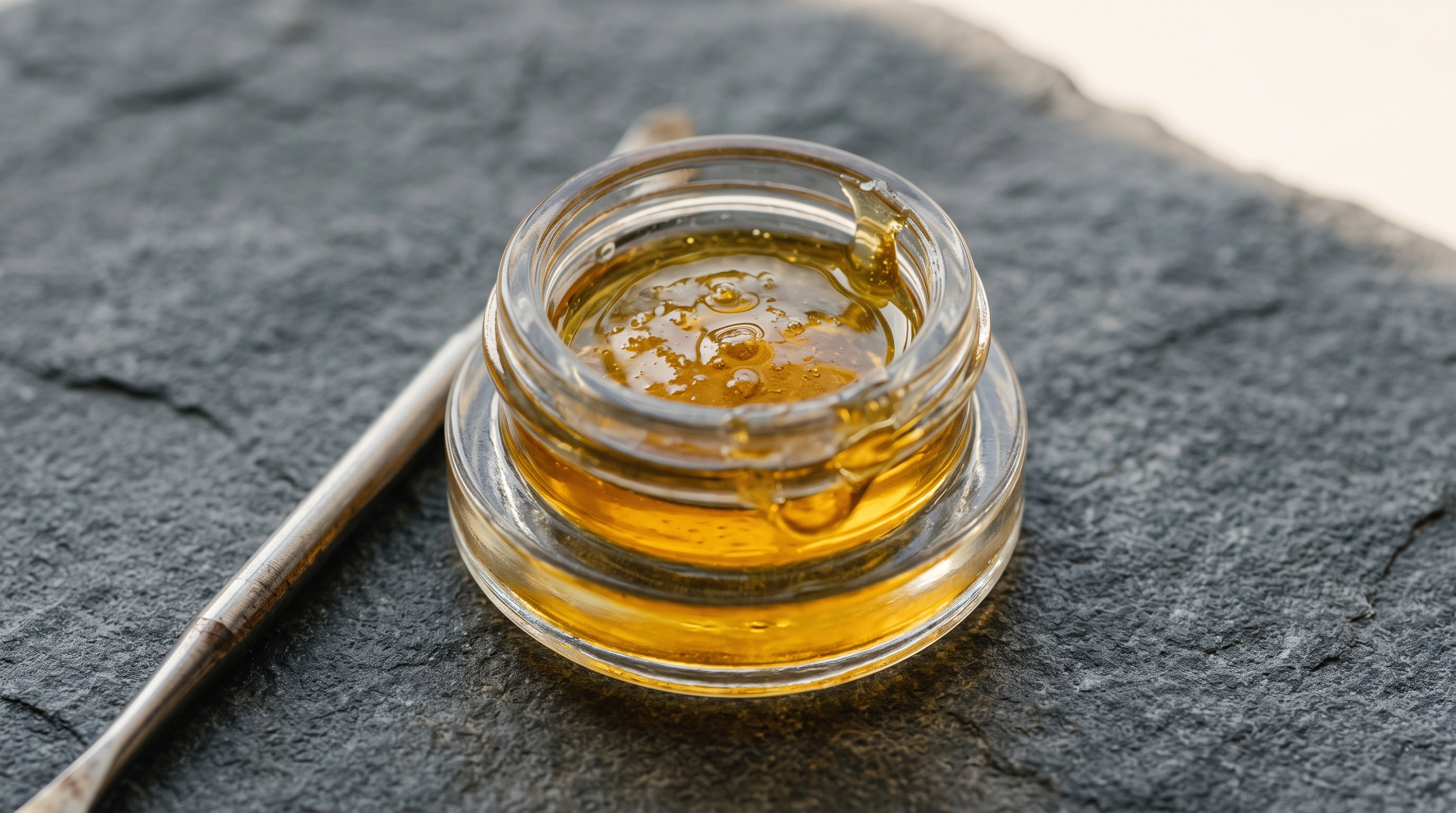
Appearance: Clear, thick, honey-like oil — often in syringes or cartridges.
Distillate is the most refined concentrate available. Through a process called fractional distillation, individual cannabinoids are isolated to extreme purity (often 90-99% THC). The trade-off? Nearly all terpenes and other compounds are stripped away.
This makes distillate a blank canvas. Many manufacturers add terpenes back in (either cannabis-derived or botanical) to create specific flavor profiles and effects. Distillate is the most common oil found in vape cartridges.
- Potency: 85-99% THC
- Texture: Thick, viscous oil
- Best for: Vape cartridges, edibles, precise dosing
- Terpene retention: None (unless reintroduced)
Solventless Concentrates
These are made without any chemical solvents — just heat, pressure, water, or mechanical agitation. Many consumers prefer solventless products because there’s no risk of residual chemicals.
Rosin
Appearance: Golden, sappy, translucent — similar to shatter but slightly stickier.
Rosin is made by applying heat and pressure to cannabis flower, hash, or kief, squeezing out the cannabinoids and terpenes like pressing olive oil from olives. It’s the only concentrate that’s relatively safe to make at home (people use hair straighteners, though proper rosin presses yield much better results).
- Potency: Typically 60-80% THC
- Texture: Sappy, stretchy, sometimes budder-like
- Best for: Consumers who want solventless purity with great flavor
- Terpene retention: Very good
Live Rosin
Appearance: Light gold to white, creamy, intensely aromatic.
The premium of premiums. Live rosin combines the flash-freezing technique of live resin with the solventless pressing method of rosin. Fresh-frozen cannabis is first turned into bubble hash (using ice water), then pressed with heat and pressure.
The result? A solventless concentrate with the full terpene profile of the living plant. Live rosin is often considered the pinnacle of cannabis concentrates — and it’s priced accordingly.
- Potency: Typically 60-80% THC
- Texture: Creamy, badder-like, incredibly aromatic
- Best for: Connoisseurs seeking the cleanest, most flavorful experience
- Terpene retention: Exceptional
Bubble Hash (Ice Water Hash)
Appearance: Sandy, granular, light blonde to dark brown.
One of the oldest concentrate methods. Cannabis is agitated in ice water, causing the trichomes (the tiny crystal-covered glands containing cannabinoids and terpenes) to break off and sink. The water is then filtered through progressively finer mesh bags, collecting trichome heads of different sizes.
- Potency: Typically 30-60% THC
- Texture: Sandy, crumbly, ranges from dry to slightly sticky
- Best for: Traditionalists; great for pressing into rosin
- Terpene retention: Good to very good
Kief
Appearance: Fine, powdery, golden-green dust.
Kief is the simplest concentrate — it’s just the trichome crystals that fall off your flower. If you have a grinder with a bottom chamber and screen, you’ve been collecting kief already. It’s not as potent as other concentrates, but it’s the most accessible starting point.
- Potency: Typically 20-50% THC
- Texture: Fine powder
- Best for: Absolute beginners; sprinkle on flower for a potency boost
- Terpene retention: Moderate
Quick Comparison Table
| Concentrate | Extraction | Potency Range | Terpene Retention | Beginner-Friendly? |
|---|---|---|---|---|
| Shatter | Solvent (BHO) | 70-90% | Moderate | No |
| Wax | Solvent (BHO) | 60-80% | Moderate | Somewhat |
| Budder | Solvent (BHO) | 60-80% | Good | Yes |
| Crumble | Solvent (BHO) | 60-80% | Moderate | Yes |
| Live Resin | Solvent (BHO) | 65-85% | Excellent | Somewhat |
| Distillate | Solvent (CO2/Ethanol) | 85-99% | None* | Yes (in carts) |
| Rosin | Solventless | 60-80% | Very Good | Yes |
| Live Rosin | Solventless | 60-80% | Exceptional | Yes |
| Bubble Hash | Solventless | 30-60% | Good | Yes |
| Kief | Solventless | 20-50% | Moderate | Yes |
*Terpenes are often reintroduced after extraction
How to Try Concentrates Safely
Ready to explore? Here’s a beginner-friendly approach to your first concentrate experience.
Step 1: Choose a Beginner-Friendly Product
Start with one of these options:
- A vape cartridge with distillate or live resin — the easiest entry point, no special equipment needed beyond a compatible battery
- Crumble or budder to sprinkle on flower you already smoke
- Kief from your grinder’s bottom chamber
Start low, go slow. Concentrates are significantly more potent than flower. A tiny amount — literally the size of a grain of rice — is a full dose for beginners.
Step 2: Prepare Your Setup
For vape cartridges: Attach the cartridge to a compatible 510-thread battery. Start at the lowest voltage/temperature setting.
For topping flower: Pack a bowl or roll a joint as usual. Sprinkle a small pinch of crumble, kief, or budder on top or inside.
For dabbing (intermediate): You’ll need a dab rig or electronic dab device (e-rig). E-rigs like the Puffco Peak are much more beginner-friendly than torch-and-nail setups because they control temperature precisely.
Step 3: Take Your First Hit
- Take a small, gentle inhale — not a deep lung-buster
- Hold briefly (1-2 seconds is plenty; holding longer doesn’t increase absorption meaningfully)
- Exhale and wait
Step 4: Wait and Assess
Concentrates hit faster than edibles but the full effect may take 5-10 minutes to peak. Wait at least 15 minutes before deciding whether to take another hit. This is the most important rule for avoiding overconsumption.
Step 5: Store It Properly
Concentrates degrade quickly when exposed to heat, light, and air. To protect your investment:
- Store in a small, airtight glass jar
- Keep in a cool, dark place (a drawer or cabinet, not a sunny windowsill)
- For terpene-rich products like live resin or live rosin, refrigerator storage is ideal
- Avoid plastic containers — terpenes can leach into plastic over time
Temperature and Dabbing
If you go the dabbing route, temperature is the single most important variable for quality and safety.
Why Temperature Matters
Terpenes are more volatile than cannabinoids — they start breaking down at lower temperatures. Dabbing too hot destroys the flavor compounds that make premium concentrates worth the price. It also creates harsher vapor that can irritate your lungs.
Research on terpene degradation suggests that most terpenes begin breaking down well below the temperatures at which THC fully vaporizes, which is why high-temp dabs can still deliver potency while tasting flat and harsh.
Temperature Ranges
| Range | Effect |
|---|---|
| 350-430°F | Low temp: Maximum flavor, smooth vapor, lighter effects |
| 430-500°F | Medium temp: Balanced flavor and vapor production — best for most users |
| 500-550°F | High temp: Thick vapor, strong effects, some terpene loss |
| 550°F+ | Very high: Harsh, burnt taste, significant terpene degradation |
For beginners, medium temperature (430-500°F) is the sweet spot. An e-rig with precise temperature control removes the guesswork entirely.
Common Beginner Mistakes
Mistake 1: Taking Too Much
The number one issue. Concentrates are 3-5x stronger than flower. A “normal” sized hit of shatter is not a normal sized hit. Start with a piece no bigger than half a grain of rice and work up from there.
Mistake 2: Dabbing Too Hot
Scorching your concentrate destroys terpenes and creates harsh vapor. If your dab tastes burnt or makes you cough uncontrollably, your temperature is too high.
Mistake 3: Judging Only by THC Percentage
High THC doesn’t always mean a better experience. A 95% distillate with no terpenes may feel flat and one-dimensional compared to a 70% live rosin with a rich terpene profile. Look at the full picture.
Mistake 4: Buying from Unregulated Sources
Always buy from licensed dispensaries. Unregulated concentrates may contain residual solvents, pesticides, or other contaminants. Lab-tested products from legal dispensaries give you assurance of what you’re actually consuming.
Mistake 5: Storing Concentrates Poorly
Leaving concentrate in a hot car, on a sunny counter, or in a plastic bag will degrade it quickly. Terpenes are fragile — treat them like perishables.
Key Takeaways
Cannabis concentrates offer a powerful and versatile way to experience cannabis, but they require more understanding than flower. Here’s what to remember:
- Concentrates are defined by two things: extraction method (solvent vs. solventless) and post-processing (which determines texture and name)
- Potency ranges from 20% (kief) to 99% (distillate) — dramatically higher than flower’s 15-30%
- Terpene preservation matters — it shapes your experience as much as THC level. Live resin and live rosin preserve the most terpenes; distillate preserves none
- Best beginner options: vape cartridges, kief, crumble, or budder sprinkled on flower
- Dabbing intermediate options: wax, budder, or live resin with an e-rig at medium temperature (430-500°F)
- Premium options: live rosin or live resin for the full-spectrum Entourage High experience
- Always start with a tiny amount, wait 15 minutes, and buy from licensed dispensaries only
Understanding concentrates means understanding that the dispensary wall isn’t as intimidating as it looks. It’s the same plant — just expressed in many different forms, each with a different texture, flavor profile, and use case. Start slow, explore with curiosity, and let your experience guide you.
Note: Cannabis affects everyone differently. Effects described in this guide are based on reported consumer experiences and available research. Always consult applicable local laws before purchasing or consuming cannabis products.
Sources: Russo, E.B. (2011). Taming THC: potential cannabis synergy and phytocannabinoid-terpenoid entourage effects. British Journal of Pharmacology, 163(7), 1344-1364.


