Cannabis & Sleep in Depression: What Self-Medication Research Reveals
Depressed patients widely use cannabis for sleep — and the science is nuanced. Real perceived benefit, real architecture concerns. What 2026 research shows.

Professor High
The Most Common Reason People With Depression Use Cannabis
Ask someone with major depressive disorder why they use cannabis, and you might expect to hear “for my mood.” You’d usually be wrong.
When patients with depression are asked what they’re actually self-medicating, the most common answer isn’t sadness or anhedonia. It isn’t anxiety, even — though that ranks high. It’s sleep. Insomnia. Waking at 3 a.m. with the same thoughts. Cannabis, for these patients, is a sleep aid first and a mood adjustment second.
That pattern changes how you read every “cannabis for depression” study. A scoping review in Current Addiction Reports on April 16, 2026 (Goodhines et al.) sat at the intersection of three previously siloed literatures — cannabis, sleep, and affective disorders. Conclusion: cannabis’s perceived sleep benefits are substantially more pronounced among people with depression and anxiety than among people without. A reframe, not a small finding.
Before we go further: This is science explanation, not medical advice. Depression is a serious, sometimes life-threatening condition. Don’t start, stop, or change treatment based on a blog post. If you’re in crisis in the US, call or text 988 (Suicide and Crisis Lifeline). UK: Samaritans 116 123.
What “Self-Medication” Actually Means
“Self-medication” gets used loosely — sometimes pejoratively, implying impulsive use without insight. That’s not how the clinical literature uses it.
The framework comes from psychiatrist Edward Khantzian, who proposed in the 1980s that substance use is a targeted, intelligible response to specific symptoms. People don’t use substances at random; they reach for the one whose pharmacology fits the symptom they’re trying to escape. Opioids quiet rage and shame. Stimulants energize anhedonic flatness. Cannabis — in the Khantzian frame — is used to soften hyperarousal, slow rumination, and induce sleep.
It isn’t an excuse for problem use; it’s a tool for understanding it. Treat the underlying symptom adequately and self-medication often de-escalates. Don’t, and it usually doesn’t. That’s why “just stop using cannabis” advice — given to a depressed insomniac who finally sleeps after a few puffs at 11 p.m. — usually fails. The behavior is solving a problem.
This frame lets us hold two truths: cannabis is genuinely doing something useful for these patients, and what it’s doing has costs they can’t see directly. For broader context, see what 28 clinical trials actually show and the 698-patient UK registry on cannabis for depression.
The 2026 Findings
The Goodhines review pulled together 20 studies examining cannabis, sleep, and depression/anxiety together. Four patterns came through cleanly:
1. Sleep is the dominant self-medication use case. 30–60% of cannabis users with depressive/anxiety symptoms cited sleep as their primary reason; some samples ran higher.
2. Subjective sleep improves — more in this group. Self-reported latency, quality, and awakenings consistently improved in users with clinically significant depression/anxiety. Without those symptoms, the benefit was smaller, mixed, or absent.
3. The effect is mostly subjective. Of 20 studies, only one included objective polysomnography. What cannabis does subjectively and objectively to sleep are not always the same thing.
4. Frequency cuts both ways. In prospective studies, more frequent use predicted fewer sleep problems six months later — but only in those meeting clinical thresholds for anxiety/depression and already reporting sleep problems. Without those baseline conditions, more frequent use predicted worse sleep.
That asymmetry is the core finding. Cannabis-as-sleep-aid looks helpful in a specific population — depressed/anxious people already sleeping badly — and looks neutral or harmful outside it.
The Architecture Problem
Subjective improvement and objective architecture can diverge — and in depression, that divergence has implications.
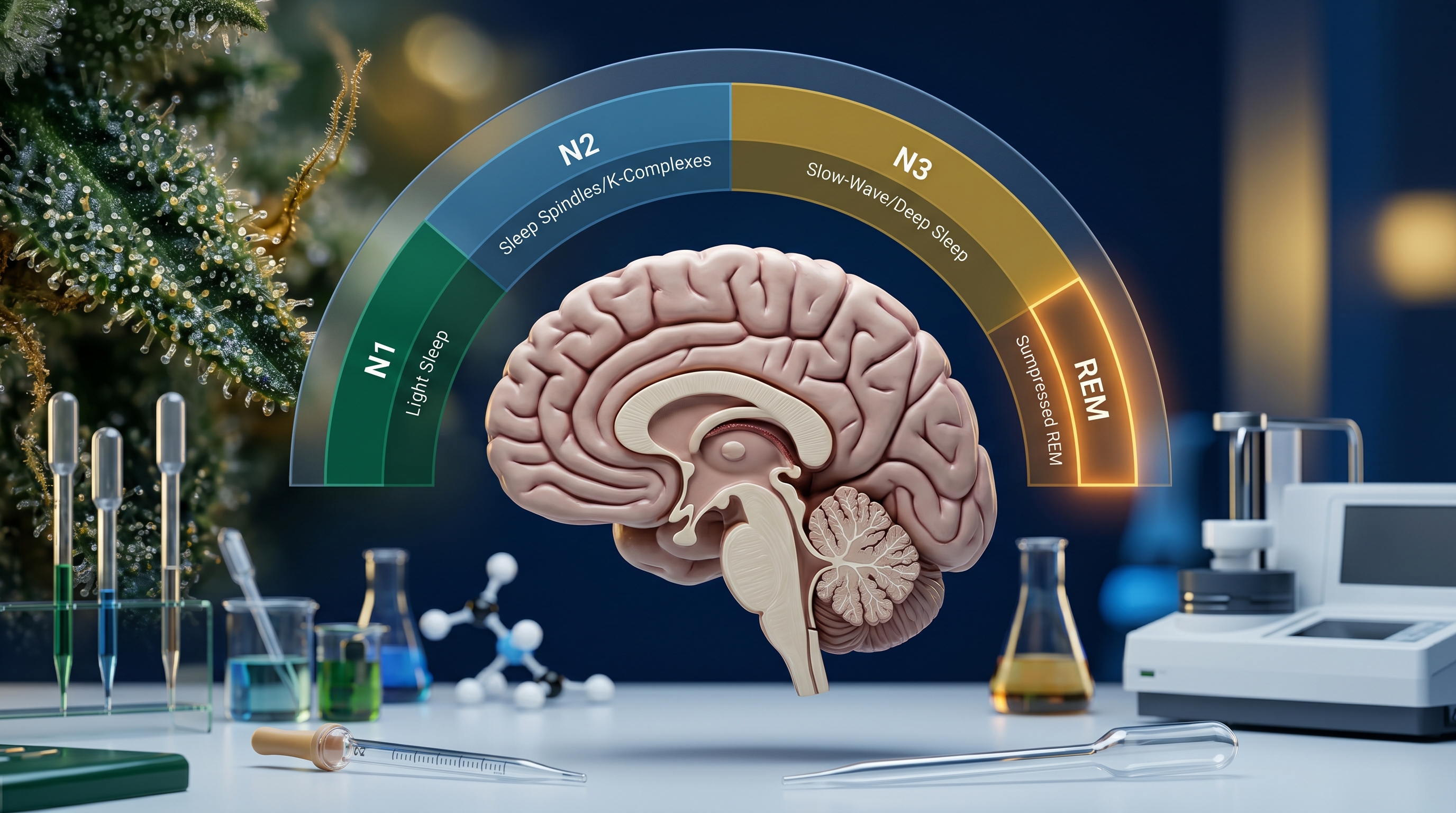
The oldest finding in cannabis-and-sleep research is that THC suppresses REM sleep. A 2025 pilot trial (Suni et al., Macquarie University) used 256-channel high-density EEG in 20 DSM-5 insomnia patients. A single oral 10 mg THC + 200 mg CBD dose reduced REM by 33.9 minutes vs placebo (p < 0.001, d = -1.5) and pushed REM latency out 65.6 minutes. A 2025 PSG meta-analysis (Hodgson et al.) concluded REM suppression is real but nuanced — modern therapeutic doses produce smaller effects than older high-dose studies — and withdrawal reliably produces REM rebound for days to weeks. See how THC affects REM sleep and dream recall.
Why REM specifically matters in depression:
- REM is where emotional memory consolidation happens — the brain’s overnight emotional-processing system. Disrupt it and you may disrupt that processing.
- Untreated depression already alters REM. Depressed patients tend to have shorter REM latency, increased REM density, and more total REM. Many effective antidepressants work partly by normalizing REM. Layering REM-suppressing cannabis on already-disrupted architecture creates a complicated picture.
This doesn’t mean cannabis is “ruining” sleep for everyone with depression. It means the trade-off is real, and whether subjective benefit outweighs architectural cost long-term remains open.
What Cannabis Does to Sleep: The Honest Profile
Pulling the literature together, the honest summary of what THC-dominant cannabis does to sleep:
- Faster onset. THC reduces sleep latency. For an insomniac, this is often the entire reason cannabis “works.”
- Less REM, less dream recall. Chronic users often notice they “stop dreaming.” Some find that a feature; a sleep researcher would call it a missed opportunity for emotional consolidation.
- Slow-wave sleep is mixed. Acute studies suggested increases in deep sleep; chronic-user data finds less slow-wave sleep than age-matched non-users.
- More wake-after-sleep-onset in frequent users. Bowles et al. (2024, J Clin Sleep Med) found use >20 days/month within 3 hours of bedtime correlated with more wake time, more stage 1 sleep, longer REM latency, and lower sleep efficiency.
- Withdrawal disrupts sleep, period. The most replicated finding in the literature: longer latency, more wake time, REM rebound, reduced total sleep — for one to several weeks.
That last point is what makes the cycle sticky. Stopping cannabis when you’ve used it nightly doesn’t just remove the sleep aid; it actively makes sleep worse for a period. So you go back.
Why It “Works” Anyway
How can chronic users objectively sleep less efficiently and subjectively report better sleep? A few non-exclusive answers:
- For depressive insomnia, sleep onset is the symptom. If cannabis cuts 90 minutes of lying-with-your-thoughts to 15, the rest of the architecture matters less to lived experience.
- Absence of dreaming feels restful to users with depression-related nightmares or ruminative dream content.
- Subjective and objective sleep quality correlate poorly in general — the brain’s report is built mostly from sleep onset, perceived continuity, and morning grogginess.
- Depression itself distorts sleep perception. Depressed patients often underestimate how much they slept. A drug that fixes the perception of falling asleep produces outsized subjective relief.
The perceived benefit is real and meaningful. It’s also incomplete. Both halves coexist.
See also the science of cannabis and sleep, best strains for sleep, and evening wind-down profiles.
The Tolerance Trap
Tolerance to cannabis’s sleep effects develops fast — measurable in days, substantial in weeks. The trajectory most users recognize from the inside: first nights, small dose works beautifully, sleep latency collapses. Two to four weeks in, same dose stops working as well; the user increases the dose. Months in, moderate-to-large doses are needed for what small doses used to produce, and daytime grogginess or motivation flatness shows up — itself easily mistaken for or compounding depression. Try to stop, and withdrawal-driven insomnia returns worse than baseline for one to several weeks. The user concludes, “I have to use cannabis to sleep.” Functionally true; pharmacologically circular.
This is the bidirectional risk model Goodhines, Rathod, and Cingranelli proposed (2025, Current Sleep Medicine Reports): sleep problems prompt self-medication, which through tolerance and rebound maintains and worsens sleep problems, which prompts more cannabis. Not inevitable — but well-described, and depression increases vulnerability.
Better and Worse Patterns
We don’t have RCT-quality evidence to prescribe a specific protocol, but the literature suggests some patterns are less likely to feed the loop than others.
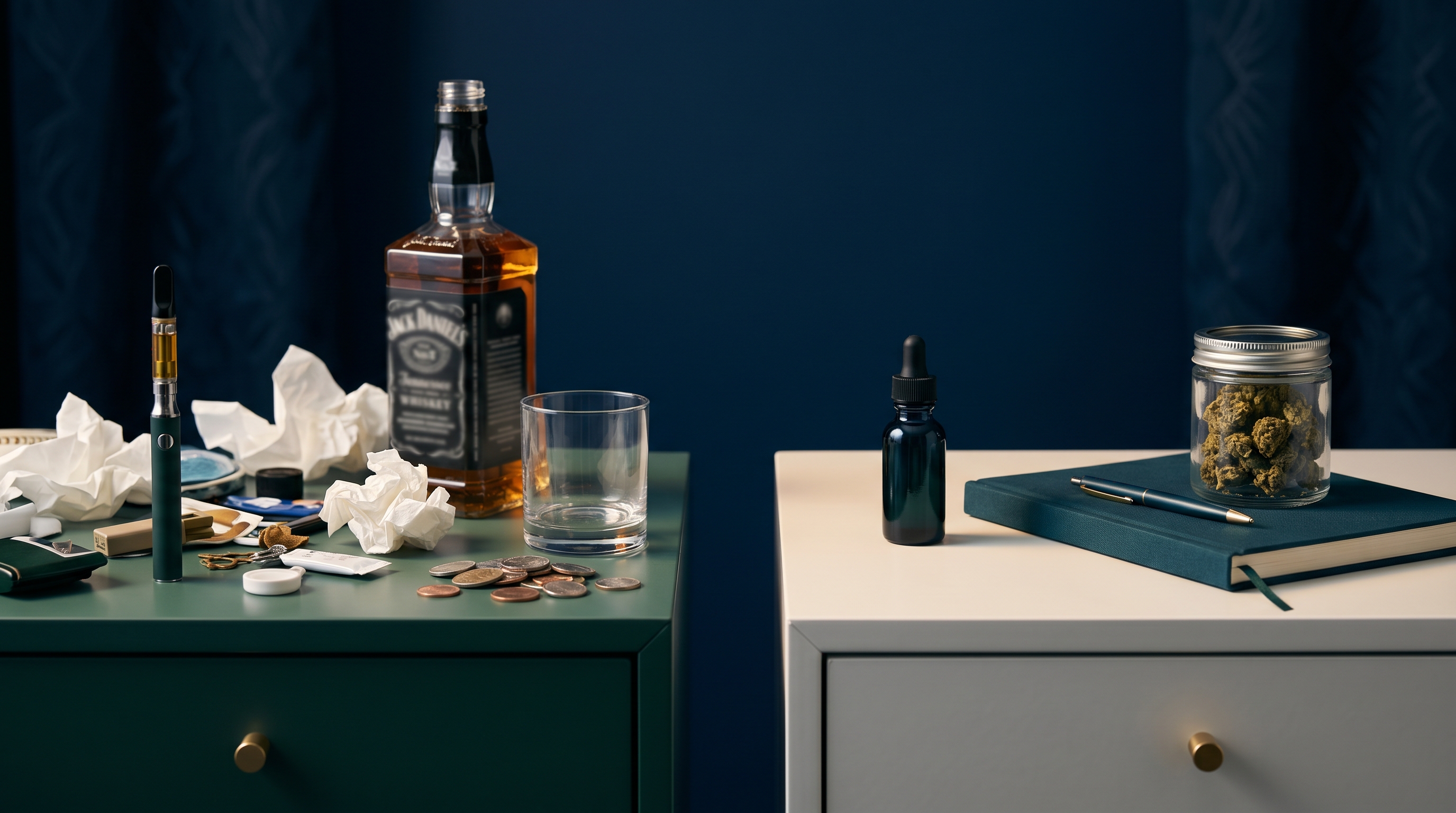
Probably worse: daily, escalating-dose high-THC concentrates near bedtime; cannabis as the sole tool for chronic insomnia; nightly cannabis combined with alcohol (synergistic REM suppression); using cannabis without addressing the underlying depression at all.
Probably better: intermittent rather than nightly use (preserves responsiveness, slows tolerance); lower THC, higher CBD profiles, or microdose THC; products richer in myrcene and linalool; caryophyllene for its CB2-mediated calming profile; strains in the Relax or Balance families over stimulating sativas late at night (Granddaddy Purple, OG Kush, and Blue Dream are common examples); CBN with the caveat the human evidence is thinner than the marketing; concurrent depression treatment, pharmacological or psychotherapeutic.
For depression-specific strain guidance, see the science-backed guide to cannabis strains for depression.
The Real Conversation With Your Prescriber
If you’re being treated for depression and using cannabis for sleep, your prescriber needs to know. SSRIs, SNRIs, and MAOIs can interact with cannabinoids via CYP450 metabolism (CBD is a known CYP inhibitor) — interactions are usually modest but they exist. Cannabis can also mask treatment response: if sleep improves on a new antidepressant and you’re using nightly cannabis, neither you nor your prescriber can tell what’s working, and dose adjustments get slower.
Worth flagging: CBT-I is first-line for chronic insomnia. Cognitive Behavioral Therapy for Insomnia has stronger evidence than any sleep medication, cannabis included, and is effective for depression-associated insomnia specifically. Frustratingly harder to access than a dispensary, but it should be on the table.
Not a moralizing point — an honesty point. Self-medication works best when coordinated with the rest of your care.
For You
The most useful thing you can do is track sleep quality and depression scores together — not just sleep onset, not just mood. PSQI takes five minutes a week. PHQ-9 takes two.
What to look for over four to eight weeks: is sleep latency still responding, or has it crept back up? Are you using more than a month ago to get the same effect? Waking at the same time(s) despite cannabis at bedtime? How’s the day after — flat, foggy, normal? Is your PHQ-9 moving in the direction you’d expect if depression treatment were working?
If sleep is improving, PHQ-9 is improving, and dose isn’t escalating — you’re in the favorable subset of the literature. If sleep is improving but PHQ-9 is flat/worsening, or dose is creeping — you’re entering the bidirectional-risk loop. Bring it to your provider.
Tracking sleep, mood, and cannabis sessions together is the only individual-level evidence that exists for you. Aggregate studies tell us what’s true on average; only your own n-of-1 data tells you which subset of the average you’re in. The High IQ app is built for exactly this triangulation — but the principle matters more than the tool.
Sources
- Goodhines PA, Wedel AV, et al. Joint Relations Among Cannabis, Sleep, and Affective Symptomatology: A Scoping Review. Current Addiction Reports, 13(39), April 16, 2026. doi:10.1007/s40429-026-00735-1
- Goodhines PA, Rathod K, Cingranelli L. Sleep Health, Self-Medication, and Cannabis Risk: A Bidirectional Model and Research Agenda. Current Sleep Medicine Reports, 11(4), January 2025. doi:10.1007/s40675-024-00314-8
- Suni E et al. Acute effects of oral cannabinoids on sleep and high-density EEG in insomnia. Macquarie University, July 2025.
- Bowles NP et al. The impact of cannabis use proximal to sleep and cannabinoid metabolites on sleep architecture. J Clin Sleep Med, October 2024.
- Hodgson et al. Cannabis and sleep architecture: A systematic review and meta-analysis. PMID: 40967124, 2025.
- Angarita GA et al. Sleep abnormalities associated with alcohol, cannabis, cocaine, and opiate use. Addiction Sci Clin Pract, 2024.
- Kolla BP et al. The Effects of Cannabinoids on Sleep. J Prim Care Community Health, April 2022.
- Khantzian EJ. The self-medication hypothesis of substance use disorders. Harvard Rev Psychiatry, 1997.
Crisis resources: US — call or text 988. UK — Samaritans 116 123. International — findahelpline.com. Mental health emergencies are real medical emergencies. Treat them that way.
