Cannabis & the Teenage Brain: What 11,000 Youth Revealed
A 2026 longitudinal study of 11,000+ youth shows THC exposure tracks with measurable brain trajectory changes — while CBD does not. The data parents need.

Professor High

The Honest Question
For thirty years, the question “does cannabis hurt teenage brains?” has been answered mostly with bad data — small samples, no toxicology, no controls for the dozens of confounders that sit alongside underage use. Parents got moral panic. Adult consumers got dismissive shrugs. Neither got science.
That changed in April 2026. The Adolescent Brain Cognitive Development Study (ABCD) — a 21-site, NIH-funded cohort tracking 11,868 American children since 2016 — published its largest analysis yet of how cannabis use during adolescence relates to cognitive development. The paper, led by Natasha Wade and colleagues at UC San Diego, followed 11,036 youth from ages 9 to 17, combined self-report with hair, urine, and oral-fluid toxicology, and broke out THC versus CBD exposure separately. (Wade et al., 2026, Neuropsychopharmacology)
The headline finding is more nuanced than either side has been ready for. Adolescent THC exposure tracked with measurably slower cognitive growth across multiple domains — not a cliff, not “permanent brain damage,” but a real and consistent flattening of trajectories. CBD-positive youth, in the same study, were indistinguishable from controls. A teen brain at 14 is not an adult brain at 28, and the data points one way for one population, a different way for the other.

What the ABCD Study Actually Is
ABCD is the largest long-term study of brain development ever conducted in the United States. It recruited a nationally diverse sample at ages 9–10 through propensity-based school recruitment at 21 sites and has followed participants annually with cognitive testing, structural and functional MRI, mental-health assessments, family interviews, and — crucially — objective biological measures of substance exposure (hair, urine, breath, oral fluid).
What makes ABCD methodologically powerful is the timing. Researchers measured brain structure and cognition at baseline, before nearly any participant had touched cannabis. When a 14-year-old shows up positive in a hair test, investigators already have four to five years of pre-exposure data on that same child. Differences that emerge after exposure get tracked against the child’s own earlier baseline rather than a stranger’s.
Wade et al.’s 2026 analysis used time-varying cannabis exposure: each participant counted as a control until verified use was identified, then joined the cannabis-use group for subsequent waves. Mixed-effects models tested whether use status interacted with age. Covariates included sociodemographics, family substance-use-disorder history, prenatal substance exposure, early psychopathology, other substance use, study site, and family clustering. This is about as well-controlled as observational adolescent research gets.
The 2026 Findings: Flattened, Not Diminished
The most important nuance in Wade 2026 is the shape of the cognitive curves, not their endpoints.
Cannabis users in the ABCD cohort did not show absolute decline. They started ahead of controls at ages 9–10 across working memory, processing speed, inhibitory control, episodic memory, and language — before nearly any of them had used cannabis. Their scores still improved with age. They just improved more slowly. By ages 15–17, the early advantage was gone or reversed across most domains. (Mental Health Daily summary)
The cannabis-by-age interaction was statistically significant across all seven cognitive domains tested (FDR-corrected p < 0.05). Standardized β coefficients — which put different tests on a common scale — ran from −0.11 for oral reading to −0.52 for working memory. Groups overlapped at ages 15–16 and users performed measurably worse by age 17.
These are small-to-moderate effect sizes. They are not the “permanent IQ damage” framing that circulated after older, methodologically weaker work. Most teen users in ABCD still scored within normal ranges. The gap is in growth rate — how fast the curve is climbing during the years when adolescent brains are doing their most important wiring. “Flattened cognitive growth during the teenage years” is a real concern. It is also recoverable, modifiable, and not equivalent to brain damage.
The CBD Comparator Surprise
The most innovative — and to many readers, most surprising — piece of Wade 2026 is the secondary analysis. In a subsample of 645 youth with repeat hair toxicology between ages 12 and 16, the researchers split exposure into three groups: THC-positive (n = 81), CBD-positive (n = 21), and controls (n = 546).
The two cannabinoids did not behave the same way.
THC-positive youth showed substantially worse episodic memory growth: β = −0.60, p = 0.007. By ages 15–17 they scored measurably worse than both controls and the CBD group on picture-sequencing memory tasks. CBD-positive youth, by contrast, did not differ from controls on any cognitive task. (Wade et al., 2026)
This is the first time a sample of this scale has been able to separate the two cannabinoids in adolescents using objective biomarkers rather than self-report. It aligns with a separate 2025 ABCD analysis of 2,262 youth that found THC and CBD predicted opposite patterns of sleep, exercise, and behavioral outcomes one year later (Aks et al., 2025, Neurotoxicology and Teratology).
A few caveats are essential. The CBD group is small (n = 21). The null finding is reassuring but does not, on its own, establish CBD safety in adolescents. Hair samples positive only for THC may include external contamination from secondhand exposure. And the secondary analysis used a less stringent statistical threshold (p < 0.01) than the primary FDR-corrected results.
But the pattern is consistent with a much larger body of mechanistic and adult research. THC and CBD are not interchangeable molecules, and treating them as one substance (“cannabis”) obscures the science. For more on how the two cannabinoids diverge in clinical settings, see our review of cannabis and mental health across 28 clinical trials.
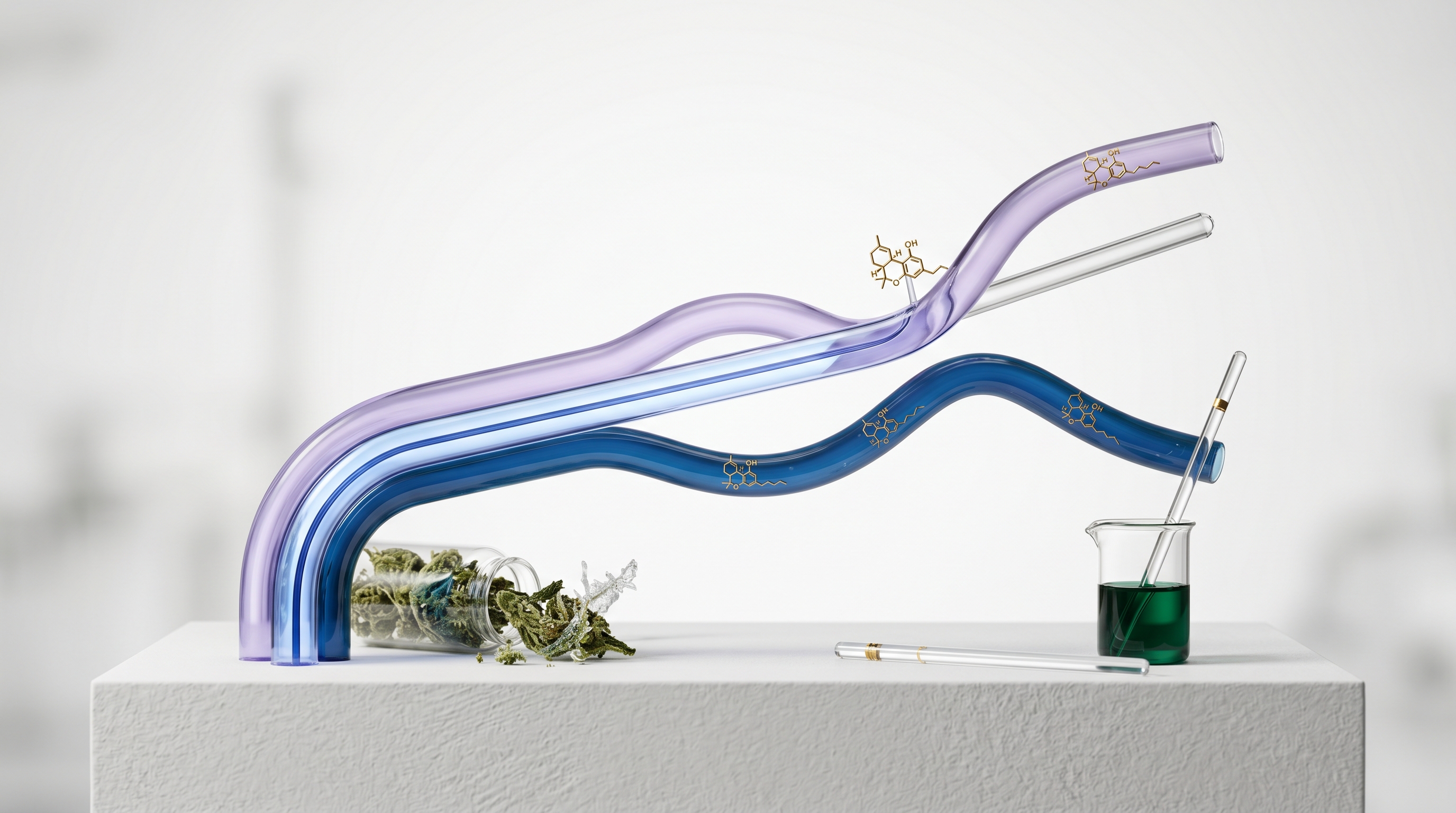
Why THC and CBD Diverge — The Receptor Story
The mechanistic explanation for the THC/CBD differential rests on a single receptor: CB1.
CB1 mediates the psychoactive effects of THC. It is also the receptor the developing brain uses to regulate synaptic pruning, axon guidance, and white-matter development during adolescence. CB1 expression peaks during the teenage years — exactly the window ABCD is measuring. A separate longitudinal neuroimaging study found that within-person increases in adolescent cannabis use were associated with reductions in cortical thickness, with the strongest effects in regions of highest CB1 expression (Watts, Navarri & Conrod, 2026). For each once-per-week increase in use, males showed about a 0.005 mm reduction in cortical thickness — roughly 18% of the annual rate of normal cortical thinning.
THC is a direct CB1 agonist. It binds, activates, and — over repeated exposure — desensitizes the receptor. In an adult brain that has finished its developmental wiring, this is the source of the high and not much else. In a teenage brain that is using CB1 signaling to perform structural work, the same activation lands in the middle of an active construction site.
CBD does not directly activate CB1. It modulates the endocannabinoid system indirectly — partial agonism at certain serotonin receptors, allosteric modulation of CB1, effects on FAAH and anandamide. Whether those secondary effects matter in adolescents is still open. But the absence of direct CB1 agonism is the simplest reason CBD-exposed youth in Wade 2026 looked like controls. For broader context on what brain scans can and cannot tell us, see our overview of neuroimaging and cannabis.
The Magnitude Question — How Worried Should Anyone Be?
The honest answer is “moderately, and specifically about THC.”
Effect sizes in Wade 2026 ranged from β ≈ −0.1 (oral reading) to β ≈ −0.5 (working memory) — small-to-moderate in behavioral-science terms. These are not the catastrophic deficits a generation of parents read about in the early 2010s. Most teen users in ABCD still scored within normal ranges on every test.
But effect sizes interact with base rates and exposure intensity. A small effect landing in the working-memory growth curve of millions of adolescents during a peak developmental window is still a public-health signal. The Watts cortical-thickness work showed the same pattern, and Wade 2026 showed dose-response: heavier use tracked with steeper trajectory flattening, concentration-dependent in the hair-toxicology subsample. That’s what a real biological signal looks like.
What Wade 2026 does not show:
- That cognitive flattening is permanent. ABCD will follow participants into their twenties; we don’t yet know which trajectories rebound after cessation.
- The effect of onset age within adolescence. We can’t yet say whether 14-year-old onset differs meaningfully from 18-year-old onset, though earlier work suggests it does.
- It cannot fully rule out residual confounding. Genetic liability, peer effects, and self-selection can never be perfectly controlled.
- It cannot speak directly to legal-age adult use. The children were 9 to 17 throughout the analysis window.
That last caveat is the one that gets lost most often.
The Adult-Use Implication: The Data Doesn’t Generalize Backward
A teenage brain is not a small adult brain. It is a brain in the middle of a structural project — synaptic pruning, white-matter myelination, prefrontal-cortex maturation — that doesn’t finish until the mid-twenties.
CB1 receptor density follows that developmental clock. It rises through childhood, peaks in adolescence, and stabilizes into the adult pattern in the mid-twenties. The receptor density THC binds during a 14-year-old’s session is not the same density it binds during a 30-year-old’s session. The downstream consequences are biologically different.
This is why the ABCD findings should not be read as evidence that cannabis is dangerous to adult consumers. They are evidence that cannabis is dangerous in a developmentally specific way to adolescents. The data points squarely at the developmental window. It does not say anything about a 35-year-old who consumes a 10mg edible on a Saturday.
The cleanest read is the one most cannabis-using parents already intuit: delay onset, watch your kids, lock up your products. There’s also a related reason to support delay: heavy adolescent THC exposure is associated with elevated risk of psychotic disorders later in life, particularly in genetically vulnerable individuals. We covered that literature in cannabis and schizophrenia risk: who should avoid THC.
What This Means for Hemp-Derived THC Products
There is an uncomfortable adjacent finding the Wade study throws into sharper relief.
In 2018, the Farm Bill created a legal pathway for hemp-derived THC products — Delta-8, Delta-9 in low-volume gummies, THC-A flower — that are sold in gas stations, vape shops, and convenience stores in many states with little or no age verification. These products have been showing up in pediatric ICUs with alarming frequency, and recent surveillance suggests minors are buying them at higher rates than parents realize. (Hemp-derived THC sending kids to the ICU | Hemp THC products sold to minors: what the data shows)
The ABCD data is the developmental backdrop those harms land against. We are not talking about hypothetical risk. Adolescents are accessing high-THC products in ways their parents often don’t see, during the exact developmental window in which the largest longitudinal study ever conducted on this question shows real cognitive trajectory effects. Storage discipline at home — locked cabinets, clear labeling, conversations about what the products in the freezer are — is not paranoia. It is reading the science.

A Practical Parent Playbook
Wade 2026 translates into five things parents can actually do, none of which require moralizing.
- Talk early and without judgment. Adolescents who hear cognitive-development information from a calm, informed parent absorb it differently than adolescents who hear “don’t” without explanation. The data is on your side.
- Emphasize delay, not prohibition. Brain development continues into the mid-twenties. The honest goal isn’t “never,” it’s “later.” A 22-year-old’s brain handles cannabis differently than a 16-year-old’s.
- Distinguish THC from CBD if it comes up. Developmental risk is concentrated in the THC pathway, not the cannabinoid family writ large. This is not permission for teen CBD use; it’s clarity about where the signal sits.
- Lock up adult products. Storage discipline is the single highest-leverage parent action. The kids ending up in the ICU are almost always finding products in their own homes.
- Watch for early-warning patterns. Working memory is the steepest trajectory in Wade 2026. If a previously sharp teenager is suddenly losing track of conversations or struggling with multi-step tasks at school, that’s worth a calm conversation — about many possible causes, THC included.
For adult consumers curious about how cannabinoid-and-terpene profiles differ across the modern market, our family guides on balance and relax walk through how compounds like myrcene and caryophyllene are weighted in mainstream products. CBD-forward cultivars like Harlequin and ACDC — both with measurable CBD-to-THC ratios — sit at the opposite end of the spectrum from the high-potency Blue Dream–style flower that increasingly dominates adult-use shelves. The two markets are increasingly distinct, and parents benefit from knowing the difference.
The Bigger Picture for Adult Consumers
The cleanest adult-consumer takeaway from Wade 2026 is one many of you already operate by: wait until ~21–25 to start, and know your own response once you do.
That guideline aligns with the developmental-neuroscience literature, with the legal-age frameworks most US states have settled on, and now with the largest longitudinal cohort ever assembled on adolescent cognitive trajectories. Adult consumers who started in their mid-twenties or later, who use intentionally, who track their response over time, are operating in the part of the data that does not show trajectory effects.
The discipline that separates a thoughtful adult consumer from a teenager is not abstention. It’s awareness — of dose, of cannabinoid ratio, of what changes for you over time, and of what your kids might be exposed to that you didn’t choose for them. Logging your own experience over months gives you the longitudinal data on yourself that no published study can. If you’ve never tracked your own response, start here — it takes a session.
Sources
- Wade NE, Sullivan RM, Wallace AL, Visontay R, Szpak V, Lisdahl KM, Huestis MA, Gonçalves PD, Byrne H, Mewton L, Jacobus J, Tapert SF. “Longitudinal neurocognitive trajectories in a large cohort of youth who use cannabis: combining self-report and toxicology.” Neuropsychopharmacology (2026). Link
- Watts JJ, Navarri X, Conrod PJ. “Independent brain cortical signatures of risk for adolescent cannabis use and consequences of such use are moderated by sex.” Neuropsychopharmacology 51, 497–505 (2026). Link
- Aks IR, Patel H, Pelham WE, Huestis MA, Wade NE. “Cannabinoids in hair and their prospective association with mental and physical health outcomes in adolescents.” Neurotoxicology and Teratology 108, 107433 (2025). Link
- Adolescent Brain Cognitive Development Study (ABCD). Study overview and methodology. abcdstudy.org
- Mental Health Daily summary of Wade 2026, “Cannabis vs. Teen Cognition: Flattened, Not Diminished.” (April 2026). Link
