Cannabis Rescheduled to Schedule III: What It Means for You
The DEA finalized cannabis rescheduling to Schedule III in April 2026. What changed for research, taxes, and banking — and what didn't change for consumers.

Professor High

On April 23, 2026, the U.S. Department of Justice issued a Final Order placing certain categories of cannabis into Schedule III of the Controlled Substances Act. It took effect when the Federal Register published it on April 28, 2026 — and fifty-plus years of cannabis sitting alongside heroin and LSD under Schedule I came to an end. Or at least, part of it did.
The short version: some things changed meaningfully, mostly for businesses. Most things that affect you as a consumer stayed the same. This piece walks through both columns clearly.

What Just Happened
The federal government has classified cannabis as a Schedule I controlled substance since the Controlled Substances Act was signed into law in 1970. Schedule I means two things officially: high potential for abuse and no currently accepted medical use. Cannabis shared that status with heroin for over five decades.
The rescheduling process began in earnest in 2023 when the Department of Health and Human Services recommended moving cannabis to Schedule III. The DEA published a proposed rule in May 2024, received more than 43,000 public comments, and ultimately issued the final order in April 2026, in alignment with an executive order President Trump signed in December 2025.
The order is titled AG Order No. 6754-2026, and it moves two specific categories of cannabis products from Schedule I to Schedule III:
- FDA-approved drug products containing marijuana (currently just Epidiolex and similar approved cannabinoid medications)
- Marijuana that is subject to a state-issued license to manufacture, distribute, or dispense for medical purposes only
Everything else remains Schedule I: recreational cannabis in any state, unlicensed cannabis activity, synthetically derived THC, and bulk extracts not covered by an FDA approval. The order did not decriminalize marijuana federally. It did not legalize it. It changed its regulatory classification — which carries real consequences, but targeted ones.
What Schedule III Actually Means
Under the Controlled Substances Act, Schedule III substances are defined as having “moderate to low potential for dependence and abuse” and accepted medical use. Other Schedule III drugs include combination products containing low-dose codeine (like Tylenol with codeine), ketamine, and anabolic steroids.
Schedule I, by comparison, is reserved for substances with no accepted medical use and high abuse potential — a classification that has made federally sanctioned cannabis research nearly impossible for decades. Schedule III is meaningfully different, not symbolically.
What Actually Changes
The 280E Tax Burden Is Gone — For Qualifying Businesses
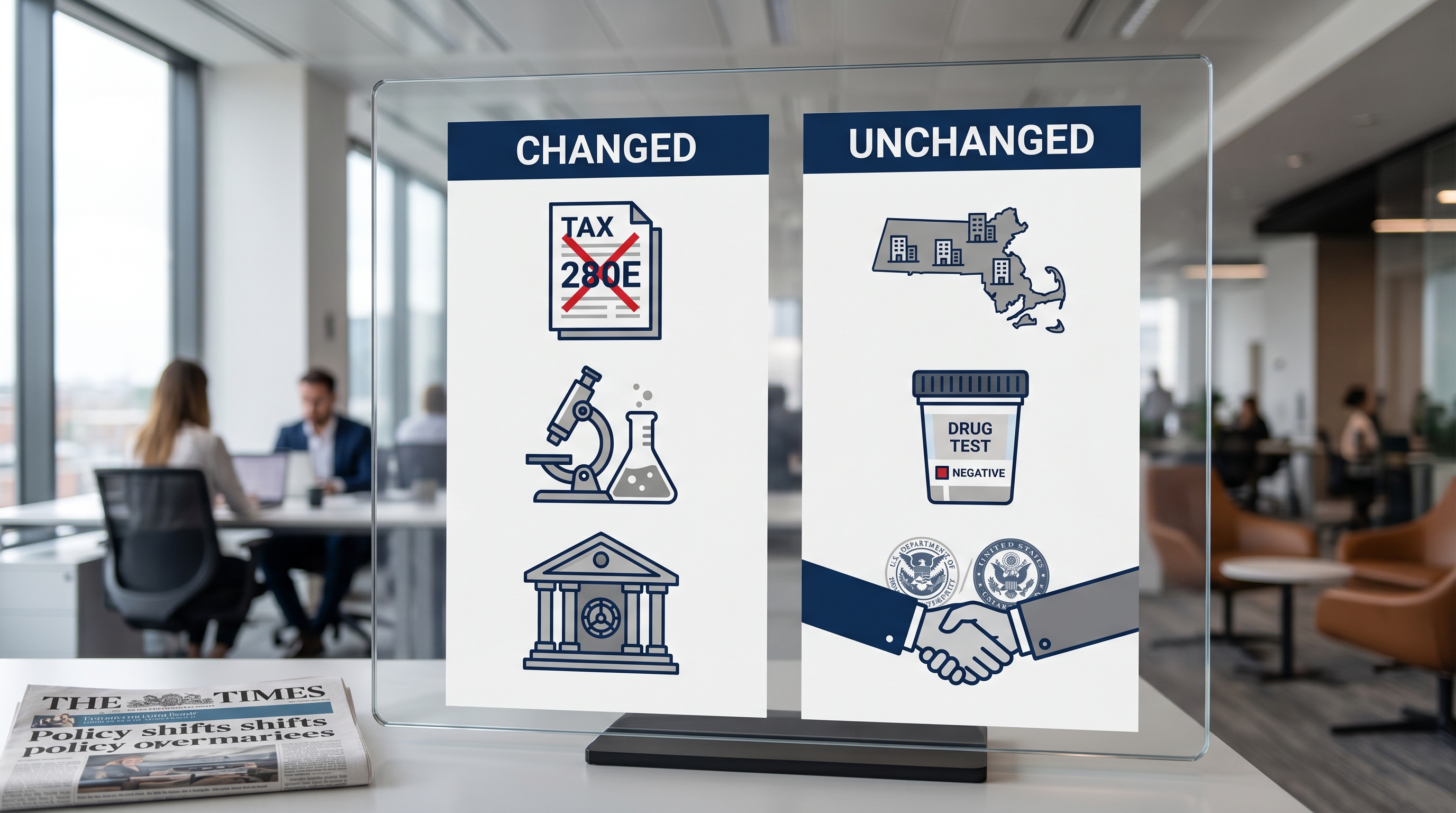
This is the single largest material change from the rescheduling, and it flows through to consumers indirectly. Section 280E of the Internal Revenue Code blocks businesses “trafficking in controlled substances” listed under Schedule I or II from deducting ordinary business expenses. Cannabis companies could deduct cost of goods sold, but not rent, payroll, utilities, or marketing.
The practical result: effective federal tax rates for cannabis businesses ranged from 70 to 90 percent, compared to the standard corporate rate of 21 percent. It has been one of the most financially punishing elements of the federal-state conflict in cannabis.
Under Schedule III, state-licensed medical marijuana businesses are no longer subject to 280E. The Treasury and IRS confirmed this in subsequent guidance, applying the change to the full taxable year that includes the April 28 effective date. Industry analysts estimate the 280E change unlocks approximately $2.3 billion in annual industry tax savings across qualifying businesses.
Recreational operators remain fully subject to 280E. If you shop at an adult-use dispensary in a state with recreational programs, the business serving you still faces 70-to-90-percent effective federal tax rates.
Research Access Opens Significantly
Schedule I has required researchers to obtain a special DEA license, source cannabis from a single federally approved facility (NIDA’s farm at the University of Mississippi, which finally expanded to additional cultivators only recently), and navigate layered approval processes that deterred most academic institutions from pursuing cannabis studies.
Schedule III removes the Schedule I research license requirement. Universities, hospitals, and private research institutions can now conduct clinical trials on cannabis products that fall under the new classification — studying efficacy for chronic pain, PTSD, epilepsy, cancer symptom management, and neurological applications — without the administrative overhead that blocked most researchers before.
This will not produce peer-reviewed results overnight. Clinical trials take years. But the infrastructure change is meaningful: more researchers can now start, which accelerates the long-term evidence base for the cannabis science that informs how products are understood and classified.
A Clearer FDA Approval Pathway
Rescheduled substances can move through FDA’s standard drug approval process more efficiently. This matters more for pharmaceutical companies developing cannabinoid-based medications than for state dispensaries, but it sets up a legal pathway for more FDA-approved cannabis-derived products. Each FDA approval adds to the body of substances that are rescheduled by default under the new order.
This is a slow-moving process — FDA drug development typically takes years to a decade — but it creates a legitimate route from cannabis plant to regulated medicine that didn’t exist in the same form under Schedule I.
Banking: Better Atmosphere, Same Structural Problem
One of the most discussed downstream effects of rescheduling is banking. Cannabis businesses have operated largely cash-only or through workaround payment systems for years because federally insured financial institutions faced regulatory and legal exposure for servicing Schedule I businesses.
Rescheduling to Schedule III reduces one layer of federal risk for medical marijuana operators. Industry analysts expect more banks and credit unions to extend services to qualifying businesses. However, the SAFE/SAFER Banking Act — which would create an explicit federal safe harbor for financial institutions serving state-legal cannabis companies — has not passed. As of early 2026, it has been reintroduced with bipartisan support for the eighth time since 2013.
Rescheduling improves the risk calculus for banks willing to engage, but it does not compel them to, and BSA/AML (Bank Secrecy Act / anti-money laundering) compliance obligations remain complex. The banking situation is improved, not resolved.

What Doesn’t Change for Consumers
You Still Buy at a State-Licensed Dispensary Under State Law
Nothing in the April 2026 order changes how you walk into a dispensary, present your ID or medical card, and purchase cannabis. State licensing requirements, dosage limits, product categories, purchase quantities, and purchase tracking remain entirely governed by your state’s cannabis regulatory agency.
Your state medical marijuana card remains your primary credential. The federal Schedule III designation changes the legal and tax framework for the businesses behind the counter — it does not change patient-facing access procedures. If you live in a state with adult-use access, the products you buy remain federally classified as Schedule I substances under the final order.
Recreational Cannabis Is Still Federally Illegal
This is the correction most worth underscoring. The April 2026 order does not legalize cannabis at the federal level for any purpose. It does not create a federal right to purchase, possess, or consume cannabis recreationally. It does not conflict with federal criminal statutes that remain on the books.
Adult-use cannabis remains a Schedule I controlled substance under federal law. States with recreational programs have legalized it under their own authority, but federal-state conflict in that space is unchanged. Federal enforcement against recreational cannabis consumers has been rare and subject to congressional appropriations restrictions, but those dynamics shift with each administration. The legal status is unchanged.
Interstate Commerce Is Still Illegal
You cannot legally transport cannabis across state lines — even between two states where cannabis is fully legal. Federal law governs interstate commerce, and cannabis remains a federally controlled substance. This has not changed under the April 2026 order, and it applies to both recreational and medical cannabis.
Employment Drug Testing Follows Employer Policy, Not the Schedule
This is the misconception that costs people jobs. Schedule III status does not mean that cannabis use is employment-protected.
Employers retain full authority to maintain drug testing programs and zero-tolerance policies. A positive drug test for THC does not change in significance because cannabis moved to Schedule III. Drug tests cannot distinguish medical from recreational use, and they cannot determine current impairment.
For most private-sector employees, whether cannabis is legal in your state and whether your employer can discipline you for off-work use are two separate legal questions. Many states have passed employment protections for off-duty cannabis use, but those are state laws, not a consequence of federal rescheduling.
One nuance did emerge: in states where medical cannabis is legal and an employee can demonstrate they use cannabis for a qualifying medical condition, the ADA reasonable accommodation analysis becomes more complex now that medical cannabis is a legal Schedule III substance rather than categorically illegal. Employers may face new obligations to engage in individualized accommodation discussions rather than applying blanket termination for a positive test. This is evolving employment law territory, and guidance varies by jurisdiction.
For federally regulated safety-sensitive roles — pilots, commercial drivers, railway workers, and others covered by DOT regulations — the picture is unambiguous: zero tolerance remains in effect regardless of rescheduling. Federal contractors are in a similar position.
If employment drug testing is relevant to your situation, read our detailed breakdown: Cannabis and Drug Testing: How Long THC Stays in Your System.
The State-Federal Conflict — Refined, Not Resolved
Before rescheduling, state recreational and medical cannabis programs operated in technical violation of federal law, tolerated largely through federal non-enforcement and appropriations riders that prevented the DOJ from using funds to interfere with state medical cannabis programs.
After rescheduling, state medical cannabis programs for licensed businesses now have a cleaner federal posture — those businesses are operating in a substance that the federal government recognizes as having medical use and moderate-to-low abuse potential. But recreational programs remain in the same legal gray zone they occupied before.
The Gibson Dunn legal analysis of the order notes that DEA and FDA have historically “declined to take enforcement action” against state cannabis programs despite technical violations, and expect enforcement discretion to continue. But that is not the same as legal protection. The STATES Act — which would exempt states from the Controlled Substances Act for cannabis programs that comply with state law — remains pending in Congress, as it has for several sessions.
This matters for understanding the April 2026 order accurately: it is a regulatory classification change, not a legalization, not a decriminalization, and not a resolution of the federal-state conflict in adult-use markets.
For global context on how other jurisdictions have handled these competing frameworks, see our coverage of Germany’s cannabis legalization experiment and the very different outcome in Thailand’s reversal.
Industry Implications
For publicly traded cannabis companies, the 280E relief is the most immediate financial event in the sector’s history. Effective tax rates dropping from 70-to-90 percent to 20-to-30 percent for qualifying medical operators is not a marginal improvement — it restructures the entire P&L.
This creates conditions for accelerated M&A as balance sheets improve, price compression as cost structures normalize, and renewed institutional investment interest from funds that were previously precluded from cannabis exposure by compliance policies tied to Schedule I status.
Brian Vicente, founding partner of Vicente LLP — one of the leading cannabis law firms in the country — called it “the biggest thing to happen in federal cannabis policy in decades.” The industry group NORML described it as “a partial but meaningful victory.” The consensus across operators is that it’s real progress with significant caveats.
For medical dispensaries specifically, the DEA issued a 60-day registration window closing June 22, 2026, for businesses to apply for federal DEA registration under the new Schedule III framework. This is a compliance step, not optional for businesses that want to operate in full alignment with the new federal status.
For companies operating in recreational markets, the situation is different. They received no immediate tax relief, and the pressure to restructure operations or add medical verticals is now acute.
Research Implications
The medical research community has operated under extraordinary constraints studying cannabis for decades. The Schedule I license requirement, the limited and often low-quality supply from the NIDA facility, and the reputational hesitation of research institutions created a knowledge gap that affects clinical practice today.
Under Schedule III, universities and hospitals can pursue clinical trials on cannabis products with the same administrative infrastructure used for other Schedule III drugs — like ketamine-assisted therapy research, which has accelerated significantly in recent years. This does not automatically produce results, but it removes the ceiling on what researchers can attempt.
Study targets most likely to accelerate: cannabis for chronic pain (already the most documented use case), anxiety and relaxation response, PTSD, epilepsy in populations not covered by existing approvals, and cannabinoid-drug interactions. Terpene science — how compounds like myrcene, limonene, and caryophyllene modify the cannabis experience — also becomes more accessible as a research target.
The practical guidance in our 100 cannabis tips guide notes how thin the peer-reviewed evidence base has been for consumer decisions. That should improve over the next five to ten years, and the April 2026 order is the policy event that makes it structurally possible.
Insurance: Still an Open Question
Cannabis rescheduling does not automatically trigger insurance coverage for medical cannabis. Health insurers are regulated at the state level, and coverage decisions follow state mandates and plan terms. The scheduling change may factor into future insurer risk analyses, but there is no immediate connection between Schedule III status and coverage eligibility.
For the full picture on what insurance does and doesn’t cover in cannabis contexts, see Cannabis and Insurance: What Consumers and Businesses Need to Know.
What’s Next
On June 29, 2026, the DEA opens a new administrative hearing in Arlington, Virginia, to evaluate whether all cannabis — including recreational products — should be rescheduled from Schedule I to Schedule III through formal federal rulemaking. This is the proceeding that could extend the benefits of rescheduling to adult-use markets.
The hearing runs through July 15, 2026. Interested parties who filed notice of participation by May 24, 2026 are eligible to present. DEA hearings of this type typically produce a recommended decision followed by a period for the Administrator to issue a final rule. A realistic timeline for broader rescheduling — if the hearing supports it — is 2027 or later.
Full descheduling (Schedule V or removal from scheduling entirely) is further out. The STATES Act, which would allow states to regulate cannabis without federal conflict, remains the legislative option most aligned with how cannabis actually functions in the market, but it has not found floor time in either chamber.
The April 2026 order is a real and significant inflection point in U.S. cannabis policy. It is not the finish line.
What to Track
If you use cannabis medically, the most relevant changes are structural: the businesses serving you are under less financial stress, which over time may affect product pricing and availability. Your state laws, dispensary, and medical card remain unchanged.
If you use cannabis recreationally in a legal state, the April order doesn’t change your experience in any direct way. The June 2026 hearing is the one to watch.
If employment drug testing is a concern, treat the April 2026 order as irrelevant to your employer’s policy unless your employer explicitly updates it — and verify that in writing. Strains like OG Kush and Gelato produce the same metabolite profile they always have, and urine tests detect the same breakdown products on the same detection windows.
Your cannabis use is your data. How you respond to balanced hybrids, which terpenes affect your experience, how Northern Lights compares to Wedding Cake for evening use — that’s pattern information that belongs to you. High IQ was built to help you track it. Use it as your personal record.
Sources
- DOJ Office of Public Affairs — Final Order Announcement, April 23, 2026
- Federal Register — Final Rule Publication, April 28, 2026
- Foley & Lardner — DEA Issues Long-Awaited Final Order
- Foley Hoag — DOJ, Treasury, and DEA Updates Since the April 23 Order
- Gibson Dunn — DEA Downschedules State Medical Marijuana, Expedited Hearing Set
- Saul Ewing LLP — DEA Reschedules FDA-Approved Marijuana Products and State-Licensed Medical Marijuana
- CBIZ — The Grass Is Greener on Schedule III: Cannabis Industry Finally Gets Its Tax Break
- Frier Levitt — Cannabis Schedule III Rescheduling: Tax, Banking, and Research
- Mondaq / Littler — What Employers Need to Know About Schedule III Rescheduling
- Abrigo — Marijuana Reclassification: What It Means for Financial Institutions
- Pharmacy Times — Marijuana Reclassified to Schedule 3: Clinical, Research, and Coverage Implications
- Cannabis Business Times — Industry Stakeholders React to Trump’s Schedule III Order
- KMK Law — From Schedule I to III: A Partial Tax Reset for Cannabis Businesses
- DISA — DOT Compliance Guide: Marijuana Rescheduling & Employer Obligations
