Does Smoking Weed Cause Gum Disease? What Studies Show
Cannabis smoking is linked to gum disease, but causation is less certain. Explore the research, dental warning signs, and everyday oral care.

Professor High
You remember the water bottle. You remember the snacks. But when was the last time cannabis made you think about your gums?
Cottonmouth gets attention because you can feel it immediately. The evidence around gum health asks a different question: what happens to the tissues supporting your teeth over years of use?
Cannabis smoking has been associated with periodontal disease in human studies, including research that followed people over time. That does not establish that smoking weed directly causes gum disease, or that every cannabis product carries the same risk. A later genetic study also complicates a simple cause-and-effect story. Thomson, 2008; Baumeister, 2022.
Professor High’s assignment today: understand the evidence without turning a dental appointment into a panic spiral. No miracle mouthwash, no strain recommendations, and no promise that a glass of water erases a long-term risk.
Gum disease is different from cottonmouth
Periodontal disease affects the tissues that hold teeth in place. Plaque buildup can inflame the gums; more advanced disease can damage supporting tissues and bone. Bleeding, gum recession, persistent bad breath, and loose teeth are reasons to seek dental assessment. Those signs are not a cannabis diagnosis. NIDCR: Gum disease.
Dry mouth describes a lack of enough saliva to keep the mouth wet. Saliva helps wash away food and protect teeth. Persistent dryness raises concerns about decay and oral infections, even when it does not mean someone has periodontitis. NIDCR: Dry mouth.
Our cottonmouth guide covers that familiar short-term experience. Here, the focus is the longer-term evidence about gums. Keeping those subjects separate helps avoid a common mistake: assuming that fixing the symptom you notice has addressed every oral-health concern.
What the long-term studies found
The 2008 study measured actual gum changes
Thomson and colleagues examined 903 participants in New Zealand’s Dunedin birth cohort. Cannabis use was assessed at ages 18, 21, 26, and 32; dental examinations took place at 26 and 32. Their outcome was periodontal attachment loss, a clinical measure of damage to the support around teeth.
The highest cannabis-exposure group had a higher risk of new or worsening attachment loss. After accounting for tobacco smoking and other measured factors, its relative risk was 2.2 compared with never-smokers of cannabis, with a 95% confidence interval of 1.2–3.9. This was an association in an observational cohort, not a randomized experiment. Thomson, 2008.
That number deserves careful reading. It is a comparison between study groups, for a particular measured outcome. It is not a prediction that your teeth will fall out, an estimate for one joint, or a risk multiplier for gummies.
Follow-up found a similar signal into the late thirties
Meier and colleagues later studied health through age 38 in the same Dunedin cohort. Cannabis exposure was associated with poorer periodontal health and decline in gum health between ages 26 and 38, including analyses accounting for tobacco exposure and earlier periodontal health. Meier, 2016.
This adds follow-up time, but an important detail often disappears in retellings: these two papers are not two independent populations. They draw on the same long-running cohort. Calling them separate replications would make the evidence sound broader than it is.
The later paper examined other physical-health measures too. Its periodontal result should not be stretched into a claim that cannabis is harmless everywhere else. The question it can help answer here is narrower: did cumulative use track with gum-health changes in this group?
A U.S. cohort broadened the picture, with a measurement tradeoff
Chaffee’s 2021 study used data from 18,872 adults in the Population Assessment of Tobacco and Health study. Cannabis use was associated with later self-reported oral-health problems after adjustment for tobacco and other risk factors. However, these were self-reported outcomes, and information about cannabis frequency and method was limited. Chaffee, 2021.
A national sample improves breadth. It does not turn a survey answer into a full periodontal examination. This is useful supporting evidence, with different strengths and weaknesses from the Dunedin research.
Why “linked to” still matters
People are not laboratory conditions. Tobacco exposure, dental care, plaque, alcohol use, and other health factors can overlap with cannabis use. Statistical adjustment helps account for measured differences; it cannot guarantee that every relevant difference has been captured. The American Dental Association’s oral-health overview explicitly recognizes this problem.
There is also evidence that challenges a straightforward causal interpretation. In 2022, Baumeister and colleagues used a method called Mendelian randomization. They studied genetic variants associated with lifetime cannabis use or cannabis use disorder and tested their relationship with periodontitis. The analysis found little evidence supporting a harmful effect of genetic liability for cannabis use on periodontal health. Baumeister, 2022.
That is not a trial assigning people to smoke. Genetic liability for ever using cannabis is also a different exposure from inhaling a measured amount of smoke each day. My reading of these designs together is that the observational signal merits attention, while the causal question remains unsettled. Neither “proven to destroy gums” nor “proven safe” captures the evidence.
Does this apply to vaping, bongs, or edibles?
The word cannabis can conceal very different exposures. A useful way to read an oral-health headline is to ask what participants actually used and what researchers actually measured.
| Product or method | What this evidence lets us say |
|---|---|
| Smoked cannabis | The original Dunedin paper specifically investigated smoking and periodontal outcomes. |
| A bong or water pipe | The cited studies do not establish that water filtration protects against periodontal damage. |
| Cannabis vapes | The smoking risk estimate cannot simply be transferred to a vape cartridge or dry-herb device. |
| Edibles | These studies do not establish the same gum-disease risk as smoking, or prove edibles have no oral-health effects. |
These are limits of the research, not a ranking of products. Our smoking-versus-vaping comparison and water-pipe filtration explainer cover the broader differences between those methods. Neither comparison provides a personalized dental recommendation.
If a headline says “weed doubles gum disease,” ask whether its evidence concerns smoking, all cannabis use, or self-reported symptoms. Those details change what the claim means. You should not have to reverse-engineer them from the fine print.
An oral-care routine worth making automatic
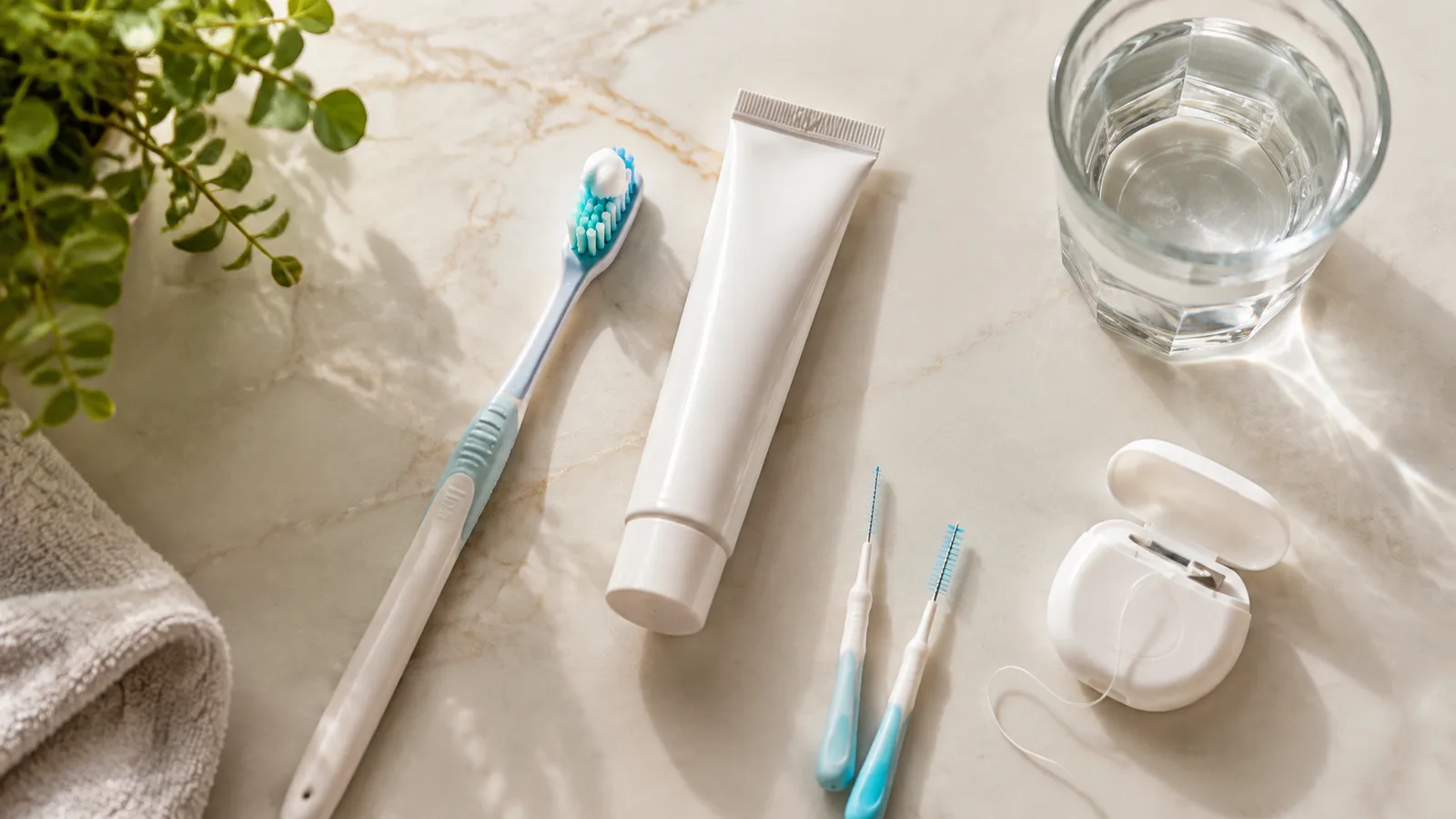
Everyday cleaning tools support oral care; this illustration does not depict a treatment for cannabis-related damage.
You do not need a cannabis-specific dental kit. NIDCR recommends brushing twice daily with fluoride toothpaste and cleaning between teeth regularly, aiming for once a day. Brush gently near the gumline. If floss is difficult to use, ask your dental professional about an interdental brush, floss holder, or water flosser. NIDCR: Oral hygiene.
Make the routine easier to remember. Keep the tools where you already brush, choose a dependable time, and put the next dental appointment in your calendar before leaving the office. A plan that fits an ordinary tired evening is more useful than an elaborate routine you follow twice.
For dryness, water and sugarless gum can help with comfort and saliva flow. Persistent dry mouth deserves an assessment because medications and other conditions can contribute. Do not assume cannabis explains every dry day, and do not change prescribed medicines on your own. NIDCR: Dry mouth.
The ADA also encourages regular dental visits and nutritious snacks over sugary choices for cannabis users. Ask your dentist whether you need additional preventive care for your own risk level. These measures are sensible oral care, not evidence that brushing cancels the association seen in cohort studies. ADA: Cannabis and oral health.
What to tell your dentist
The ADA advises patients to avoid cannabis before dental visits and encourages discussion of cannabis during health-history reviews. Intoxication can affect treatment decisions and the ability to give informed consent; anesthesia planning may also be relevant. ADA: Cannabis and dental appointments.
Bring a simple description: what you use, how you take it, how often, and when you last used it. Include tobacco use and your medication list. If you use cannabis for a medical reason, tell the dental team so they can coordinate care as needed. Ask for instructions before a procedure rather than borrowing a waiting period from someone else’s experience.
If you have dental anxiety, raise that when booking. Our cannabis-and-anxiety guide explores the broader subject, but an appointment is the place for a plan agreed with your dental team.
FAQs
Can my dentist tell I smoke weed by looking at my gums?
Gum changes are not proof of cannabis use. Many factors affect oral health. Give an accurate history instead of relying on the dentist to infer it from appearance; that information is more useful for planning care. ADA: Cannabis and oral health.
Does quitting reverse gum disease?
Do not promise yourself a reset based on stopping one exposure. Early plaque-related gingivitis can often improve with proper daily care, while established periodontal disease needs professional treatment. The dentist can explain what damage is present and what improvement is realistic. NIDCR: Gum disease.
If my gums do not hurt, can I skip the checkup?
Pain is not a substitute for an examination. Routine visits let a professional assess your teeth and gums, and the right schedule depends on your needs. Seek an appointment for recurring bleeding, recession, loose teeth, or persistent bad breath. NIDCR: Gum disease.
Should I switch to gummies to protect my gums?
The cited research does not establish a product substitution that protects against periodontal disease. Discuss your use and oral-health findings with your clinicians. Our flower, edibles, and concentrates guide explains format differences without replacing that conversation.
Key takeaways for your next dental visit
You do not need certainty about every biological pathway to make your next dental visit more useful. Bring your questions, describe your actual habits, and ask what your examination shows. Let the research inform the conversation; let your own dental findings guide the care.
Sources
- Thomson, W. M., et al. (2008). Cannabis smoking and periodontal disease among young adults. JAMA, 299(5), 525–531. PubMed. DOI: 10.1001/jama.299.5.525.
- Meier, M. H., et al. (2016). Associations Between Cannabis Use and Physical Health Problems in Early Midlife: A Longitudinal Comparison of Persistent Cannabis vs Tobacco Users. JAMA Psychiatry, 73(7), 731–740. PubMed. DOI: 10.1001/jamapsychiatry.2016.0637.
- Chaffee, B. W. (2021). Cannabis Use and Oral Health in a National Cohort of Adults. J Calif Dent Assoc, 49(8), 493–501. PubMed.
- Baumeister, S.-E., et al. (2022). Cannabis use and the risk of periodontitis: A two-sample Mendelian randomization study. Journal of Clinical Periodontology, 49(7), 654–661. PubMed. DOI: 10.1111/jcpe.13632.
- American Dental Association. Cannabis: Oral Health Effects.
- American Dental Association. Half of Dentists Say Patients Are High at Dental Appointments.
- National Institute of Dental and Craniofacial Research. Periodontal (Gum) Disease, Dry Mouth, and Oral Hygiene.
