Bong vs Dry Pipe: Does Water Actually Filter Smoke?
Does bong water really filter cannabis smoke? The science is messier than you think. Here is what water removes, what it keeps, and what it costs you.


Ask ten cannabis smokers why they prefer a bong over a dry pipe, and at least eight will say some version of the same thing: “the water filters it.” It is one of the most repeated beliefs in cannabis culture. The water turns brown, you cough less, and the logic feels airtight. Smoke goes in dirty, comes out clean.
Here is the uncomfortable truth: that story is mostly wrong. The research that should have settled it actually made things more complicated. Water does something to your smoke. But what it removes, and whether that trade is good for you, is one of the most counterintuitive topics in cannabis. Let me walk you through it the way the data reads, not the way the bong shop sign promises.
If you want the broader context first, my breakdown of vaping vs smoking cannabis and what cannabis and lung health research actually shows are useful companions to this one.
The two devices, defined
Before we get into chemistry, let us be precise about what we are comparing.
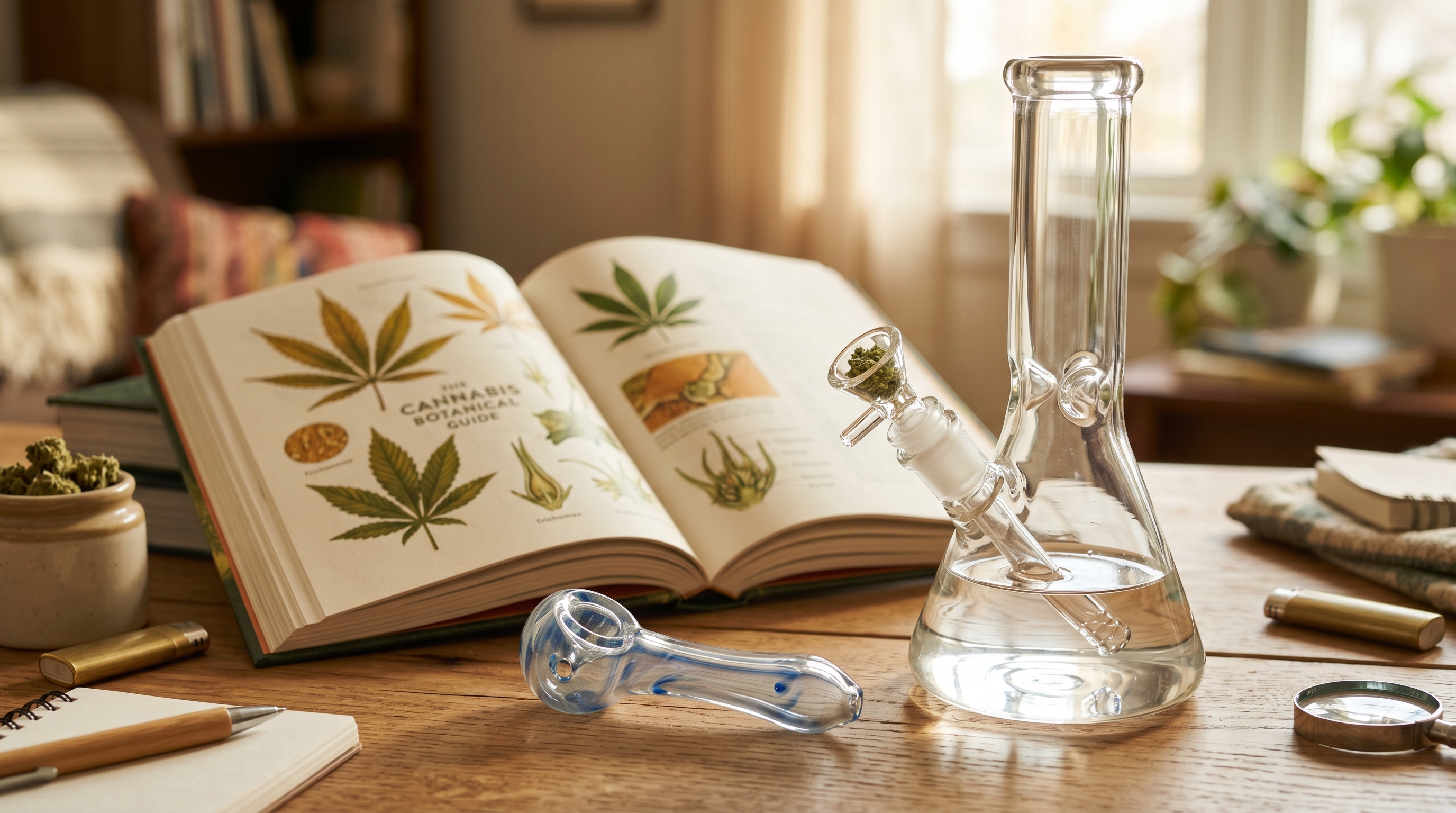
A dry pipe is any handheld piece with no water in the path: spoon pipes, chillums, glass blunts, one-hitters, and most hand pipes. Smoke travels from the bowl, through the stem, and into your mouth. The only cooling comes from the length of the pathway and the thermal mass of the glass or metal. That is it.
A bong (water pipe) routes smoke through a water chamber before it reaches you. As you inhale, smoke bubbles up through the water, then rises through the tube. Percolators and ash catchers add more bubbling surfaces to maximize how much the smoke contacts the water. The whole pitch is that bubbling stage.
So the real question is narrow and answerable: what happens to cannabis smoke when you force it through water, compared to letting it travel through dry air?

What “filtration” actually means here
When people say water “filters” smoke, they are imagining a coffee filter trapping grounds. But filtration through water is a chemistry problem, not a sieve problem. Whether a compound stays behind in the water depends mostly on whether it dissolves in water.
This matters enormously, because the things you want and the things you do not want have very different relationships with water:
- Cannabinoids (THC, CBD, CBN) and terpenes are not water-soluble. They are oily, non-polar molecules. Water is a polar solvent, which is exactly why extraction chemists use butane or alcohol, never water, to pull cannabinoids out of plant material. In theory, this means cannabinoids should sail right through a water chamber untouched.
- Many combustion gases are water-soluble. Carbon monoxide, hydrogen cyanide, and some volatile aldehydes and phenols dissolve more readily, so water can absorb a portion of them.
- Tar and particulate matter are not water-soluble either, but water still physically traps some of it. That is the brown sludge you see.
So far, this sounds like good news for the bong: keep the cannabinoids, lose the gases. Unfortunately, real combustion does not cooperate with the theory.
What water removes, and what it keeps (the honest version)
The single most important study here is the mid-1990s investigation by Dale Gieringer of California NORML, funded with the Multidisciplinary Association for Psychedelic Studies (MAPS). Researchers ran standardized smoke from joints, three water pipes, and vaporizers through a smoking machine and measured the ratio of tar to cannabinoids.
The result blindsided everyone [Gieringer, 1996]. The water pipes performed worse than an unfiltered joint. The least-bad bong produced roughly 30% more tar per cannabinoid than a plain joint, and the device that mixed smoke most aggressively with water scored worst of all.
How is that possible? Because of that “sticky” property of cannabinoids. THC will not dissolve in water. But the molecules cling to the very tar particles the water is trapping. So when water grabs particulates, it drags cannabinoids down with them. You lose more of the good stuff than the bad stuff. That means you have to inhale more smoke to feel the same effect. The researchers put it bluntly: water filtration may be “counterproductive” for the tar-to-cannabinoid ratio.
A more recent 2025 GC-MS analysis comparing joint and bong smoke across three strains reached a quieter but consistent conclusion: no compound between 5 and 350 g/mol was completely removed by bong water. The smoke profiles from joints and bongs looked largely the same, with caryophyllene, phenol, p-cresol, and naphthalene showing up either way. The authors were careful about limitations (small samples, particulates and metals their instrument could not detect), but the headline held: water did not scrub the smoke clean.

Now for the genuine counterpoint, because the science is nuanced. An earlier literature review by pharmacologist Nicholas Cozzi (also for MAPS) [Cozzi, 1993] pulled together 1970s studies from the University of Athens. Those found water did trap some THC, but most passed through, and the water removed several behaviorally active and toxic compounds. The takeaway: water filtration can remove some known toxicants, especially water-soluble gases, while letting most THC through. The Gieringer study only measured tar and cannabinoids, not gases like carbon monoxide or hydrogen cyanide, so it may have missed a real benefit on the gas-phase side.
So where does that leave us? Honestly, in a gray zone:
- Water does not meaningfully purify your smoke of tar and particulates. That belief is not supported.
- Water may absorb a portion of water-soluble combustion gases, which is a plausible but incompletely measured benefit.
- Water reliably costs you cannabinoids relative to tar, which can nudge you toward inhaling more.
Anyone who tells you a bong gives you “clean” hits is selling the myth, not the data. This is the same problem I keep flagging with crowd-sourced strain reviews and why dispensary labels are mostly wrong — confident folklore outrunning evidence.
Cooling and harshness: the one clear win
If water does not clean the smoke, why do bong hits feel so much smoother? Because cooling is real, and it is the bong’s most defensible advantage.
Smoke leaving a burning bowl is hot. Passing it through water acts as a heat sink. It drops the temperature a lot before the smoke hits your throat. That is why a bong rip feels creamy and a dry pipe hit can feel like a small campfire. The water also catches loose ash, so you are less likely to inhale a hot ember.
This is not only a comfort feature, either. Heat is a co-factor in the harshness and irritation smoke causes, and cooler smoke is gentler on the airway in the moment. What cooling does not do is remove the carcinogens and combustion byproducts — those still arrive, just at a more comfortable temperature. A smoother hit is not a safer hit. For the full picture on irritation and recovery, see my notes on cottonmouth and dry mouth and the gentler routes in cannabis topicals.
The trap here is behavioral. Because bong hits feel easy, people take bigger hits and hold them longer. That can mean more tar per breath, quietly erasing any gas-phase benefit. The device that feels safest can nudge you toward heavier exposure.
The cleaning problem nobody mentions on the sign
There is a health issue with bongs that has nothing to do with filtration chemistry: the water itself becomes a microbial habitat.
Stagnant bong water is warm, moist, and full of resin nutrients — close to an ideal culture medium. Bacterial counts climb within hours, and biofilm (that slimy film on the glass) forms on chamber walls and percolator crevices. One widely cited swab study found the average cannabis pipe carried dramatically more bacteria than a public toilet seat, and there are published case reports of serious lung infections, including a Pseudomonas necrotizing pneumonia traced to contaminated bong-water aerosol.
The fix is simple and free: change the water every session and never store a bong wet. Rinse with hot water after use, and do a full clean with isopropyl alcohol and coarse salt regularly. I wrote a full walkthrough in how to clean and maintain your bong, and hot vs cold bong water temperature science covers what to put in the chamber in the first place.
Dry pipes dodge the standing-water problem entirely, but they are not maintenance-free. Resin builds up fast in their narrow channels, and that black residue is loaded with combustion byproducts and PAHs — not something you want to re-smoke. A spoon pipe is genuinely easier and faster to clean than a percolator bong, just on a different schedule.
Which one should you actually use?
Strip away the myth and the choice gets clearer, because it is no longer about “filtration” and is now about fit.
Reach for a dry pipe when:
- You value portability and zero setup — a spoon pipe slips in a pocket and is ready instantly.
- You take small, occasional hits and do not want to babysit water.
- You are traveling, at a festival, or anywhere fragile glass and spillable water are a liability.
- You want the simplest possible cleaning routine.
Reach for a bong when:
- Throat and lung comfort matter most to you, and harsh dry-pipe hits make you cough.
- You mostly session at home on a stable surface.
- You will actually commit to changing the water every time and cleaning regularly.
- You like the ritual and the smoother experience, with clear eyes about what it does and does not do.
And here is the honest framing my fellow cannabis nerds tend to land on: the device matters far less than the dose, the temperature, and your own response. If your real goal is reducing combustion exposure, neither a bong nor a dry pipe is the answer — a vaporizer or a non-inhaled route does that job, and cannabis consumption methods ranked by bioavailability shows just how differently each route delivers.
The pivot that actually moves the needle
Smokers spend years chasing the “right” device the same way they chase the “right” strain name, and both searches miss the point. The smoothest hit in the world from your favorite glass still depends on how that specific chemovar interacts with your body — your tolerance, your terpene sensitivity, your dose. That is the real variable, and it is the one almost nobody tracks.
This is exactly the gap High IQ is built to close. Instead of guessing whether the bong or the pipe “worked better,” you log what you used, how much, and how you actually felt — and patterns surface that no product label or culture myth can give you. Understanding your own data through the High Families framework tells you more about your next great session than any filtration claim. If you are still early in the journey, how to find your ideal high and the first-time user’s guide are good places to start, and how to build a cannabis journal that actually improves your sessions shows the habit in practice.
The verdict
Does water actually filter smoke? A little, but not the way the myth claims. Water reliably cools your smoke and catches some ash, and it may absorb a fraction of water-soluble gases. What it does not do is purify the smoke of tar and particulates — and it may even cost you more cannabinoids than tar, leading to bigger hits. A bong is a comfort device, not a safety device.
If comfort, ritual, and home use are your priorities, a well-maintained bong is a fine choice — just change that water. If portability and simplicity win for you, a dry pipe is honest about what it is: hot, direct, and ready to go. Neither one makes smoke safe. The smartest move is to be clear-eyed about the trade-offs, pick the experience that fits your life, and pay more attention to the dose and the chemovar than to the marketing on the glass.
Key takeaways
- Water does not purify your smoke. It traps some particulates and ash, but not most of it, and the “clean hit” belief is not supported by the research.
- The most-cited study found bongs made the ratio worse, removing cannabinoids at least as readily as tar and nudging users toward bigger hits [Gieringer, 1996].
- Cooling is the real, defensible benefit. Bongs deliver smoother, less harsh smoke — but smoother is not safer.
- Water may absorb some gas-phase toxicants, a plausible but incompletely measured upside [Cozzi, 1993].
- Bong water is a microbial hazard. Change it every session and never store the piece wet.
- If your goal is lower combustion exposure, a vaporizer or non-inhaled route beats both devices.
Frequently asked questions
Does bong water really filter out THC? Some, yes. Cannabinoids are not water-soluble, but they cling to tar particles, so when water traps particulates it pulls some THC down with it. The NORML/MAPS research found water pipes removed cannabinoids at least as readily as tar, worsening the tar-to-cannabinoid ratio.
Are bongs healthier than dry pipes? Not in any proven way. Bongs deliver cooler, smoother smoke, but the carcinogens and tar still reach your lungs. There is no strong evidence that bongs are safer than dry pipes for your respiratory system, and stagnant bong water adds its own infection risk.
Why does my bong water turn brown if it is not filtering tar? It is trapping some particulates and ash — that is the brown sludge. But “some” is not “most,” and the trapping is not selective enough to clean the smoke meaningfully. Brown water is evidence of partial particulate capture, not purification.
How often should I change bong water? Every session, ideally. Bacteria colonize warm, resin-rich water within hours, and never store a bong with water sitting in it. Fresh water also gives you cooler, better-tasting hits.
If I want to reduce smoke exposure, what should I use? Combustion is the problem, and neither a bong nor a dry pipe avoids it. A dry-herb vaporizer or a non-inhaled route like edibles or tinctures avoids combustion byproducts entirely.
Sources
- Gieringer, D. (California NORML / MAPS). “Marijuana Water Pipe and Vaporizer Study.” MAPS Bulletin, mid-1990s. maps.org
- Cozzi, N.V. “Effects of Water Filtration on Marijuana Smoke: A Literature Review.” MAPS Newsletter, Vol. IV #2, 1993. maps.org
- “Qualifying the effectiveness of Cannabis smoke filtration via Bong water using GC-MS.” bioRxiv, 2025. biorxiv.org
- Barcott, B. “Cannabis science 101: The complex chemistry of the bong.” Leafly, 2016. leafly.ca
- “How Does a Bong Work? Benefits, Risks, and Myths.” Healthline, 2019. healthline.com
- “Marijuana ‘bong’ pseudomonas lung infection: a detrimental case.” PMC. ncbi.nlm.nih.gov


