Cannabis Works Best When It Treats Everything: The Biopsychosocial Approach
A 2026 study: cannabis works better for chronic pain when it ALSO improves sleep, stress, and mood. Why multi-system effects matter — and how to use them.

Professor High
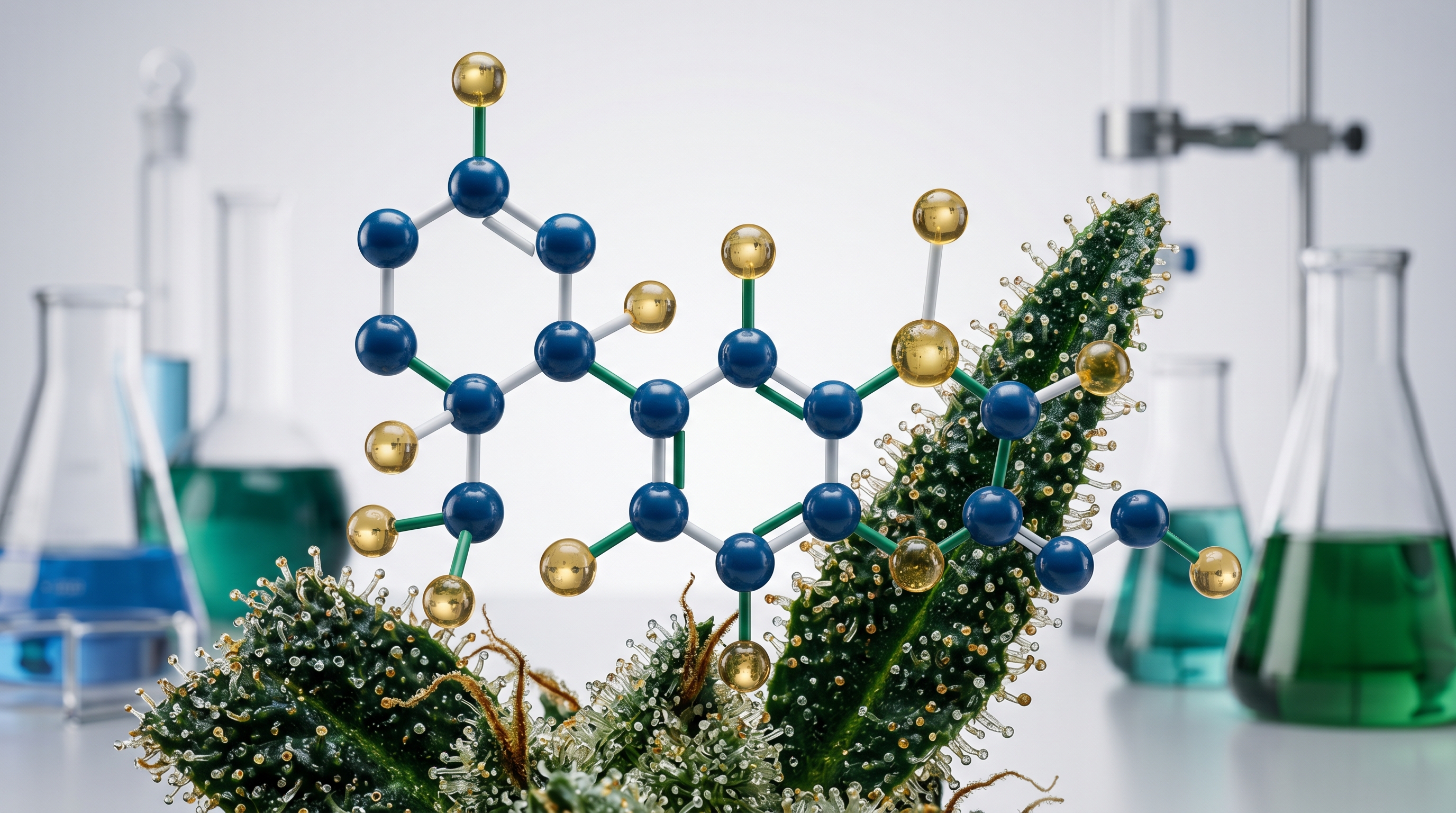
The Limitation of Single-Symptom Thinking
If you live with chronic pain, you already know what textbooks underplay: chronic pain is never just pain. It’s the bad night that wrecks the next morning. The tightness when you brace for a flare. The slow erosion of mood from years of negotiating with your body. The anxiety of not knowing if today is a 4 or an 8.
And yet — for decades — we’ve measured “Did the medicine work?” with one number. A 0-to-10 pain scale. Pain down? Success. Same? Failure. That’s not how chronic pain behaves. And it’s not how we should be evaluating cannabis.
A 2026 perspective paper in a flagship psychology journal made this explicit: when researchers focus only on pain severity in cannabis trials, the results look modest. Zoom out — sleep, mood, anxiety, role functioning, opioid substitution — and the picture shifts. Cannabis isn’t a great single-symptom drug. It’s a multi-system modulator. The evidence is finally catching up to what patients have been saying for years.
The 2026 Finding
Here’s the headline:
When chronic pain patients use cannabis and only pain improves, the effect looks small. When pain, sleep, mood, and anxiety all improve together, the overall benefit looks dramatically larger — and more durable.
Three findings stack:
-
The 2026 perspective paper argued cannabis trials have been measuring the wrong things. Most patients describe cannabis as helpful not because it silences pain, but because it changes their relationship to pain — better sleep, less rumination, more capacity to keep doing what matters.
-
The UK Medical Cannabis Registry (n=1,139) split chronic pain patients by sleep status. The cohort with co-morbid sleep impairment — the multi-domain group — showed greater improvements on pain severity than the pain-alone cohort. More domains in play, more leverage.
-
The QUEST Initiative (n=2,353) found clinically meaningful 12-month improvements across the board: pain (Cohen’s d = 0.50–0.76), sleep (d = 0.76), anxiety (d = 0.69), quality of life (d = 0.52–0.91). The biggest effects weren’t pain — they were sleep and life quality. A JAMA Network Open case series (n=3,148) showed improvements on all 8 SF-36 domains, with balanced THC:CBD outperforming isolates.
The pattern holds across jurisdictions. Single-target thinking underestimates cannabis. Multi-system thinking captures what’s actually happening.
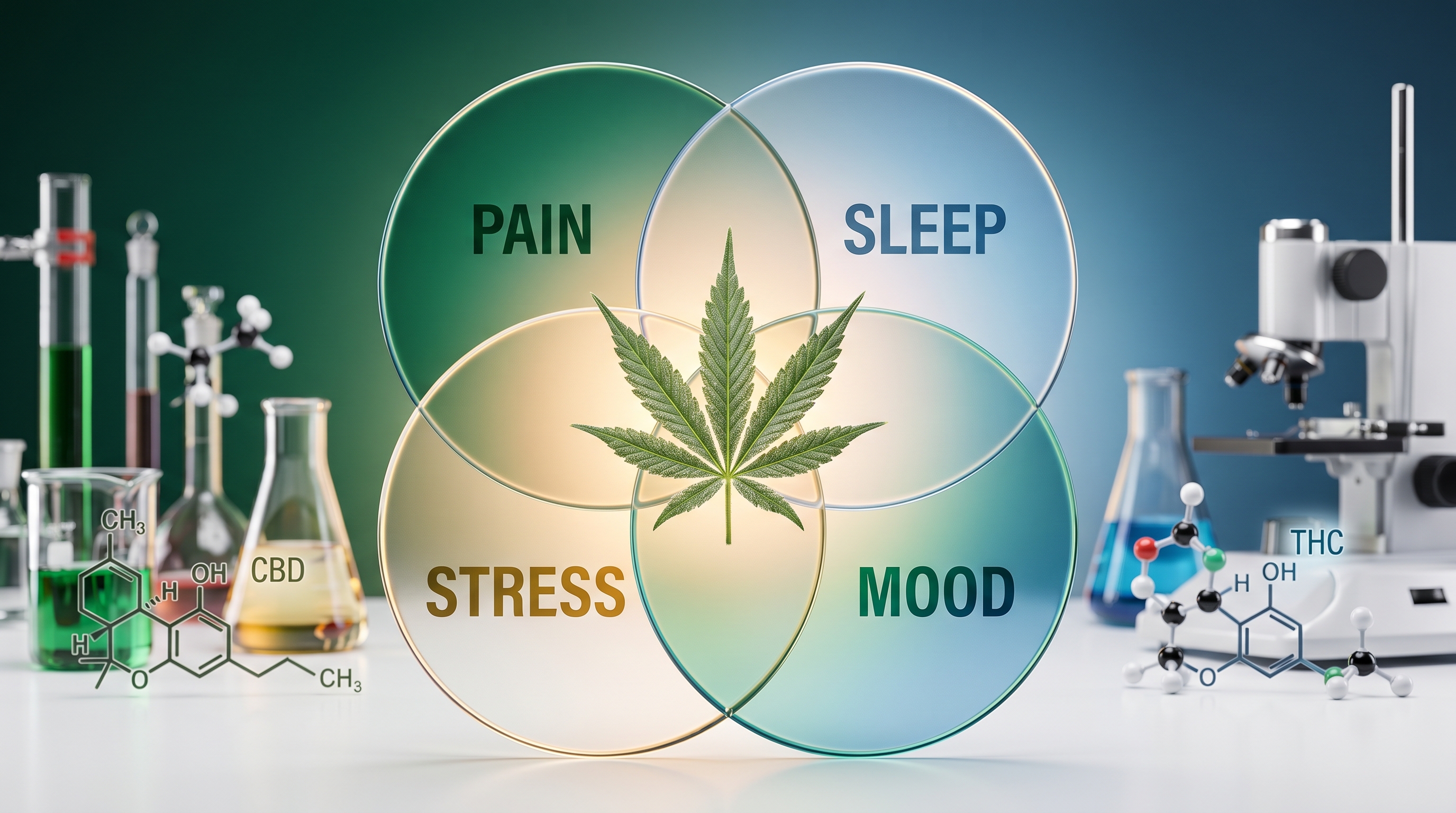
The Biopsychosocial Model in 60 Seconds
The framework underneath this isn’t new. In 1977, psychiatrist George Engel published a famous Science paper arguing medicine had become too reductive — find the broken part, fix the broken part. Engel proposed something fuller: the biopsychosocial model. Health emerges from three interacting layers:
- Biological — cells, tissues, neurochemistry
- Psychological — thoughts, emotions, coping
- Social — relationships, work, support
Chronic pain is the canonical example. A herniated disc might initiate pain, but what maintains it for years is the web around it: sleep loss that lowers your pain threshold, catastrophizing that amplifies the signal, social withdrawal that erodes mood, workplace stress that keeps your sympathetic system locked on. Pain isn’t a thing in a tissue. It’s a system.
If pain is biopsychosocial, any therapy that only addresses one layer is structurally incomplete. Cannabis is interesting precisely because it doesn’t only do one thing.
Why Cannabis Maps Naturally to Multi-System Effects
Most pharmaceuticals are selective. A COX-2 inhibitor blocks one enzyme. An SSRI targets one transporter. A mu-opioid agonist hits one receptor class. Selectivity is a virtue when you want narrow effects.
Cannabis is the opposite. Its active compounds engage at least six receptor families: CB1 (pain, mood, sleep, appetite), CB2 (inflammation), TRPV1 (heat and inflammatory pain), GPR55 (neuropathic pain), 5-HT1A (serotonin — CBD’s anxiolytic site), and PPARγ (inflammation, neuroprotection).
This isn’t a bug. It’s why cannabis acts more like a modulator than a blocker. Where an opioid silences pain at one receptor, cannabis nudges several systems at once — turning down inflammation here, dialing down sympathetic arousal there, shifting sleep architecture somewhere else.
Most pharmaceuticals are scalpels. Cannabis is a tuning system. That’s why it under-performs in trials designed for scalpel effects and over-performs in trials that capture the whole patient.
For more, see Anandamide: Your Body’s Natural THC and the family pages for Balance, Relief, and Relax.
Pain + Sleep + Stress + Mood: The Feedback Loop
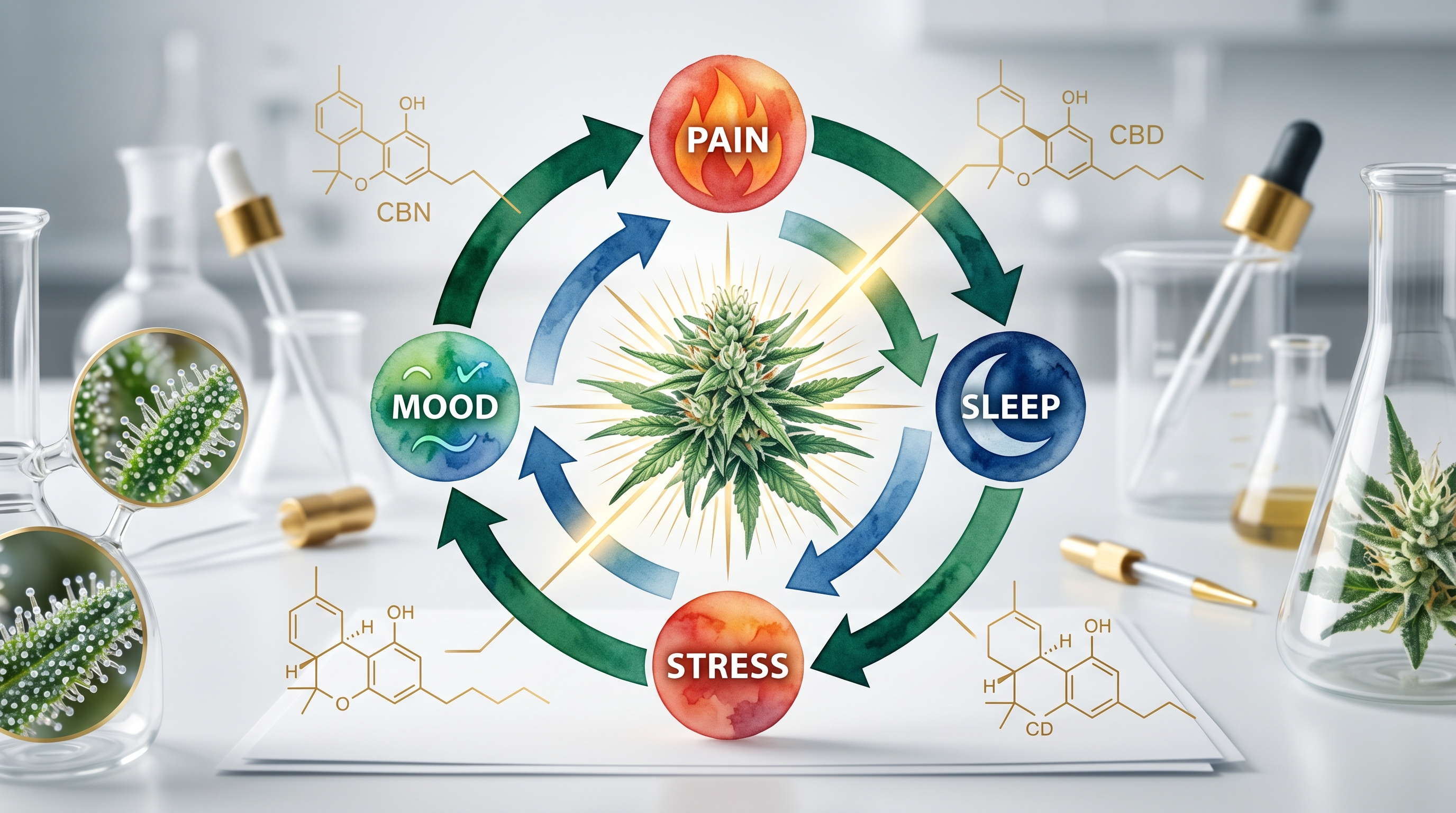
The reason multi-system effects matter in chronic pain is that the four big domains aren’t independent — they’re a feedback loop.
- Pain wrecks sleep. 67–88% of UK chronic pain patients report disturbed sleep.
- Bad sleep amplifies pain. Experimental sleep restriction lowers next-day pain thresholds after even one bad night.
- Stress worsens both. Chronic sympathetic arousal increases muscle tension, fragments sleep, and keeps the threat-detection system online when it should be powering down.
- Depression compounds. It amplifies pain perception, reduces motivation for rehab, and worsens sleep on its own.
- And around again. Worse pain → worse sleep → worse mood → more stress → worse pain.
This is why single-target therapy plateaus. You medicate the pain; sleep is still wrecked; mood keeps sliding; six weeks later the pain is back — because the system never moved.
A balanced cannabis product — a THC:CBD evening tincture with calming terpenes — can intervene at several points in the loop at once:
- THC and CBD reduce pain at spinal and supraspinal levels
- THC at modest evening doses promotes sleep onset; CBD supports sleep architecture
- CBD’s 5-HT1A activity is anxiolytic-like; linalool and myrcene add calming tone
- Lower next-day pain → better mood → better sleep tomorrow → the loop runs the other direction
The 2026 perspective paper put this explicitly: cannabis’s value may lie less in acute analgesia than in the systemic re-stabilization of a body stuck in pain-stress-insomnia-mood lockup for years.
For each leg of the loop, see our Sleep Guide, Stress Relief Guide, Depression Guide, and Pain Management Guide.
What “Multi-System” Looks Like in Practice
Imagine a 1:1 THC:CBD oil tincture, 5 mg of each, dosed an hour before bed, alongside a cultivar high in caryophyllene, myrcene, and linalool.
That single intervention works across domains in parallel:
- Pain → CB1 in the spinal cord dampens nociceptive signaling. CB2 and TRPV1 reduce inflammatory and neuropathic components. Caryophyllene independently agonizes CB2.
- Sleep → THC shortens sleep latency. CBD modulates sleep architecture. Myrcene and linalool contribute GABAergic sedative tone.
- Stress → CBD’s 5-HT1A activity blunts ruminative anxiety. Linalool lowers sympathetic arousal in animal models.
- Mood → Better sleep tonight means better next-day affect. Less pain interference means more capacity for people, work, and pleasure.
One product. Four domains. Touched at the same time. That is the structural feature.
And it’s why patients with the biggest cannabis wins are often the ones with the most going wrong at once. The UK Registry data showed it: patients with both chronic pain and sleep impairment improved more on pain severity than the pain-alone group. More inputs, more leverage.
For strain examples of balanced multi-domain cultivars, see Harlequin (CBD-leaning daytime calm), Northern Lights (evening multi-domain workhorse), and ACDC (CBD-dominant non-sedating relief).
The Single-Target Trap
Here’s the failure mode, especially in patients new to cannabis:
“I just want it for pain. I don’t want to feel high. I don’t want it for sleep. Just pain.”
It’s a reasonable instinct. People want surgical precision. The data are clear, though, that cannabis used as a single-target drug is cannabis used at a disadvantage.
- High-CBD-only for pain often disappoints. CBD’s standalone analgesic effect is modest. Without the sleep and mood lift, pain goes from a 7 to a 6 — improvement, but not life-changing.
- High-THC-only for pain also disappoints. THC reduces pain, but at high doses it amplifies anxiety, disrupts deep sleep, and produces fast tolerance. A week in, you’re tired, edgy, and back at baseline.
- Balanced products with terpene complexity outperform both. The JAMA case series found balanced THC:CBD gave the broadest SF-36 improvement — not the most extreme single-domain effect, but the widest footprint.
Companion reading: Finding Your THC:CBD Sweet Spot — What 1,400 Pain Patients Discovered for dose-finding, and Cannabis Terpenes Relieve Pain Through Adenosine Receptors for the terpene side.
The takeaway: if you’ve optimized only for pain, you’re likely leaving 50–70% of the benefit on the table.
Whole-Plant vs Isolate
Once you accept multi-system effects are the point, the whole-plant vs isolate question gets easier.
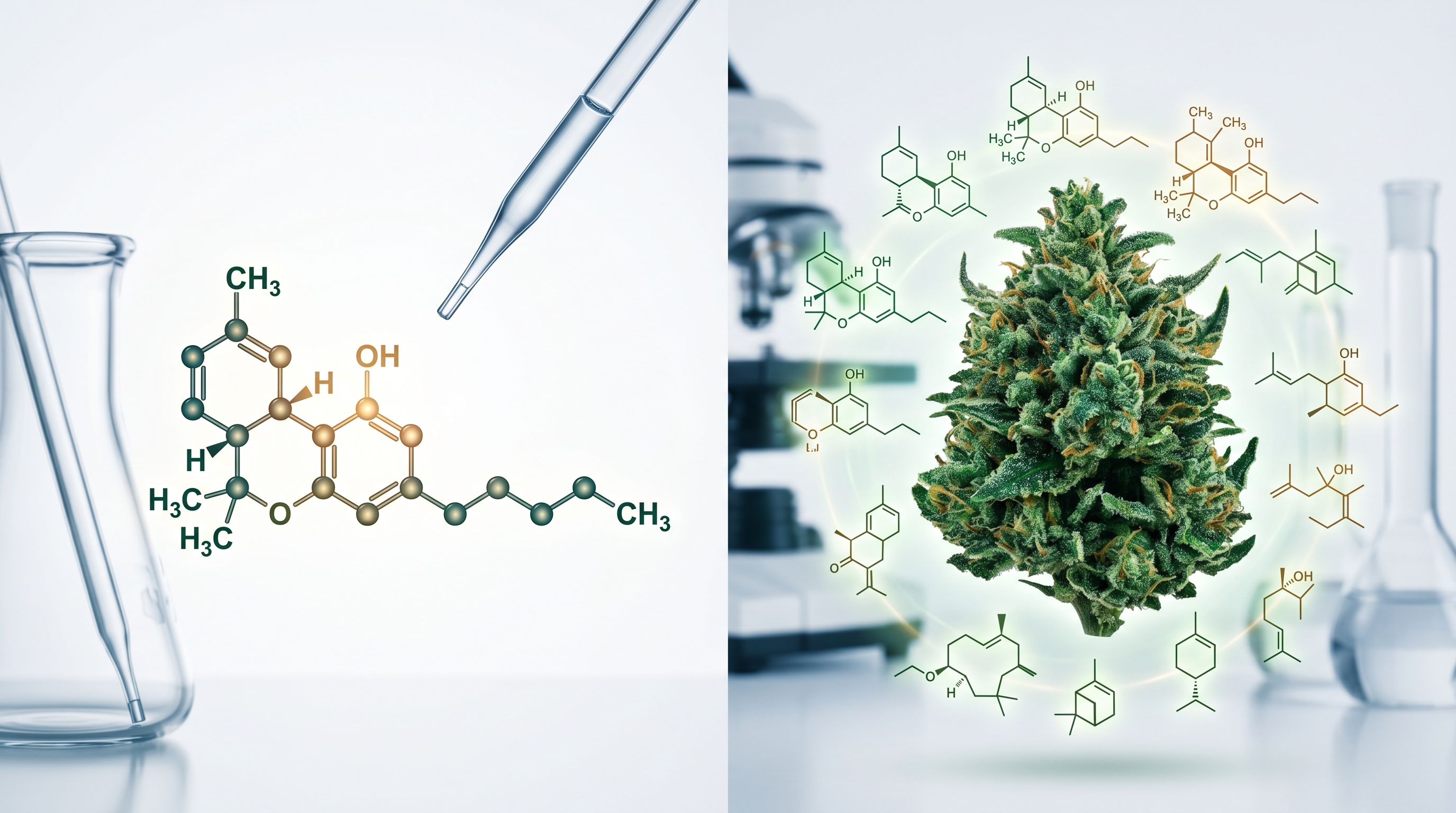
Isolates — pure CBD, pure THC, pure CBN — are excellent for studying single mechanisms and sometimes right for precision needs (a seizure protocol, a strict drug-test requirement).
Full-spectrum products carry cannabinoids, terpenes, and flavonoids the plant evolved together. The 2025 Frontiers full-spectrum study in 29 women with chronic pain syndromes found benefit across pain, mood, sleep, fatigue, cognition, work capacity, and family relationships. That’s not what isolates typically produce.
If your goal is multi-system stabilization, full-spectrum has more raw material to work with. Not magic — just better-suited to the kind of problem chronic pain actually is.
This also explains why multi-system pain conditions like migraine respond especially well to whole-plant cannabis. See Cannabis Beats Placebo for Migraines: First RCT Results — migraines are textbook biopsychosocial (pain + nausea + photophobia + mood + sleep), and cannabis’s broad footprint fits.
What This Doesn’t Mean
A few things this argument is not saying. The cannabis space is full of overclaiming, so let me be explicit.
Cannabis is not a magic bullet. Effect sizes in the best studies are real but moderate (Cohen’s d 0.5–0.8). Clinically meaningful. Not a cure.
It doesn’t replace the rest of the toolkit. CBT for chronic pain has some of the strongest evidence in the literature. Physical therapy, sleep hygiene, graded exercise, stress reduction all work. The gold standard is multimodal care — cannabis fits inside it, not on top of it.
Multi-target doesn’t mean shotgun. Treating everything doesn’t mean throwing every product at the problem. It means a small number of well-chosen products touching multiple domains intentionally. A balanced evening tincture is multi-target. A daily rotation of seven cartridges is chaos.
Adverse effects are real — somnolence, dry mouth, fatigue, occasional anxiety, dose-related cognitive effects. Most are mild and dose-responsive, but cannabis isn’t free of cost.
Some pain conditions don’t respond well. Acute post-surgical pain is better managed with conventional analgesics. The biopsychosocial argument applies primarily to chronic pain — pain doing system-wide work for months or years.
The honest framing: cannabis is a useful, multi-domain tool inside a multimodal approach. Not the whole approach.
For You: Track All the Dimensions
One practical takeaway:
Stop measuring cannabis the way the old trials measured it. Start measuring it the way your body actually experiences it.
For two weeks, before bed, write four numbers on a 0–10 scale:
- Pain today (worst point)
- Sleep last night (quality)
- Mood today (overall)
- Stress today
Track whether or not you used cannabis. After two weeks, look at the data. You’ll find the days where pain and sleep and mood and stress all moved in the right direction — those are the wins worth chasing. And they’re almost always the days you used a well-chosen balanced product, dosed correctly, at the right time.
That’s the discipline. Cannabis as multi-system therapeutic, evaluated multi-systemically.
Tracking pain, sleep, mood, and stress together is the right discipline for chronic conditions — not just pain alone. The High IQ app logs all four by default, so over a few weeks the picture sharpens and you stop optimizing one number while the rest of the system drifts. Try the app once.
Sources
-
Wartolowska, K. A., et al. (2026). “Beyond pain reduction: A perspective on patient-centered outcomes for clinical trials of cannabis for chronic pain.” Manuscript in press, American Psychological Association. PsycNet preprint
-
Pillai, M., et al. (2024). “UK medical cannabis registry: A clinical outcome analysis of medical cannabis therapy in chronic pain patients with and without co-morbid sleep impairment.” Journal of Pain & Palliative Care Pharmacotherapy. Imperial College Spiral repository
-
Tait, M. A., et al. (2025). “Improvements in Quality of Life from the QUEST Initiative — 12-month follow-up.” PLOS ONE. (Australia, n=2,353)
-
MacCallum, C. A., et al. (2023). “Assessment of Medical Cannabis and Health-Related Quality of Life.” JAMA Network Open, 6(5). Full text
-
Aviram, J., et al. (2021). “Prolonged Medical Cannabis Treatment is Associated With Quality of Life Improvement and Reduction of Analgesic Medication Consumption in Chronic Pain Patients.” Frontiers in Pharmacology. Full text
-
Bicca, M. A., et al. (2025). “Full-spectrum cannabis extracts for women with chronic pain syndromes: a real-life retrospective report.” Frontiers in Pharmacology. Abstract
-
Aragon, F., et al. (2025). “Effectiveness of Full Spectrum Cannabis Extracts in the Treatment of Chronic Pain: An Open Label Study.” PDF
-
Wang, Y., et al. (2021). “Health outcomes among adults initiating medical marijuana for chronic pain: A 3-month prospective study incorporating ecological momentary assessment (EMA).” Cannabis, 4(2). Article
-
Engel, G. L. (1977). “The need for a new medical model: a challenge for biomedicine.” Science, 196(4286), 129–136. [Foundational biopsychosocial paper.]
-
Finan, P. H., & Smith, M. T. (2013). “The comorbidity of insomnia, chronic pain, and depression: dopamine as a putative mechanism.” Sleep Medicine Reviews, 17(3), 173–183.
This article is for educational purposes only and is not medical advice. Cannabis affects each person differently. Talk to a qualified healthcare provider before starting, stopping, or changing any therapy — including cannabis — especially if you live with chronic pain or take other medications.
