Decarboxylation Explained: The Science of Activating Cannabis
Why raw cannabis won't get you high. Learn the science of decarboxylation, how heat activates cannabinoids, and how to do it right.

Updated April 15, 2026 — Refreshed with new internal links to our companion guides on THCA/CBDA, cannabutter, 11-hydroxy-THC, and CBN. The chemistry and 110-120°C / 30-60 min target still reflect best evidence — no changes to the core science.
You Could Eat an Entire Cannabis Plant and Barely Feel a Thing
Here’s a fact that surprises almost everyone: raw cannabis flower, straight off the plant, contains almost no THC. You could technically chew through a handful of freshly harvested buds and experience little more than a grassy, unpleasant snack. The same goes for CBD — the raw plant produces very little of the compound that’s become a wellness phenomenon.
So why does smoking, vaping, or baking cannabis into brownies produce such powerful effects? The answer lies in a chemical reaction with a wonderfully intimidating name: decarboxylation.
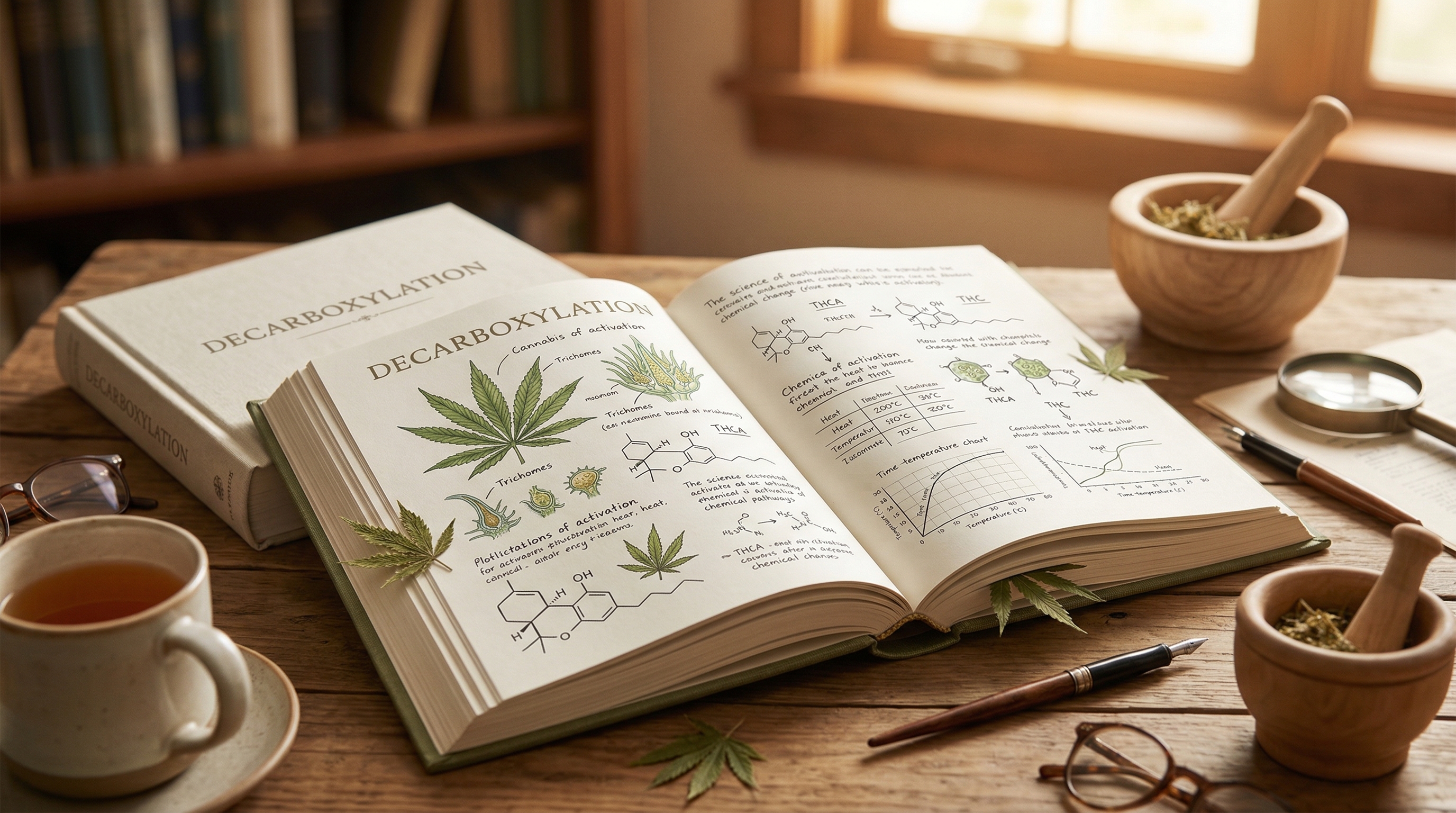
Decarboxylation (often shortened to “decarb”) is the process by which heat transforms the inactive acid forms of cannabinoids — like THCA and CBDA — into their active counterparts, THC and CBD. It’s the single most important chemical reaction in all of cannabis consumption, and yet most people have never heard of it.
Understanding decarboxylation isn’t just academic trivia. It has real, practical consequences for your experience:
- If you’re making edibles, getting the decarb wrong is the number-one reason homemade cannabis foods either don’t work or taste terrible.
- If you’re choosing a consumption method, decarboxylation explains why smoking hits instantly while eating raw flower does nothing.
- If you’re interested in the therapeutic potential of cannabinoids, knowing the difference between THCA and THC helps you understand which products may offer which benefits.
In this article, we’re going to break down the chemistry of decarboxylation in plain language, walk through what the research actually shows about optimal time and temperature, and give you practical knowledge you can use whether you’re a curious beginner or a seasoned cannabis enthusiast looking to level up your understanding.
Let’s heat things up.
The Science Explained
What’s Actually in Raw Cannabis?
To understand decarboxylation, you first need to understand what the cannabis plant actually produces. And here’s the key insight: the living cannabis plant does not produce THC or CBD directly.
Instead, the plant biosynthesizes cannabinoid acids — precursor molecules that have a carboxyl group (a cluster of carbon, oxygen, and hydrogen atoms, written as -COOH) attached to them. The two most abundant are:
- THCA (tetrahydrocannabinolic acid) — the precursor to THC
- CBDA (cannabidiolic acid) — the precursor to CBD
These acid forms are chemically distinct from their “activated” counterparts. THCA, for instance, doesn’t bind efficiently to the CB1 receptors in your brain — which is why it doesn’t produce intoxicating effects [Wang et al., 2016]. Think of THCA as a key with an extra bump on it: it’s almost the right shape for the lock, but that extra piece (the carboxyl group) prevents it from fitting properly.
Quick definition: A carboxyl group is a small molecular “tag” made of one carbon atom, two oxygen atoms, and one hydrogen atom (-COOH). It’s attached to the cannabinoid molecule and changes its shape and behavior.
This is where decarboxylation comes in. The word itself tells you what’s happening:
- De- = removal
- -carboxyl- = the carboxyl group (-COOH)
- -ation = the process of
So decarboxylation literally means “the process of removing the carboxyl group.” When that -COOH group breaks away, it leaves as carbon dioxide (CO₂) and water (H₂O), and what remains is the active cannabinoid — THC, CBD, or whichever compound was locked in its acid form.
How Decarboxylation Works: The Mechanism
Imagine each THCA molecule as a tiny package with a tag tied to it. That tag is the carboxyl group. As long as the tag is attached, the package can’t be opened — it can’t interact with your endocannabinoid system in the way that produces the classic cannabis high.
Heat provides the energy to snap that tag off.
At the molecular level, thermal energy causes the bond between the carboxyl group and the rest of the cannabinoid molecule to vibrate faster and faster until it breaks. The carboxyl group departs as CO₂ gas (which is why you might notice a slight fizzing or off-gassing when you heat cannabis), and the remaining molecule rearranges into its active form [Citti et al., 2018].
The reaction looks like this in simplified form:
THCA + Heat → THC + CO₂
This is a non-reversible reaction — once the carboxyl group is gone, it doesn’t reattach. However, if you continue applying heat beyond the optimal point, THC itself begins to degrade into CBN (cannabinol), a mildly sedating cannabinoid. This is why over-decarboxylation is just as problematic as under-decarboxylation [Taschwer & Schmid, 2015].
It’s worth noting that decarboxylation can also happen very slowly at room temperature over extended periods. This is why aged cannabis tends to test higher in THC and lower in THCA than freshly harvested flower — time alone can gradually break those carboxyl bonds, though the process takes months to years [Repka & Ševčík, 2020].
What the Research Shows: Optimal Time and Temperature
This is where things get really practical. Researchers have studied decarboxylation kinetics — essentially, how fast and completely the reaction occurs at different temperatures — and the findings give us a clear roadmap.
One of the most frequently cited studies on this topic was conducted by Veress, Szanto, and Leisztner (1990), who analyzed the thermal decomposition of cannabinoid acids and established that the reaction follows first-order kinetics. This means the rate of conversion depends on both temperature and time in a predictable, mathematical way.
More recent work by Citti et al. (2018) used advanced analytical techniques (HPLC and GC-MS) to map the decarboxylation curves of both THCA and CBDA at various temperatures. Their findings, along with other studies, suggest the following general guidelines:
| Temperature | Time for ~Full THCA→THC Conversion | Notes |
|---|---|---|
| 100°C (212°F) | ~60-90 minutes | Slow, preserves more terpenes |
| 110°C (230°F) | ~40-60 minutes | Common recommendation for home decarb |
| 120°C (248°F) | ~30-40 minutes | Faster, moderate terpene loss |
| 140°C (284°F) | ~15-20 minutes | Rapid, significant terpene loss begins |
| 150°C+ (302°F+) | Under 15 minutes | Risk of THC degradation to CBN |
Note: These are approximations. Actual conversion depends on factors including moisture content, density of material, and oven accuracy.
A key finding from Citti et al. (2018) is that CBDA decarboxylates at a slightly different rate than THCA, meaning if you’re working with a CBD-rich cultivar, you may need to adjust your approach slightly. CBDA appears to require marginally higher temperatures or longer times for complete conversion.
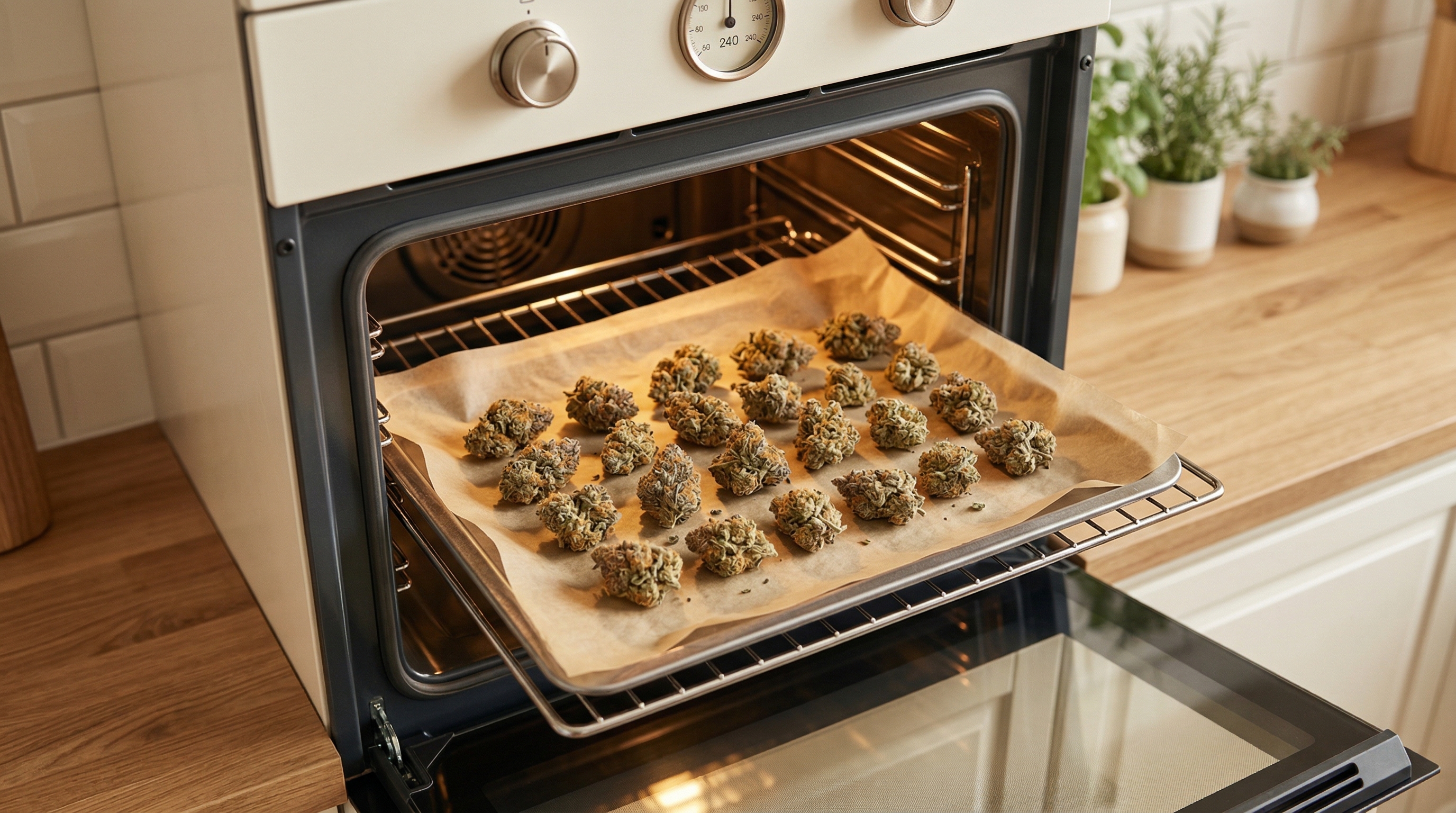
The sweet spot that most researchers and experienced cannabis preparers converge on is approximately 110-120°C (230-250°F) for 30-60 minutes for THC-dominant flower [Citti et al., 2018; Wang et al., 2016].
The Terpene Factor: What Else Changes During Heating
Here’s something that often gets overlooked in decarboxylation discussions: you’re not just transforming cannabinoids — you’re also affecting terpenes.
Terpenes are the aromatic compounds that give cannabis its distinctive smell and flavor, and research increasingly suggests they play a significant role in shaping the overall experience through what’s known as the entourage effect [Russo, 2011]. The problem is that many terpenes have relatively low boiling points:
| Terpene | Boiling Point | Associated High Family |
|---|---|---|
| Myrcene | 167°C (332°F) | Relaxing High |
| Limonene | 176°C (349°F) | Uplifting High |
| Linalool | 198°C (388°F) | Uplifting High |
| Caryophyllene | 160°C (320°F) | Relieving High |
| Terpinolene | 186°C (367°F) | Energetic High |
At standard decarboxylation temperatures (110-120°C), most terpenes are below their boiling points and should be largely preserved. However, some volatile monoterpenes begin to evaporate even at these lower temperatures, especially over longer durations [Taschwer & Schmid, 2015].
This matters because the terpene profile of your starting material is what determines which High Family your cannabis belongs to. A strain rich in limonene and linalool that falls into the Uplifting High family could lose some of those characteristic terpenes during aggressive decarboxylation, potentially shifting the experience toward something less nuanced — closer to the Balancing High family, where lower terpene profiles produce gentler, less defined effects.
Key takeaway: Lower temperatures and shorter times preserve more terpenes. If you want the full Entourage High experience — where multiple terpenes and cannabinoids work together — gentle decarboxylation is your friend.
When Decarboxylation Happens Automatically
If you smoke or vape cannabis, you’ve been decarboxylating all along — you just didn’t need to think about it.
- Smoking (combustion): Temperatures exceed 600°C (1112°F). Decarboxylation is instantaneous, but so is the destruction of many terpenes and the creation of combustion byproducts [Moir et al., 2008].
- Vaping: Temperatures typically range from 160-220°C (320-428°F). Decarboxylation occurs rapidly while preserving more terpenes than combustion, which is one reason many people report that vaporized cannabis has a more nuanced effect profile.
- Dabbing concentrates: Extremely high temperatures ensure instant decarboxylation, though many concentrates are already partially or fully decarboxylated during extraction.
The only time you need to actively decarboxylate is when you’re preparing cannabis for oral consumption — edibles, tinctures, capsules, or infused oils — where there’s no combustion or vaporization step to do the work for you. (For the full cannabutter workflow that starts with a proper decarb, see our cannabutter foundation guide.) Oral cannabis also behaves differently once it hits the liver, where THC is converted to the more potent 11-hydroxy-THC — another reason decarb accuracy matters for edibles.
Practical Implications
Getting Your Decarb Right at Home
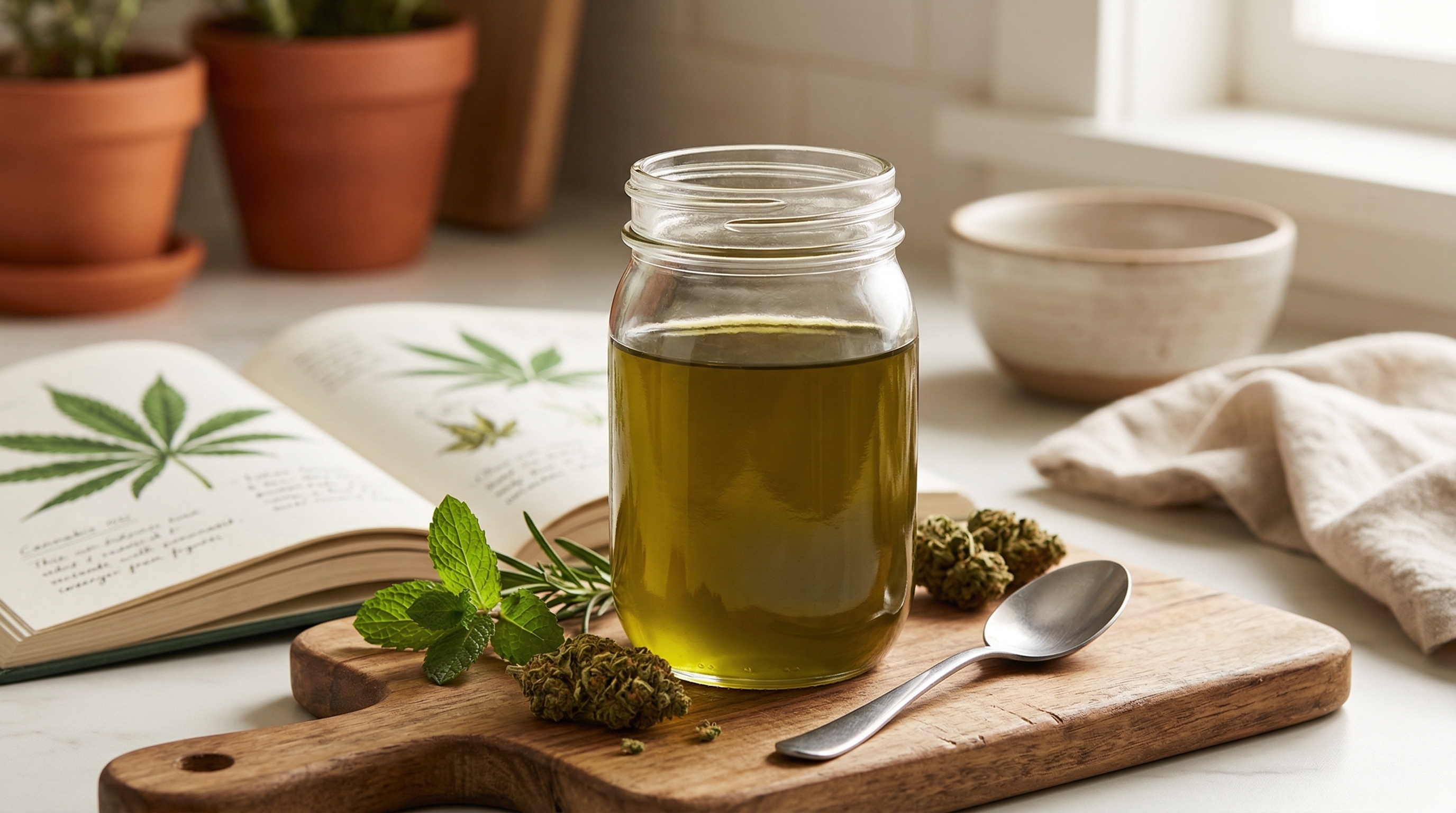
Armed with the science, here’s how to apply it practically. Whether you’re making cannabutter, infused oil, or tinctures, the decarboxylation step is the foundation of a successful product.
The Standard Oven Method:
- Preheat your oven to 110-120°C (230-250°F). Use an oven thermometer — most home ovens are inaccurate by 10-25°F, and that margin matters here.
- Break your cannabis into small, even pieces (about the size of a grain of rice). Don’t grind it to powder — this increases surface area and can lead to uneven heating and terpene loss.
- Spread evenly on a parchment-lined baking sheet in a single layer.
- Bake for 30-45 minutes, gently stirring once at the halfway point. The cannabis should turn from green to a light golden-brown color.
- Let it cool completely before proceeding with your infusion.
Pro tips from the research:
- Seal it up. Some people use oven-safe bags or mason jars (with the lid loosely placed) to trap terpenes that would otherwise escape into the oven. This can help preserve the terpene profile and, by extension, the High Family characteristics of your starting material.
- Don’t rush it. Cranking the temperature to save time is the most common mistake. Research clearly shows that higher temperatures accelerate THC degradation to CBN [Taschwer & Schmid, 2015]. You’ll end up with a sleepier, less potent product.
- Consider your starting material. If you’re working with a CBD-dominant cultivar — perhaps something in the Relaxing High or Relieving High family — you may benefit from slightly longer decarb times, as CBDA can be somewhat more resistant to conversion than THCA [Citti et al., 2018].
The THCA Question: Is There Value in NOT Decarboxylating?
Interestingly, emerging research suggests that THCA and CBDA may have their own distinct biological activities, separate from their decarboxylated forms. THCA has shown potential anti-inflammatory and neuroprotective properties in preclinical studies [Nadal et al., 2017], and CBDA appears to interact with serotonin receptors in ways that CBD does not [Bolognini et al., 2013].
This is why some wellness-focused consumers deliberately seek out raw cannabis juices, THCA tinctures, or “live” products that preserve the acid forms. It’s an area of active research, and while we’re far from definitive conclusions, it underscores an important point: decarboxylation isn’t always the goal. Sometimes the “inactive” forms are exactly what someone is looking for.
Important disclaimer: The therapeutic potential of THCA and CBDA is based on preclinical and early-stage research. These compounds are not approved treatments for any condition. Always consult a healthcare provider about therapeutic cannabis use.
Key Takeaways
- Raw cannabis contains THCA and CBDA, not THC and CBD. Heat removes a carboxyl group (-COOH) to “activate” these compounds into their familiar forms — a process called decarboxylation.
- The optimal temperature range is 110-120°C (230-250°F) for 30-60 minutes. Going too hot or too long degrades THC into the less potent CBN.
- Terpenes are affected by heat too. Gentle decarboxylation preserves the terpene profiles that define High Families and drive the entourage effect.
- Smoking and vaping decarb automatically. You only need to actively decarb when you’re making edibles, tinctures, capsules, or infused oils for oral consumption.
- THCA and CBDA have their own emerging research. “Not decarbing” is a legitimate choice for consumers interested in the acid cannabinoids’ distinct biology — just don’t expect classic THC effects.


