Drying and Curing Cannabis: The Complete Post-Harvest Guide
Learn how to properly dry and cure cannabis for maximum flavor, potency, and smoothness with this step-by-step post-harvest guide.

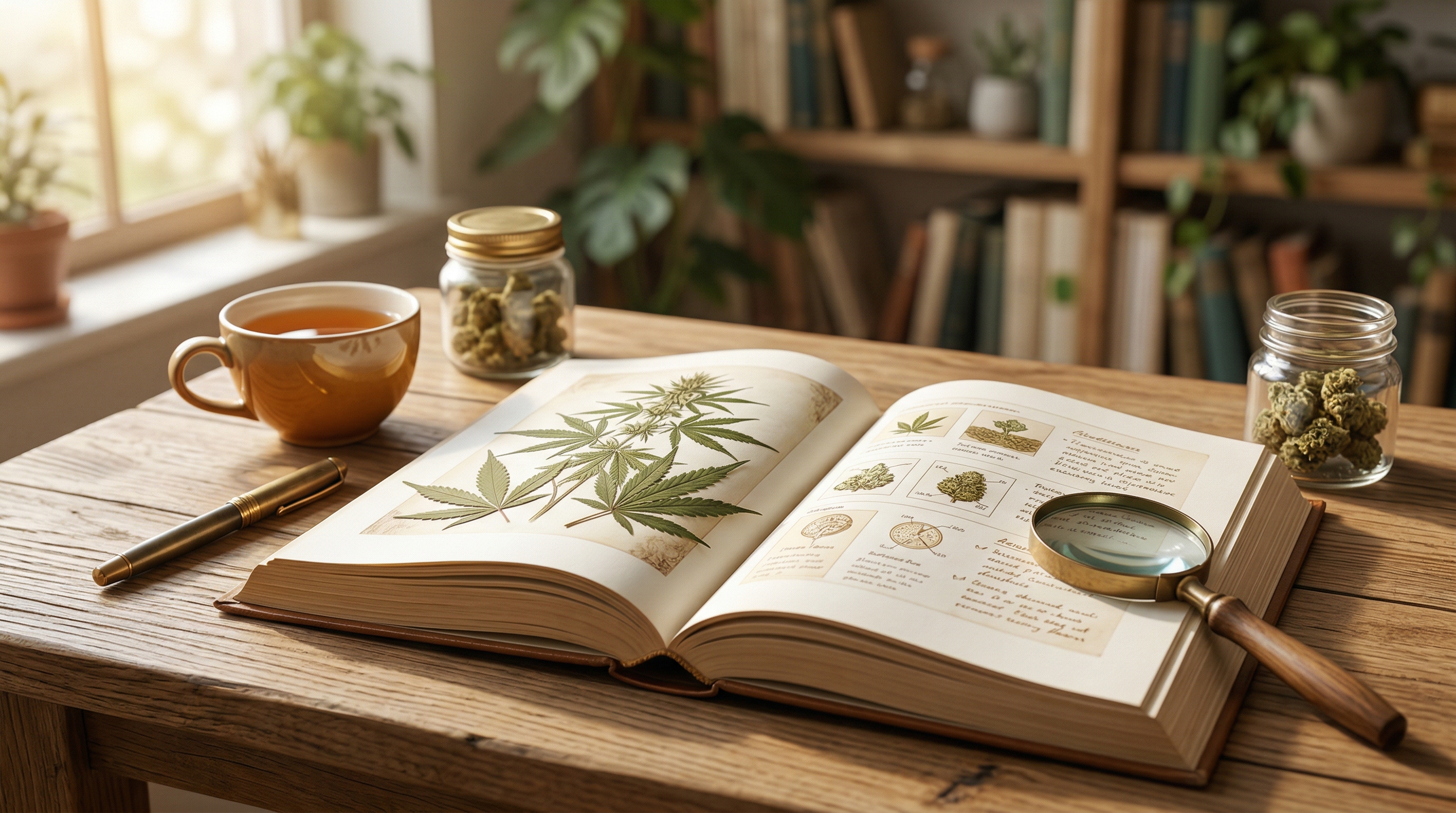
You’ve spent weeks—maybe months—nurturing your cannabis plants from seed to harvest. The buds look gorgeous, the trichomes are milky and perfect, and you’re ready to enjoy the fruits of your labor. But here’s the thing: chopping your plants down is only half the battle. What you do after harvest determines whether you end up with smooth, flavorful, potent flower—or harsh, hay-smelling bud that doesn’t do your grow justice.
Drying and curing are the unsung heroes of quality cannabis. These two post-harvest processes preserve terpenes, convert cannabinoids to their active forms, and break down chlorophyll so your flower tastes and smokes the way it should. Skip them, rush them, or botch them, and even the most genetically gifted cultivar will disappoint.
What you’ll accomplish: Properly dried and cured cannabis with maximum terpene retention, smooth smoke, and full potency expression.
Estimated time: 2–4 weeks for drying and initial cure; 4–8+ weeks for a full cure.
Difficulty level: Beginner-friendly (patience is the hardest skill required).
What You’ll Need
Required
- A dark, enclosed drying space — closet, grow tent, or dedicated room
- Hanging line, wire, or drying rack — for suspending branches or buds
- Hygrometer — to monitor humidity (digital preferred, ~$10–20)
- Thermometer — many hygrometers include one
- Airtight glass jars — wide-mouth Mason jars (quart size works great)
- Trimming scissors — sharp, spring-loaded for comfort
- Small fan — for gentle air circulation (not pointed directly at buds)
Optional
- Boveda or Integra Boost humidity packs (58% or 62% RH) — for dialing in cure humidity
- Humidity-controlled curing containers — like CVault stainless steel containers
- Drying rack/net — mesh hanging racks for individual buds
- Rubber gloves — nitrile or latex, to keep resin off your hands
Safety Equipment
- Well-ventilated space — drying cannabis produces strong odors and moisture
- Carbon filter (optional) — if odor control is a concern
Step-by-Step Instructions
Step 1: Harvest and Prepare Your Branches
Start by cutting branches from your plant in manageable lengths—12 to 18 inches works well for hanging. At this stage, you have a choice: wet trim or dry trim.
- Wet trimming means removing fan leaves and sugar leaves immediately after harvest, while the plant is still moist. This speeds up drying and is easier on your hands.
- Dry trimming means hanging whole branches with leaves intact, then trimming after drying. This slows the dry, which many growers believe preserves more terpenes.
Either approach works. If your drying space has low humidity (below 45% RH), dry trimming helps slow things down. If humidity runs high (above 65% RH), wet trimming reduces the risk of mold.
Key takeaway: There’s no single “right” trim method—match your approach to your environment.
Time estimate: 1–3 hours depending on harvest size.
Tip: At minimum, remove the large fan leaves. They contain very little resin and can trap moisture against buds.
Step 2: Set Up Your Drying Environment
This is where most people go wrong. Your drying room conditions matter more than almost anything else in this process.
Target conditions:
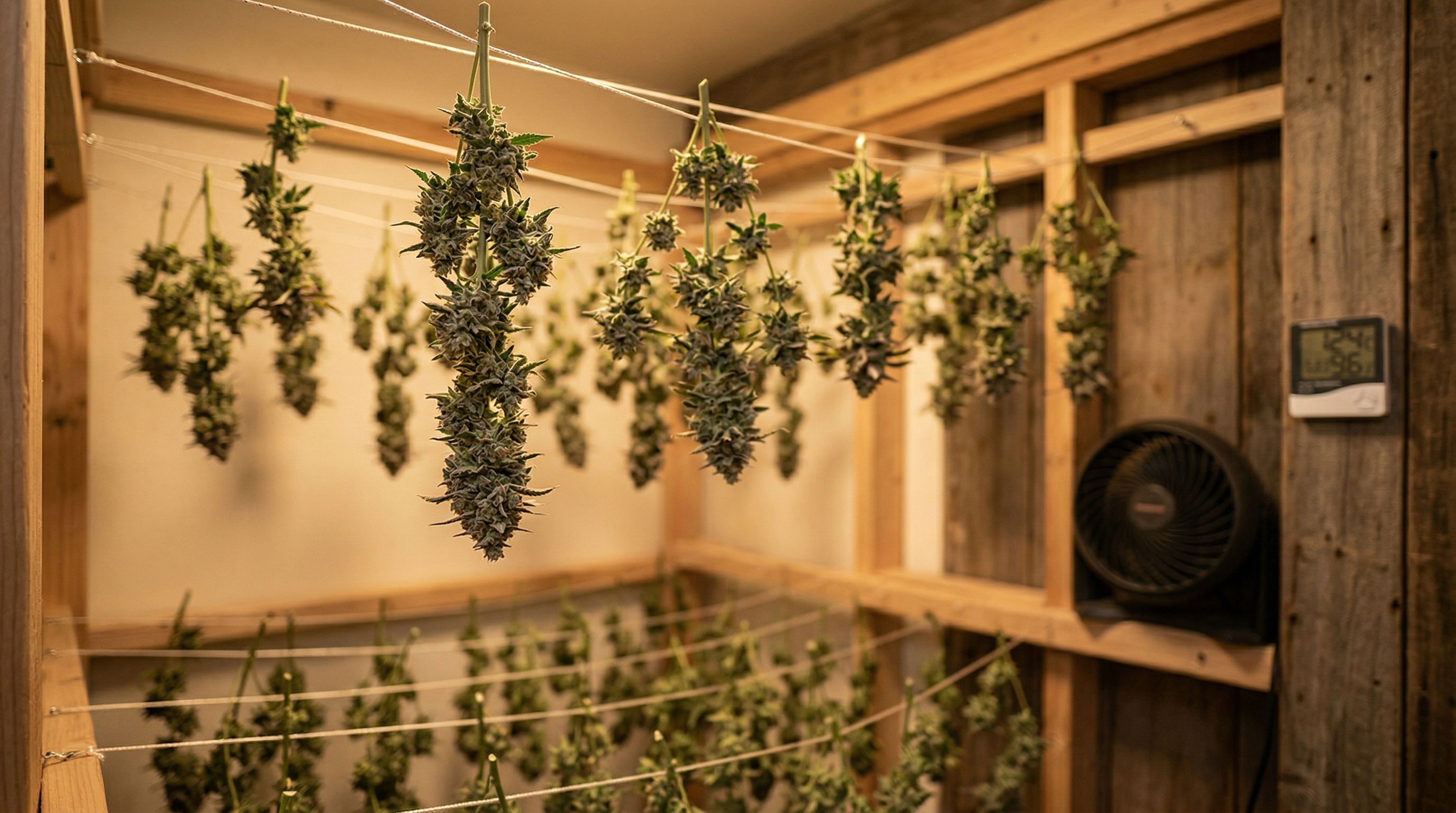
- Temperature: 60–70°F (15–21°C)
- Relative humidity: 55–65% RH
- Light: As dark as possible (light degrades THC and terpenes)
- Airflow: Gentle and indirect—never blow a fan directly on your buds
Hang your branches upside down from wire or string, spacing them so they aren’t touching each other. If you’re using a drying rack, spread individual buds in a single layer and rotate them every 12–24 hours to prevent flat spots.
Time estimate: 30–60 minutes for setup.
Tip: If your space is too dry, hang a damp towel in the room or use a small humidifier. Too humid? A dehumidifier or increased airflow can help. Monitor your hygrometer daily.
Step 3: Dry for 7–14 Days
Now comes the patience part. A slow, controlled dry is the single most important factor in producing quality flower. Rushing this step with high heat or excessive airflow strips volatile terpenes—the compounds responsible for aroma, flavor, and the nuanced effects associated with different High Families.
For example, strains in the Uplifting High family are rich in limonene and linalool—terpenes that are particularly volatile and easily lost to heat. A slow dry preserves these delicate compounds.
How to tell when drying is complete:
- Small stems snap cleanly rather than bending
- The outside of buds feels dry to the touch but not crispy
- Buds no longer feel damp or cool when squeezed gently
If stems still bend without snapping, give it more time. If buds are crunchy and crumbling, you’ve over-dried (don’t worry—the cure can partially recover this).
Time estimate: 7–14 days, depending on bud density, humidity, and trim method.
Step 4: Trim (If Dry Trimming) and Jar Your Buds
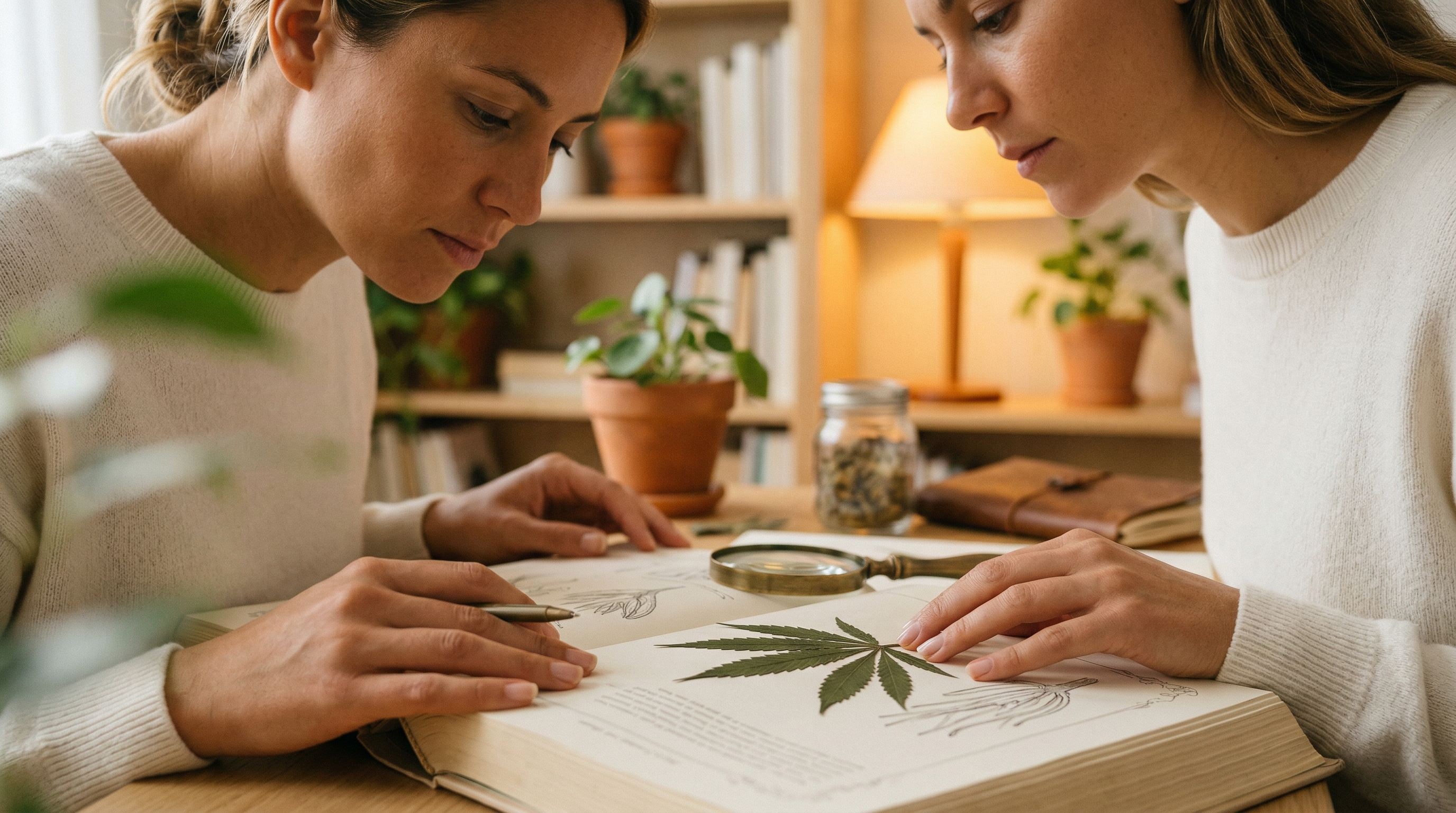
If you dry trimmed, now is the time to manicure your buds. Remove remaining sugar leaves and shape the buds to your preference. Save the trim—it’s great for making edibles or extracts.
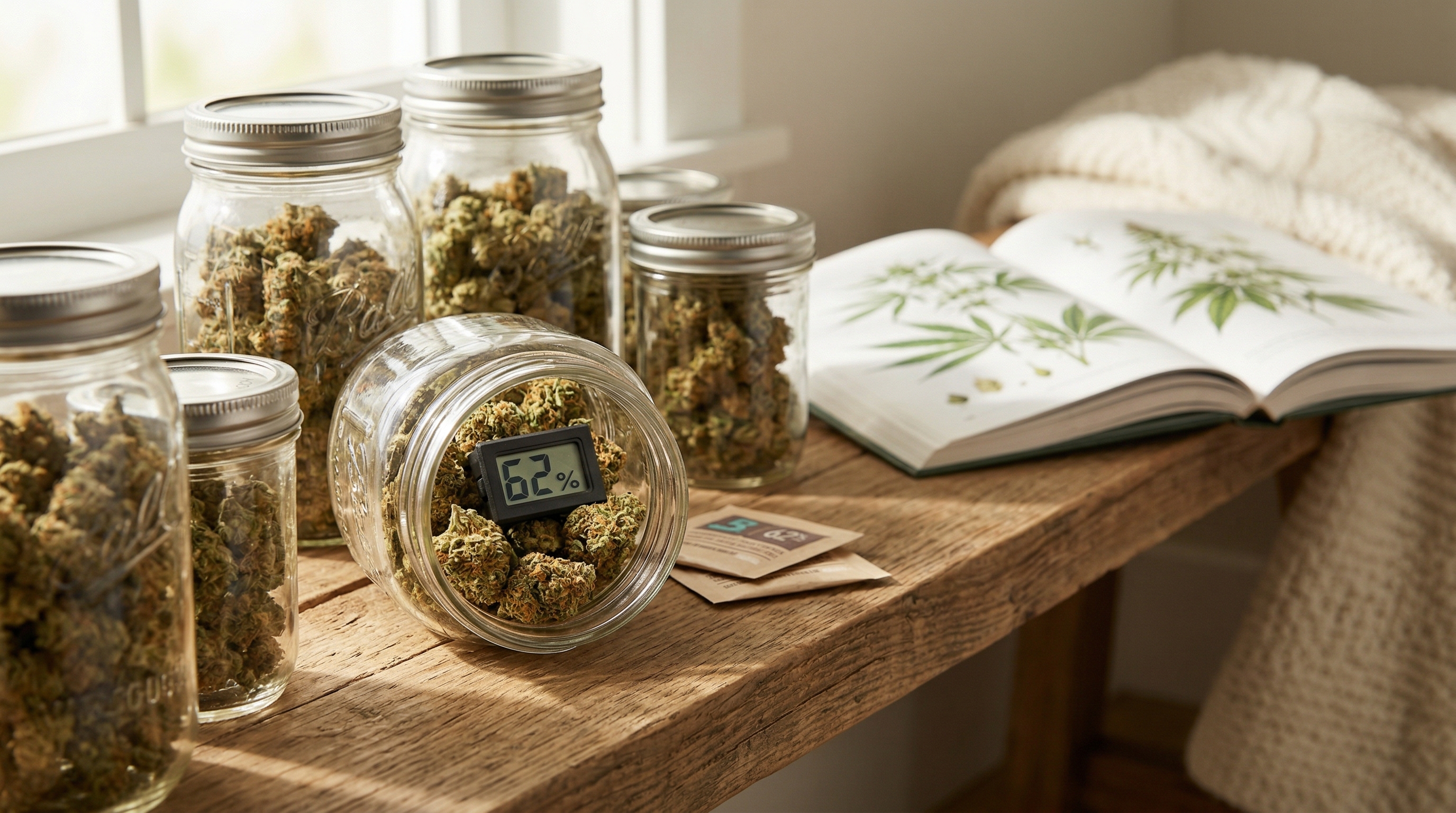
Gently place your trimmed buds into airtight glass Mason jars, filling each jar about 75% full. You want enough room for air exchange when you open the lids. Don’t pack them tightly—compressed buds invite mold.
Time estimate: 1–3 hours depending on harvest size.
Tip: If you have a hygrometer small enough to fit inside your jar (or use a Boveda sensor), place it in. You’re aiming for 58–65% RH inside the jar after sealing.
Step 5: Cure for 2–8+ Weeks
Curing is where the magic happens. During this phase, residual moisture redistributes from the center of each bud to the outside, anaerobic bacteria break down chlorophyll and plant sugars, and cannabinoid conversion continues—research suggests that THCA slowly decarboxylates and minor cannabinoids may develop further during a proper cure [Wang et al., 2016].
The burping schedule:
- Week 1–2: Open each jar for 5–15 minutes, 2–3 times per day. This releases moisture and replenishes oxygen.
- Week 3–4: Reduce to once per day for 5–10 minutes.
- Week 5+: Burp once every few days, or stop entirely if humidity is stable at 58–62% RH.
If you open a jar and smell ammonia, that’s a red flag—your buds were too moist when jarred. Remove them, let them air-dry for 12–24 hours, and re-jar.
Time estimate: Minimum 2 weeks; 4–8 weeks for noticeable improvement; some connoisseurs cure for 6+ months.
Tip: Boveda 62% humidity packs are excellent insurance during the cure. They absorb or release moisture to maintain a stable environment inside each jar.
Pro Tips
Slow is always better. If you can keep your drying room at 60°F and 60% RH, you’ll preserve significantly more terpenes than at 75°F and 45% RH. Some craft growers even target a 14–21 day dry. The longer the dry (within reason and without mold), the smoother and more flavorful the final product.
Don’t over-handle your buds. Trichomes—those frosty, resinous glands covering your flower—are fragile. Every time you squeeze, toss, or rub a bud, you’re knocking off trichome heads and losing potency and flavor. Handle buds by their stems whenever possible.
Whole-plant hanging (cutting the entire plant at the base and hanging it whole) is gaining popularity among craft cultivators. This creates the slowest possible dry, as moisture must travel through the entire stem system before evaporating. It’s space-intensive but produces exceptional results.
The cure never truly “ends.” Well-cured cannabis stored in a cool, dark place with stable humidity will continue to improve for months. Many experienced growers report peak flavor and smoothness at the 3–6 month mark. After about a year, THC begins slowly degrading into CBN, which may produce more sedative effects—something fans of the Relaxing High family might actually appreciate.
Troubleshooting
| Problem | Likely Cause | Solution |
|---|---|---|
| Buds smell like hay or grass | Dried too fast; chlorophyll not broken down | Slow the dry next time; a longer cure (4–8 weeks) can partially recover flavor |
| Ammonia smell when opening jars | Buds were too wet when jarred; anaerobic bacteria | Remove buds immediately, air-dry 12–24 hours, re-jar, and burp more frequently |
| Mold or white fuzz on buds | Humidity too high (above 70% RH) during drying or curing | Discard affected buds (do not smoke moldy cannabis); lower humidity and increase airflow |
| Buds are crispy and crumbling | Over-dried (humidity too low or dried too long) | Place a Boveda 62% pack in the jar; moisture will slowly redistribute from stems |
| Harsh smoke despite good cure | Residual nutrients from late feeding; incomplete chlorophyll breakdown | Extend cure to 6–8 weeks; consider flushing plants before harvest next grow |
| Uneven drying across branches | Inconsistent airflow or branch density varies | Rotate branches, separate dense colas, ensure even air circulation |
Variations
Quick Dry (Emergency Only)
If you absolutely need to sample your harvest, you can dry small buds in a paper bag in a cool, dark space for 3–5 days. The quality won’t compare to a proper dry and cure, but it’ll give you a preview of what’s to come. Never use a microwave or oven—you’ll destroy terpenes and cannabinoids.
Water Curing
Some growers submerge dried buds in water for 5–7 days (changing water daily) to rapidly leach chlorophyll, salts, and sugars. The result is an incredibly smooth smoke, but it strips most terpenes and aroma. This technique is sometimes used for cannabis destined for edibles where flavor isn’t the priority.
Large-Scale Adjustments
Growing more than a few plants? Invest in a dedicated drying tent with an inline fan, carbon filter, and humidistat-controlled humidifier/dehumidifier. Consistency across a large harvest requires environmental automation—manual monitoring becomes impractical beyond a handful of jars.
Drying and curing aren’t glamorous, but they’re the difference between forgettable flower and something truly special. Give your harvest the time it deserves, keep your environment dialed in, and your future self will thank you with every smooth, flavorful session.
Sources
- Wang, M., et al. (2016). “Decarboxylation Study of Acidic Cannabinoids: A Novel Approach Using Ultra-High-Performance Supercritical Fluid Chromatography/Photodiode Array-Mass Spectrometry.” Cannabis and Cannabinoid Research, 1(1), 262–271. DOI: 10.1089/can.2016.0020
- Russo, E.B. (2011). “Taming THC: potential cannabis synergy and phytocannabinoid-terpenoid entourage effects.” British Journal of Pharmacology, 163(7), 1344–1364. PMID: 21749363
- Jin, D., et al. (2019). “Cannabis Indoor Growing Conditions, Management Practices, and Post-Harvest Treatment: A Review.” American Journal of Plant Sciences, 10(6), 925–946. DOI: 10.4236/ajps.2019.106067


