Find Your Ideal High: Why Strain Names Don't Matter
Discover why chasing strain names leads you astray and how terpene chemistry actually shapes your cannabis experience.

Updated July 2026: Added 2025 German market study of 140 medicinal cannabis strains confirming no correlation between indica/sativa labels and terpene profiles. New internal links to terpene bioavailability research and dispensary guides.
The $30 Billion Naming Problem
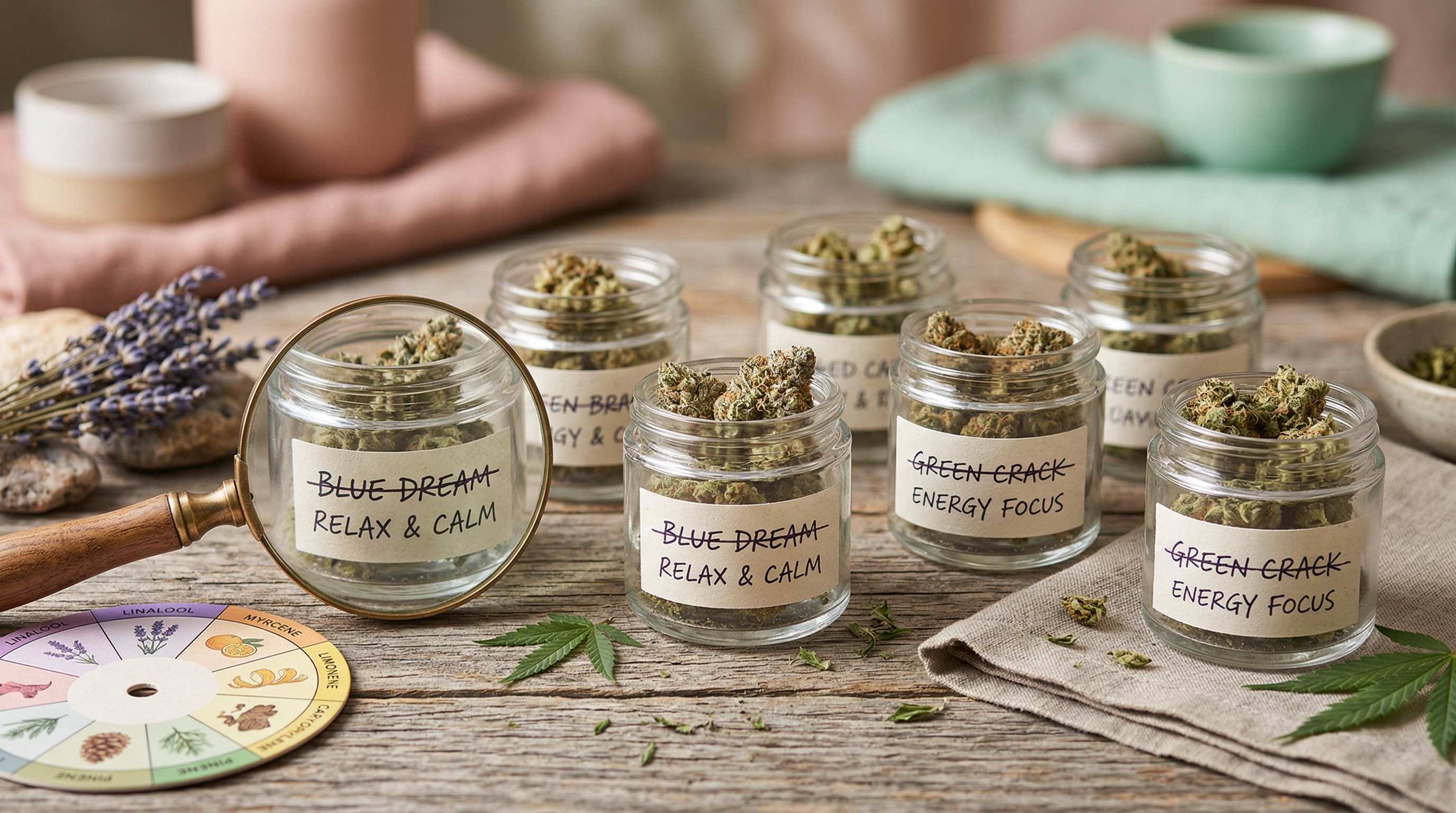
Here’s a fact that might sting a little: that “Blue Dream” you bought last week at your local dispensary probably has almost nothing in common with the “Blue Dream” your friend swears by from a shop across town. In fact, a landmark 2015 study found that cannabis samples sold under the same strain name frequently had wildly different chemical profiles, while samples with completely different names were sometimes near-identical [Sawler et al., 2015].
Let that sink in. The entire way most of us shop for cannabis — browsing menus, hunting for familiar strain names, asking budtenders for “that one strain that was amazing last time” — is built on a system that’s about as reliable as judging a book by someone else’s description of its cover.
This isn’t your fault. The cannabis industry inherited a naming convention from decades of underground cultivation where names were marketing tools, not scientific classifications. “Girl Scout Cookies” sounds a lot more memorable than “high-myrcene, moderate-caryophyllene, THC-dominant cultivar,” right? But that second description would actually tell you what to expect when you consume it.
The good news? There’s a better way to find your ideal high — one rooted in chemistry, not branding. In this article, you’ll learn why strain names fail you, what actually determines your cannabis experience, and how to use terpene science and the High Families system to consistently find the effects you’re looking for. Whether you’re seeking deep relaxation, creative energy, or gentle physical comfort, understanding the why behind your high changes everything.
Let’s break down the science.
The Science Explained
Why Strain Names Are Broken
To understand the problem, you need to understand how cannabis strains get their names. Unlike, say, apple varieties — where a Honeycrisp is genetically standardized and will taste roughly the same whether it’s grown in Washington or Michigan — cannabis “strains” (more accurately called cultivars or chemovars) have no standardized genetic registry. Anyone can call anything whatever they want.
A 2019 study from the University of Colorado analyzed 122 commercially available cannabis samples and found that strain name was a poor predictor of chemical consistency. Samples labeled as the same strain varied dramatically in both cannabinoid and terpene content [Schwabe & McGlaughlin, 2019]. A separate analysis by Leafly’s research team in collaboration with lab partners found that genetic drift, different growing conditions, harvest timing, and curing methods all cause the same “strain” to produce vastly different chemical profiles from one grow to the next.
The evidence keeps accumulating. A 2025 study by Herwig and colleagues analyzed 140 medicinal cannabis flowers on the German market using GC-MS terpene profiling. Their multivariate analysis found no statistical correlation between terpene profiles and genetic classification—sativa, indica, and hybrid strains showed equally heterogeneous terpene compositions. The researchers concluded that terpene-based classification “allows a clearer, finer and, above all, more meaningful classification than the existing sativa/indica classification” [Herwig et al., 2025].
Think of it like this: imagine you ordered a “Margherita pizza” at ten different restaurants. You’d expect tomato, mozzarella, and basil every time — but what if some restaurants used cheddar, others used barbecue sauce, and one just served you flatbread with ketchup? That’s essentially what’s happening with cannabis strain names. The label promises consistency, but there’s no recipe enforcement.
What Actually Shapes Your Experience
So if the name on the jar doesn’t reliably predict your experience, what does? The answer lies in the plant’s chemical profile — specifically, the interplay between three categories of compounds:
1. Cannabinoids — These are the heavy hitters you’ve heard of. THC (tetrahydrocannabinol) is the primary psychoactive compound. CBD (cannabidiol) modulates THC’s effects and may promote calm. But there are over 100 known cannabinoids, including CBG, CBN, and THCV, each contributing their own piece to the puzzle [ElSohly et al., 2017].
2. Terpenes — These aromatic compounds are found throughout the plant kingdom (limonene in lemons, myrcene in mangoes, linalool in lavender). In cannabis, they don’t just create flavor and aroma — emerging research suggests they significantly influence the subjective effects of the high. Dr. Ethan Russo’s influential 2011 paper proposed that terpenes modulate cannabinoid activity through what’s called the entourage effect, where the whole-plant chemical ensemble produces effects that isolated compounds cannot [Russo, 2011].
3. Flavonoids — Less studied but increasingly recognized, these compounds may contribute to the anti-inflammatory and antioxidant properties some users report [Ferrante et al., 2019].
Of these three, terpenes are the most actionable variable for consumers—and recent research on terpene bioavailability confirms that meaningful amounts reach the brain through inhalation. Here’s why: while cannabinoid ratios (like THC:CBD) give you a rough sense of potency and whether effects will be more psychoactive or balanced, terpenes appear to be what make two strains with the same THC percentage feel completely different.

The Entourage Effect: Why the Whole Plant Matters
The entourage effect is the theory that cannabis compounds work synergistically — that the combined effect of cannabinoids, terpenes, and flavonoids together is different from (and potentially greater than) any single compound alone.
Here’s a practical example: two cannabis products might both test at 25% THC. But one is rich in myrcene (a terpene associated with sedation and deep relaxation), while the other is dominant in terpinolene (associated with uplifting, focused energy). Despite identical THC numbers, these two products may produce dramatically different experiences.
A 2018 review in Frontiers in Neurology examined evidence for terpene-cannabinoid interactions and found preliminary support for the idea that specific terpenes modulate how cannabinoids bind to receptors in the endocannabinoid system [Ferber et al., 2020]. While the authors noted that more controlled human trials are needed, the existing evidence — combined with centuries of anecdotal use — suggests that terpene profiles are a far more reliable guide to effects than strain names or even THC percentages alone.
Key insight: Two products with the same name can feel different. Two products with different names can feel the same. The chemical profile — especially the terpene profile — is what actually matters.
Moving Beyond Indica vs. Sativa
While we’re dismantling cannabis myths, let’s address the biggest one: the indica vs. sativa classification. You’ve probably heard that “indica = in-da-couch” (relaxing) and “sativa = energizing.” This distinction was originally a botanical classification describing plant morphology — leaf shape, growth patterns, geographic origin — not effects [McPartland, 2018].
Genetically, most modern cannabis is so heavily hybridized that the indica/sativa distinction is nearly meaningless as a predictor of experience. For a deeper look at what these hybrid labels actually mean in practice, see our indica-dominant vs. sativa-dominant hybrid comparison. A 2021 analysis of over 100,000 cannabis samples found no consistent correlation between indica/sativa labeling and actual chemical composition [Watts et al., 2021].
What does predict experience? You guessed it: the terpene and cannabinoid profile. This is exactly why the High Families system exists — to give you a framework based on chemistry, not mythology.
Practical Implications: Using High Families to Find Your Ideal High
So how do you actually apply this science when you’re standing in a dispensary or browsing an online menu? This is where the High Families classification system becomes your most powerful tool.
Instead of asking “What strain should I get?” — a question that, as we’ve established, is inherently unreliable — you start asking “What kind of experience am I looking for?” Then you match that desired experience to a High Family based on terpene chemistry.
Here’s how each family maps to common wellness goals:
| Your Goal | High Family | Key Terpenes to Look For |
|---|---|---|
| Mood boost, social connection, creative spark | Uplifting High | Limonene, Linalool |
| Focused productivity, daytime clarity | Energetic High | Terpinolene, Ocimene |
| Deep relaxation, sleep support, unwinding | Relaxing High | Myrcene, high CBD |
| Gentle introduction, mild effects | Balancing High | Low terpene profiles |
| Physical comfort, body-focused relief | Relieving High | Caryophyllene, Humulene |
| Complex, full-spectrum, nuanced experience | Entourage High | Multi-terpene complex |
Your New Shopping Strategy
Here’s a step-by-step approach to finding your ideal high consistently:
-
Identify your intention. What do you want from this session? Relaxation after a long day? Creative energy for a project? Gentle comfort for sore muscles? Start with the why.
-
Match your intention to a High Family. Use the table above as your starting point. If you want sleep support, you’re looking at the Relaxing High family. If you want social energy, explore the Uplifting High family.
-
Read the lab results, not just the label. Increasingly, dispensaries provide Certificates of Analysis (COAs) or at least terpene profiles on packaging. Look for the dominant terpenes and match them to your target High Family.
-
Keep a journal. This is the single most impactful thing you can do. Record the product name, its terpene profile (if available), the dose, and how you felt. Over time, you’ll build a personal map of what works for your unique body chemistry.
-
Talk terpenes with your budtender. Instead of asking “What’s your best strain?”, try: “I’m looking for something high in limonene and linalool — what do you have that fits?” You’ll get dramatically better recommendations. If it’s your first time, our dispensary visit guide covers what to expect and what to ask.

Why Your Body Chemistry Matters Too
One final piece of the puzzle: even with the perfect terpene profile, your experience is filtered through your unique endocannabinoid system (ECS). Your diet can influence ECS tone, and even dopamine signaling plays a role in how rewarding a particular session feels. Factors like your genetics, tolerance, metabolism, stress levels, what you’ve eaten, and even your mood can all influence how you respond to the same product on different days [Lu & Bhatt, 2019].
This is why the journal approach is so important. You’re not just tracking the product — you’re tracking you. Over time, patterns emerge. You might discover that myrcene-dominant products work beautifully for sleep on weeknights but feel too heavy on weekends when your stress levels are lower. That kind of personalized insight is worth more than any strain recommendation.
Key Takeaways
-
Strain names are unreliable. The same name can mean vastly different chemical profiles depending on the grower, batch, and growing conditions. Don’t chase names — chase chemistry.
-
Terpenes are the best predictor of experience. While cannabinoid ratios matter (especially THC:CBD), terpene profiles appear to be what make one high feel different from another. Learn the key terpenes and what they do.
-
The indica/sativa distinction is outdated. Modern cannabis is too hybridized for these botanical categories to predict effects. Use the High Families system instead — it’s based on actual terpene science.
-
Your ideal high is personal. Your endocannabinoid system is unique. Keep a consumption journal to track what works for your body, and you’ll find consistency far faster than any strain-chasing strategy.
-
Ask better questions. At the dispensary, ask about terpene profiles and cannabinoid ratios instead of strain names. You’ll get better results every time.
FAQs
Does this mean strain names are completely useless?
Not entirely. A strain name can give you a starting point — a rough expectation based on that cultivar’s genetic lineage. But it’s not a guarantee. Think of it like a restaurant’s menu description: it gives you an idea, but the actual dish depends on the chef, the ingredients that day, and how it’s prepared. Always check the lab data when available.
What if my dispensary doesn’t provide terpene profiles?
This is increasingly common, but not universal. If terpene data isn’t available, ask your budtender about the dominant terpenes they’ve noticed in specific products. You can also look up the cultivar on databases that aggregate lab results. And advocate for transparency — dispensaries that provide terpene data are serving their customers better, and consumer demand drives change.
Can two people have completely different reactions to the same product?
Absolutely. Your endocannabinoid system, tolerance, metabolism, body composition, and even your current emotional state all influence your experience [Lu & Bhatt, 2019]. This is normal and expected. It’s one more reason why personal experimentation and journaling matter more than anyone else’s recommendation.
How do I know which High Family is right for me?
Start with your intention. What do you want to feel? Then explore the High Families overview to find the family that matches your goal. Try a product from that family at a low dose, note the results, and adjust from there. Most people find that one or two families consistently deliver what they’re looking for.
Sources
-
Sawler, J., et al. (2015). “The Genetic Structure of Marijuana and Hemp.” PLOS ONE. DOI: 10.1371/journal.pone.0133292
-
Schwabe, A.L. & McGlaughlin, M.E. (2019). “Genetic tools weed out misconceptions of strain reliability in Cannabis sativa: implications for a budding industry.” Journal of Cannabis Research. DOI: 10.1186/s42238-019-0001-1
-
Herwig, N. et al. (2025). “Classification of Cannabis Strains Based on their Chemical Fingerprint—A Broad Analysis of Chemovars in the German Market.” Cannabis and Cannabinoid Research. DOI: 10.1089/can.2024.0127
-
Russo, E.B. (2011). “Taming THC: potential cannabis synergy and phytocannabinoid-terpenoid entourage effects.” British Journal of Pharmacology. PMID: 21749363
-
ElSohly, M.A., et al. (2017). “Phytochemistry of Cannabis sativa L.” Progress in the Chemistry of Organic Natural Products. DOI: 10.1007/978-3-319-45541-9_1
-
Ferrante, C., et al. (2019). “In vitro study on the anti-inflammatory activity of flavonoids from Cannabis sativa L.” Phytotherapy Research. DOI: 10.1002/ptr.6400
-
Ferber, S.G., et al. (2020). “The ‘Entourage Effect’: Terpenes Coupled with Cannabinoids for the Treatment of Mood Disorders and Anxiety Disorders.” Current Neuropharmacology. DOI: 10.2174/1570159X17666190903103923
-
McPartland, J.M. (2018). “Cannabis Systematics at the Levels of Family, Genus, and Species.” *Cannabis and Cannabinoid Research


