Indoor vs Outdoor Cannabis Growing: Pros, Cons, and Yields
Compare indoor and outdoor cannabis cultivation methods. Explore costs, yields, quality, and which growing style fits your goals.

The Decision: Where Should You Grow?
If you’re thinking about growing cannabis — whether you’re a first-timer with a single seed or an experienced cultivator ready to scale up — one of the most fundamental choices you’ll face is where to grow. Indoor or outdoor? It sounds simple, but this single decision shapes nearly everything that follows: your startup costs, your daily routine, the terpene profiles of your harvest, your yields, and ultimately, the kind of experience your flower delivers.
This isn’t a question with one right answer. Indoor growing gives you laboratory-level control over every environmental variable, while outdoor growing harnesses the full power of the sun and natural ecosystems. Each method has passionate advocates, and each produces world-class cannabis when done well.
In this guide, we’ll break down the real differences — not the myths — between indoor and outdoor cannabis cultivation. We’ll compare costs, yields, quality, complexity, and environmental impact so you can make an informed decision based on your goals, budget, and circumstances. Whether you’re chasing frosty, terpene-rich buds from a Uplifting High strain or growing a hearty outdoor crop of a Relaxing High cultivar, this comparison will help you find your path.
Quick Comparison
Before we dive deep, here’s a high-level snapshot of how indoor and outdoor growing stack up:
| Factor | Indoor Growing | Outdoor Growing |
|---|---|---|
| Startup Cost | High ($1,000–$10,000+) | Low ($100–$500) |
| Ongoing Cost | High (electricity, climate control) | Low (water, soil amendments) |
| Yield per Plant | 1–5 oz (typical) | 6–30+ oz (typical) |
| Harvests per Year | 4–6 (photoperiod) / continuous (autos) | 1–2 (climate dependent) |
| Quality Potential | Very high (precise control) | Very high (full-spectrum light) |
| Terpene Expression | Excellent (controlled stress) | Excellent (natural UV exposure) |
| Environmental Impact | Higher (energy intensive) | Lower (sun-powered) |
| Control over Environment | Complete | Limited |
| Pest/Disease Risk | Lower (enclosed) | Higher (open environment) |
| Skill Level Needed | Moderate to advanced | Beginner-friendly (basics) |
| Best For | Year-round growers, quality chasers, limited space | Budget growers, large yields, sustainability-minded |
| Avoid If | You can’t afford high electricity bills | You live in a harsh or very short-season climate |
Deep Dive: Indoor Cannabis Growing
What It Is
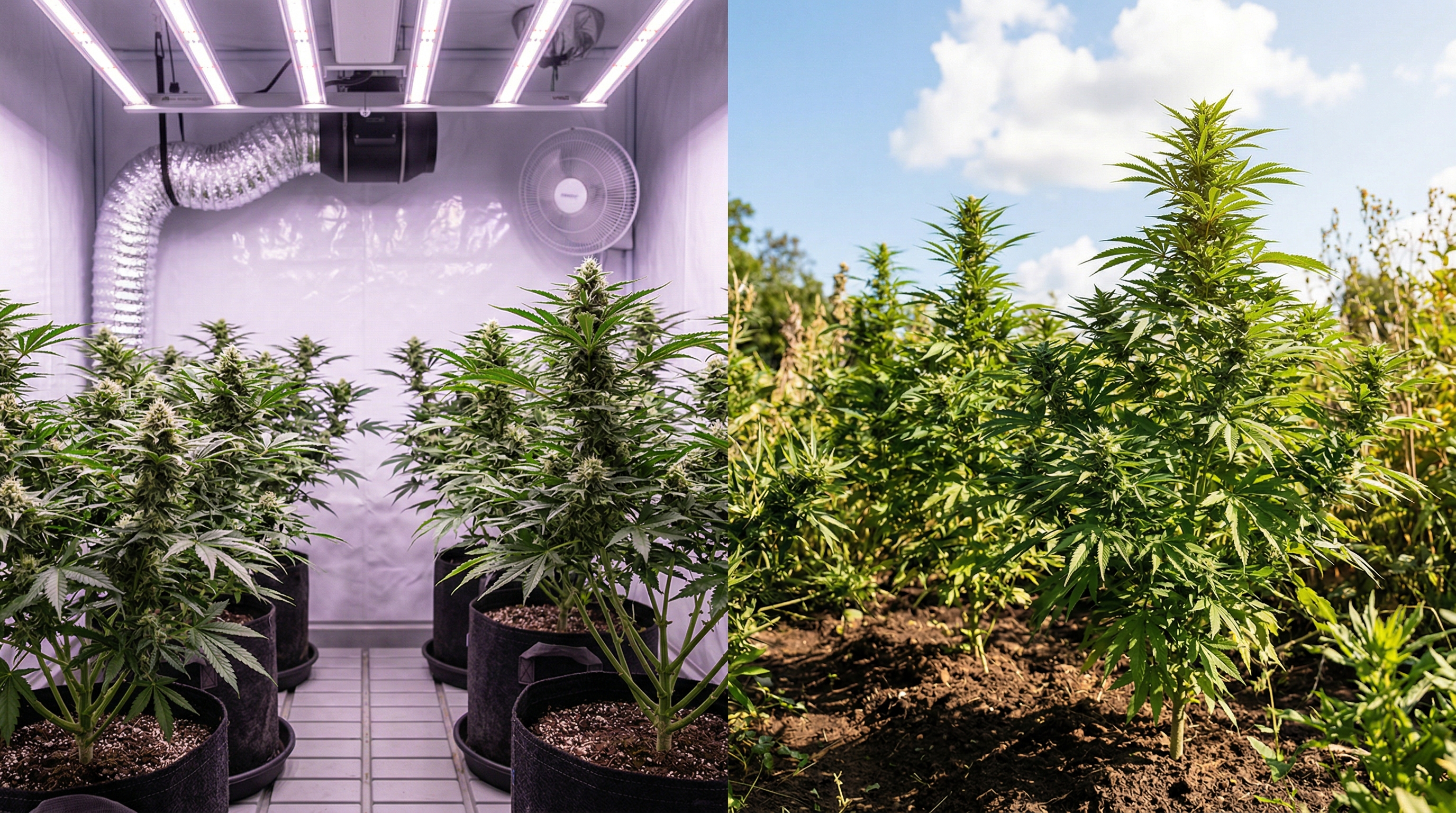
Indoor growing means cultivating cannabis inside a controlled environment — a grow tent, a spare room, a closet, a warehouse, or a purpose-built facility. You replace sunlight with grow lights, control temperature and humidity with HVAC systems, and manage airflow with fans and filters. Every aspect of the plant’s environment is in your hands.
How It Works
Indoor growers recreate (and often optimize) the conditions cannabis needs to thrive:
- Lighting: LED, HPS (high-pressure sodium), or CMH (ceramic metal halide) lights provide the photosynthetically active radiation (PAR) plants need. You control the light schedule — typically 18 hours on/6 off during vegetative growth, then 12/12 to trigger flowering in photoperiod strains.
- Climate Control: Temperature (ideally 70–85°F during veg, slightly cooler during late flower), humidity (40–60% depending on stage), and CO₂ levels are all managed manually or with automated controllers.
- Growing Medium: Soil, coco coir, rockwool, or hydroponic systems. Indoor growers often use soilless media for faster growth and more precise nutrient delivery.
- Nutrients: Liquid or dry fertilizers delivered on a schedule tailored to the plant’s growth stage.
- Air Filtration: Carbon filters control odor, while intake and exhaust fans maintain fresh airflow and prevent mold.
Pros
- Total environmental control: You dictate light, temperature, humidity, and CO₂. This means you can optimize conditions for specific strains, dialing in the exact environment that maximizes terpene production — crucial if you’re growing a terpinolene-dominant Energetic High strain that needs precise conditions to express its full profile.
- Year-round cultivation: No waiting for seasons. You can run 4–6 harvests per year with photoperiod strains, or even more with autoflowers.
- Higher potency and bag appeal: The controlled environment often produces denser, more resinous buds with vibrant colors. Research suggests that manipulating light spectrum and temperature during late flowering can enhance cannabinoid and terpene concentrations [Magagnini et al., 2018].
- Reduced pest pressure: Enclosed environments are easier to keep pest-free (though not immune — fungus gnats and spider mites can still find their way in).
- Privacy and security: Growing indoors keeps your garden out of sight.
Cons
- High startup and operating costs: Quality lights, tents, fans, filters, and climate control equipment add up fast. Electricity bills for lighting alone can run $50–$200+ per month for a small grow.
- Environmental footprint: Indoor cannabis cultivation is energy-intensive. One study estimated that indoor cannabis production accounts for roughly 1% of total U.S. electricity consumption, though this figure is debated and varies by region [Mills, 2012].
- Steeper learning curve: Managing VPD (vapor pressure deficit), light intensity, nutrient EC/pH, and airflow requires knowledge and attention.
- Space limitations: Unless you have a large facility, you’re working with limited canopy space, which caps your total yield.
Ideal Use Cases
Indoor growing is ideal if you live in a climate with harsh winters or short growing seasons, if you want to grow year-round, if you’re focused on producing the highest-quality flower possible, or if you need discretion. It’s also the go-to for cultivators who want to experiment with specific terpene profiles by fine-tuning environmental variables.
Deep Dive: Outdoor Cannabis Growing
What It Is
Outdoor growing is the original method — planting cannabis in the ground (or in containers) outside, under the sun. It’s how cannabis has been cultivated for thousands of years across Central Asia, the Hindu Kush mountains, equatorial regions, and eventually, backyards and farms around the world.
How It Works
Outdoor cultivation follows the natural rhythm of the seasons:
- Lighting: The sun provides a full spectrum of light — including UV-A and UV-B rays — that no artificial light fully replicates. Photoperiod strains naturally begin flowering as days shorten in late summer and early fall.
- Climate: Temperature, humidity, and wind are determined by your local climate and microclimate. Growers in Mediterranean climates (think Northern California’s Emerald Triangle) have ideal conditions; those in northern latitudes or humid regions face more challenges.
- Growing Medium: Native soil (amended with compost, worm castings, and organic nutrients), raised beds, or large fabric pots. Many outdoor growers embrace living soil — a biodiverse ecosystem of microorganisms that feed the plant naturally.
- Nutrients: Organic amendments (bat guano, kelp meal, bone meal) are common, though some outdoor growers use liquid fertilizers as well.
- Water: Rain supplemented by irrigation. Water management is one of the most important outdoor growing skills.
Pros
- Dramatically lower cost: The sun is free. Soil is cheap. A basic outdoor grow can be started for under $200 in seeds, soil, and amendments.
- Massive yields: Outdoor plants can grow enormous — 6 to 10 feet tall or more — and produce yields of 1–3 pounds per plant under ideal conditions. That dwarfs typical indoor yields.
- Full-spectrum sunlight: The sun delivers a broader and more intense light spectrum than any grow light. Research suggests that UV-B exposure may stimulate increased trichome and cannabinoid production as a protective response [Lydon et al., 1987].
- Sustainability: Sun-grown cannabis has a dramatically smaller carbon footprint than indoor. For environmentally conscious growers, this matters.
- Terpene complexity: Many experienced growers and connoisseurs report that outdoor-grown cannabis — especially from living soil — produces more complex, nuanced terpene profiles. This aligns well with Entourage High strains that thrive on multi-terpene complexity.
- Simpler daily routine: Once established, outdoor plants require less daily intervention than indoor grows.
Cons
- One to two harvests per year: You’re bound by the seasons. In most climates, you plant in spring and harvest in fall — one shot per year.
- Weather vulnerability: Rain during flowering can cause bud rot (Botrytis cinerea). Hailstorms, early frosts, and heat waves can devastate a crop.
- Pest and disease exposure: Caterpillars, aphids, spider mites, powdery mildew, and larger critters (deer, rabbits) are constant threats in an open environment.
- Less control over appearance: Outdoor buds are often less visually “perfect” than indoor — they may be airier, less uniformly trimmed, and more variable in color. This doesn’t necessarily mean lower quality, but it affects market perception.
- Privacy and legal concerns: Outdoor grows are visible and can attract unwanted attention. Check your local regulations — many jurisdictions require plants to be out of public view.
- Climate dependency: If you live somewhere with a short growing season, heavy rainfall, or extreme temperatures, outdoor growing becomes significantly harder.
Ideal Use Cases
Outdoor growing shines if you have the space and a favorable climate, if you’re growing on a budget, if you want maximum yield, or if sustainability is a priority. It’s also a natural fit for growers who embrace organic, regenerative agriculture practices and want their cannabis to express the full character of its genetics and terroir.
Head-to-Head Analysis
Let’s compare these two methods across the factors that matter most to growers.
Quality and Terpene Expression
This is where the debate gets heated. Indoor advocates point to the precise control that allows growers to manipulate late-flower temperatures (dropping to 60–65°F at night) to bring out anthocyanin pigments (purple hues) and preserve volatile terpenes. Outdoor advocates counter that the sun’s full spectrum — particularly UV-B — triggers a natural stress response that may boost trichome production and terpene diversity [Lydon et al., 1987].
The truth? Both methods produce exceptional cannabis. Indoor growing tends to yield more visually consistent, potent flower. Outdoor growing — especially in living soil — often produces more complex terpene profiles that some connoisseurs prefer. If you’re growing a caryophyllene-rich Relieving High strain, for example, both environments can bring out that spicy, peppery profile, but the path to get there differs.
Key takeaway: Quality depends more on the grower’s skill and genetics than on whether the grow is indoor or outdoor.
Yield and Efficiency
This one isn’t close in terms of per-plant yield: outdoor plants win by a landslide. A single outdoor plant in optimal conditions can produce 2+ pounds. Indoors, even skilled growers typically harvest 1–5 ounces per plant.
However, indoor growers compensate with frequency. With 4–6 harvests per year, a small indoor setup can produce a surprisingly large annual total. And indoor yield per square foot can be very high with techniques like SOG (Sea of Green) or SCROG (Screen of Green).
| Metric | Indoor | Outdoor |
|---|---|---|
| Yield per plant | 1–5 oz | 6–48 oz |
| Harvests per year | 4–6 | 1–2 |
| Yield per sq ft (annual) | 4–8 oz | 2–6 oz |
| Grams per watt | 0.5–2.0g | N/A (free sunlight) |
Cost Considerations
Startup costs favor outdoor growing heavily. Seeds, soil, and basic amendments can get you started for $100–$300. An indoor setup with a quality LED light, tent, fan, filter, and nutrients easily runs $500–$2,000 for a small grow, and $5,000–$10,000+ for a more serious setup.
Ongoing costs also favor outdoor. Your biggest recurring expense outdoors is water and soil amendments. Indoors, electricity is the constant drain — a 400W LED running 18 hours a day for a month consumes roughly 216 kWh, which at $0.15/kWh costs about $32 per light, per month, just for illumination. Add climate control, and costs climb.
Cost per gram tends to be significantly lower for outdoor cannabis, which is why the commercial market increasingly relies on outdoor and greenhouse cultivation for more affordable products.
Environmental Impact
This is increasingly important to consumers and growers alike. Indoor cannabis cultivation has a substantial carbon footprint due to electricity consumption for lighting, HVAC, and dehumidification. One analysis estimated that producing one kilogram of indoor cannabis generates approximately 4,600 kg of CO₂ emissions [Mills, 2012].
Outdoor growing, powered by sunlight and natural airflow, has a fraction of that footprint. Greenhouse growing (a hybrid approach we’ll touch on shortly) offers a middle ground — using sunlight supplemented by artificial light when needed.
User Experience and Lifestyle
Indoor growing is a daily commitment. You’re checking temperatures, adjusting lights, monitoring humidity, feeding nutrients, and watching for problems. It’s hands-on and technical — rewarding for people who love tinkering and optimizing.
Outdoor growing is more seasonal and rhythmic. There’s intense work during planting and harvest, but the middle stretch is more relaxed — watering, occasional feeding, pest scouting, and training. Many outdoor growers describe it as meditative and deeply connected to the natural world.
Your lifestyle and personality matter here. If you love data, gadgets, and year-round projects, indoor growing might be your jam. If you love gardening, being outside, and working with nature’s rhythms, outdoor growing could be more fulfilling.
The Verdict
Choose Indoor Growing If…
- You live in a climate with harsh winters, short summers, or extreme humidity
- You want to grow year-round with multiple harvests
- You’re focused on producing the most visually appealing, potent flower
- You have


