Massachusetts Question 8: What a Yes or No Vote Changes for Weed
Massachusetts Question 8 marijuana would end recreational sales and home grow on January 1, 2028, while adults 21+ could still possess 1 ounce.

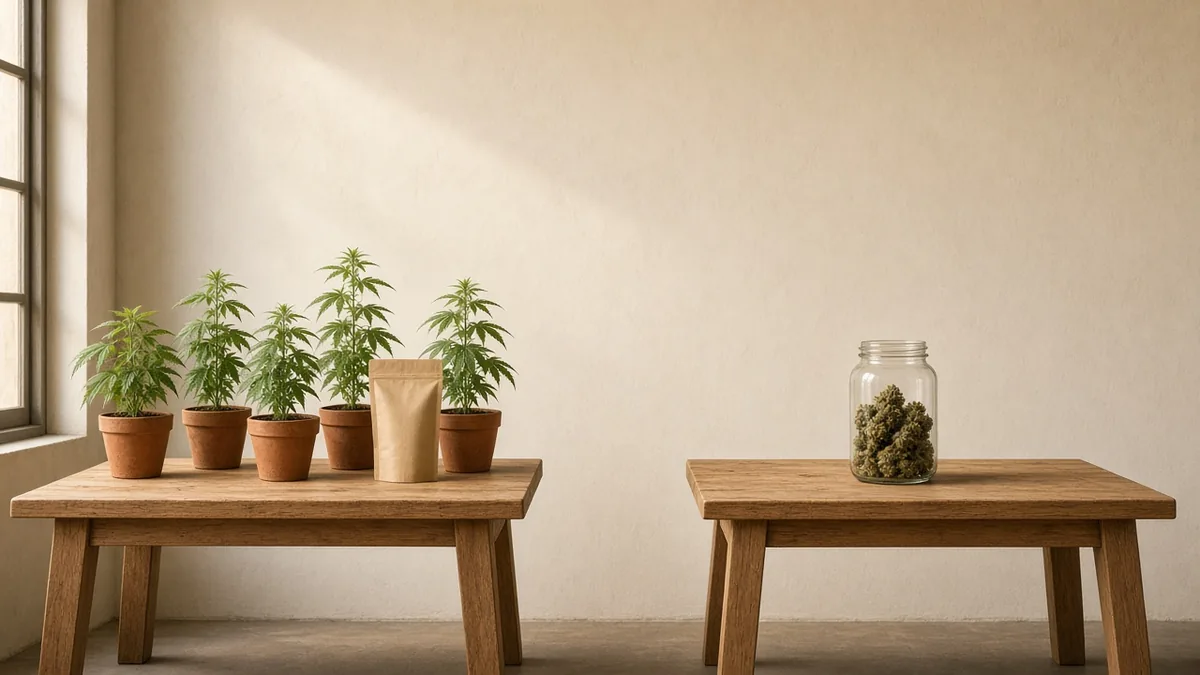
A yes vote on Massachusetts Question 8 would end licensed recreational sales and home growing, while adults 21 and older could still possess 1 ounce or less, including no more than 5 grams of concentrate.
Last checked: October 8, 2026. This is a High School lesson, not legal advice. A later statute, rule, or court order can change the picture after this date. This page does not tell you how to vote.
Voters decide Question 8 on Tuesday, November 3, 2026. The question is a proposed law. The Senate and House did not vote on it before May 6, 2026. If it passes, the certified text takes effect on January 1, 2028. It does not take effect on election night. A no vote would make no change to the law on marijuana.
The photo above is a comparison, not a recommendation. The left table stands in for what current adult-use law allows at home: plants, plus a purchased product. The right table stands in for the narrower possession the petition would leave. It is not a photo of a weighed ounce.
The map of state rules sits in the 2026 state-by-state legal guide. This page stays on one Massachusetts question.
What is on the Massachusetts Question 8 ballot?
The Secretary of the Commonwealth prints the question as “Prohibit Retail Sale of Adult Recreational Use Marijuana.” It is Question 8 of nine binding statewide questions. The official ballot question, and the summary voters will read, is on the Secretary’s 2026 ballot-questions page. The same summary is in the 2026 Information for Voters.
The Attorney General wrote the summary. The yes and no lines were written jointly by the Attorney General and the Secretary. Those lines say:
A yes vote would prohibit the legalization, regulation, and taxation of the retail sale of adult recreational use marijuana, and change the penalties for possession of marijuana.
A no vote would make no change to the law relative to marijuana.
The summary then fills in the possession rule. Adults 21 and older could possess 1 ounce or less. No more than 5 grams of that amount could be concentrate. They could also give that same amount, without payment, to another person 21 or older. The summary adds a civil penalty of $100, plus forfeiture, for possession between 1 and 2 ounces.
The proposed law itself is Initiative Petition 25-10, Version B. Its short title is “An Act to Restore A Sensible Marijuana Policy.” The full text is in the voter book and in the certified petition PDF. Section 10 says the law takes effect on January 1, 2028.
The ballot shows the summary. The petition text is the law a yes vote would enact. Read both. They are not worded the same way in every line. The age line is the clearest example, and it is below.
Early voting runs October 17 through October 30, 2026. The voter book says you must be registered by Saturday, October 24, 2026. Polls on Election Day run from 7 a.m. to 8 p.m. Those dates are about how to vote. They do not change what the marijuana question does.
What does a yes vote change for sales, possession, home grow, and medical use?
A yes vote is a future change, not a change that is law today. Nothing in this table is in force unless voters approve the question and the January 1, 2028 date arrives.
| Topic | If voters say yes | If voters say no |
|---|---|---|
| Adult-use sales | Licensed recreational retail would end when the law takes effect on January 1, 2028. Chapter 94G, the adult-use statute, would be repealed. | Licensed adult-use sales stay under current law. |
| Possession at 21 or older | 1 ounce or less is not a civil or criminal penalty. No more than 5 grams may be concentrate. More than 1 ounce, up to 2 ounces, is a $100 civil penalty and forfeiture. | You may carry up to 2 ounces. You may keep up to 10 ounces at home. Amounts over 2 ounces at home must be locked. |
| Home growing, adult use | The 6-plant adult-use right is in chapter 94G. Repealing that chapter removes it. The petition does not copy a 10-ounce home allowance or a 6-plant right. | Up to 6 plants at home, or up to 12 if two or more adults live there. |
| Giving marijuana away | Up to 1 ounce, with no more than 5 grams of concentrate, to a person 21 or older. The transfer cannot be advertised or promoted. | Up to 2 ounces, or the product amount the Commission sets as equivalent, to a person 21 or older. The transfer cannot be advertised or promoted. |
| Medical use | Chapter 94I stays. The petition’s purpose includes continuing the medical program. The Commission would regulate that market. | The medical program stays as it is. |
| The Commission | The Commission stays. Its authority would be modified so it regulates the medical market. | The Commission keeps its adult-use and medical roles. |
| Start date | January 1, 2028. Not election night. | This question would make no change. |
The petition’s own purpose section states three aims. Keep the medical program. Keep simple possession of 1 ounce or less, for people 21 and over, free of civil and criminal penalties. Make possession over 1 ounce, up to 2 ounces, a civil penalty only. Then repeal chapters 94G and 64N. Chapter 64N is the chapter that taxes marijuana that is not medically prescribed. This page does not state a tax rate. The rate was not needed to explain the repeal.

The picture is the yes outcome only. It is not a recommendation. A no vote leaves current law in place. “1 ounce stays” means the petition’s 1-ounce rule for adults 21 and older. It does not mean today’s 2-ounce carry limit, and it does not mean today’s 10 ounces at home.
The 1-ounce rule, and what happens above it
Petition section 4 would replace section 32L of chapter 94C, as that section appeared in the 2024 Official Edition. For a person 21 or older, two acts would not bring arrest, prosecution, a penalty, or forfeiture of assets. One is possessing 1 ounce or less, except that not more than 5 grams may be concentrate. The other is giving away, without payment, up to that same amount to a person 21 or older, if the transfer is not advertised or promoted to the public.
Above that line, the petition is specific. For an offender 21 or older, more than 1 ounce and up to 2 ounces is only a civil offense. The civil penalty is $100, plus forfeiture of the marijuana. The petition says that band is not any other criminal or civil punishment or disqualification.
At exactly 1 ounce, the no-penalty rule applies. At exactly 2 ounces, the $100 civil penalty applies. The ballot summary says “between the weight of 1 and 2 ounces.” The petition text says “between more than 1 ounce and 2 ounces or less.” Use the petition for the edges.
There is no separate home-storage allowance in the petition. Today, chapter 94G lets an adult keep up to 10 ounces at home, and any marijuana the home plants produced. Amounts over 2 ounces in the home must be locked. The petition repeals chapter 94G. It does not recreate the 10-ounce home allowance. More than 1 ounce, up to 2 ounces, would be the $100 civil offense wherever it is kept.
The petition does not set a jail term for more than 2 ounces. It says the new section does not repeal the laws on possession of more than 2 ounces. What that means after chapter 94G is gone, and after the April 2026 edits to chapter 94C, is not spelled out in the petition. That penalty is uncertain. Do not treat a guess as the law.
The age line on the ballot and the age line in the petition
The ballot summary says the under-21 rules apply to “persons 21 years of age and younger.” The petition does not use that phrase. Section 4(a) and section 4(b) cover a person 21 or older. Section 4(c) covers an offender “under the age of 21.” A 21-year-old is in the adult sections of the petition text.
For someone under 21, possession of 2 ounces or less would draw the same $100 civil penalty and forfeiture, if the person completes a drug awareness program under section 32M. Parents or guardians of an offender under 18 would be notified under section 32N. If an offender under 18 does not finish both the program and the required community service within one year, the civil penalty may rise to $1,000 under section 32N. The petition says the offender and the parents are then jointly and severally liable.
In June 2026, the Supreme Judicial Court decided Pineau v. Attorney General. The court held that the Attorney General did not err in certifying the petition, and that the summary is fair under Article 48 of the state constitution. The court did not turn the summary into the statute. The petition text is still the proposed law.
Medical use, the Commission, and licensed shops
Section 1 says a purpose of the act is continuing the medical-use program. Section 4 says the new possession section does not apply to sale or delivery of medical-use marijuana under chapter 94I. Section 6 repeals chapter 94G. It does not repeal chapter 94I.
The petition would keep the Cannabis Control Commission and insert a new medical-chapter section for it. That section tells the Commission to write advisory guidelines on growing marijuana in a primary residence “pursuant to section 2 of this chapter.” The chapter in that sentence is 94I, the medical chapter. Section 2 of chapter 94I is the medical program, not the adult-use home-grow rule in chapter 94G. The guideline sentence does not itself authorize non-medical home growing.
Section 8 tells the Commission to speed up medical licensing for current chapter 94G licensees, including marijuana establishments. It also tells the Commission to let those licensees sell existing supplies to medical marijuana treatment centers licensed under chapter 94I. The petition does not publish a day-by-day calendar for closing adult-use stores. The repeal date is January 1, 2028.
The Commission’s Know the Laws page, opened October 8, 2026, says a registered patient 18 or older may possess up to a 60-day supply. The same page says registered medical patients may grow up to 12 flowering plants and 12 vegetative plants at home. Those are today’s Commission statements. The petition sections read for this article do not rewrite a patient purchase amount or that plant count. Do not treat them as numbers Question 8 locks in.
What can adults possess and grow in Massachusetts today?
Today’s adult-use rules are in force. They stay in force if Question 8 fails. They also stay in force until January 1, 2028 even if Question 8 passes.
On April 19, 2026, Chapter 65 of the Acts of 2026 took effect. The compiled General Laws mark the chapter 94G possession edits as effective that day. The April 2026 reform lesson explains that bill. Question 8 is a different proposal. It is not that statute.
The Cannabis Control Commission’s Know the Laws page, opened October 8, 2026, states the practical adult-use rules:
- You must be 21 or older to buy or grow adult-use marijuana. A retailer must see a government ID.
- You may carry up to 2 ounces. You may possess up to 10 ounces in your home.
- You may grow up to six plants at home, or up to 12 plants if two or more adults live there.
- You cannot use cannabis in public, including smoking, vaping, or eating, or on federal land.
- An open container in the passenger area of a vehicle can bring a civil penalty of up to $500. The Commission says to keep it in a closed container in the trunk or a locked glove box.
- It is illegal to drive across state lines with cannabis, or to carry it out of Massachusetts by plane, train, boat, or other transport. You cannot mail it.
- More than 2 ounces at home must be locked. The Commission also says it is best to lock all cannabis away from children and pets. That “best” line is advice. The lock rule with a penalty is the amount over 2 ounces.
- It is illegal to drive while impaired by cannabis.
The same limits appear in chapter 94G, section 7 and section 13. Section 7(a)(1), as replaced by Chapter 65, covers possessing, using, purchasing, processing, or manufacturing 2 ounces or less, or the equivalent amount of marijuana products the Commission sets. Section 7(a)(2) is the home rule: up to 10 ounces in the primary residence, plus marijuana produced by plants grown there, and not more than 6 plants, so long as not more than 12 plants are grown on the premises at once.
Section 13(b) says marijuana over “2 ounce” in the home must be secured by a lock. The civil penalty is not more than $100, plus forfeiture. The statute uses “2 ounce,” not “2 ounces,” in that clause.
Other current civil penalties in section 13, still on the books as checked October 8, 2026, include these:
- Plants visible from a public place without optical aids, or grown outside a locked area: a civil penalty of not more than $300, plus forfeiture.
- Public consumption, or smoking marijuana where smoking tobacco is banned: a civil penalty of not more than $100. A city or town can vote to allow a designated area inside a marijuana establishment. The ban does not limit medical use.
- A person under 21, other than a qualifying medical patient, who buys or tries to buy, or who fakes an age: a civil penalty of not more than $100 and a drug awareness program. The Commission’s penalty table adds parent notice under 18.
The statute no longer prints a concentrate cap inside section 7(a)(1). It points that product math to the Commission. The Commission’s FAQ, opened October 8, 2026, says a person over 21 may possess up to 2 ounces on their person, except that not more than 10 grams may be concentrate. That FAQ line is the Commission’s current statement. It is not a sentence in section 7(a)(1). An April 17, 2026 Commission bulletin, written before Chapter 65 was signed, discussed 10 grams of active THC in concentrate, and a milligram figure for edibles, as a way to apply the old concentrate rule to a 2-ounce flower limit. Those are not the same phrase as “10 grams of concentrate.” This page uses the live FAQ plus the statute for the current carry rule.
Federal law still conflicts with state legalization. State rules do not erase that conflict. The 2026 state-by-state cannabis law lesson is the wider map.
What stays in place if voters say no?
The Secretary’s no-vote line is the whole answer. A no vote would make no change to the law relative to marijuana.
Chapter 94G would stay. Chapter 64N would stay. Adult-use shops would stay licensed under current rules. The 2-ounce carry limit, the 10-ounce home allowance, and the 6-plant home-grow rule would stay. The Commission would keep its adult-use role. The medical program would stay on its own track.
A no vote also leaves the conduct rules that are easy to miss. Public use stays banned. Open containers in cars stay banned. Impaired driving stays illegal. Mailing cannabis stays illegal. Carrying it across the state line stays illegal. The travel guide covers why a state license is not a pass to cross a border. The driving lesson covers the impairment rule. A Research Hub note on cannabis and impaired driving in young adults is a study summary, not a Massachusetts crash statistic.
Employers, landlords, cities, and towns can still set their own policies. The Commission says a landlord cannot be punished by the state for allowing consumption that is lawful under state law. That protection is tied to the adult-use statute. The tenant-rights lesson explains how landlord rules and state rules can differ. A landlord rule can be stricter than the state possession limit. Question 8 does not require a landlord to allow use.
Who put Question 8 on the ballot?
Mass.gov’s 2026 ballot-initiatives list shows petition 25-10, Version B, as certified. The listed proponent contact is sensiblecannabisact@gmail.com. The Supreme Judicial Court’s June 12, 2026 opinion in Pineau states that Attorney General Andrea Joy Campbell certified the petition on September 3, 2025, under Article 48.
The voter book also prints two 150-word arguments. The argument for a yes vote is signed by Dr. Jeffrey Morgan for the Coalition for a Healthy Massachusetts. The argument for a no vote is signed by Ryan Dominguez for the Massachusetts Cannabis Coalition. The book says those arguments are the writers’ opinions. The Commonwealth does not endorse them. It does not certify that any statement in them is true. This page does not repeat campaign figures from either argument as facts.
One official number is in the voter book, and it is not a campaign line. The Executive Office of Administration and Finance wrote the fiscal statement. It says that repealing the laws that legalize and tax adult-use retail sales would reduce what the state and cities and towns receive from those sales. In fiscal year 2025, that taxation raised approximately $280 million in state revenue and $50 million in local revenue. “Approximately” is the office’s word. The figure is a FY2025 receipt. It is not a forecast of a later budget.
A Research Hub summary of a systematic review on legalization and public health is a pointer to research. It is not proof of the Massachusetts claims in either campaign argument.
What is still uncertain?
Several points are not settled by the pages checked on October 8, 2026.
The criminal penalty for more than 2 ounces, after a repeal of chapter 94G, is not stated as a jail term in the petition. The petition says it does not repeal the laws on possession above 2 ounces. How that interacts with Chapter 65 of the Acts of 2026 is not mapped in the petition. Do not fill the gap with a number this page did not find.
The petition sets January 1, 2028, as the effective date. It tells the Commission to speed medical licensing and to allow sales of existing adult-use supplies to medical treatment centers. It does not publish a week-by-week wind-down for stores. Whether a shop may sell adult-use products until that date follows from the effective date. The transition steps beyond section 8 are not written out.
The petition limits some collateral penalties for possession of 2 ounces or less. Section 4 says that amount shall not, by itself, be a basis to deny student financial aid, public housing, or public financial assistance, including unemployment benefits. It also says the offense shall not be entered as a criminal-record entry in the CORI system. The same section says it does not repeal personnel policies. An employer can still set workplace rules. The employment-protections lesson is the place for how job rules and state possession rules differ. Question 8 does not promise that a job is safe, and it does not itself fire anyone.
The petition preserves the impaired-driving laws it names. The voter-book text cites section 24I of chapter 90, and chapter 387 of the acts of 2008. It also says cities and towns may still regulate or prohibit public consumption. It does not create a right to carry marijuana out of Massachusetts.
Patient purchase amounts, and the exact plant count on a medical cultivation registration after 2028, were not rewritten in the petition sections read here. Today’s Commission page is the source for today’s medical supply and today’s medical plant numbers. Those numbers are not restated as future limits.
Key takeaways
- Question 8 is on the November 3, 2026 ballot. A yes vote would take effect on January 1, 2028. A no vote would leave marijuana law unchanged.
- If it passes, licensed recreational sales would end, and the adult-use home-grow right in chapter 94G would go with that chapter.
- Adults 21 and older could still possess 1 ounce or less, including no more than 5 grams of concentrate, without a civil or criminal penalty under the petition.
- More than 1 ounce, up to 2 ounces, would be a $100 civil penalty and forfeiture. The current 10-ounce home allowance would not carry over.
- The medical program in chapter 94I would stay. The Commission would remain, with authority aimed at the medical market.
- Today, until any change takes effect, adults 21 and older may carry up to 2 ounces and keep up to 10 ounces at home, under chapter 94G and the Commission’s October 8, 2026 guidance.
- The ballot summary and the petition text use different age wording. The court held the summary fair. The petition text is the proposed law.
- Campaign arguments in the voter book are opinions. The Commonwealth does not certify them.
FAQ
Does Massachusetts Question 8 ban possession of marijuana?
No. The certified petition would still let a person 21 or older possess 1 ounce or less without a civil or criminal penalty. No more than 5 grams of that amount may be concentrate. Possession over 1 ounce, up to 2 ounces, would be a $100 civil penalty and forfeiture. The current right to keep up to 10 ounces at home would not remain, because that right is in chapter 94G, which the petition repeals.
When would Question 8 take effect?
Section 10 of the petition says the law takes effect on January 1, 2028. The Attorney General’s summary on the ballot says the same date. A yes vote on November 3, 2026, would not change the rules on election night. A no vote would not change them at all.
Does Question 8 end medical marijuana?
The petition says one purpose is continuing the medical-use program. It repeals chapter 94G, not chapter 94I. It would keep the Cannabis Control Commission and point that commission at the medical market. It also tells the Commission to let current adult-use licensees apply for medical licenses on a faster track, and to sell existing supplies to medical treatment centers. This page does not restate a patient ounce limit as a number the petition locks in.
Can you still grow cannabis at home if Question 8 passes?
The adult-use right to grow up to six plants, or 12 in a home with two or more adults, is in chapter 94G, section 7. The petition repeals that chapter and does not copy the plant limit. A guideline sentence in the medical chapter tells the Commission to publish advisory home-cultivation practices under chapter 94I, section 2. That sentence is not a new non-medical grow right. Registered medical cultivation is a separate current rule on the Commission’s site.
What happens to dispensaries if Question 8 passes?
Licensed adult recreational retail would lose its statutory base when chapter 94G is repealed on January 1, 2028. The petition tells the Commission to speed medical licensing for current chapter 94G businesses and to allow them to sell remaining adult-use inventory to medical treatment centers. It does not list a store-by-store closing schedule. Shops that never get a medical license are not given a new adult-use path in the sections read here.
Sources
Primary pages checked October 8, 2026:
- Secretary of the Commonwealth, 2026 ballot questions. Question text and the Attorney General summary as it appears for the ballot.
- 2026 Information for Voters, English PDF. Question 8 summary, yes and no statements, fiscal statement, argument disclaimer, and the full petition text, including the January 1, 2028 effective date.
- Information for Voters hub.
- Initiative Petition 25-10, Version B, certified PDF.
- Attorney General final summary for 25-10, Version B.
- Mass.gov list of 2026 ballot initiatives. Certification status and proponent contact.
- Pineau v. Attorney General, Supreme Judicial Court, decided June 12, 2026. Certification on September 3, 2025, and the holding that the summary is fair.
- Chapter 65 of the Acts of 2026. The enacted April 19, 2026 cannabis statute that current possession limits reflect.
- General Laws chapter 94G, section 7 and section 13. Current adult-use possession, home storage, home cultivation, and civil penalties.
- General Laws chapter 94I, section 2. The medical-program section the petition’s home-cultivation guideline points to.
- Cannabis Control Commission, Know the Laws and FAQ. Current practical limits, checked October 8, 2026.