How to Travel with Cannabis: A State-by-State Legal Guide
Navigate cannabis travel laws across the US — from TSA rules to state borders. Practical, current, and harm-reduction focused.

The Trip That Started Well and Ended in Handcuffs
It’s a story that repeats itself every summer: someone drives from Colorado to visit family in Kansas, forgets the half-ounce they bought legally in Denver is still in the center console, and gets pulled over for a broken tail light. In Kansas, where cannabis remains fully illegal, that forgotten purchase becomes a misdemeanor — or felony, depending on amount — regardless of how legally it was acquired.
The maddening part? Both people in that car followed the law in their home state perfectly. They just didn’t understand where the law stops protecting them.
Cannabis travel in the United States is one of the most legally complex consumer situations that exists. You’re operating across a patchwork of 54 different legal systems (50 states + D.C. + 3 territories) layered beneath a federal framework that still classifies cannabis as a Schedule I controlled substance alongside heroin. As of early 2026, 24 states plus Washington D.C. have legalized recreational cannabis, and 40 states allow some form of medical use — but the federal law hasn’t moved from Schedule I, and that’s what governs every airport, interstate highway, national park, and state border crossing.
This guide will make you a literate traveler. We’ll cover the federal baseline, break down every transportation mode, give you a practical state-by-state reference framework, and walk through the harm-reduction strategies that experienced consumers use to stay on the right side of a complicated legal landscape.
Legal disclaimer: This guide is for educational and harm-reduction purposes only. It does not constitute legal advice. Cannabis laws change frequently — always verify current regulations before traveling. When in doubt, consult a licensed attorney in the relevant jurisdiction.
The Federal Baseline: Why State Laws Don’t Travel With You
Before anything else, you need to internalize one rule that doesn’t bend regardless of how many states legalize:
Crossing a state line with cannabis is a federal crime.
It doesn’t matter if both states are fully recreational. It doesn’t matter if the amount is within both states’ possession limits. It doesn’t matter if you have a medical card. The moment cannabis crosses a state border, you are transporting a Schedule I controlled substance in interstate commerce — a federal offense under the Controlled Substances Act that can carry penalties up to 5 years for a first offense (for amounts under 50kg).
This reality creates the foundational logic for everything else in this guide:
- Within a single legal state = governed by that state’s law. Manageable with proper knowledge.
- Crossing a state line = federal jurisdiction. Illegal without exception.
- Airports, Amtrak, federal highways, national parks, military bases = federal jurisdiction regardless of which state they sit in.
- International borders = an entirely different and far more serious category of law.
The only cannabis-derived product that moves freely across state lines under federal law is hemp-derived CBD with less than 0.3% THC, as protected under the 2018 Farm Bill. Even that comes with caveats — some states impose additional restrictions on CBD products, and labeling matters.
Where Federal Rescheduling Stands (Early 2026)
You may have heard that the DEA has been working to reschedule cannabis from Schedule I to Schedule III. As of early 2026, that rescheduling process has advanced through DEA review — but it has not been finalized. Even if it is finalized, Schedule III rescheduling would not legalize cannabis, would not remove the interstate transport prohibition, and would not change state possession laws. It would primarily affect taxation, banking access, and research restrictions. Do not make travel decisions based on rescheduling news.
State Legal Status: The Four-Tier Framework
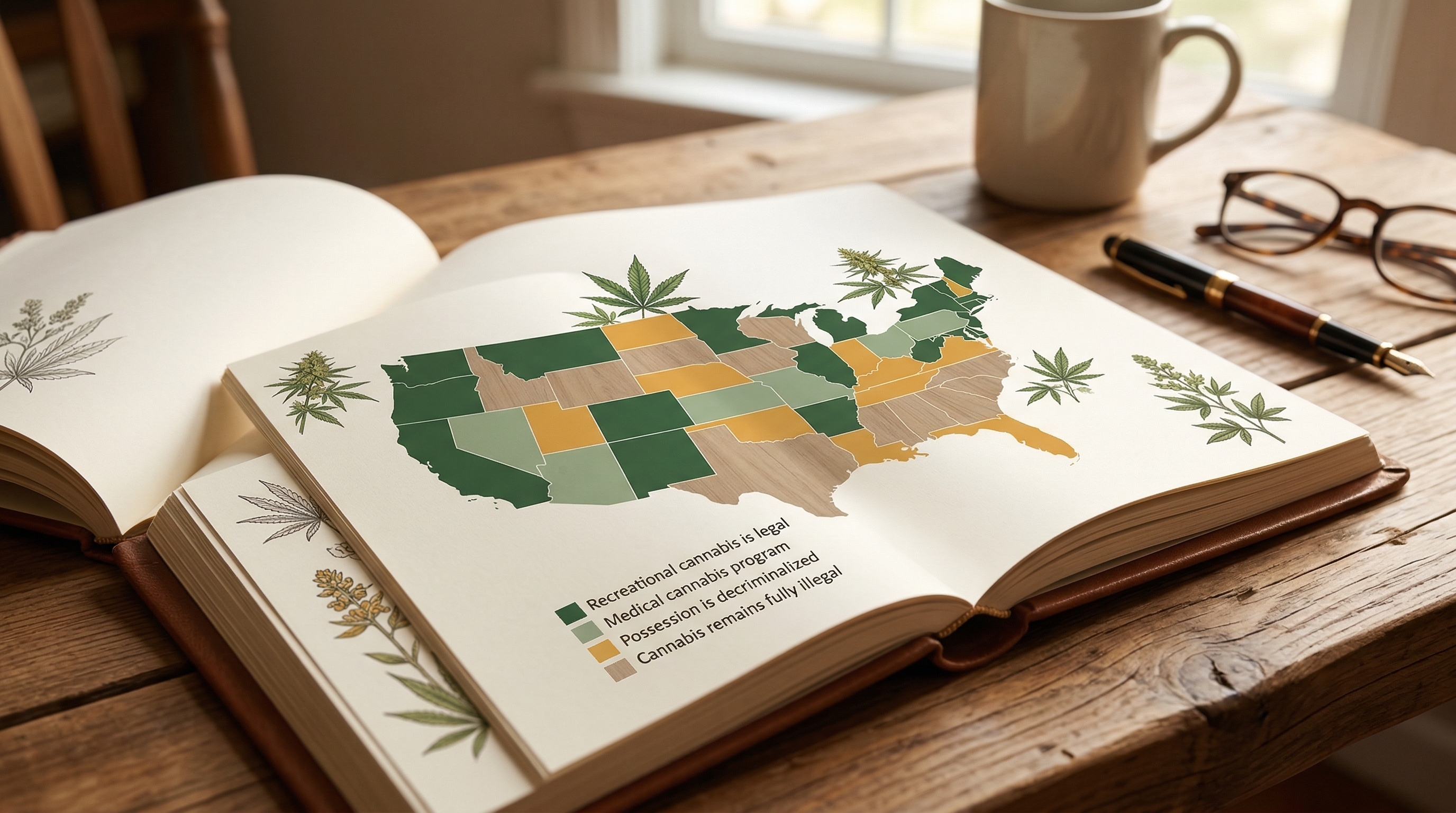
As of early 2026, every US state falls into one of four categories. Your route’s legal risk is determined by whichever tier represents the most restrictive state you pass through — not your home state, not your destination, but every state your vehicle touches.
Tier 1: Fully Legal (Recreational)
24 states + Washington D.C. have legalized recreational cannabis for adults 21 and older. Possession within state limits is legal for any adult regardless of residency.
| State | Public Possession Limit (Flower) | Concentrate Limit | Home Limit |
|---|---|---|---|
| Alaska | 1 oz | 7g (concentrate) | 4 oz |
| Arizona | 1 oz | 5g | 6 plants |
| California | 1 oz (28.5g) | 8g | 6 plants |
| Colorado | 2 oz | 8g | 2 oz |
| Connecticut | 1.5 oz | 7.5g | 5 oz (home) |
| Delaware | 1 oz | — | — |
| Illinois | 30g residents / 15g visitors | 5g residents / 2.5g visitors | 5 plants |
| Maine | 2.5 oz | — | 3 mature plants |
| Maryland | 1.5 oz | — | 2 oz (home) |
| Massachusetts | 1 oz | 5g | 10 oz (home) |
| Michigan | 2.5 oz | — | 2.5 oz |
| Minnesota | 2 oz | 8g | 2 oz |
| Missouri | 3 oz | — | 3 plants |
| Montana | 1 oz | 8g | 1 oz |
| Nevada | 1 oz | 3.5g | 1 oz |
| New Jersey | 6 oz | — | — |
| New Mexico | 2 oz | 16g | 6 plants |
| New York | 3 oz | 24g | 5 lbs (home) |
| Ohio | 2.5 oz | — | — |
| Oregon | 1 oz (public) | 5g | 8 oz (home) |
| Rhode Island | 1 oz | — | 10 oz (home) |
| Vermont | 1 oz | — | 2 oz (home) |
| Virginia | 1 oz | — | 4 plants |
| Washington | 1 oz | 7g | 1 oz |
| Washington D.C. | 2 oz | — | 8 oz (home) |
Important: Illinois has different limits for residents vs. visitors. Always check current state statutes — limits shown here reflect the general landscape as of early 2026 and may have changed.
Tier 2: Medical Only
These states allow possession only for registered patients with a valid in-state medical card. Possession without a card is illegal.
States with medical-only programs (as of early 2026): Alabama, Arkansas, Florida, Georgia (limited), Hawaii, Louisiana, Mississippi, New Hampshire, North Dakota, Oklahoma, Pennsylvania, South Dakota (medical only), Utah, West Virginia.
Out-of-state cards: Most medical-only states do not honor out-of-state cards for purchasing, though a few (including Oklahoma and some others) have moved toward limited reciprocity. Verify before you travel — never assume your home state card protects you.
Tier 3: Decriminalized (No Medical Program or Limited Access)
Small amounts result in a civil fine rather than criminal charges, but cannabis is not legal and there’s typically no retail access. North Carolina, for example, has decriminalized small amounts but has no medical or recreational program.
States in this category fluctuate as medical programs launch and recreational ballot measures pass. Check NORML.org for current status.
Tier 4: Fully Illegal (No Legal Status)
Cannabis possession is a criminal offense — potentially a felony depending on amount — with no medical or recreational protections.
States as of early 2026: Idaho, Kansas, Nebraska, Wyoming, and a small number of others. These states also tend to be geographic corridors between major legal markets. I-70 through Kansas is particularly notorious as an active enforcement corridor where officers regularly stop drivers with Colorado or other legal-state plates.
The Kansas Corridor Warning: Driving between Colorado and Missouri via I-70 means passing through Kansas, where cannabis is fully illegal. Law enforcement on this route knows legal-state travelers commonly make this mistake. There are documented instances of officers using the smell of cannabis as probable cause on this corridor. If your route touches fully illegal states, the “buy there” strategy (covered below) is essential.
Transportation Mode by Mode
Driving: The Nuanced Case
Driving is the most commonly misunderstood mode because the risk landscape shifts dramatically based on a single question: are you crossing a state line?
Within a single legal state: This is the lowest-risk travel scenario. You’re subject to that state’s possession and storage laws, not federal law. The rules are clear and manageable.
Crossing state lines: You are immediately in federal jurisdiction at the border, regardless of what’s in the trunk. The practical risk of federal enforcement for personal amounts is lower than state-level enforcement in illegal states, but “lower risk” is not “no risk” — and if you’re caught in an illegal state, it’s that state’s law that applies to your charges.
Storage rules within a legal state (applies to all legal states, with minor variations):
- Keep cannabis in its original dispensary packaging with labels intact
- Place it in a sealed, opaque, child-resistant container
- Store it in the trunk or a rear locked compartment — away from the passenger cabin
- Never exceed the state’s possession limit (flower, concentrate, and edibles are typically counted separately)
- Keep your dispensary receipt
- Never consume while operating the vehicle — cannabis DUI laws exist in every state
Open container analogy: Most legal states treat cannabis in a vehicle similarly to alcohol. Just as you can’t have an open beer in the passenger area, you can’t have accessible, open cannabis. The “locked in the trunk” rule is the safest universal standard.
Cannabis odor as probable cause: This is a rapidly evolving area of law. In several states including New York, New Jersey, and Virginia, courts and legislatures have curtailed the use of cannabis odor alone as probable cause for a vehicle search — recognizing that the smell of something legal shouldn’t justify a search. In other states (including most illegal-state corridors), odor remains valid probable cause. Know the rule for each state on your route.
Flying: Federal Law, No Exceptions
This section is the simplest of all modes, because there is only one answer: you cannot legally fly with cannabis in the United States.
Here’s the architecture that makes this true:
- The TSA is a federal agency operating under federal law
- Commercial airspace is federally regulated
- Airlines operate under federal authority
- Cannabis is federally Schedule I
What TSA’s actual policy says: TSA officers are primarily focused on security threats, not drug enforcement. Their published policy states that if cannabis is discovered during screening, they will refer the matter to local law enforcement — they do not make arrests themselves.
What “referral to local law enforcement” means in practice: This varies significantly by airport location.
- At legal-state airports (LAX, Denver, SFO, O’Hare, etc.): Local law enforcement at many of these airports has adopted a policy of not pursuing charges for amounts within state limits found during TSA screening. At some California airports, you may simply be asked to dispose of the product or return it to your vehicle. This is policy, not law, and it can change.
- At airports in illegal or medical-only states: Local law enforcement will likely charge you under state law.
- In federal airspace once you’ve boarded: You’re in federal jurisdiction regardless of departure or destination state.
The honest risk calculation: In legal states with liberal airport policies, carrying a small amount may result in disposal rather than arrest. But “may” is doing a lot of work in that sentence. People have been charged. Policies change. One new sheriff’s deputy on a different shift can have a different approach. The risk-reward ratio for flying with cannabis simply doesn’t math out when you can buy it legally at your destination.
What about medical cannabis on flights? The same federal framework applies. The TSA does not recognize state medical cannabis cards. Airlines do not either. Flying with medical cannabis — even prescribed for a serious condition — carries the same legal exposure as recreational use.
Edibles and tinctures: These look like food in X-ray scans and get discovered less often — but “less often” is not the same as “not discovered,” and the legal exposure is identical if they are. Do not let this be your strategy.
Amtrak and Interstate Buses
Both are federal or interstate commerce territory. Amtrak police are federal law enforcement officers. Major interstate bus companies (Greyhound, FlixBus, etc.) prohibit cannabis and cross state lines, which invokes federal jurisdiction. Risk level: high, with limited upside.
Cruise Ships and Ferries
Cruise ships in international or interstate waters are subject to federal maritime law and the laws of foreign ports. Cannabis has caused passengers to be detained at Caribbean and Mexican ports. Do not bring cannabis on a cruise ship.
Your Pre-Trip Legal Checklist
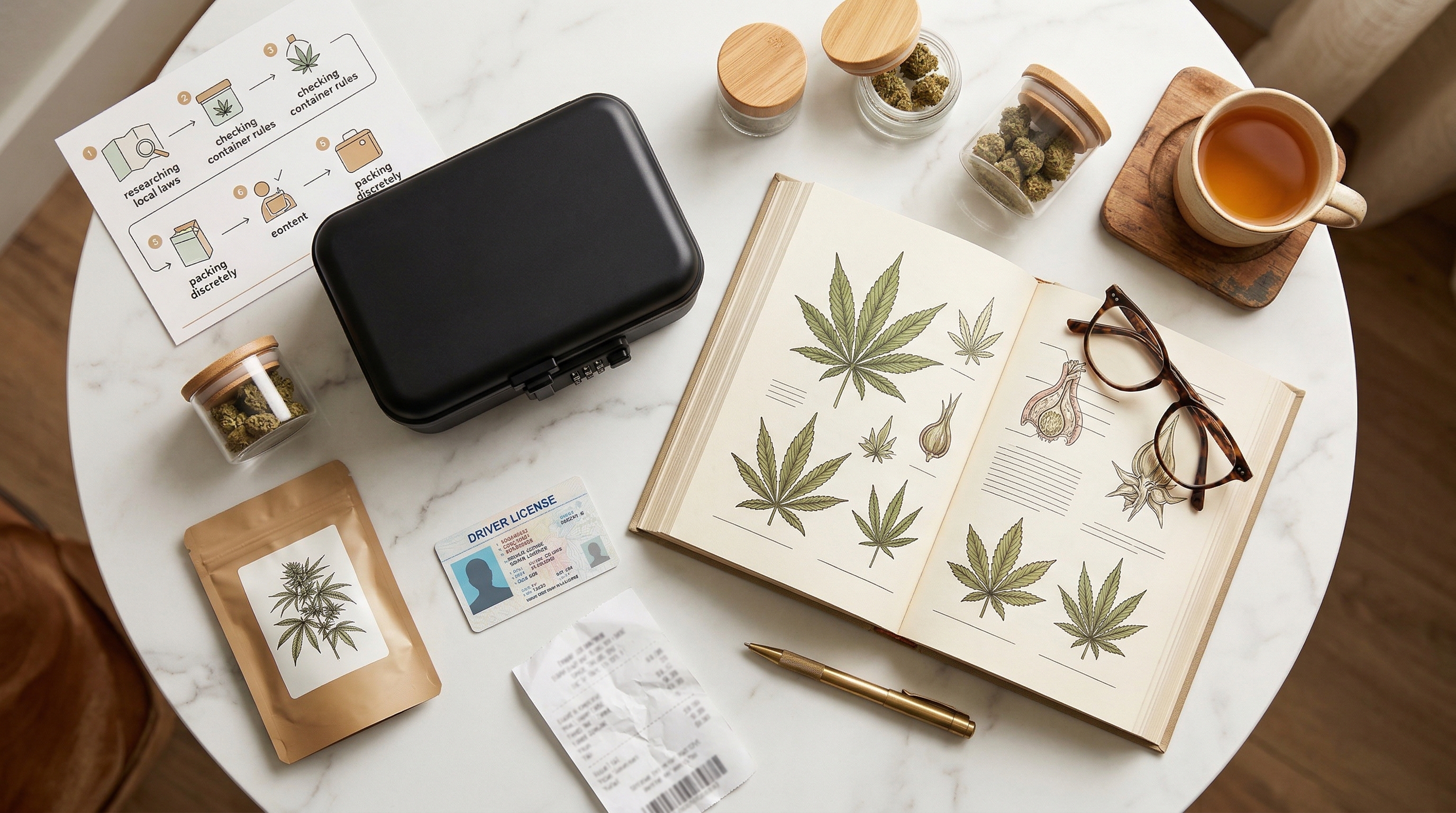
Use this checklist before every trip where cannabis may be involved:
48 hours before departure:
- List every state your route passes through (not just destination)
- Check current legal status for each state via NORML.org or official state .gov sites
- Note possession limits for each legal state (flower, concentrate, and edibles separately)
- If you’re a medical patient, check reciprocity status for destination state
- Research dispensary options near your destination if using the “buy there” strategy
- Check your hotel/rental’s cannabis policy
Day of departure:
- Cannabis is in original dispensary packaging with labels intact
- Packaging is inside a sealed, opaque, child-resistant container
- Container is stored in trunk or locked rear compartment
- Amount is within the possession limit of your departure state (and all states en route)
- Receipt is accessible (phone photo is fine)
- You are not crossing any state lines
If traveling by air:
- Cannabis stays home or gets purchased at your destination
The “Buy There” Strategy: The Practical Gold Standard
The single most effective harm-reduction strategy for cannabis travel is also the simplest: if you’re going to a legal state, buy your cannabis there.
This approach eliminates interstate transport risk entirely, ensures your products comply with local regulations, and gives you access to local dispensary expertise. Most recreational states welcome out-of-state visitors at licensed dispensaries — you only need a valid government ID proving you’re 21 or older.
A few things to know about buying at your destination:
Illinois visitor limits: Illinois has specific lower limits for non-residents (15g flower vs. 30g for residents, 2.5g concentrate vs. 5g). Know this before you buy.
Research ahead: Most legal-state dispensaries have full online menus. You can browse products, check pricing, and read strain reviews before you arrive. If you want to find the right experience for your trip — an energizing profile for city exploration or a relaxing one for unwinding at a beach rental — our High Families system can help you communicate exactly what you’re looking for to a budtender in any state.
Cash vs. card: Many dispensaries still operate cash-only due to federal banking restrictions on cannabis businesses. Have cash on hand. Some dispensaries have ATMs on site.
Keep your receipt: Even when buying locally, hold onto the receipt. In the unlikely event you’re questioned while within that state, it’s your proof of legal purchase.
Medical Cannabis Travelers: Specific Considerations
If you use cannabis medically, your situation is slightly more nuanced but not fundamentally different from a federal standpoint.
State Reciprocity — What It Actually Means
A handful of states offer some form of reciprocity for out-of-state medical patients. As of early 2026, states with documented reciprocity provisions include:
- Arkansas — honors out-of-state cards for purchasing
- Maine — allows out-of-state patients to purchase
- Michigan — recognizes out-of-state cards
- Missouri — some reciprocity provisions
- New Hampshire — honors certain out-of-state cards
- Oklahoma — has allowed out-of-state purchases
- Washington D.C. — recognizes out-of-state patients
Critical caveats: Reciprocity rules vary enormously. Some states let you purchase; others only protect you from possession charges without allowing purchase. Some require you to register as a temporary patient. Rules change legislatively. Always verify directly with the destination state’s health department or an in-state dispensary before relying on reciprocity.
Flying with Medical Cannabis: Still No
Federal law does not recognize state medical cannabis programs. TSA does not honor medical cards. Airlines do not either. The medical designation provides no protection at any point during air travel.
CBD and Low-THC Products
Hemp-derived CBD (under 0.3% THC) is federally legal to transport under the 2018 Farm Bill — but this applies strictly to compliant hemp products. Products marketed as “CBD” that exceed 0.3% THC are not protected. Always check the certificate of analysis (CoA) for any CBD product before traveling, and keep it accessible. Some states have additional requirements around CBD labeling and packaging even for federally compliant products.
Knowing Your Rights During a Traffic Stop
If you’re pulled over while traveling within a legal state and have cannabis stored properly, knowing how to handle the interaction matters.
-
Stay calm and be polite. Most legal-state stops involving properly stored cannabis end without charges when the driver is cooperative and compliant.
-
You are not required to consent to a search in most circumstances. You can politely say: “I don’t consent to searches.” Officers may search anyway if they have probable cause, but declining consent is legally meaningful.
-
Cannabis odor as probable cause: In states like New York, New Jersey, and Virginia, odor alone is no longer sufficient for a search. In most other states it still is. Know your state’s rule before you drive.
-
Be truthful about legal possession. In a legal state where you are compliant, there is little to hide. You can truthfully state that you have a legal amount of legally purchased cannabis in a sealed container in the trunk.
-
Do not volunteer interstate travel information. If you crossed a state line with cannabis, that information can escalate a state traffic stop into a federal matter.
-
If cited or arrested: Do not resist. Do not argue on the side of the road. Contact a cannabis-friendly attorney immediately — many states have bar associations with cannabis law referral networks.
Destination-Specific Notes: High-Traffic Cannabis Travel Scenarios
Colorado to California via Nevada (Legal States All the Way)
This is one of the most commonly traveled legal-state routes. The catch: to get from Colorado to California by car, you pass through Utah (medical-only) or Nevada. If you go through Nevada, you stay in legal territory but are still crossing state lines — which is federally illegal. The “buy there” strategy is the correct approach here: consume or leave your Colorado product in Colorado, and purchase in Nevada or California when you arrive.
Pacific Northwest (Washington, Oregon, California)
All three states are recreational. Washington and Oregon share a border. Short drives between Portland and Seattle pass through two legal states but still cross a state line. If you’re making this drive, the same federal framework applies even though enforcement risk is practically very low. For trips of a few days, buying locally in each state is cleaner.
Northeast Corridor (Massachusetts, Connecticut, Rhode Island, New York, New Jersey)
This is one of the densest legal-state corridors in the country. But each state has different possession limits, and New York and New Jersey in particular have their own nuances. Flying within this corridor — say, Boston to New York — is still subject to federal rules even though both states are legal.
Las Vegas
Las Vegas is the most cannabis-friendly major tourist destination in the US, but it comes with specific rules. Nevada law prohibits cannabis consumption in hotel rooms, casinos, rental cars, and most public spaces. Consumption lounges have emerged as a solution — Nevada licensed on-site consumption. Buy at a dispensary, consume at a licensed lounge. Do not drive after consuming, and do not bring Nevada cannabis onto a flight at LAS.
National Parks
National parks are federal land regardless of which state they sit in. Possession of cannabis in Rocky Mountain National Park (Colorado), Olympic National Park (Washington), or any other federal park property is a federal offense. This applies on park roads and at campgrounds.
Frequently Asked Questions
Can I bring cannabis to a state that just legalized? If the state has an operational retail market and you’re already in that state, you can purchase locally. You still cannot transport cannabis across a state line to get there.
What if I forget cannabis is in my bag when I go through TSA? TSA will refer to local law enforcement. In legal states with lenient airport policies, this often results in disposal and no charges. In illegal states, it can mean arrest. This is why doing a thorough bag check before any flight is essential.
My hotel says I can’t smoke. What are my options? Edibles, tinctures, and vaporizers (used discreetly) are the most hotel-compatible options. Look for hotels that explicitly advertise 420-friendly policies, or use Airbnb with hosts who specify cannabis is welcome. Some cities now have licensed cannabis consumption lounges.
I’m driving from a legal state to another legal state — am I really at risk? The federal legal risk is real but enforcement is variable. The highest-risk situations involve: passing through illegal states, getting pulled over in an illegal-state corridor (like I-70 in Kansas), large amounts, and visible/odorous storage. Personal amounts transported discreetly between legal states are low-enforcement-priority but not zero-risk.
Does the DEA rescheduling to Schedule III change anything for travel? Not in any practical way for travelers. Schedule III rescheduling, if finalized, would not remove the interstate transport prohibition, would not legalize cannabis, and would not affect state-level enforcement of possession laws.
Can I mail cannabis? No. Using the US Postal Service (a federal agency) or private carriers like FedEx or UPS to ship cannabis is a federal crime (mail fraud + controlled substance laws). This applies even between legal states.
The Bottom Line
Cannabis travel in the United States in 2026 is simultaneously more accessible and more legally complex than it’s ever been. The geographic reach of legal cannabis has expanded dramatically — nearly half the country now has recreational access — but the federal framework hasn’t kept pace. The result is a landscape where a deeply informed traveler can move through legal states with low risk, while an uninformed one can turn a routine road trip into a criminal matter by misreading a state line.
The practical hierarchy is simple:
- Travel within a single legal state — manageable, low risk with proper storage
- Flying — leave cannabis home, buy at your destination
- Interstate driving (legal to legal) — technically illegal, practical risk varies, “buy there” is safest
- Any contact with fully illegal states — treat as high-risk, “buy there” only
- International travel — never, under any circumstances
Stay informed, check laws within 48 hours of departure, and when in doubt — buy it there.
For more on the broader legal landscape, see our comprehensive state-by-state legalization guide. If you’re planning to visit a dispensary in an unfamiliar market, our dispensary guide walks through how to read menus and communicate what you’re looking for. And if you’re concerned about cannabis and drug testing windows before or after travel, our THC detection guide covers the full timeline.
Travel smart. Know your route. Enjoy the destination.


