Morning Cannabis: The Chemistry of Energy and Focus Before Noon
The science behind wake-and-bake: how terpenes, cortisol rhythms, and the ECS interact—and which strains fuel focus before noon.

Professor High
Your friendly cannabis educator, bringing science-backed knowledge to the community.

Why Does Cannabis Hit Different in the Morning?
Here’s something that might surprise you: your body’s endocannabinoid system doesn’t operate the same way at 7 AM as it does at 7 PM. Just like your metabolism, hormone levels, and cognitive sharpness follow a daily rhythm, so does the system that processes cannabis. That means the same strain, same dose, and same consumption method can produce a noticeably different experience depending on when you use it.
For the growing number of people integrating cannabis into their morning routines—whether for creative work, exercise, or simply starting the day with intention—this matters a lot. Choosing the wrong terpene profile before noon can turn a productive morning into an unplanned nap on the couch. But choosing the right one? Some people report sharper focus, elevated mood, and a sense of calm energy that coffee alone never quite delivers.
In this article, we’re going to unpack the chemistry behind morning cannabis use. You’ll learn how your body’s internal clock interacts with cannabinoids, which terpenes are most likely to support alertness and focus, and how to build a morning routine that works with your biology rather than against it. No bro-science, no hype—just the research and practical takeaways you can actually use.

The Science Explained
How Your Circadian Rhythm Shapes Your High
Your body runs on a 24-hour internal clock called the circadian rhythm, and it governs far more than just sleep. Cortisol, your primary “alertness hormone,” peaks within 30 to 60 minutes of waking—a phenomenon researchers call the cortisol awakening response (CAR) [Fries et al., 2009]. Think of it as your body’s natural espresso shot: a surge designed to get you alert and moving.
Here’s where it gets interesting for cannabis users. Your endocannabinoid system (ECS)—the network of receptors that THC, CBD, and other cannabinoids interact with—also follows circadian patterns. Research has shown that levels of anandamide, one of your body’s own endocannabinoids (sometimes called the “bliss molecule”), tend to be higher upon waking [Hanlon et al., 2015]. This means your ECS is already primed and active in the morning, which may explain why many people report feeling cannabis effects more acutely during early hours.
Imagine your ECS as a series of locks, and cannabinoids as keys. In the morning, more locks are open and waiting. That’s why dose control becomes especially important before noon—your system may be more sensitive than you expect.
What the Research Shows About Terpenes and Alertness
While THC and CBD get most of the headlines, terpenes—the aromatic compounds that give each strain its unique scent and character—are increasingly recognized as key players in shaping the cannabis experience [Russo, 2011].
Two terpenes stand out for morning use:
-
Limonene: Found in citrus peels and many cannabis cultivars, limonene has been associated with elevated mood and reduced anxiety in preclinical studies [de Almeida et al., 2012]. It appears to influence serotonin and dopamine pathways, which may explain why limonene-dominant strains often feel uplifting rather than sedating.
-
Terpinolene: Less common but highly distinctive, terpinolene is found in strains often described as “energetic” or “cerebral.” Early research suggests it may have mild stimulating properties, though human studies remain limited [Ito & Ito, 2013].
On the flip side, myrcene—the most abundant terpene in cannabis—has been associated with sedation and muscle relaxation in animal studies [do Vale et al., 2002]. Strains high in myrcene may work against your morning goals, pulling you toward the couch when you’re trying to get to your desk.
The takeaway: Morning cannabis isn’t just about THC percentage. The terpene profile may matter even more for shaping whether you feel energized or sedated.
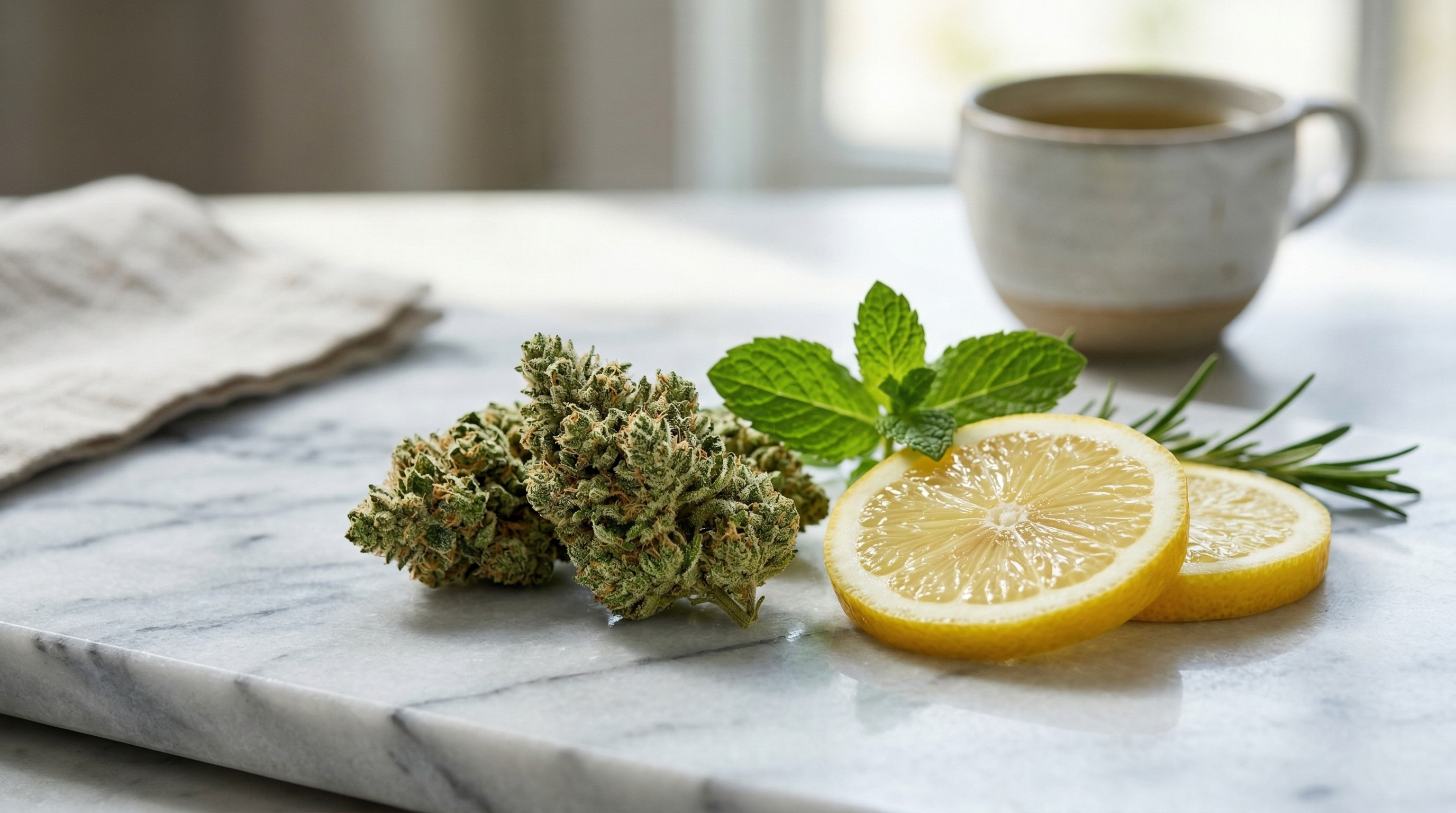
Practical Implications: Building a Morning-Friendly Routine
Choose by High Family, Not by Indica or Sativa
The old “sativa for energy, indica for sleep” framework is largely a myth rooted in plant morphology, not chemistry [Piomelli & Russo, 2016]. What actually matters is the terpene and cannabinoid profile of the specific cultivar you’re consuming.
This is where our High Families system becomes genuinely useful for morning routines:
-
Uplifting High: Dominated by limonene and linalool, these strains are associated with mood elevation and social energy. If your morning involves creative brainstorming or collaborative work, this family is worth exploring.
-
Energetic High: Driven by terpinolene and ocimene, these cultivars are often described as producing focused, clear-headed effects. Think of this as the “productivity” family—some users find it pairs well with deep work sessions.
-
Balancing High: With lower terpene intensity and gentler effects, this family may suit morning newcomers who want to explore without overwhelming their already-sensitive morning ECS.
Conversely, the Relaxing High family—rich in myrcene—is probably best saved for evening wind-down rather than your 8 AM routine.
Dose Low, Start Slow
Given that your endocannabinoid system may be more responsive in the morning, consider starting with a lower dose than you’d use in the evening. Many experienced morning consumers report that microdosing (roughly 2.5–5 mg of THC) provides the focus and mood lift they’re looking for without cognitive impairment. A vaporizer with temperature control lets you target lower temperatures that favor terpene preservation, which may enhance the entourage effect without maximizing THC delivery.
Pair with Intention
Cannabis doesn’t replace your morning structure—it integrates into it. Some people find that combining a small dose with journaling, a walk, or a focused work block creates a synergy that neither element achieves alone. The key is consistency: same time, same dose, same activity, so you can actually evaluate what’s working.

Key Takeaways
- Your endocannabinoid system is more active in the morning, with higher anandamide levels and a cortisol surge that may amplify how you experience cannabis.
- Terpenes matter more than THC percentage for morning use—look for limonene and terpinolene-dominant strains from the Uplifting High or Energetic High families.
- Avoid high-myrcene strains before noon unless sedation is your goal—these belong to the Relaxing High family.
- Start with a lower dose than your evening norm—your morning ECS sensitivity means less can genuinely be more.
- Pair cannabis with intentional activities like journaling, exercise, or focused work to maximize the benefits of an alert, terpene-forward experience.
FAQs
Is morning cannabis use safe for everyone?
Cannabis affects everyone differently, and morning use isn’t appropriate for all situations—especially if you’re driving, operating machinery, or managing certain health conditions. If you’re new to cannabis or considering it for therapeutic purposes, consult a healthcare provider. This article is educational, not medical advice.
Will morning cannabis make me less productive?
It depends entirely on the strain, dose, and your individual biology. High-THC, myrcene-heavy strains may impair focus, while low-dose, terpinolene-dominant options from the Energetic High family may support it. The research is still emerging, and personal experimentation with careful dose control is key.
Does coffee and cannabis mix well in the morning?
Many people combine the two, but research on the interaction is limited. One animal study found that caffeine may alter endocannabinoid signaling [Cornelis et al., 2018], though human implications remain unclear. If you try both, pay attention to how the combination affects your anxiety levels and heart rate.
Sources
- Fries, E., Dettenborn, L., & Kirschbaum, C. (2009). “The cortisol awakening response (CAR): Facts and future directions.” International Journal of Psychophysiology, 72(1), 67–73. PMID: 18854200
- Hanlon, E.C., Tasali, E., Leproult, R., et al. (2015). “Circadian rhythm of circulating levels of the endocannabinoid 2-arachidonoylglycerol.” The Journal of Clinical Endocrinology & Metabolism, 100(1), 220–226. PMID: 25368979
- Russo, E.B. (2011). “Taming THC: potential cannabis synergy and phytocannabinoid-terpenoid entourage effects.” British Journal of Pharmacology, 163(7), 1344–1364. PMID: 21749363
- de Almeida, A.A., Costa, J.P., de Carvalho, R.B., et al. (2012). “Evaluation of acute toxicity of a natural compound (+)-limonene epoxide and its anxiolytic-like action.” Brain Research, 1448, 56–62. PMID: 22418736
- Ito, K., & Ito, M. (2013). “The sedative effect of inhaled terpinolene in mice and its structure-activity relationships.” Journal of Natural Medicines, 67(4), 833–837. PMID: 23339024
- do Vale, T.G., Furtado, E.C., Santos, J.G., & Viana, G.S. (2002). “Central effects of citral, myrcene and limonene, constituents of essential oil chemotypes from Lippia alba.” Phytomedicine, 9(8), 709–714. PMID: 12587690
- Piomelli, D., & Russo, E.B. (2016). “The Cannabis sativa Versus Cannabis indica Debate.” Journal of Cannabis Therapeutics. DOI: 10.1089/can.2015.29003.ebr
- Cornelis, M.C., Erlund, I., Michelotti, G.A., et al. (2018). “Metabolomic response to coffee consumption: application to a three-stage clinical trial.” Journal of Internal Medicine, 283(6), 544–557. PMID: 29516517


