How to Report a Cannabis or CBD Side Effect
Find the right cannabis or CBD reporting route in the US and Canada, what details to save, and how a safety report differs from care or a refund.

For a suspected cannabis or CBD side effect, get medical help when needed, then use the reporting channel for the product and country. In the US, FDA MedWatch explicitly covers cannabinoid-hemp products such as CBD; state cannabis agencies have their own complaint routes. In Canada, Health Canada accepts suspected cannabis side-effect reports.
You do not have to solve what caused the reaction before describing what happened. A useful report records the product, timing, symptoms and care received. It is a safety record, separate from a request for treatment or a refund.
Does someone need help right now?
Do not wait for a reporting form if someone needs urgent care. FDA directs people with a serious reaction posing an immediate danger to call 911 or go to an emergency department. In the US, call Poison Help at 1-800-222-1222 for suspected poisoning; you do not need to wait for symptoms. Keep the container nearby if you can, without delaying the call. Outside the US, use local emergency and poison-service numbers. FDA delta-8 reporting guidance, HRSA Poison Help.
The form can wait. Our cannabis overdose guide discusses the separate health question. An agency complaint inbox cannot assess someone who is unwell in front of you.
Which reporting route should you use?
Start with the product and place. This table gives verified examples, not one form that covers every jurisdiction.
| Situation | Official starting point | What the route covers |
|---|---|---|
| US cannabinoid-hemp product, including CBD | FDA MedWatch forms | Consumer safety reporting; choose the consumer/patient route |
| New York cannabis reaction or product concern | OCM: Report an Incident | Unwanted health reactions, product and packaging concerns, and other cannabis complaints |
| Suspected violation by a California cannabis business | DCC complaints | Matters within DCC’s regulatory authority; some complaints may be referred elsewhere |
| Cannabis side effect in Canada | Health Canada consumer reporting | Suspected reactions involving medical or nonmedical cannabis |
For another US state, start on its cannabis regulator’s official website and look for consumer complaints or adverse-event reporting. Follow the product-specific instructions there. The FDA route does not remove the need to check the relevant state channel.
Avoid choosing a form solely because the product came in a vape. FDA lists separate tobacco-product and animal-product routes; a cannabis cartridge, nicotine device and pet product are not the same reporting question. The forms hub explains those distinctions.
How do you report a CBD or hemp-product reaction to FDA?
The current consumer form, FDA 3500B, explicitly lists cannabinoid-hemp products, including CBD. FDA’s delta-8 guidance also directs consumers to MedWatch. Reporting through that channel does not mean FDA approved the product.
Open the official MedWatch online page and choose Consumer/Patient. The downloadable consumer form is another option. Form 3500 is aimed at health professionals; 3500A concerns mandatory reporting by specified organizations. An ordinary shopper does not need to become an industry reporter.
You can ask a clinician or pharmacist to help explain the medical details. You can also report yourself. FDA’s reporting overview makes that option explicit.
A practical detail: the online page says an unfinished report can be resumed within three days of starting it, using its report ID and date. After submission, it cannot be reopened for editing. To add information, follow FDA’s instructions for a new report that identifies the earlier case. Save your own copy and reference details privately.
What information is useful before you start?
Prepare a short factual record, using what you actually know:
- Product: name, maker, form, labeled strength and lot or batch number.
- Purchase: seller or website, location, approximate date and receipt if available.
- Exposure: amount, how it was used, when it was used and when symptoms started.
- Health event: what happened, how it changed and any care or test results.
- Other context: medicines, supplements, alcohol or other products used around the same time.
These are the kinds of details requested in the FDA consumer form. Fill in what you can; its instructions allow a report with missing information. Label estimates as estimates. Do not guess a lot number, convert an unknown puff into invented milligrams, or diagnose a contaminant from a symptom.
Photograph the package while the label is still available. If several codes appear, our batch and COA matching guide explains why a retail barcode, laboratory sample number and product lot may differ. FDA asks for pictures and says not to send the physical product unsolicited.
A private timeline helps separate observation from explanation. For example: “I used the product at about 8 p.m.; nausea began around 8:45 p.m.; I called for advice at 9 p.m.” That is an invented example of clear reporting, not a diagnosis or an expected reaction time. A simple cannabis journal can help preserve dates; an entry is not a laboratory finding.
Keep the product in its original packaging and secure it away from children and pets while following official instructions. New York’s consumer safety guidance explains why the original label also matters during medical care.
How does Canada’s process differ?
Health Canada’s cannabis guidance encourages reporting on suspicion, including products from legal, illegal or unknown sources. It covers both medical and nonmedical use. If a product name is unknown, provide the available description; the cannabis instructions do not require inventing a Drug Identification Number.
Use the online or printable form linked from the consumer guidance page. Telephone reporting is also available at 1-866-234-2345. That reporting number serves a different purpose from urgent medical advice.
Health Canada explains that reports can help identify a possible safety signal. A signal then needs evaluation; it does not prove that the product caused the event. Why report a side effect.
Is reporting the same as checking a recall or asking for a refund?
No. These tasks can involve the same package, but they answer different questions.
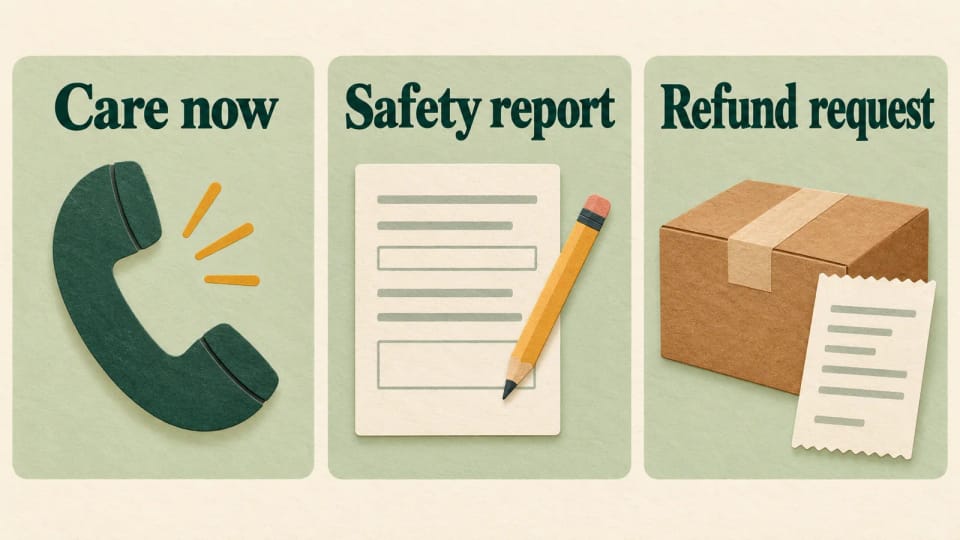
Different purposes, not a required sequence. Do not delay care while preparing a safety report or contacting a seller.
A recall check asks whether an official notice covers a product. Our batch-by-batch recall guide explains how to match it. A missing notice does not settle what caused a reaction.
A safety report gives an authority information to review. New York OCM says it may contact a reporter for more details but cannot provide investigation status or outcomes. California DCC similarly describes jurisdiction review and says complainants will not receive the outcome of their complaint. Neither statement promises a personal diagnosis.
A refund request concerns the purchase and the seller’s obligations or policy. Tell the retailer about the product problem, but do not assume a return conversation filed a government report for you. The California returns guide explains that state’s separate transaction rules.
FAQ
Do I need proof that cannabis caused the reaction?
No. FDA says a suspected association can justify a report; Health Canada also accepts suspicion. Describe the sequence and relevant facts. Reporting does not establish causation. FDA reporting instructions.
Can I report without knowing the brand or lot number?
Provide the information you have and identify what is missing. The FDA consumer instructions accept incomplete information; Health Canada’s cannabis guidance permits an available product description when the name is unknown. A package photo may still help.
Must my doctor file it for me?
You can use the consumer route yourself. A health professional may help supply accurate clinical details, especially when treatment or test results are involved. Reporting yourself does not replace getting care.
Will the company see my contact information?
Read the specific form’s privacy choices. MedWatch’s online instructions let reporters request that FDA not share their contact information with the manufacturer. California DCC requires contact details even though it offers an anonymity option. Do not assume every route is fully anonymous, and put health details in the official form rather than a public comment.
Does a report guarantee a refund or a recall?
No. Reporting, regulatory review and retail remedies are separate processes. Keep your reference information and follow the authority’s instructions for updates or additional facts. Contact the retailer separately about the purchase.
Key takeaways
- Address current health concerns before paperwork.
- Choose the official route for the product and jurisdiction.
- Record observations and uncertainties without inventing missing details.
- Keep reporting, recall matching and refund requests separate.