Can You Overdose on Weed? What the ER Data Actually Shows
Can you overdose on weed? A fatal dose of THC alone is unlikely, but ER and poison-center data show real harm from edibles, kids, and heart events.


A fatal overdose from THC alone is unlikely, but too much cannabis still sends people to the emergency room.
People ask can you overdose on weed because they picture an opioid death. The records tell a split story. Poison centers logged 7,043 edible exposures in children under 6 from 2017 through 2021. The count rose from 207 cases in 2017 to 3,054 in 2021, a rise of 1,375%. The CDC says a fatal overdose caused only by cannabis is unlikely, and that cannabis is not harmless. In a 2026 CDC file of overdose deaths, cannabis was the only drug involved in nine deaths.
This High School lesson stays with those records. It is not a medical dose guide. It does not tell you to start, stop, or change a medicine. If you use cannabis and you take other drugs, talk with your doctor or a pharmacist.
Can you die from weed?
A fatal overdose from plant THC alone does not follow the opioid pattern. Opioids can shut down the drive to breathe. Cannabis does not do that in the same way.
A 1990 brain-mapping study helps explain the idea, and only the idea. Herkenham and colleagues stained cannabinoid receptors in brain slices from several mammals, including humans. Binding was dense in movement circuits, the hippocampus, and the cerebellum. It was sparse in the lower brainstem, where heart rate and breathing are controlled. The authors wrote that those sparse densities “may explain why high doses of THC are not lethal.” That sentence is their reading of a map. It is not a count of human deaths.
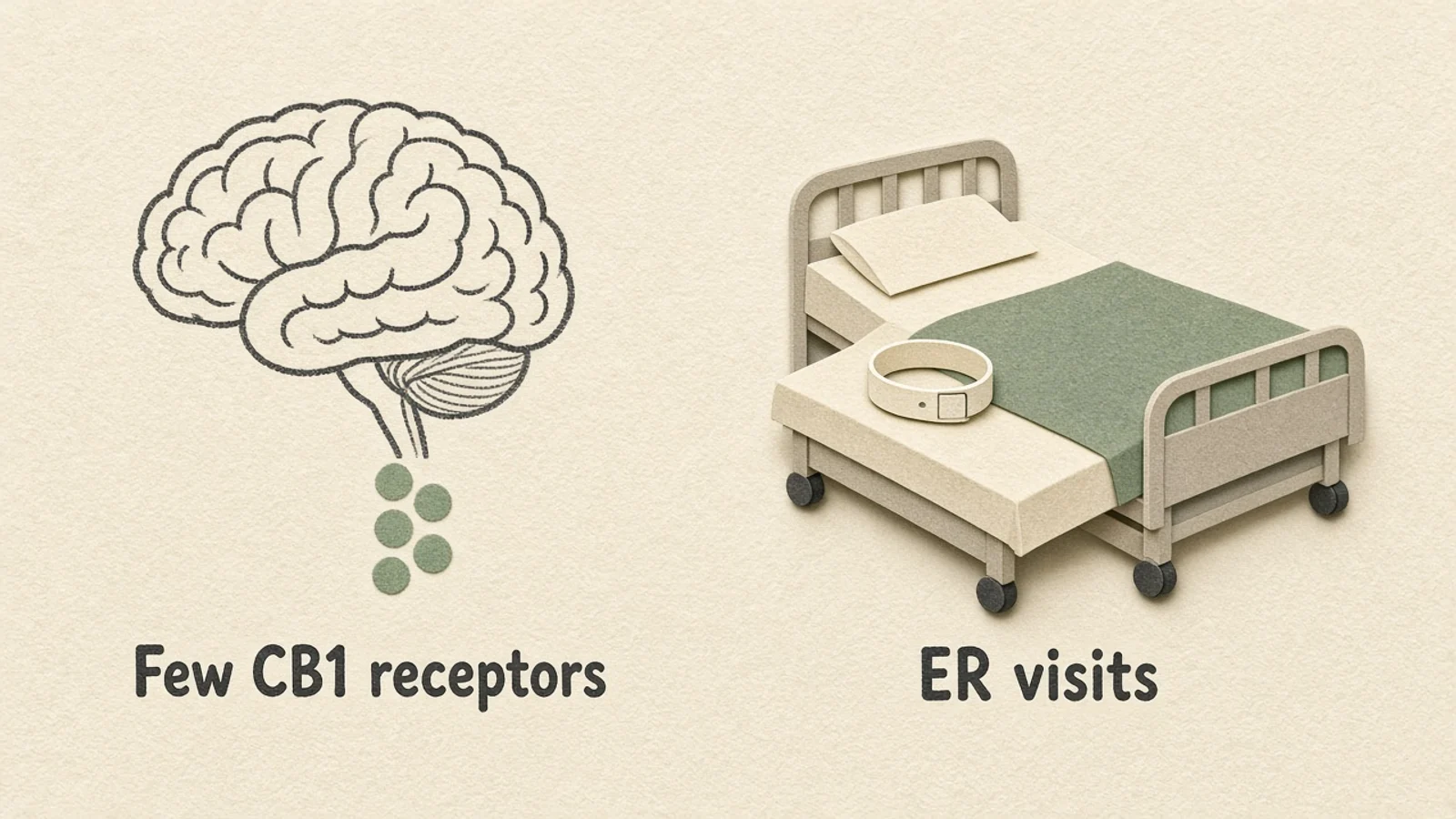
The map is a hypothesis about lethal dose. Emergency rooms still see people who took too much. Children can still have trouble breathing after an edible.
A 2025 review led by Hoch, with Nora Volkow of the National Institute on Drug Abuse among the authors, put the same split in one line. “Risk of death due to cannabis toxicity is very low, but there is a link between cannabis use at high doses and lethal motor vehicle collisions, cardiac pathophysiology and possibly suicide.” The paper is a narrative review. It did not collect a new set of deaths. The authors also say it is unclear whether those deaths come from cannabis, from other risks, or from both.
The CDC’s own FAQ uses plain words. A fatal overdose caused solely by cannabis is unlikely. Cannabis is not harmless.
The sharper death file is newer. CDC’s State Unintentional Drug Overdose Reporting System covered 31 states and the District of Columbia from January 2021 through June 2025. Among 209,166 overdose deaths with toxicology, cannabis was detected in 43,880, or 21.0%. A medical examiner listed cannabis as causing death in 1,687 deaths, or 0.8%. Cannabis was the only drug involved in nine deaths, or 0.004%.
Among deaths with cannabis detected, 73.5% also involved illegally made fentanyl, and 60.4% involved a stimulant such as cocaine or methamphetamine. In ages 12 to 17, cannabis showed up in 42.7% of overdose deaths in this file (439 deaths). In that teen group, 88.6% of the cannabis-detected deaths also involved illegally made fentanyl. Detection is not the same as cause.
CDC’s reading is direct. Overdose deaths caused by cannabis are rare. Finding cannabis on a toxicology report mostly points to use of more than one drug. Testing for cannabinoids is not done on every death, so the true detection rate is likely higher, not lower. The file is not the whole United States. It also leaves out synthetic cannabinoids. Those are a different drug, covered below.
Do not read the nine deaths as “nobody has ever died.” Do not read them as “weed kills like heroin.” The honest line is narrower. A fatal overdose from THC alone is unlikely. It still appears, rarely, on a death certificate. Almost every overdose death with cannabis in the blood also involves another drug.
What are weed overdose symptoms?
The CDC lists the signs of too much cannabis. They look like the usual effects, turned up. They can include extreme confusion, anxiety, paranoia, panic, a fast heart rate, delusions or hallucinations, higher blood pressure, and severe nausea or vomiting.
Those effects can lead to a crash, a fall, or another poisoning. That is harm, even when nobody dies.
People often call this a green-out. The body piece of that story, including nausea and a racing heart, is in the science of greening out. The spinning feeling has its own walk-through in why weed makes you dizzy.
If the person is scared but awake, talking, and breathing in a normal way, the usual plan is rest, water, and a calm room. How to sober up from being too high covers that window. It is not a rescue plan for a child, a seizure, a collapse, or breathing trouble. Those need a phone call, and the numbers are below.
Cannabis mixed with alcohol, or with a drug you did not expect, can impair you more than cannabis alone. The CDC says that mix may raise overdose risk. Tell Poison Control every substance you know about.
Why do edibles send more people to the ER?
Smoked cannabis hits fast. You feel it, and many people stop. An edible can take up to 2 hours before you feel it, the CDC says. In that quiet gap, people eat more. Then both doses arrive.
A Colorado study measured how that shows up in one emergency department. Monte and colleagues reviewed visits from 2012 through 2016 at one urban academic hospital. There were 9,973 visits with a cannabis diagnosis code. Of those, 2,567 (25.7%) were at least partly due to cannabis. Edibles were involved in 238 of those visits, or 9.3%.
The route changed the complaint. Inhaled visits were more often cannabinoid hyperemesis syndrome (18.0% versus 8.4% for edibles). Edible visits were more often acute psychiatric symptoms (18.0% versus 10.9%), intoxication (48% versus 28%), and cardiovascular symptoms (8.0% versus 3.1%).
Sales made the gap sharper. From 2014 through 2016, edibles were 10.7% of the cannabis-linked visits at that hospital. They were only 0.32% of Colorado cannabis sales, counted as kilograms of THC. The authors said the edible share of visits was about 33 times the edible share of sales. They also listed the holes in that comparison. It is one hospital against statewide sales. The THC math used average product strength. Home grows and unregulated sales are missing. Patients reported the route themselves. A dose was written down in only 130 of 2,567 visits, about 5%. The work was funded by the Colorado Department of Public Health and Environment.
So the study can say edibles were over-represented in that ER. It cannot give you a safe milligram number. This article will not either. The practical habit is to wait. The 2-hour rule for edible dosing is about that wait. How long edibles last, hour by hour tracks the usual arc. Neither page is a medical prescription.
| What the Colorado chart review compared | Inhaled cannabis | Edible cannabis |
|---|---|---|
| Share of cannabis-linked visits, 2012–2016 | Most of the 2,567 visits | 238 visits (9.3%) |
| Cannabinoid hyperemesis syndrome | 18.0% | 8.4% |
| Acute psychiatric symptoms | 10.9% | 18.0% |
| Intoxication | 28% | 48% |
| Cardiovascular symptoms | 3.1% | 8.0% |
| Share of visits vs share of THC sales, 2014–2016 | The rest of the visits | 10.7% of visits, 0.32% of sales |
The table is one hospital. It is not a national rate.
Are children getting sick from cannabis edibles?
Yes. The 7,043 cases above are the clearest public count. Tweet, Nemanich, and Wahl studied National Poison Data System reports for edible cannabis in children under 6, from 2017 through 2021. This was a look back at calls, not a lab experiment.
The median age was 3 years. The middle half of ages ran from 2 to 4. Two-year-olds were 27.7% of cases. In the results, 6,842 exposures (97.1%) happened in a residence, and 6,391 (90.7%) happened in the child’s own home. The abstract rounds the home share to 97.7%.
Of all 7,043 reports, 573 children (8.1%) went to critical care, and 1,027 (14.6%) went to a noncritical bed. Together that is the 22.7% admission figure. Major effects were coded in 155 cases (2.2%). Moderate effects were coded in 1,539 (21.9%).
Symptom rates use a smaller set. Staff could not follow 2,216 cases to a known outcome, so those were left out of the symptom math. That left 4,827. Central nervous system depression, from mild to severe, was reported in 3,381 of them (70.0%). Breathing depression was reported in 148 (3.1%). Seizures were reported in 79 (1.6%). No deaths were reported in the five years.
Read the limits with the rise. Poison centers only hear about calls. A change in reporting, or less shame about calling, can raise the count even if some of the rise is real. The 2021 rows were still preliminary when the paper came out. Codes are entered by poison-center staff, not by a single research team. The authors’ hospitals included Illinois Poison Center, Southern Illinois University, Rush, and NorthShore. The board review was exempt because the file is public and has no names.
The CDC adds a plain reason small children get sicker. Infants and young children who swallow cannabis are more likely to need a hospital bed than older children who swallow a similar product. Their bodies are smaller, and the symptoms hit harder.
Hemp-derived THC, including delta-8, sits in the same danger zone for kids. The National Institute on Drug Abuse says eating large amounts of delta-8 products has led to medical emergencies, including breathing problems. What parents need to know about hemp-derived THC and the ICU covers that product class. Keep foods and drinks that contain THC where a child cannot reach them. If a child already ate one, call Poison Control. Do not wait to see if they “sleep it off.”
Can too much cannabis affect your heart?
It can be linked with heart events. That is not the same as proof that cannabis caused them.
Jeffers, Glantz, Byers, and Keyhani used the Behavioral Risk Factor Surveillance System from 2016 through 2020. The survey covered adults 18 to 74 in 27 states and two territories. The sample was 434,104 people. About 4% said they used cannabis daily. About 7.1% used it on some days, but not daily. Outcomes were self-reported coronary heart disease, heart attack, and stroke.
After adjustment, daily use lined up with these odds versus no use:
- Coronary heart disease: 1.16 (95% confidence interval 0.98 to 1.38). That range crosses 1. The result is not a clear link.
- Heart attack: 1.25 (1.07 to 1.46).
- Stroke: 1.42 (1.20 to 1.68).
- The three outcomes combined: 1.28 (1.13 to 1.44).
Among people who had never smoked tobacco, daily use still lined up with heart attack (1.49, 1.03 to 2.15), stroke (2.16, 1.43 to 3.25), and the combined outcome (1.77, 1.31 to 2.40).
This is a cross-section of a survey. People reported their own use and their own diagnoses. The design cannot show that cannabis caused the events. It has no blood pressure and no cholesterol. Young adults may not yet show the slow damage of artery disease. One author, Stanton Glantz, reports consulting for the World Health Organization outside this paper. Funding included a National Cancer Institute training grant and a National Heart, Lung, and Blood Institute grant. The funders had no role in the work.
If you have heart disease, or you take heart medicine, talk with your doctor or pharmacist about cannabis. Do not start, stop, or change a medicine because of this article. A longer look at the cardiovascular papers is in cannabis and heart health.
What else sends people to the hospital?
Three other paths show up again and again. None of them is “THC stopped the heart in a healthy adult,” and none of them is trivial.
Repeated vomiting. Cannabinoid hyperemesis syndrome is cycles of severe vomiting in some people who use cannabis often. Hot showers are a common clue. A 2026 JAMA Insights article by Venkatesan, Hasler, and Camilleri reviews how it presents and what is known about risk. It is a clinical essay, not a new prevalence study. The page on our Research Hub is Cannabinoid hyperemesis syndrome. The symptom guide is CHS: symptoms, causes, and what we know.
Crashes. A 2016 meta-analysis by Rogeberg and Elvik pooled 28 estimates from 21 observational studies of cannabis and motor vehicle collisions. A random-effects model gave an odds ratio of 1.36 (1.15 to 1.61). A meta-regression gave 1.22 (1.10 to 1.36). That is a low-to-moderate rise in the odds of a crash. The authors say leftover selection effects may limit a causal reading. Being impaired and then driving is still a bad bet. The CDC lists a crash among the injuries that can follow too much cannabis.
Synthetic cannabinoids. K2 and Spice are not “strong weed.” The CDC says they are lab-made chemicals. Despite the name, they are not cannabis and they are not cannabinoid medicines. Effects are poorly predicted because the contents change. CDC reports severe injury and death, including outbreaks when a bad batch hits one area. A 2023 systematic review by de Oliveira and colleagues concluded that these drugs carry greater toxicity than cannabis, and that early cases include poisoning and death. The National Institute on Drug Abuse says use is linked with severe health effects that can threaten life. If someone may have used K2 or Spice, say that when you call. Do not assume the packet was plant THC.
When should you call Poison Control or 911?
Call Poison Control at 1-800-222-1222 if you, or someone with you, may have used too much cannabis. That includes a child who ate an edible, a teen who ate a hemp-derived product, and an adult who is very sick but still awake. The line is free, and it is for this. Tell them the product, the amount if you know it, the time, and any other drugs or alcohol.
Call 911 if the person collapses, has a seizure, or is not breathing well. The CDC says those signs need emergency care. Do not spend the wait searching for a home remedy.
There is no chart in this article for a milligram “rescue dose.” There is no product on this site that undoes THC. Say what was taken, and let Poison Control or the emergency crew direct the next step.
| Plant THC | Synthetic cannabinoids (K2, Spice) | Opioid pattern people compare it to | |
|---|---|---|---|
| Fatal overdose from that drug alone | Unlikely. CDC: solely cannabis is unlikely. Nine deaths in the 2021–2025 CDC file listed cannabis as the only drug. | CDC reports severe injury and death. A 2023 review describes early deaths. | Breathing can fail. Different drug. Different emergency. |
| What the records mostly show | Panic, a fast heart rate, vomiting, confusion. Edibles over-represented in one ER. Kids admitted after edibles. | Unpredictable chemicals. Not plant cannabis. | Other drugs are in almost every cannabis-detected overdose death. |
| What you do | Poison Control, 1-800-222-1222. 911 if breathing fails, there is a seizure, or the person collapses. | Say it may be K2 or Spice. Use the same numbers. | Call 911. |
Key takeaways
- A fatal overdose from THC alone is unlikely. That is not a claim that too much cannabis is safe.
- From 2017 to 2021, poison centers saw edible exposures in children under 6 rise from 207 to 3,054. No deaths were in that set. Breathing depression was in 3.1% of the cases they could follow.
- In one Colorado ER, edibles were a small share of THC sales and a much larger share of cannabis-linked visits.
- A national survey links daily cannabis use with higher odds of heart attack and stroke. It does not prove cause. The heart-disease result was not clear.
- CDC overdose deaths with cannabis in the blood almost always involve another drug, often fentanyl. Cannabis was the only drug in nine deaths in that partial system.
- K2 and Spice are not THC. Injury and death are part of that record.
- Call 1-800-222-1222, or 911 for collapse, a seizure, or breathing failure. Talk with a doctor or pharmacist before you mix cannabis with medicine.
FAQ
What happens if you use too much weed?
You can get very sick, and you can end up in the emergency room, but a fatal overdose from THC alone is unlikely. The CDC lists extreme confusion, anxiety, paranoia, panic, a fast heart rate, higher blood pressure, and severe nausea or vomiting. Edibles are a common path there, because they can take up to 2 hours to start and people take a second portion too soon. If a child ate one, or someone has a seizure, a collapse, or trouble breathing, call Poison Control at 1-800-222-1222 or 911.
What are 5 signs of an overdose?
For cannabis, five signs the CDC includes are extreme confusion, panic, a fast heart rate, higher blood pressure, and severe nausea or vomiting. Anxiety, paranoia, and hallucinations can appear with them. This is not the opioid pattern, where the drive to breathe can shut down. Call 911 if someone collapses, has a seizure, or is not breathing well.
What happens if you get too high?
Most people who get too high feel panic, nausea, a racing heart, or spins, and that sickness usually passes with time. If the person is scared but awake, talking, and breathing normally, the usual plan is rest, water, and a calm room. Call 911 for a collapse, a seizure, or breathing trouble, and call Poison Control at 1-800-222-1222 if a child ate an edible. Death from THC alone is unlikely, and a child can get much sicker than an adult from the same piece.
What are the symptoms of too high?
The symptoms look like the usual cannabis effects, turned up: extreme confusion, anxiety, paranoia, panic, a fast heart rate, and severe nausea or vomiting. People often call that a green-out. It is not the same pattern as an opioid overdose, which can shut down breathing. If breathing fails, or a child is hard to wake, call 911.
Sources
- Tweet MS, Nemanich A, Wahl M (2023). Pediatric Edible Cannabis Exposures and Acute Toxicity: 2017–2021. Pediatrics. https://doi.org/10.1542/peds.2022-057761
- Monte AA, Shelton SK, Mills E, Saben J, Hopkinson A, Sonn B, Devivo M, Chang T (2019). Acute Illness Associated With Cannabis Use, by Route of Exposure: An Observational Study. Annals of Internal Medicine. https://doi.org/10.7326/M18-2809
- Jeffers AM, Glantz S, Byers AL, Keyhani S (2024). Association of Cannabis Use With Cardiovascular Outcomes Among US Adults. Journal of the American Heart Association. https://doi.org/10.1161/JAHA.123.030178
- Herkenham M, Lynn AB, Little MD, Johnson MR, Melvin LS, de Costa BR, Rice KC (1990). Cannabinoid receptor localization in brain. Proceedings of the National Academy of Sciences. https://doi.org/10.1073/pnas.87.5.1932
- Tanz LJ, Quader ZS, Mattson CL, Vivolo-Kantor AM (2026). Notes from the Field: Cannabis Detection Among Overdose Deaths — United States, 2021–2025. MMWR Morbidity and Mortality Weekly Report. https://doi.org/10.15585/mmwr.mm7534a2
- Hoch E, Volkow ND, Friemel CM, Lorenzetti V, Freeman TP, Hall W (2025). Cannabis, cannabinoids and health: a review of evidence on risks and medical benefits. European Archives of Psychiatry and Clinical Neuroscience. https://doi.org/10.1007/s00406-024-01880-2
- Rogeberg O, Elvik R (2016). The effects of cannabis intoxication on motor vehicle collision revisited and revised. Addiction. https://doi.org/10.1111/add.13347
- de Oliveira MC, Vides MC, Lassi DLS (2023). Toxicity of Synthetic Cannabinoids in K2/Spice: A Systematic Review. Brain Sciences. https://doi.org/10.3390/brainsci13070990
- Venkatesan T, Hasler WL, Camilleri M (2026). Cannabinoid Hyperemesis Syndrome. JAMA. https://doi.org/10.1001/jama.2026.7873
- Centers for Disease Control and Prevention. Cannabis Frequently Asked Questions. https://www.cdc.gov/cannabis/faq/index.html
- National Institute on Drug Abuse. Cannabis (Marijuana). https://nida.nih.gov/research-topics/cannabis-marijuana


