Thailand's Cannabis Reversal: What It Means
Thailand became Asia's first cannabis-legal nation in 2022, then reversed course in 2025. A breakdown of what went wrong and what it means globally.

Professor High
Your friendly cannabis educator, bringing science-backed knowledge to the community.

In June 2022, Thailand made history. It became the first Asian country to remove cannabis from its narcotics list. Drug laws in the region are notoriously harsh — Singapore, Indonesia, and the Philippines still carry the death penalty for certain drug offenses. Thailand’s move was a major break from regional norms.
Three years later, on June 26, 2025, recreational cannabis was illegal again. More than 7,000 of the dispensaries that had opened are now closed.
This is one of the most important cannabis policy stories of the decade — not because legalization failed, but because of how it failed. The lesson matters for every country watching from the sidelines.
How It Started: The 2022 Decriminalization
The push for cannabis reform came primarily from Anutin Charnvirakul, leader of the Bhumjaithai Party and Thailand’s Health Minister at the time. His vision was essentially economic and agricultural: cannabis as a cash crop, a medical industry catalyst, and a driver of cannabis-curious tourism.
On June 9, 2022, cannabis flower was removed from Thailand’s Category 5 narcotics list. Overnight, it became legal to grow, buy, sell, and consume cannabis — with one key caveat that nobody really enforced: recreational smoking was technically still penalized under the Public Health Act, and the official framing was always “medical and wellness use.”
The government underscored its commitment by distributing one million free cannabis plants to Thai households. The economic signal was clear. The regulatory signal was not.
But one thing was missing: a standalone Cannabis Act. Parliament couldn’t agree on one. The result was a legal gray zone — decriminalization with no rulebook.
The Explosion: 10,000+ Shops, Zero Framework
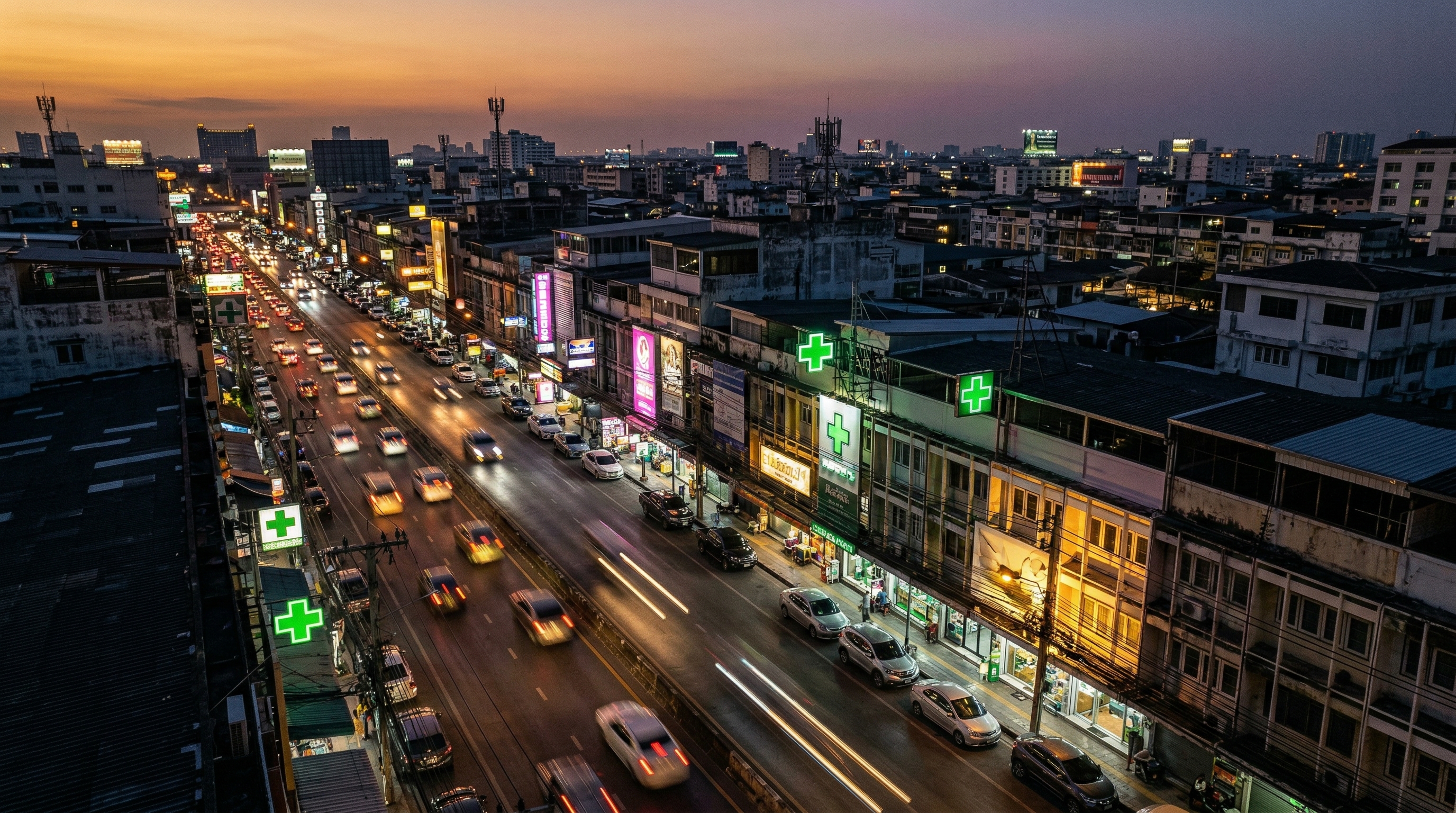
What followed was one of the fastest cannabis market expansions anywhere in the world. By late 2024, Thailand had registered 18,433 cannabis dispensaries — a number that staggers even by U.S. standards. Dispensaries clustered in tourist corridors: Bangkok’s Khaosan Road, Pattaya, Phuket, Chiang Mai. Google Maps filled with green leaf icons.
This was cannabis tourism at raw scale. Travelers from around the world — including many who had read our cannabis tourism guide — began routing trips specifically through Thailand for its open, accessible cannabis culture.
But the explosion came with serious problems no one had properly planned for.
Public health data told a sobering story. Between 2022 and 2025, Thailand recorded:
- A 3.5x increase in cannabis poisoning cases
- A 6.5x surge in cannabis addiction diagnoses
- A measurable rise in cannabis-induced psychosis
These multipliers partly reflect a reporting effect — people who used cannabis under prohibition rarely sought formal medical help. Under decriminalization, they did. That matters for context. But even accounting for that, Thai health authorities reported a genuine rise in emergency visits tied to unregulated edibles and high-potency products.
Young people were most affected. Edibles were sold with no potency labels and no age checks. Emergency rooms began seeing cases they hadn’t seen before. And with no cannabis control law on the books, there was no legal tool to fix any of it.
As we’ve written before about the failures of lab testing standards, these problems are not unique to Thailand — but they’re dramatically amplified when an entire market launches without a regulatory spine.
The Political Turn: Pheu Thai Takes Over
The 2023 Thai elections changed everything. The Bhumjaithai Party — cannabis’s biggest champion — lost its top position in the government. The Pheu Thai party took power with a very different agenda.
New Prime Minister Srettha Thavisin, and later his successor Paetongtarn Shinawatra, both pushed to re-criminalize cannabis. Health Minister Somsak Thepsuthin led the public campaign, saying cannabis would be reclassified and recreational use would end.
The stated reason was public health. But politics played a big role too. Cannabis had become a divisive issue. Conservative Thais were angry about the explosion of dispensaries in their neighborhoods and tourist areas.
On June 26, 2025, a ministerial order took effect reclassifying cannabis flower as a “controlled herb” under the Thai Traditional Medicine Knowledge Act. Recreational use became explicitly illegal. Medical use required a valid prescription from a licensed practitioner — valid for up to 30 days and renewable.
What the Reversal Actually Looks Like in 2026
By early 2026, the numbers tell the story clearly. Of the 18,433 cannabis dispensaries that once operated, 7,297 had closed — roughly 40%. About 11,136 remained, but under dramatically different rules: each must now employ a licensed medical professional on-site, maintain traceability records for every sale, operate under medical facility licensing, and serve only patients with valid prescriptions.
A purchase-tracking system called PT.33 logs every dispensary sale — prescriber, patient, diagnosis, and dosage. Public use is prohibited. Fines run 10,000–25,000 THB, with potential jail time. All cannabis advertising is banned.
Cannabis tourism is officially over. Foreign visitors can access cannabis through a Thai medical prescription — but only after seeing a licensed doctor in person. That is a narrow, bureaucratic process, not the walk-in dispensary culture that made Thailand famous.
More closures are coming. An additional 4,587 licenses expire in 2026 and 5,210 in 2027. The $1.2 billion cannabis sector is being restructured from scratch. Small business owners who spent millions of baht on rent, renovations, and equipment are absorbing those losses without compensation.
What Went Wrong: A Diagnostic
Let’s be precise about the failure mode here, because it matters for how we evaluate cannabis policy globally.
The 2022 decriminalization wasn’t the mistake. The mistake was executing decriminalization without simultaneously passing a Cannabis Act that established:
- Minimum age requirements
- Potency limits and mandatory testing
- Advertising restrictions
- Licensing standards for dispensaries
- A public health education campaign
Thailand’s political environment made legislation contentious and slow. The Bhumjaithai Party wanted reform credit; the opposition stalled the framework. The result was a market that outgrew any ability to regulate it before the political window closed.
The global cannabis industry needs to understand this failure. The U.S. took a very different path: each state had to build a regulatory system before or alongside legalization. Colorado’s 2012 ballot measure told legislators to create rules. Uruguay launched legalization with tight government control. Both built markets that are still standing.
Thailand skipped that step. It opened the door without building the walls — as the Health Minister himself later admitted.
What It Means Globally
For Legalization Advocates
Thailand’s reversal will be weaponized by prohibitionists — and advocates need to be ready with the honest counter-argument: the problem was the absence of a regulatory framework, not the presence of decriminalization. Cannabis without rules creates chaos. Cannabis with thoughtful rules creates stable industries and public health outcomes.
This matters especially for the global cannabis culture conversation. Across Europe, parts of Latin America, and emerging reform discussions in Southeast Asia, policymakers are watching Thailand carefully. The lesson they should draw is that reform speed and regulatory readiness must be matched.
For Travelers and Consumers
If you use our cannabis travel guide as a reference, Thailand is now firmly in the “medical-only, prescription required” category. The days of openly browsing Bangkok dispensaries are over. Travelers who visit expecting the open market of 2023 risk significant legal consequences.
For cannabis tourists, the broader cannabis tourism landscape has diversified significantly — and Thailand’s contraction leaves more space for destinations with stable frameworks (Germany, the Netherlands, Colorado, Canada) to attract the global cannabis traveler.
For Southeast Asia
Thailand’s reversal may slow regional momentum. Malaysia had been inching toward cannabis reform conversations. Vietnam has seen unofficial policy discussions. None of these governments will move faster in the wake of Bangkok’s chaotic boom-and-bust cycle.
In the near term, the countries most likely to attempt cannabis liberalization in Southeast Asia are those with the strongest economic incentives and the political will to pair reform with legislation — a very high bar given regional norms around drug enforcement.
Where Thailand Stands in Early 2026
The current framework is a hybrid — not a full recriminalization, but not a functioning medical market either. Cannabis flower is legal under the Thai Traditional Medicine Knowledge Act. A prescription-based medical system exists on paper. But the infrastructure is thin, the public remains confused (many tourists still assume cannabis is freely available), and enforcement is inconsistent.
The government has signaled it may eventually pursue a comprehensive Cannabis Act — the bill that should have come first. Whether that happens, and what it looks like, will determine whether Thailand’s cannabis industry finds stable footing or continues to contract.
Several questions remain open:
- Will the medical licensing framework be accessible enough to sustain any meaningful industry?
- How aggressively will enforcement target tourists versus the gray market that has inevitably persisted?
- Will Thailand revisit reform under a future government — and if so, will it build the regulatory foundation first?
The Real Lesson
Thailand’s story shows what happens when decriminalization moves faster than regulation.
Opening the market wasn’t the mistake. The mistake was skipping the rulebook — no age limits, no testing standards, no licensing controls. When a market scales to 18,000+ shops without those guardrails, public health problems follow. And when problems follow, political backlash is close behind.
The nations that built lasting legal cannabis markets — Colorado, Canada, Uruguay — didn’t just remove penalties. They built systems: testing labs, age checks, licensed dispensaries, consumer education. That work takes longer, but it holds.
Thailand skipped all of it. Now thousands of business owners are absorbing those losses.
For anyone watching from outside: bold policy moves require legislative follow-through. Political will alone doesn’t build a stable cannabis industry. Thailand learned that lesson at high cost.
Key Takeaways
- Thailand decriminalized cannabis in June 2022 — the first in Asia — but never passed a Cannabis Act to regulate the market.
- By late 2024, over 18,000 dispensaries had opened. The market exploded without age checks, potency limits, or testing rules.
- On June 26, 2025, Thailand reversed course. Cannabis became prescription-only. Recreational use now carries fines and potential jail time.
- Over 7,000 dispensaries have closed as of early 2026. Thousands more licenses expire in 2026–2027.
- Public health data drove the reversal. Cannabis poisoning cases increased 3.5x. Addiction diagnoses rose 6.5x since 2022.
- Cannabis tourism in Thailand is over. Tourists cannot freely buy cannabis. A Thai medical prescription is required.
- The global lesson: Decriminalization works when paired with a regulatory framework. Without one, political backlash is almost certain.
Stay current on cannabis policy around the world at This Is Why I’m High Learn. We track legalization changes and what they mean for real consumers.


