The Daily Driver Revolution: Why Cannabis Regulars Choose Consistency
Cannabis regulars don't chase trending strains — they pick reliable daily drivers like Blue Dream and Wedding Cake. The data on consistency over hype.

Professor High
The Connoisseur Paradox
Cannabis Twitter is having a moment with Toad Venom. Hash Burger just dropped in three markets. Someone on Reddit claims they found a single-source batch of Permanent Marker at 34% THC, and the comments are running hot.
Meanwhile, the registers at dispensaries across America are quietly ringing up the same five strains they’ve been ringing up for a decade.
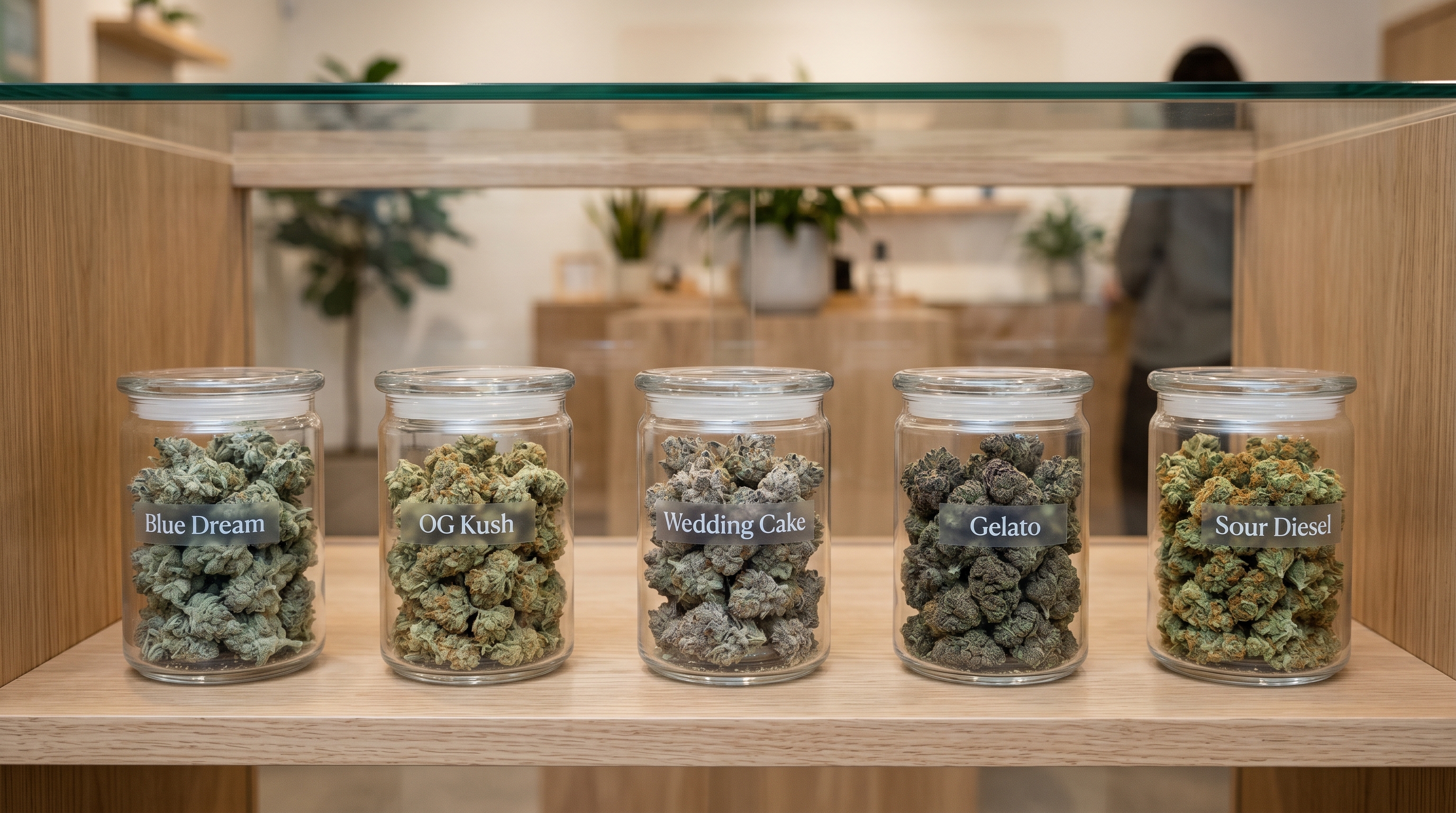
Blue Dream. Wedding Cake. Gelato. OG Kush. Sour Diesel.
This is the connoisseur paradox: the strains that dominate the cultural conversation are rarely the strains that dominate the sales floor. Leafly analyzed millions of dispensary orders in 2025 and found Blue Dream at number one — for the third consecutive year. Wedding Cake held number three. Gelato sat at number six. These aren’t hype plays. These are pantry staples. This piece is about why, and what that tells us about how serious cannabis consumers actually shop.
What “Daily Driver” Actually Means
The term comes from car culture, where it describes a vehicle that isn’t the most exciting machine in the garage — but is the one you actually rely on every day, in every condition, without surprises.
A daily driver cannabis strain has a specific profile:
- Predictable potency: typically 18–24% THC in commercial batches — enough to be effective, not so strong it derails a Tuesday afternoon
- Stable terpene expression: a recognizable flavor and effect character across growers, batches, and markets
- Multiple use cases: works morning or evening, solo or social, on or off the couch
- Wide cultivation: grown by enough producers that it’s genuinely available, not a single-pheno boutique drop you see once and never again
- Phenotype stability: the genetics are stabilized enough that most phenos express consistently — you know roughly what you’re getting before you open the jar
Contrast this with the exotic end of the market: a 32% THC Gas Mask phenotype from a single Seattle breeder, available in one dispensary, gone in a week. That’s a special occasion. That’s the sports car you take out on weekends. The daily driver is the reliable vehicle you actually live with.
Understanding this distinction — through terpenes, High Family classification, and effect profiling — is exactly what the app was built for.
The Top 5: Why Each One Persists
Blue Dream — The Universal Baseline
No strain has been analyzed, dissected, and declared dead as many times as Blue Dream, and none has refused to die quite as stubbornly. BDS Analytics found it at number one in Colorado, Washington, and California simultaneously — across thousands of competing strains. Leafly confirmed $21.7 million in California flower sales alone from January through November 2025.
Blue Dream is a sativa-dominant hybrid with a Blueberry × Haze lineage. THC runs 17–22% in most commercial batches. Its myrcene-forward terpene profile — softened by caryophyllene and a touch of limonene — delivers a balanced uplift that stays functional. It’s a Balance and Uplift family strain depending on the batch, and that flexibility is precisely the point: it doesn’t box you into a single use case.
The more interesting question is why Blue Dream remains number one while producing relatively little excitement. The answer is cultivation. Blue Dream is notoriously consistent for growers — two pounds per 1,000-watt light is standard, and it’s resistant to powdery mildew. Consistency in the grow room produces consistency in the jar. Consistency in the jar produces repeat customers.
OG Kush — The Original Standard
OG Kush is the strain that taught an industry what “dank” means. Its lineage traces back to the early 1990s, and it underpins an enormous percentage of the modern strain catalog: Headband, GSC, Wedding Cake, Chemdawg — most of what’s considered premium today has OG Kush somewhere in its family tree.
Its terpene profile — myrcene, limonene, caryophyllene — is essentially the blueprint for the earthy-fuel-citrus profile that defines West Coast cannabis culture. THC typically runs 19–24%. It sits squarely in the Relax family. And because its genetics are so widely distributed, a competent grower can produce a consistent OG Kush expression in nearly any market — which means it never disappears from the shelf for long.
Wedding Cake — The Modern Daily Driver
Wedding Cake is the most modern entry in this list, having achieved consistent top-5 status since 2019. Seed Junky Genetics’ Triangle Kush × Animal Mints cross delivers caryophyllene, limonene, and myrcene in a ratio that produces what most consumers describe as “a perfect evening wind-down.” It’s the strain detailed in our full Wedding Cake breakdown — a deeply examined case study in why a well-bred cross becomes a perennial.
Its 22–27% THC range skews toward the higher end of daily-driver territory, which means some users find it fits better as an evening strain than an all-day companion. But the sheer breadth of its cultivation — dozens of producers across every major legal market — keeps it available and reasonably affordable. That availability is the difference between a daily driver and a boutique curiosity.
Gelato — The Dessert Era Standard
Gelato represents the moment cannabis met fine dining — Sunset Sherbet × Thin Mint GSC, bred by the Cookies Collective in San Francisco. The full history is in our Gelato deep-dive, but the short version is this: Gelato is the only strain besides Blue Dream that appears in the top five across flower, concentrates, and pre-rolls simultaneously, according to Headset’s sales data.
That cross-category dominance is a daily driver signal. When a strain sells in every format, it means consumers are seeking it by name regardless of how they consume — which is exactly what brand loyalty looks like in CPG, transposed onto plant genetics.
Sour Diesel — The Energetic Anchor
Sour Diesel dropped off the Leafly national top-selling list in 2024 before returning to number four in 2025 — a reminder that daily drivers can dip, but they don’t disappear. The fuel-and-citrus terpene signature is instantly recognizable. Headset’s data notes that while Sour Diesel has a large number of producers selling it (which creates per-brand oversaturation), its aggregate sales volume remains strong because consumers seek it consistently.
This is a sativa-leaning Uplift family strain with limonene and caryophyllene at the front of its terpene profile. It’s the morning strain that has served as a morning strain for thirty years. That is not an accident.
The Behavioral Economics of Reliability
Here’s the critical context that makes sense of all that sales data: according to the most recent analysis, more Americans consume cannabis daily or near-daily than consume alcohol daily — 17.7 million daily cannabis users compared to 14.7 million daily drinkers. Ipsos research finds that 61% of cannabis consumers use at least once a week.
When you consume four times a week, the decision calculus changes entirely.
A weekend enthusiast can afford to experiment. If a hype strain disappoints on a Saturday afternoon, the consequence is a mildly bad Saturday afternoon. But if you’re a daily consumer who relies on cannabis for sleep, creative focus, pain management, or anxiety, a bad surprise has real costs: a wasted workday, a disrupted sleep cycle, an anxious afternoon you couldn’t afford.
This is why 66% of Canadian consumers — in a 2024 Brightfield Group report — said product consistency matters more to them than price. That’s a striking finding in a price-sensitive market. These are consumers who have learned, through repeated experience, that reliability is worth paying for.
Behavioral economists call this loss aversion: the pain of a bad outcome outweighs the pleasure of an unexpectedly good one. For daily cannabis consumers, the consistent mid-potency daily driver eliminates the negative tail risk. You don’t need Blue Dream to blow your mind. You need it to be Blue Dream.
The Hype Cycle vs. The Pantry
Cannabis culture has a hype cycle problem that mirrors fashion and sneaker culture: the hottest new drop gets all the attention, the conversation, the Instagram content. Look at the arc of Toad Venom: it arrived with astronomical THC numbers, limited regional availability, and a name engineered for virality. The coverage it generated was enormous relative to its actual market share.
But hype strains serve a different population than daily drivers. As the 420property.com analysis noted, brands that chase hype over consistency train their customers to be one-time buyers. “You can’t scale equity if every purchase feels like a first date.” The shelf rotation problem — new SKUs constantly replacing last month’s hero product — breaks the expectation loop that creates loyalty.
The daily driver category is the opposite logic. Blue Dream is the consumer packaged goods dream: ubiquitous availability, predictable experience, multi-format presence, sufficient margin to sustain production. It’s not vanilla in the pejorative sense. It’s vanilla in the sense that vanilla is the most consumed flavor on the planet — because it works with everything, offends nobody, and delivers reliably.
The distinction maps cleanly to flavor family dynamics too. If you want to understand gas vs. candy as flavor categories, you’ll notice that daily drivers tend to occupy the established middle: earthy-fuel (OG lineage) or dessert-sweet (Cookies lineage) — flavor profiles that have been cultivated and standardized across thousands of grows. Extreme novelty — floral, fermented, cheese, tropical — appears more often in boutique and hype strains precisely because mainstream cultivation hasn’t scaled those expressions yet.
What Makes a Strain Become a Daily Driver
Not every well-bred strain achieves daily driver status. The pathway requires a specific set of conditions converging:
1. Open-source genetics. Blue Dream became ubiquitous partly because clones were available for $5–8 apiece in the early California market. No single breeder owned it. When genetics aren’t controlled, cultivation scales. When cultivation scales, availability increases. When availability is consistent, buying behavior repeats.
2. Phenotype stability. A strain with 20 wildly different phenotype expressions creates a roulette problem — consumers can’t form expectations across purchases. Stabilized genetics produce consistent phenotypes. OG Kush’s decades of cultivation have created a well-understood expression that competent growers can reliably hit.
3. Mid-range potency. The THC arms race of 2020–2023 produced strains above 30% that many consumers found anxiety-inducing at normal dose sizes. Daily driver strains cluster in the 18–24% range — potent enough for experienced consumers, not so potent they require micro-dosing discipline every time. This is part of why Blue Dream at 17–22% THC has more repeat buyers than a 32% exotic: the margin for error is larger.
4. Accessible terpene profile. The myrcene-caryophyllene-limonene terpene triangle — present across all five daily driver strains in varying ratios — represents the terpene profile that cannabis consumers have been calibrated to over decades. It’s familiar. It’s what cannabis “smells like” to most people. Novel terpene profiles require re-calibration of expectations, which adds friction to repeat purchases.
5. Cross-format availability. Blue Dream and Gelato appear at the top of flower, concentrate, and pre-roll sales simultaneously (per Headset data). A strain that only works as flower doesn’t become a category staple. Strains that translate well across formats become infrastructure.
The Anti-Daily-Drivers
Understanding the category requires knowing its opposite. Anti-daily-drivers share predictable characteristics:
- THC above 28–30%, which narrows the effective dose window significantly
- Single-source genetics from one boutique breeder with intentionally limited distribution
- High price premium ($70–$100+/eighth) that creates psychological friction for routine purchase
- Terpene profiles so novel or intense that the experience doesn’t background into a routine
- Short production windows that create scarcity by design
These strains serve a real market — experienced connoisseurs, enthusiasts who treat cannabis like wine collecting, weekend users who want something special. But they are categorically not daily drivers. The dispensary carrying twelve jars of Hash Burger alongside a hundred jars of Blue Dream understands its customer base. The Hash Burger is the attraction; the Blue Dream pays the bills.
Building Your Daily Driver Rotation
The practical application of all this data is a personal one: constructing a two- to four-strain rotation that covers your actual use cases without experimentation anxiety.
A solid daily driver rotation typically looks like:
Morning anchor (1 strain): A sativa-leaning Uplift family strain — Sour Diesel, Green Crack, Durban Poison, or Jack Herer. High limonene, moderate THC, no sedation. This is the strain that goes with coffee.
All-day hybrid (1 strain): A true Balance family hybrid — Blue Dream, Trainwreck, GSC. This is the universal adapter: works mid-morning, works mid-afternoon, doesn’t commit you to a couch.
Evening anchor (1–2 strains): A Relax family indica-leaning strain — Wedding Cake, OG Kush, Gelato, or Northern Lights. Higher myrcene, stronger body component, works with dinner or wind-down.
Occasional special (optional): This is where the exotic, the boutique, the hype strain lives — set aside for weekends, celebrations, or genuine curiosity. Not a daily driver by definition, but it has a place in the garage.
The key principle: know what each strain reliably does for your body before it becomes a regular. Effect profiling — tracking terpenes, THC range, and your personal response — turns an expensive guessing game into predictable self-knowledge.
Why This Trend Matters for the Cannabis Industry
The persistence of daily driver strains has structural implications for how cannabis markets work:
For cultivators and breeders: Exotic genetics get the press, but stable perennials sustain operations. The Blue Dreams and OG Kushs of the world represent durable volume that forecasters can actually model. Breeders who develop genuinely stable, multi-pheno-consistent genetics create lasting catalog value.
For dispensaries: The daily driver segmentation explains why floor mix matters. Chasing novelty at the expense of consistent staple inventory frustrates repeat customers who come in with a specific need. The 86% of consumers who say personalized recommendations would drive loyalty — that recommendation system only works if the recommended strain is reliably in stock.
For brands: The consistency-over-hype thesis is essentially a manifesto for CPG-style thinking in cannabis. Brands that build around a stable daily driver strain — predictable COA ranges, consistent availability, identifiable terpene profile — have a retention story. Brands that rotate inventory on trend cycles cannot build that story.
For consumers: Market maturation benefits experienced buyers. As markets age, Headset data shows top-strain concentration falls (from 25%+ in young Canadian markets to 14% in mature U.S. markets), which means more cultivar diversity at stable price points. The daily driver category gets more competitive and more accessible simultaneously.
The Foundation of Cannabis Self-Knowledge
The hype cycle will keep running. Toad Venom will be replaced by something with an even more alarming name. Limited-run exotics will sell out in hours and generate content for weeks. That market segment has real value for real consumers.
But the registers will keep ringing up Blue Dream.
Knowing your daily drivers — the strains your body responds to predictably, that fit your rhythms, that you can buy on a Tuesday without drama — is the foundation of cannabis self-knowledge. It’s the difference between a consumer who learns and one who experiments indefinitely.
The app is built around this principle: effect profiling, terpene tracking, strain matching to your actual use cases. Not to tell you what to buy. To help you figure out what already works for you — so you can stop guessing, and start relying.
Sources
- Leafly, Best-Selling Cannabis Strains 2025 — strain sales ranking from millions of dispensary orders nationwide
- BDS Analytics / BDSA, Why Blue Dream Is the Most Popular Marijuana Strain — sales data from Colorado, Washington, California
- Headset, Cannabis Strain Sales Data — cross-category strain analysis, generational preferences, brand concentration data
- Brightfield Group via multiple outlets, 2024 Canadian Consumer Consistency Survey — 66% prioritize consistency over price
- New Frontier Data, August 2025 Biggest Dispensary and Cannabis Consumer Shifts — daily user population data
- Ipsos / Pax, Most Cannabis Consumers Use Weekly or More — 61% weekly+ consumption statistic
- Carnegie Mellon / NIH, Daily Marijuana Use Is Now More Common Than Daily Alcohol Use — 17.7M daily cannabis users vs. 14.7M daily drinkers
- 420property.com, Hype Over Consistency: Why Cannabis Brands Are Failing — CPG consistency framework analysis
- Budvue, From Price Shoppers to Brand Loyalists: Understanding the 2025 Cannabis Consumer — loyalty program ROI data
