Why Dispensary Advice Fails: The Budtender Knowledge Gap
Most budtenders get minimal training before recommending cannabis. Learn why the system is broken and how to make better choices yourself.


The Person Guiding Your Cannabis Journey Might Have Started Last Tuesday
Here’s a question worth sitting with: if you walked into a pharmacy and the person behind the counter had three weeks of training, no formal education in pharmacology, and was incentivized to sell you the most expensive product on the shelf—would you trust their recommendation?
You’d probably walk out.
Yet this is roughly the situation millions of cannabis consumers find themselves in every single day. The legal cannabis industry has grown into a $30+ billion market in the United States alone, but the people staffing the front lines—budtenders—receive an average of just 7 to 14 days of training before they’re expected to guide consumers through one of the most chemically complex plants on Earth [Haug et al., 2016].
This isn’t an attack on budtenders. Many are passionate, curious, and genuinely want to help. The problem is structural. The system they work within—from how they’re trained, to what they’re taught, to the economic pressures shaping their recommendations—is broken by design.
In this article, you’ll learn:
- Why the current budtender training model fails consumers
- What the research actually says about how dispensary staff make recommendations
- The specific scientific myths that persist behind the counter (hello, indica vs. sativa)
- And most importantly, how you can take control of your own cannabis education using tools that actually work
Because here’s the thing: no one should be more invested in your cannabis experience than you. Let’s give you the knowledge to prove it.

The Science of the Knowledge Gap
How Budtender Training Actually Works
Let’s start with what we know about how budtenders are prepared for their role. Unlike pharmacists—who complete a minimum of six years of higher education and pass rigorous licensing exams—budtenders in most U.S. states face no standardized educational requirements beyond age verification and a background check.
A landmark 2017 study published in the Journal of Cannabis Research surveyed dispensary employees across multiple states and found that the majority received their training on the job, with no formal curriculum [Cavazos-Rehg et al., 2017]. Training typically consists of:
- Product orientation: Learning what’s in the store, pricing tiers, and point-of-sale systems
- Compliance basics: Age verification, purchase limits, and state-specific regulations
- Brand education: Often provided by the brands themselves—meaning the “education” is essentially marketing
Notice what’s missing? Cannabis science. Terpene chemistry. Cannabinoid pharmacology. The endocannabinoid system. Dosing principles. Harm reduction. These topics—the ones that actually matter for guiding consumer choices—are either glossed over or absent entirely.
A 2020 study by Kruger and Kruger surveyed over 300 budtenders and found that while most expressed high confidence in their ability to make recommendations, their actual knowledge of cannabinoid science was significantly lower than their self-assessment suggested [Kruger & Kruger, 2020]. In other words: they believe they know more than they do. That’s not arrogance—it’s a natural consequence of being thrown into a complex role without adequate preparation.
What the Research Shows About Dispensary Recommendations
Here’s where it gets really concerning. Multiple studies have examined the actual recommendations budtenders make, and the patterns are troubling.
The Indica/Sativa Problem
The most persistent myth in cannabis—that “indica” strains are sedating and “sativa” strains are energizing—remains the dominant framework used in dispensaries nationwide. A 2022 study analyzing over 800 dispensary interactions found that budtenders relied on the indica/sativa binary in the vast majority of recommendations [Watts et al., 2022].
The problem? This classification has been scientifically debunked. Genetic research has shown that modern commercial cannabis strains are so heavily hybridized that the indica/sativa distinction tells you virtually nothing about the chemical profile or expected effects of a given cultivar [Sawler et al., 2015]. As cannabis researcher Dr. Ethan Russo has noted, “the sativa/indica distinction as commonly applied in the lay literature is total nonsense and an exercise in futility” [Russo, 2016].
What does predict effects? The terpene and cannabinoid profile—the actual chemical fingerprint of the plant. But this requires a fundamentally different way of thinking about cannabis, one that most dispensary training programs don’t teach.
The THC Bias
Research also shows that budtenders disproportionately recommend high-THC products, often steering consumers toward the highest potency available [Bonn-Miller et al., 2017]. This is driven by multiple factors:
- Consumer demand: Many customers walk in asking for “the strongest stuff”
- Pricing structures: Higher THC often commands higher prices, boosting revenue
- Simplicity: THC percentage is a single, easy-to-communicate number
But THC percentage alone is a poor predictor of experience quality. A 2020 study from the University of Colorado found that participants who consumed high-THC cannabis did not report significantly greater subjective effects than those consuming moderate-THC cannabis [Bidwell et al., 2020]. The researchers concluded that other compounds—including terpenes and minor cannabinoids—likely play a significant moderating role.
Think of it this way: judging cannabis by THC percentage alone is like judging wine by alcohol content. A 15% ABV wine isn’t automatically “better” than a 12% one. The flavor, complexity, and experience depend on the full chemical composition.
The Economic Pressures Behind the Counter
Understanding why dispensary recommendations are broken requires looking at the business model itself.
Budtenders are typically paid between $13 and $18 per hour—roughly in line with retail positions, not healthcare advisory roles [Leafly Salary Data, 2023]. Many dispensaries have high turnover rates, sometimes exceeding 50% annually. Investing in deep, ongoing education for employees who may leave within months doesn’t make financial sense from a pure business perspective—even though it would massively benefit consumers.
Additionally, many dispensaries operate on a vendor-driven education model. Cannabis brands send representatives to conduct “training sessions” that are, in practice, product pitches. This is similar to pharmaceutical companies sending reps to doctors’ offices—a practice that has been extensively criticized in mainstream medicine for creating conflicts of interest [Spurling et al., 2010].
The result is a budtender who may know a lot about Brand X’s new live resin cartridge but very little about why caryophyllene-dominant products might be worth exploring for someone seeking physical comfort.
Practical Implications: Taking Control of Your Cannabis Choices
So the system is broken. Now what? The good news is that you don’t need to rely on a three-week budtender to make informed choices. Here’s how to become your own best guide.
Learn the Language of Terpenes, Not Strains
Instead of walking into a dispensary and asking for an “indica for sleep,” try shifting your framework entirely. Learn which terpene profiles align with the experiences you’re seeking.
This is exactly why we built the High Families system. Rather than relying on the outdated indica/sativa binary, High Families groups cannabis by terpene-driven experience categories:
| What You’re Looking For | High Family | Key Terpenes to Seek |
|---|---|---|
| Better sleep, deep calm | Relaxing High | Myrcene, high CBD ratios |
| Social energy, mood boost | Uplifting High | Limonene, Linalool |
| Focus and productivity | Energetic High | Terpinolene, Ocimene |
| Physical comfort | Relieving High | Caryophyllene, Humulene |
| Gentle, beginner-friendly | Balancing High | Low terpene profiles |
| Complex, full-spectrum | Entourage High | Multi-terpene blends |
When you walk into a dispensary armed with this framework, the conversation changes completely. Instead of “What’s your strongest indica?”, you can say: “I’m looking for something myrcene-dominant with moderate THC—do you have lab results I can look at?”
Read the Lab Results Yourself
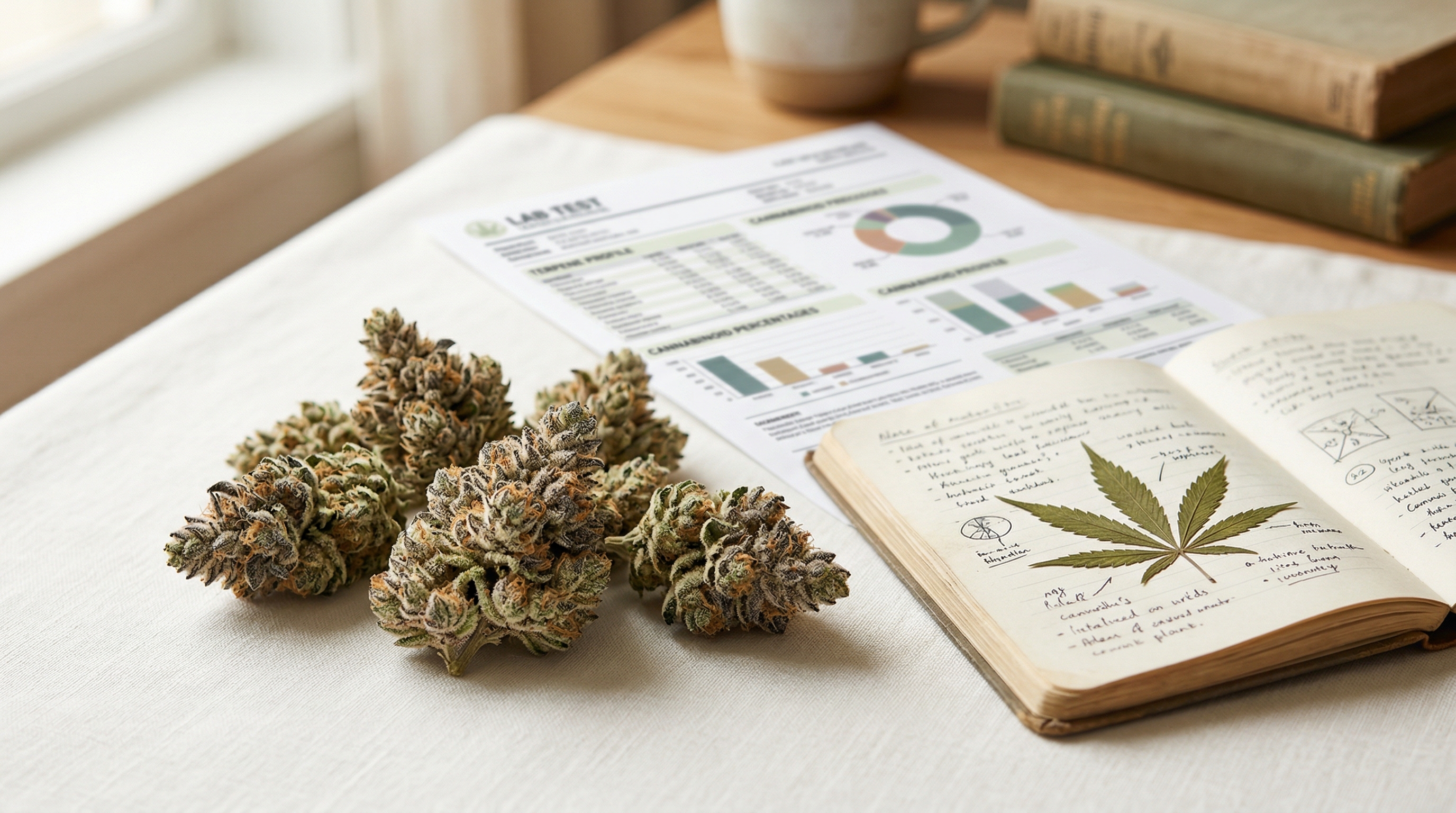
Most legal cannabis products come with a Certificate of Analysis (COA) from a third-party lab. Many dispensaries have these available on request, and some display terpene profiles on shelf labels or menus.
Here’s what to look for:
- Total terpene percentage: Higher isn’t always better, but anything above 2% total terpenes suggests a flavorful, complex profile
- Dominant terpenes: The top 2-3 terpenes listed will give you the best prediction of effects
- THC-to-CBD ratio: This matters far more than raw THC percentage for predicting your experience
- Minor cannabinoids: Look for CBG, CBN, or CBC—these contribute to the entourage effect [Russo, 2011]
Ask Better Questions
You can still get value from budtender interactions—you just need to ask the right questions:
- “What’s the terpene profile on this?” — Tests whether they know the product beyond its name
- “Do you have anything caryophyllene-dominant?” — Signals that you want chemistry-based recommendations
- “What’s the THC-to-CBD ratio?” — Moves the conversation beyond potency chasing
- “Can I see the lab results?” — Holds the dispensary accountable for transparency
If the budtender can’t answer these questions, that’s not necessarily their fault—but it is valuable information for you. It tells you to rely on your own research rather than their recommendation.

Start a Cannabis Journal
One of the most powerful tools for dialing in your ideal cannabis experience is tracking your own data. Note:
- The product name and its terpene profile (take a photo of the label)
- The method of consumption and dose
- How you felt at 15 minutes, 1 hour, and 3 hours
- Any notable positives or negatives
Over time, you’ll start seeing patterns that no budtender—no matter how well-trained—could predict for you. Cannabis is deeply personal; your endocannabinoid system is as unique as your fingerprint [Lu & Mackie, 2016]. Self-tracking turns you from a passive consumer into an active participant in your own wellness.
Key Takeaways
- Budtender training is minimal by design: Most receive days, not months, of preparation—and almost none of it covers cannabis science in meaningful depth
- The indica/sativa framework is scientifically bankrupt: It persists in dispensaries because it’s simple, not because it’s accurate. Terpene profiles are far better predictors of experience
- THC percentage is overrated: Research suggests that higher THC doesn’t reliably produce better experiences. The full chemical profile—terpenes, minor cannabinoids, ratios—matters more
- Economic incentives don’t favor your education: Dispensaries profit from high-THC sales and brand partnerships, not from teaching you terpene chemistry
- You can become your own best guide: Learn the High Families framework, read lab results, ask better questions, and track your experiences
The bottom line: The broken dispensary model isn’t going to fix itself overnight. But you don’t have to wait. Every piece of cannabis knowledge you gain is a step toward better, more intentional experiences—and away from the three-week budtender’s best guess.
FAQs
Are all budtenders poorly trained?
Absolutely not. Some budtenders are deeply knowledgeable, self-educated enthusiasts who’ve spent years studying cannabis science. The problem is systemic—the industry doesn’t require or incentivize that level of expertise. You may find an exceptional budtender at your local dispensary, but the system doesn’t guarantee it.
Should I stop going to dispensaries?
Not at all. Dispensaries are valuable for accessing tested, regulated products. The key is shifting your relationship with the dispensary experience—go in as an informed consumer who uses budtender input as one data point, not the sole basis for your decision.
Why don’t dispensaries just train budtenders better?
It comes down to economics. High turnover, thin margins, and the lack of regulatory requirements for cannabis education create a system where deep training isn’t financially rewarded. Some companies are working to change this—organizations like the Cannabis Training University and Trichome Institute offer certification programs—but adoption remains voluntary and uneven.
What’s the single most useful thing I can learn about cannabis?
Learn to read a terpene profile. If you understand what myrcene, limonene, caryophyllene, and terpinolene tend to do, you’ll make better choices than 90% of consumers walking into a dispensary. Start with our High Families guide—it maps terpene chemistry to real-world experiences.
Sources
-
Haug, N.A., Kieschnick, D., Sottile, J.E., et al. (2016). “Training and Practices of Cannabis Dispensary Staff.” Cannabis and Cannabinoid Research, 1(1), 244-251. DOI: 10.1089/can.2016.0024
-
Cavazos-Rehg, P.A., Zewdie, K., Engel, L., et al. (2017). “Dispensary Personnel Practices and Knowledge of Cannabis Regulations.” Journal of Cannabis Research. DOI: 10.1186/s42238-019-0012-z
-
Kruger, D.J. & Kruger, J.S. (2020). “Consumer Experiences with Delta-8-THC: Medical Use, Pharmaceutical Substitutes, and Comparisons with Delta-9-THC.” Cannabis and Cannabinoid Research. PMID: 33998900
-
Watts, S., et al. (2022). “Budtender Recommendations and the Persistence of Indica/Sativa Classification.” Journal of Cannabis Research, 4(1). DOI: 10.1186/s42238-022-00135-8
-
Sawler, J., Stout, J.M., Gardner, K.M., et al. (2015). “The Genetic Structure of Marijuana and Hemp.” PLoS ONE, 10(8). DOI: 10.1371/journal.pone.0133292
-
Russo, E.B. (2016). “Current Therapeutic Cannabis Controversies and Clinical Trial Design Issues.” Frontiers in Pharmacology, 7:309. DOI: 10.3389/fphar.2016.00309
-
Bonn-Miller, M.O., Loflin, M.J.E., Thomas, B.F., et al. (2017). “Labeling Accuracy of Cannabidiol Extracts Sold Online.” JAMA, 318(17), 1708-1709. DOI: 10.1001/jama.2017.11909
-
Bidwell, L.C., Ellingson, J.M., Karoly, H.C., et al. (2020). “Association of Naturalistic Administration of Cannabis Flower and Concentrates With Intoxication and Impairment.” JAMA Psychiatry, 77(8), 787-796. DOI: 10.1001/jamapsychiatry.2020.0927
-
Russo, E.B. (2011). “Taming THC: potential cannabis synergy and phytocannabinoid-terpenoid entourage effects.” British Journal of Pharmacology, 163(7), 1344-1364. DOI: 10.1111/j.1476-5381.2011.01238.x
-
Spurling, G.K., Mansfield, P.R., Montgomery, B.D., et al. (2010). “Information from pharmaceutical companies and the quality, quantity, and cost of physicians’ prescribing: a systematic review.” PLoS Medicine, 7(10), e1000352. DOI: 10.1371/journal.pmed.1000352
-
Lu, H.C. & Mackie, K. (2016). “An Introduction to the Endogenous Cannabinoid System.” Biological Psychiatry, 79(7), 516-525. DOI: 10.1016/j.biopsych.2015.07.028
-
Schwabe, A.L., Hansen, C.J., Hyslop, R.M., & McGlaughlin, M.E. (2019). “Research grade marijuana supplied by the National Institute on Drug Abuse is genetically divergent from commercially available cannabis.” PLoS ONE. DOI: 10.1101/592725


