Thirdhand Cannabis Smoke: What Stays on Your Surfaces?
Cannabis smoke can leave residue on surfaces after the air clears. Explore what studies measured, what remains unknown, and sensible prevention.

Professor High
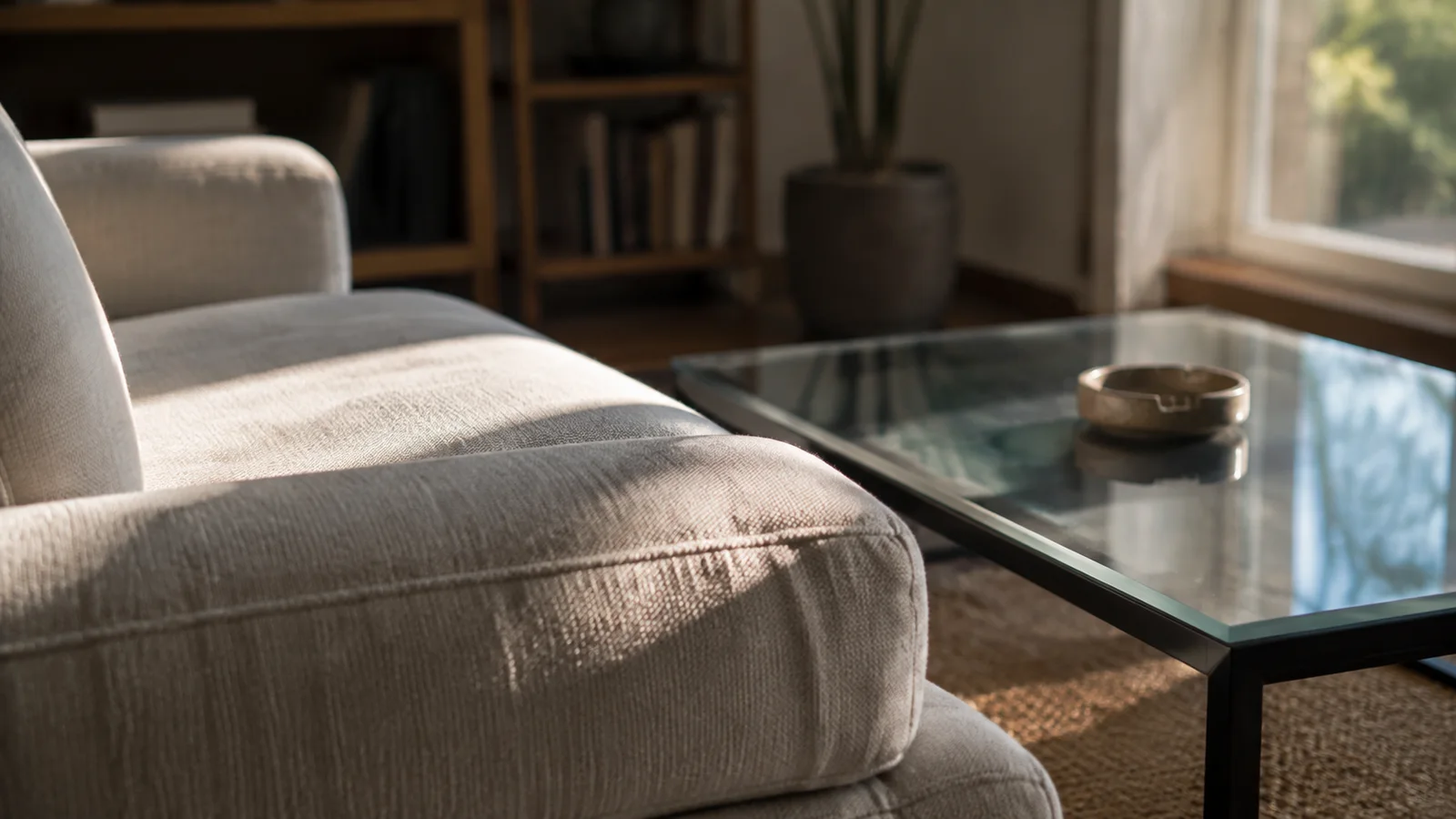
The joint is out. The window has been open. Your living room looks exactly as it did before anyone lit up. Is the smoke gone?
From the air, some of it may be. From the room as a whole, that is a different question.
Thirdhand cannabis smoke means the residue that remains on indoor surfaces after a smoking event. Researchers have measured cannabis-related surface contamination, but they have not established what ordinary household contact with that residue means for long-term human health. Both parts deserve equal attention. Yeh et al., 2022
That makes this a surprisingly useful topic for anyone sharing a home. You do not need to believe a couch can get someone high to care about what settles on it. You also do not need to turn a laboratory detection into a household emergency.
What makes smoke “thirdhand”?
Think about three different questions: What did the person smoking inhale? What did a bystander breathe? What remained on the furniture afterward?
The first is firsthand exposure. The second is secondhand cannabis smoke. The third is the subject here.
For a broader look at respiratory questions, see our cannabis and lung health article.
The distinction concerns where smoke-related chemicals end up and how someone might encounter them. It is not a ranking in which thirdhand automatically means one-third as strong, or a special form of smoke that appears three hours later.
A review by Yeh and colleagues examined how chemicals from several kinds of smoke distribute themselves indoors. Its exposure model predicted different possible routes depending on a compound’s properties: breathing some chemicals, absorbing others through skin, or ingesting material through hand-to-mouth contact. Those were model estimates across smoke constituents, not direct measurements of children absorbing THC from sofas. Yeh et al., 2022
For this article, keep four words separate: presence, contact, dose, effect. Finding a substance answers the first question. It does not automatically answer the other three.
What researchers actually found on surfaces
One of the clearest demonstrations came from a 2019 study by Sempio and colleagues. They sampled surfaces in a room where participants used a cannabis vaporizer. THC was measurable in six of 15 samples; control samples outside the room were negative. Quantifiable measurements ranged from 348 to 4,882 nanograms per square meter. Sempio et al., 2019
This small study did not measure a bystander’s absorbed dose or health outcome, or represent all devices and households.
The room had an unusually efficient ventilation system, designed to exchange its air within two minutes. Surface contamination still occurred. Ventilation did not prevent deposition in that setting. Sempio et al., 2019
How to read a number like “nanograms per square meter”
It describes an amount spread across an area. It is not the amount a person swallowed, inhaled, or absorbed.
An ordinary comparison helps: knowing how much flour is on a counter does not tell you how much ended up in someone’s mouth. You would need to know whether anyone touched the counter, how much transferred, and what happened afterward. With cannabis residue, the chemistry and absorption questions add further steps.
That is why converting a surface measurement directly into an edible dose creates false precision. Our THC absorption guide covers why route matters; a laboratory wipe result supplies no such route or absorbed-dose measurement.
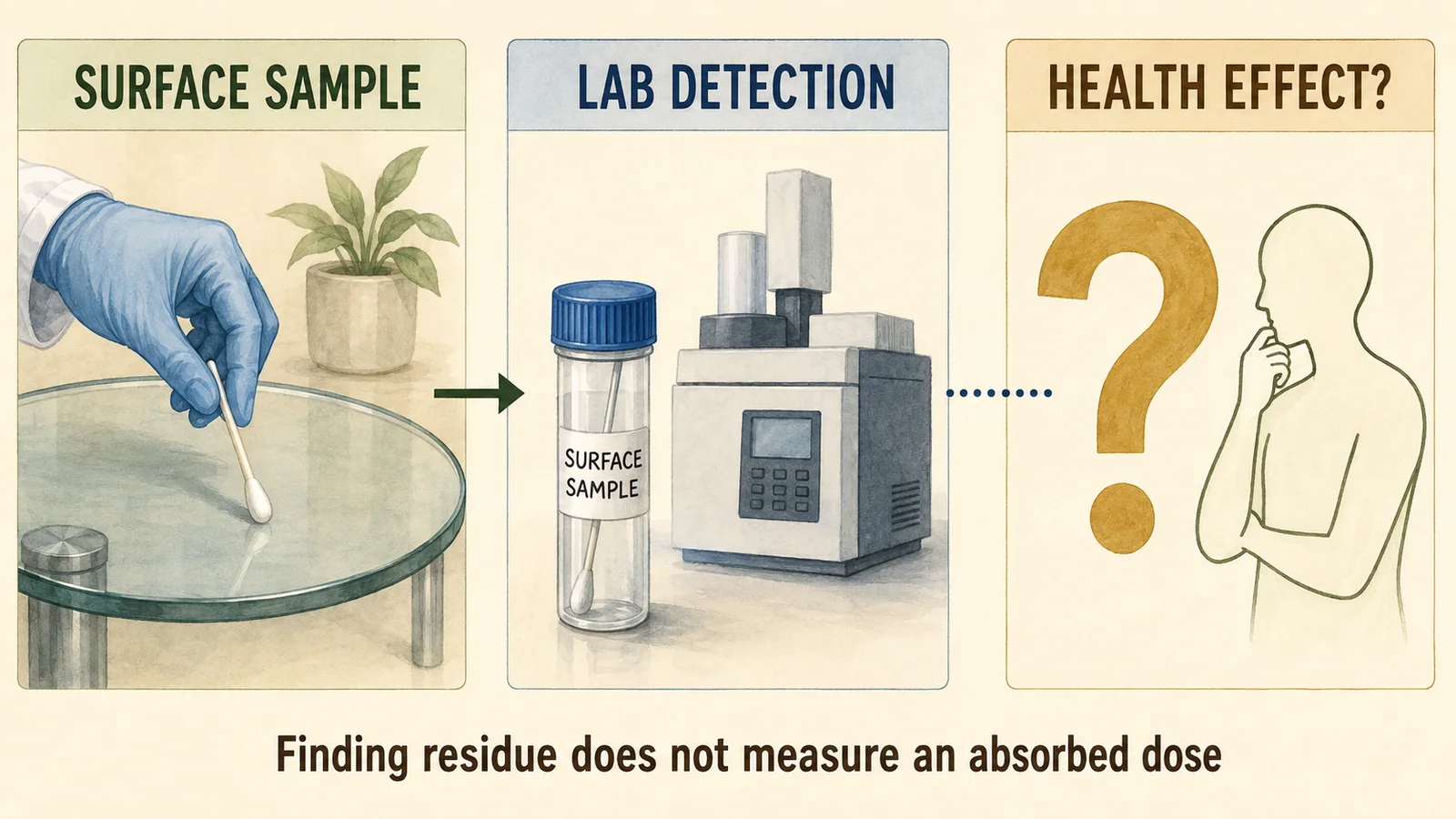
Conceptual illustration, not study data: a positive surface sample leaves questions about transfer, absorbed dose, and health effects unanswered.
Residue changes after it lands
A deposited chemical does not necessarily sit unchanged forever.
In a 2020 laboratory study, Wylie and Abbatt examined THC reacting with ozone, both as a pure compound and within cannabis smoke. They detected oxidation products and found that THC’s loss from glass and cotton depended on conditions such as the surface, film thickness, and ozone level. Wylie and Abbatt, 2020
This was a chemistry experiment. It was not a trial measuring illness in people who touched those materials. It also did not give every home a universal countdown to “residue-free.”
The result matters because less original THC is not the same finding as complete removal of every smoke-related chemical. A molecule can change into another molecule. Asking only whether THC remains misses that distinction.
A good follow-up question for research would be: what substances persist under realistic household conditions, how much transfers to people, and at what doses? The chemistry study helps frame those questions. It does not settle them.
Why tobacco findings need their own label
Thirdhand tobacco research is often used to explain the general concept. That can be helpful, provided the source stays visible.
Cannabis and tobacco are different source materials. A nicotine result should not quietly become a THC result. A health effect from tobacco residue should not be presented as a demonstrated outcome from cannabis residue. The multi-source review specifically treats composition as source-dependent. Yeh et al., 2022
When an alarming claim skips from “tobacco researchers found” to “your cannabis-smelling jacket causes,” look for the missing cannabis-specific evidence.
What do studies of children tell us?
There is real evidence that children in homes with indoor cannabis smoking can be exposed. That deserves attention without assigning a route the study did not isolate.
A 2025 study by Tripathi and colleagues analyzed 275 children from households recruited with an adult tobacco smoker. Reported indoor cannabis smoking was associated with about five times the odds of detectable urinary cannabis biomarkers. This was a cross-sectional analysis, and the outcome was biomarker detection, not diagnosed disease or intoxication. The association between additional smoking events and biomarker quantity among children with detectable levels was not statistically significant. Tripathi et al., 2025
This study does not establish how much of the measured exposure came from breathing secondhand smoke versus contact with residue. It cannot serve as proof that touching furniture caused the positive samples.
The CDC says more research is needed on the effects of secondhand cannabis smoke and identifies exposure of children as a concern. Keeping indoor spaces smoke-free addresses a known source of unwanted exposure while researchers investigate the remaining questions. CDC guidance
For families, the useful question is practical: can we stop adding smoke to the rooms children use? That decision does not require a calculation of how much might transfer from a specific cushion.
What each observation can—and cannot—tell you
| Observation | Reasonable interpretation | Unsupported leap |
|---|---|---|
| THC is recovered from a surface wipe | That sample contained measurable THC | Anyone touching it receives an intoxicating dose |
| THC reacts during a laboratory experiment | The original molecule can change under those conditions | The entire room becomes harmless after a set time |
| A child has a urinary cannabis biomarker | Cannabis-related exposure occurred | A particular couch or shirt caused it |
| A room no longer smells like cannabis | The smell is no longer noticeable to that person | Every smoke-related chemical has disappeared |
The table is a guide to interpreting evidence, not a set of exposure limits. None of these observations, alone, supplies a safe-or-unsafe threshold for an entire home.
A reasonable response for a shared home
Start with an agreement about where smoking happens. “No smoking indoors” is easier to understand and follow than “smoke only until the purifier catches up.” For someone who shares the space, consent to an occasional smell is also not necessarily consent to repeated indoor smoking.
The EPA places source control first in its general approach to indoor air pollution, ahead of ventilation and air cleaning. Applied here, preventing indoor smoke is more straightforward than trying to prove that every surface has been restored afterward. EPA indoor-air guidance
For a room already used for smoking, ordinary surface cleaning and laundering washable fabrics are reasonable housekeeping steps. Follow the material’s care instructions. Treat this as practical upkeep, not a cannabis-specific decontamination protocol with a proven success percentage. For the separate task of dealing with lingering odor, see our home, car, and clothes smell-removal guide.
Do not use your own nose as a clearance test. Our explanation of why you can stop noticing cannabis on yourself addresses the perception side. A pleasant-smelling room and a chemically tested room are different things.
Ozone is not a shortcut
A study showing that ozone reacts with THC is not an instruction to buy an ozone generator. The EPA warns that ozone can harm lungs, may create irritating reaction products, and generally does not effectively control indoor air pollution at concentrations within public-health standards. EPA ozone guidance
Chemistry happening faster is not automatically cleaning happening better.
FAQs
Can thirdhand cannabis smoke get you high?
The surface studies discussed here do not demonstrate intoxication from ordinary contact with furniture or clothing. Detectable residue is not an absorbed dose. That is a limit on what these studies show, rather than proof that every imaginable exposure is harmless.
Does cannabis vaping leave residue too?
Yes, the Sempio study measured surface THC after cannabis vaporization. It does not establish a universal estimate for every device.
How long does thirdhand cannabis smoke last?
There is no single household expiration time established by the research reviewed here. The laboratory chemistry depends on conditions and materials. Waiting a fixed number of hours cannot be presented as a validated whole-room clearance method.
Should I throw away a couch after someone smoked nearby?
The studies cited here do not provide a blanket replacement rule or a health-based pass/fail threshold for furniture. One event also tells you little about the furniture’s overall history. Consider what is actually known about the situation before making an expensive decision; the evidence supports preventing repeat indoor exposure more clearly than it supports universal disposal advice.
Is thirdhand smoke just another name for weed smell?
No. Smell is a sensory observation; residue is material on surfaces. They can overlap, but noticing one does not measure the other. Fragrance, a fading odor, or someone saying “I can’t smell anything” cannot answer a surface-chemistry question.
Key Takeaways
Keep the evidence and the response in proportion: prevent avoidable indoor smoke, maintain shared spaces, and ask what a study actually measured before turning its findings into a frightening headline.
Sources
- Sempio, C., et al. (2019). Surface Detection of THC Attributable to Vaporizer Use in the Indoor Environment. Scientific Reports, 9, 18587. Full study.
- Wylie, A. D. L., and Abbatt, J. P. D. (2020). Heterogeneous Ozonolysis of Tetrahydrocannabinol: Implications for Thirdhand Cannabis Smoke. Environmental Science & Technology, 54(22), 14215–14223. Study.
- Yeh, K., Li, L., Wania, F., and Abbatt, J. P. D. (2022). Thirdhand smoke from tobacco, e-cigarettes, cannabis, methamphetamine and cocaine: Partitioning, reactive fate, and human exposure in indoor environments. Environment International, 160, 107063. Review and exposure model.
- Tripathi, O., et al. (2025). Exposure to Secondhand Cannabis Smoke Among Children. JAMA Network Open, 8(1), e2455963. Study.
- Centers for Disease Control and Prevention. Cannabis and Secondhand Smoke. Public-health guidance.
- U.S. Environmental Protection Agency. Ozone Generators that are Sold as Air Cleaners. Indoor-air guidance.
