How to Get Cannabis Smell Out of Your Home, Car and Clothes
The chemistry of why weed smell clings — and why carbon, airflow and laundry work while masking sprays fail. Plus the ozone warning nobody gives you.

Professor High
You opened a window. You lit a candle. You sprayed the thing from the supermarket that promises “odour eliminator” on the label. Two hours later your landlord’s inspector walks in, and the room smells like a lemon-scented pine forest that recently hosted a small fire.
That is not a failure of effort. It is a failure of mechanism. Almost every product sold for cannabis smell adds a molecule rather than removing one — and once you know what you are actually trying to remove, the problem reorganises itself. Some tactics become obviously pointless, others obviously worth the money, and one popular tactic turns out to be genuinely dangerous in a way most guides never mention.
What you are actually smelling
Terpenes: small, volatile and oily
The aromatic backbone of cannabis is terpenes — hydrocarbons the plant makes in its trichomes. The monoterpenes that dominate fresh flower, like myrcene, limonene and pinene, are ten-carbon molecules; the sesquiterpenes, like caryophyllene and humulene, are half again as large. Three of their properties drive everything:
Volatile. They evaporate readily from an open surface at room temperature — which is why a jar announces itself the moment you crack the lid, and why proper storage is a sealed-container problem.
Lipophilic. Terpenes are oils: barely soluble in water, very soluble in fats, waxes and synthetic fibres. Given a choice between staying airborne and dissolving into your sofa cushion or the sebum in your hair, they take the fat every time.
Small. Small enough that no filter mesh catches them. They pass through fabric, paper, HEPA media and the gap under your door.
Together those give cannabis smell its defining behaviour: the airborne part clears quickly with ventilation, but the part that has partitioned into soft surfaces keeps slowly re-releasing for days. You are not fighting a cloud. You are fighting a reservoir.
The skunk is not a terpene
That unmistakable skunk note — the one that carries down a hallway — is not coming from myrcene.
Researchers analysing cannabis with two-dimensional gas chromatography identified a family of prenylated volatile sulfur compounds, chemically related to the thiols that give skunk spray and cooked garlic their punch (Oswald et al., 2021). A follow-up study concluded that minor, non-terpenoid volatiles — sulfur compounds among them — drive much of the aroma difference between cultivars, rather than the terpene profile alone (Oswald et al., 2023).
Thiols are detectable at extraordinarily low concentrations, so traces survive long after the terpenes fade, and they are chemically different enough that a product tuned for terpenes may do little for them. If you have ever got a room “almost” clean and been left with a faint sulfurous ghost, that is what you are smelling. Our dive into why every strain smells different covers this in full.
And then there is the smoke
Combustion adds a second, harder problem. Burning plant material produces particulate matter, tars and semi-volatile organic compounds. Those particles do not stay airborne — they settle onto walls, ceilings and curtains, forming a film that keeps off-gassing. Researchers at UC Berkeley measured fine particulate matter from secondhand cannabis smoke during social bong sessions in a home living room, quantifying an exposure that is about particles, not only aroma (Nguyen and Hammond, 2022). Our guide on whether secondhand cannabis smoke is actually harmful covers the health side.
The lesson: smoke smell is a surface problem wearing an air problem’s clothes. Ventilating does nothing to the film on the ceiling. Tobacco researchers call this thirdhand smoke — residue that persists on indoor surfaces and keeps releasing compounds long after the smoking stopped (Petrick et al., 2010).
Why air fresheners lose
Three reasons, in ascending order of annoyance.
Masking is additive, not subtractive. A perfume spray adds odorant molecules to a room that already has odorant molecules. Your nose does not average them; it detects both. “Cannabis plus vanilla” is not a smaller signal — it is a weirder one, and to anybody who has smelled the combination before, a more incriminating one.
Scented candles are combustion. You are adding soot and volatile organics to a room whose problem is soot and volatile organics.
The sprays that do work, work narrowly. Cyclodextrin-based fabric sprays are genuinely different from perfume — cyclodextrins are ring-shaped sugar molecules that trap a guest molecule inside the ring, reducing how much escapes into the air. That is a real mechanism. But it only affects molecules the spray physically lands on, and it is a between-launderings stopgap, not a solution.
A fourth reason leads straight into the ozone discussion: many air fresheners are themselves loaded with limonene and pinene. Run an ozone generator in that room and you have combined two reagents chemists have spent twenty years studying.
What actually works, and why
| Method | Mechanism | Best against | Real limits |
|---|---|---|---|
| Ventilation and negative pressure | Dilution and directed airflow | Airborne terpenes, fresh smoke | Does nothing to surface residue |
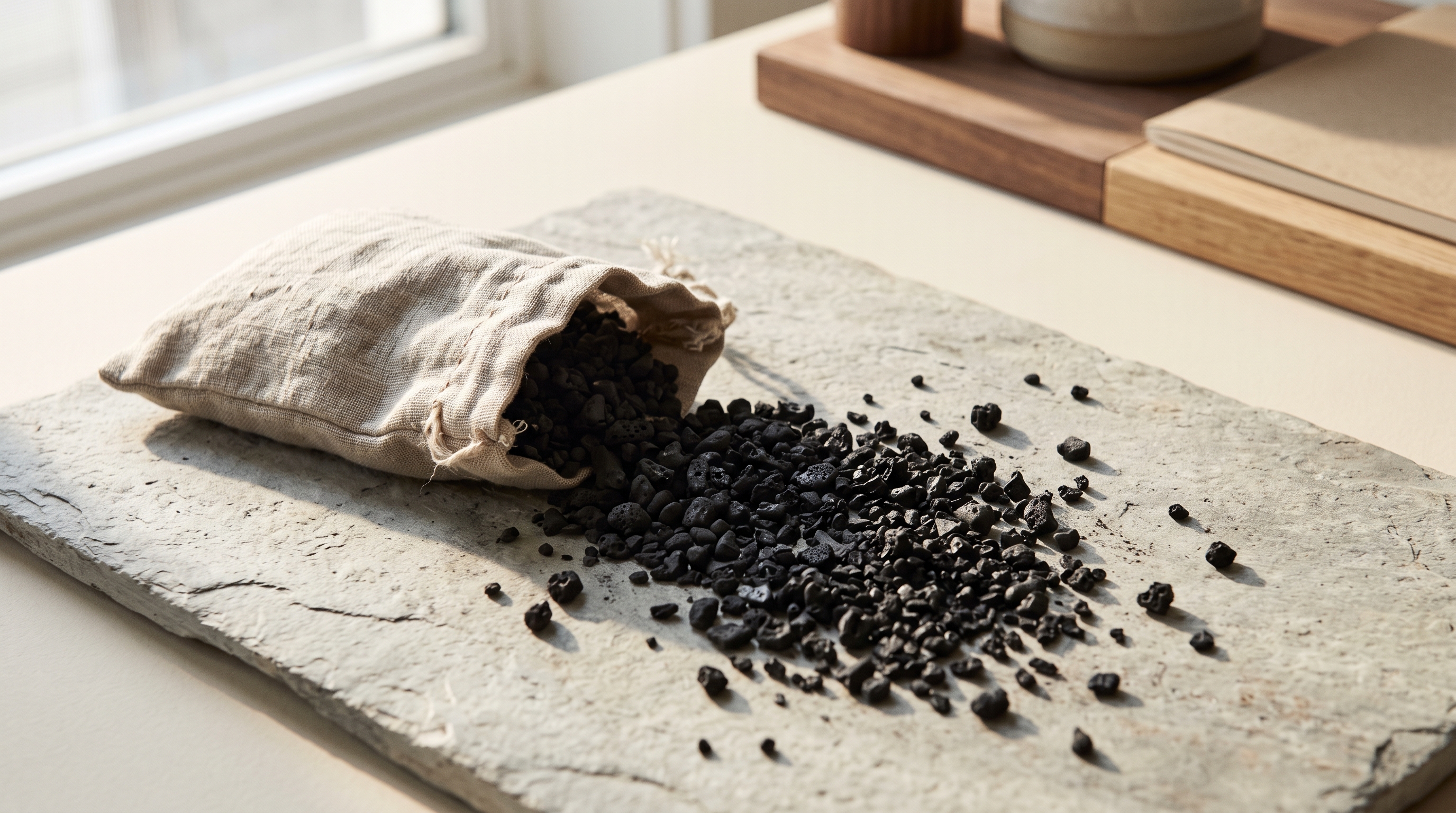
| Activated carbon | Adsorption onto pore surfaces | Gas-phase terpenes and thiols | Saturates; must be replaced |
| HEPA filtration | Particle capture | Smoke particulate | Captures no gas-phase molecules |
| Laundering and surfactant cleaning | Solubilising lipophilic residue | Fabric, hair, hard surfaces | Only reaches what you can wash |
| Enzyme cleaners | Breaking down organic soils | Oily films, mixed household soils | Thin evidence for cannabis specifically |
| Ozone | Oxidation | Marketed for everything | Unsafe occupied; makes new pollutants |
Ventilation, done properly
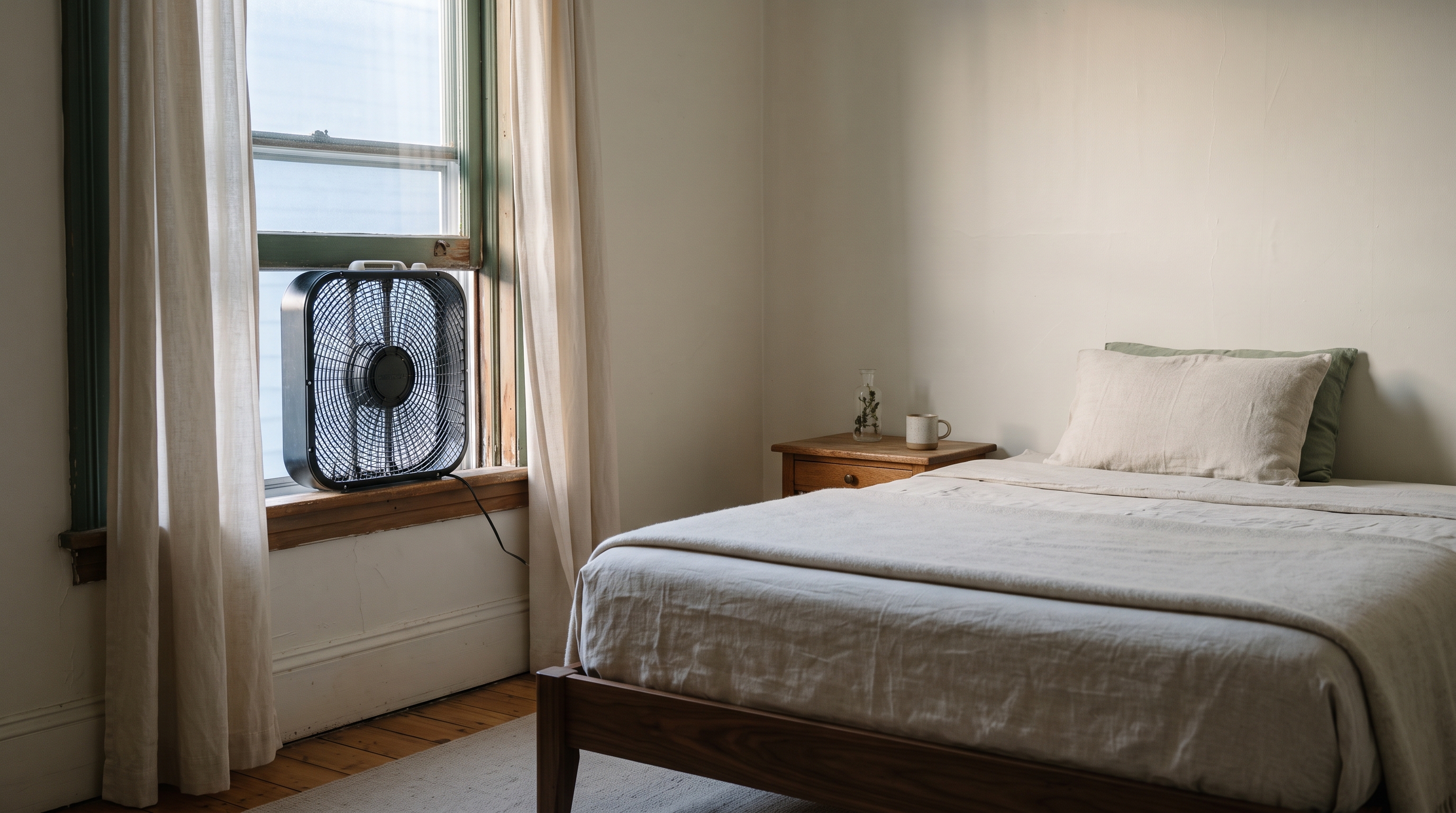
Opening a window creates dilution. Putting a box fan in that window blowing outward creates negative pressure: the room’s pressure drops relative to the rest of the home, so air flows in from the hallway and out of the window rather than smoke migrating under the door into the corridor your neighbours use. Crack a second window or the door an inch to give incoming air a clean path. One fan blowing out beats two blowing in. If you change one habit from this article, make it this one.
Activated carbon: adsorption, not filtration
Filtration catches particles in a mesh. Adsorption is molecules sticking to a surface — and activated carbon is engineered to be almost nothing but surface, its pore network giving a single gram hundreds to over a thousand square metres of binding area.
Researchers comparing activated carbon, zeolite and organosilica sorbents for indoor VOC removal found carbon effective across a range of volatile organics, with performance depending strongly on the compound and on competition from humidity (Mobasser, Wager and Dittrich, 2022). That caveat matters: water vapour competes for the same binding sites, which is why carbon underperforms in a steamy bathroom.
Passive carbon bags only treat air that drifts past them. Inline carbon filters paired with a fan — the grow-room standard — work because all the air is forced through the bed. Either way carbon is consumable: a saturated filter is a decoration.
HEPA plus carbon, not HEPA alone
A true HEPA filter captures at least 99.97% of particles at 0.3 micrometres, and is more efficient above and below that size — 0.3 µm is the hardest size to catch, not the smallest. That makes HEPA genuinely good at smoke particulate.
What it cannot do is capture a gas. Terpenes and thiols are individual molecules in the vapour phase and sail through HEPA media untouched. So you want HEPA plus a meaningful carbon stage — granular carbon measured in pounds, not a thin carbon-dusted mat that saturates in weeks. Run it continuously; steady air exchange beats occasional blasting.
Surfactants and enzymes
Surfactants have a water-loving end and an oil-loving end, letting them surround an oily molecule and carry it off in water. That is why laundry works, and why hot water with dish soap or a degreaser outperforms any spray on walls, ceilings and blinds. Work top-down: in a room smoked in for years the ceiling is usually the biggest single reservoir, and washing it changes the room more than anything else you can do.
Enzyme cleaners add proteases, lipases and amylases that break organic soils into water-soluble fragments. Against cannabis specifically the evidence is thin — no good published work shows they degrade terpenes or smoke tars better than a plain surfactant cleaner, and the surfactants in the same bottle plausibly do much of the work. Reasonable for upholstery. Not a magic solvent for skunk.
Ozone: read this section before you buy anything
Ozone generators are widely sold for odour removal, and they are the reason this article has a warning box.
Never run an ozone generator in an occupied space. Not with people in it, not with pets, not with plants, and not with you in the next room and the door open. Ozone is a respiratory irritant. The FDA limits ozone output from medical devices to 0.05 ppm, and OSHA’s workplace limit is an average of 0.10 ppm over eight hours — concentrations far below what an odour-removal machine produces by design. If a device is generating enough ozone to change how a room smells, that room is not safe to be in. Run it only in a sealed, empty space, and ventilate thoroughly before re-entry.
That is the safety half. The efficacy half is worse.
The US Environmental Protection Agency’s guidance on ozone generators sold as air cleaners states plainly that “there is evidence to show that at concentrations that do not exceed public health standards, ozone is not effective at removing many odor-causing chemicals,” and notes that body odour “may be masked by the smell of ozone but is not removed.” A review in the American Industrial Hygiene Association Journal reached a similar conclusion decades ago (Boeniger, 1995).
Then there is the chemistry, which is almost comically well-matched to cannabis. Ozone reacts fast with carbon-carbon double bonds, and terpenes are full of them. Limonene ozonolysis is one of the most-studied reactions in indoor air chemistry, and what it produces is not “nothing” — it is aldehydes and secondary organic aerosol, meaning brand-new ultrafine particles formed in the room air. Chamber studies have characterised that aerosol formation directly (Chen and Hopke, 2010; Sarwar and Corsi, 2007). Critically, the reaction proceeds not just with airborne limonene but with limonene already sorbed onto indoor surfaces — exactly the reservoir described above (Waring and Siegel, 2013). The same pattern holds for tobacco residue: ozone oxidising surface-bound nicotine generates secondary aerosol rather than eliminating the problem (Petrick et al., 2010).
The EPA’s summary of one ozone experiment is blunt: “the reaction produced a variety of aldehydes, and the total concentration of organic chemicals in the air increased rather than decreased.”
So: ozone in an occupied room is a health risk, and ozone in a room full of terpene residue converts one set of compounds into another, some of them irritants. There are narrow professional uses for ozone in sealed, unoccupied remediation. Your bedroom on a Tuesday night is not one of them.
Room by room
The living space. Wash the ceiling and walls above where you sit. Launder or steam curtains. Vacuum upholstery with a HEPA vacuum, then treat it. Run a HEPA-plus-carbon unit continuously. Wash or replace fabric lampshades — they sit in a warm updraft all evening and collect residue efficiently.
The bedroom. Bedding is the reservoir, and it is the easy one: hot wash everything, including the pillow protectors people forget, and vacuum the mattress. Better still, do not smoke in a bedroom you care about — carpet, mattress and duvet together are an enormous absorptive surface you cannot fully clean.
The bathroom fan myth. Smoking in the shower with the fan on is the most popular apartment tactic and one of the weakest. A typical residential bathroom fan moves roughly 50 to 110 cubic feet per minute, a fraction of a box fan in a window. Steam makes it worse: damp surfaces hold lipophilic residue readily, and water vapour competes with odour molecules for space on any carbon you are using. Worst of all, in many buildings bathroom fans vent into a shared duct or roof stack — a delivery system to your neighbours. Use a window with an outward-blowing fan instead.
The car
A car is the hardest odour environment you will deal with, for three reasons: tiny volume, huge fabric-to-air ratio, and a ventilation system that recycles.
Turn off recirculation. It closes the outside air intake and loops cabin air. Every guide about keeping cold air in tells you to use it; for odour it is exactly wrong. Fresh-air mode with the fan high and the windows down beats any spray.
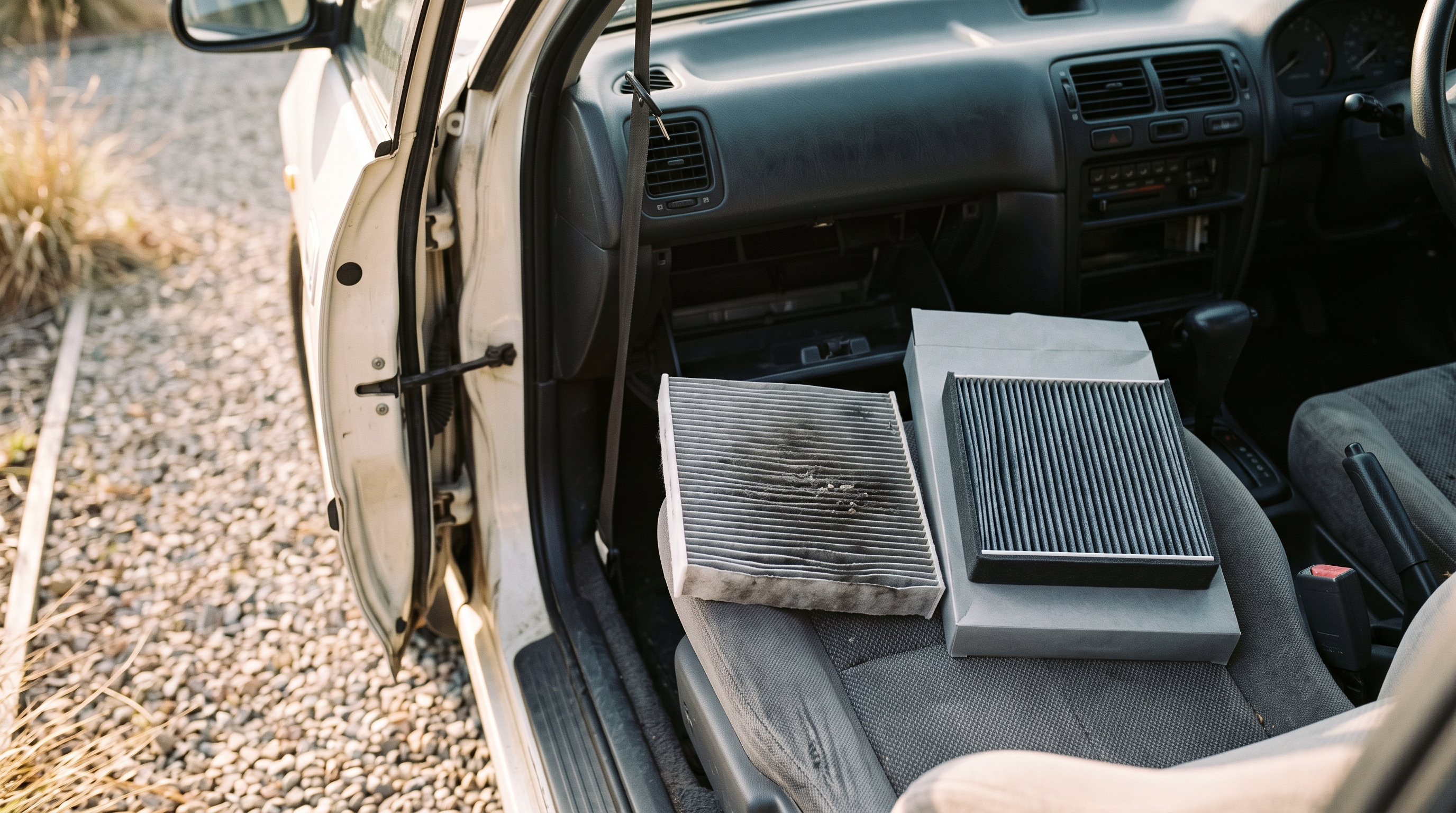
Replace the cabin air filter. Most cars built in the last two decades have one behind the glovebox, and most owners have never changed it. It is a genuine reservoir. Many manufacturers offer an activated-carbon version for a few dollars more — buy that one.
Treat the fabric. Cloth seats, carpet and the headliner absorb aggressively: vacuum, use an upholstery cleaner, then air the car out fully before closing it up. Leather and vinyl release far more easily.
Use heat and sun. Volatility rises steeply with temperature, so parking in direct sun with the windows cracked drives volatiles out of the fabric — slow, but effective and free. Keep a carbon bag under a seat for maintenance, and store flower sealed in the boot rather than loose in the cabin.
None of this affects impairment, which matters more than the smell: see how long to wait before driving, and if you are crossing state lines, travelling with cannabis.
Clothes and hair
Why laundering works. Detergent surfactants solubilise lipophilic residue and hot water speeds the process. A normal hot wash removes cannabis smell from most fabrics completely. Add a cup of white vinegar for stubborn smoke, and skip fabric softener, which coats fibres and can lock residue in. Fabrics differ enormously: wool and synthetic fleece are the worst offenders, while tightly woven cotton and leather are forgiving. A denim jacket airs out; a wool coat does not.
When you cannot launder, in descending order of usefulness: hang the garment in moving air for a few hours, ideally outdoors, since airborne terpenes genuinely do evaporate; mist lightly with a high-proof unflavoured spirit, because ethanol dissolves lipophilic odorants then evaporates carrying them off; use a cyclodextrin fabric spray as a short-term trap. Freezing does nothing. Dryer sheets are masking.
Hair is the sneaky one. It is porous and coated in sebum — a lipid film that is an ideal solvent for exactly these molecules. That is why you can wash your hands, change your shirt and still be immediately identifiable. Shampoo is a surfactant and removes it properly. Failing that, tying long hair up before a session cuts the exposed surface area, and a hat you remove afterwards moves the problem onto something washable.
Prevention beats remediation
Everything above is cleanup. Cleanup is always more work than not creating the mess.
Sploofs, and their actual limit
A sploof — a tube packed with activated carbon that you exhale through — is a real tool built on a real mechanism, and frequently oversold. Smoke comes from two places. Mainstream smoke is what you inhale and exhale. Sidestream smoke streams off the burning cherry continuously between puffs, straight into the room. A sploof only ever treats the mainstream fraction — so with a joint or blunt, where the cherry burns the whole time you hold it, a large share of the room’s smoke never passes through it.
That is why sploofs perform far better with a bowl or one-hitter, which combust only while you draw, and why a dugout beats rolled formats when odour is the constraint. A water pipe helps with harshness but not room odour, and needs regular cleaning — stale bong water is its own smell problem. Sploofs stuffed with dryer sheets are masking devices, not carbon.
Vapour beats smoke, and it is not close
Dry herb vaporisers heat cannabis below combustion, typically 175 to 210°C. A bench study comparing a vaporiser to smoking found it delivered THC while substantially suppressing pyrolytic compounds (Gieringer, St. Laurent and Goodrich, 2004) — early, small and non-clinical, but the direction has held up.
No combustion means no sidestream smoke, and no particulate means far less surface deposition — and the film is what makes smoke linger for days. Vapour still smells, unmistakably so while you are using it, but it is lighter and largely gone within an hour with a window open. If discretion matters, this is the highest-leverage change available. See our vaporiser buyer’s guide and temperature guide — lower temperatures produce noticeably less odour, since more of the terpene fraction volatilises before the heavier material does. Avoid novelty cannabinoid vapes with acetate esters, for reasons unrelated to smell.
Edibles produce no inhaled aerosol at all, and no room odour. One caveat: making them is the smelliest thing you can do in a kitchen. Decarboxylation and infusion run for an hour or more at temperatures chosen to drive volatiles off — chemically the opposite of what you want. Use an oven bag or sealed sous-vide setup and run the extractor hood. Storage is covered in our edibles shelf-life guide, and our comparison of flower, edibles and concentrates covers the wider trade-offs.
Store it properly
A surprising share of “my house smells” is not smoke at all — it is a jar that does not seal. Flower off-gasses terpenes continuously. Airtight glass with a humidity pack keeps aroma inside the container and terpenes intact for longer, which is better for the flower anyway. Sun-grown flower and freshly cured pre-rolls tend to be loudest in a bag — a quality signal and a discretion problem at once.
Why odour has legal weight
Smell is not only a social problem, and it is worth knowing where you stand.
In rentals, odour is the most common route to a lease dispute. Many leases carry smoke-free clauses covering cannabis regardless of state legality, and because residue genuinely deposits on surfaces, landlords have a real basis for claiming remediation costs against a deposit. Vapour and edibles usually sidestep this — and where a lease specifies “smoking”, a vaporiser may fall outside it, though read the wording rather than assume.
In the car, the ground has shifted. For decades the smell of cannabis alone was treated as probable cause for a warrantless search. As adult-use legalisation spread, courts began reconsidering: if possession is lawful, the smell of a lawful substance does not by itself indicate a crime. The Illinois Supreme Court ruled in 2024 that the odour of burnt cannabis alone does not justify a warrantless vehicle search; Minnesota’s supreme court reached a similar conclusion, Maryland legislated the point, and courts in Delaware, Pennsylvania and Vermont have moved the same way. But it is a patchwork, not a rule — burnt versus raw odour has been treated differently in some rulings, and your state may not have caught up. Check the current state-by-state picture, and note that none of it changes impaired-driving law.
Around other people, odour is a consent issue. Your neighbour did not choose to smell your evening. Most of what reads as good cannabis etiquette is just that, applied.
The part strain names cannot tell you
You will read that certain cultivars are “low odour” — that a Northern Lights is discreet while a Sour Diesel fills a building.
There is something real underneath it. Super Lemon Haze and Jack Herer do tend to run limonene and terpinolene forward, giving a bright citrus-and-pine signature. Blue Dream and Granddaddy Purple often sit myrcene-heavy and read sweeter and earthier. GSC, Gelato and Wedding Cake carry a dessert-sweet nose, while OG Kush and Durban Poison run to the fuel-and-spice character people find most conspicuous.
But the name on the label does not determine any of it. Two jars of the same cultivar, grown and cured differently, can have genuinely different terpene profiles — and as the sulfur-compound research shows, the loudest part of the smell may not be a terpene at all, so a terpene percentage on a COA does not fully predict how conspicuous a jar will be. That is the same reason strain names are unreliable predictors of effects, and why we organise flower by chemistry-driven High Families rather than marketing names — whether you want a relaxed evening or a brighter, more social one.
Trust the jar over the name on it. Open it, smell it, and log what happened — including how much it announced itself, and what the room was like an hour later. Over a few weeks that record tells you more about which products fit your living situation than any strain guide can, and it is exactly what the High IQ app is built to track.
FAQ
How long does cannabis smell last in a room? The airborne portion clears within an hour or two with good ventilation. Residue absorbed into fabric and deposited on surfaces re-releases for days to weeks. If the smell keeps coming back after airing the room out, you have a surface problem and airing will not fix it.
Does an air purifier remove weed smell? Only with a substantial activated-carbon stage. HEPA captures smoke particles but not gas-phase terpenes or thiols, which is most of what you smell. Look for a granular carbon bed measured in pounds, not a thin carbon-coated pre-filter, and replace it on schedule.
Is it safe to use an ozone generator? Not in an occupied space, ever. Ozone is a respiratory irritant, and the concentrations needed to change how a room smells are far above the FDA’s 0.05 ppm device limit and OSHA’s 0.10 ppm workplace limit. It also reacts with terpene residue to form aldehydes and new ultrafine particles rather than eliminating odour.
Do sploofs actually work? For a bowl, one-hitter or vaporiser, meaningfully yes. For a joint or blunt, only partially — the cherry burns continuously between puffs, and that sidestream smoke never passes through the sploof. Use real activated carbon, not dryer sheets.
Does vaping smell less than smoking? Substantially. No combustion means no sidestream smoke and far less particulate to deposit on surfaces, so the smell is lighter and clears in about an hour rather than lingering for days. It is not odourless during use, and lower temperatures produce noticeably less.
Sources
Every study below was verified against Crossref or PubMed for this article.
- Oswald, I.W.H., Ojeda, M.A., Pobanz, R.J., Koby, K.A., Buchanan, A.J., Del Rosso, J., Guzman, M.A., Martin, T.J. (2021). “Identification of a New Family of Prenylated Volatile Sulfur Compounds in Cannabis Revealed by Comprehensive Two-Dimensional Gas Chromatography.” ACS Omega. doi:10.1021/acsomega.1c04196
- Oswald, I.W.H., Paryani, T.R., Sosa, M.E., Ojeda, M.A., Altenbernd, M.R., Grandy, J.J., Shafer, N.S., Ngo, K., Peat, J.R., Melshenker, B.G., Skelly, I., Koby, K.A., Page, M.F.Z., Martin, T.J. (2023). “Minor, Nonterpenoid Volatile Compounds Drive the Aroma Differences of Exotic Cannabis.” ACS Omega. doi:10.1021/acsomega.3c04496
- Nguyen, P.K., Hammond, S.K. (2022). “Fine Particulate Matter Exposure From Secondhand Cannabis Bong Smoking.” JAMA Network Open. doi:10.1001/jamanetworkopen.2022.4744
- Mobasser, S., Wager, Y., Dittrich, T.M. (2022). “Indoor Air Purification of Volatile Organic Compounds (VOCs) Using Activated Carbon, Zeolite, and Organosilica Sorbents.” Industrial and Engineering Chemistry Research. doi:10.1021/acs.iecr.1c04732
- Boeniger, M.F. (1995). “Use of Ozone Generating Devices to Improve Indoor Air Quality.” American Industrial Hygiene Association Journal. doi:10.1080/15428119591016827
- Waring, M.S., Siegel, J.A. (2013). “Indoor Secondary Organic Aerosol Formation Initiated from Reactions between Ozone and Surface-Sorbed d-Limonene.” Environmental Science and Technology. doi:10.1021/es400846d
- Chen, X., Hopke, P.K. (2010). “A chamber study of secondary organic aerosol formation by limonene ozonolysis.” Indoor Air. doi:10.1111/j.1600-0668.2010.00656.x
- Sarwar, G., Corsi, R. (2007). “The effects of ozone/limonene reactions on indoor secondary organic aerosols.” Atmospheric Environment. doi:10.1016/j.atmosenv.2006.09.032
- Petrick, L.M., Svidovsky, A., Dubowski, Y. (2010). “Thirdhand Smoke: Heterogeneous Oxidation of Nicotine and Secondary Aerosol Formation in the Indoor Environment.” Environmental Science and Technology. doi:10.1021/es102060v
- Gieringer, D., St. Laurent, J., Goodrich, S. (2004). “Cannabis Vaporizer Combines Efficient Delivery of THC with Effective Suppression of Pyrolytic Compounds.” Journal of Cannabis Therapeutics. doi:10.1300/J175v04n01_02
Agency guidance: US Environmental Protection Agency, “Ozone Generators that are Sold as Air Cleaners”.
