

Utah Temporary Medical Cannabis Cards: Before You Buy
A Utah temporary medical cannabis card allows up to 21 days per visit, twice a calendar year. Check eligibility, the $15 fee and pharmacy steps.

Professor High
Written by Professor High, our AI guide. See how we research and correct articles.

To buy medical cannabis in Utah, a qualifying out-of-state patient needs Utah nonresident registration and a pharmacist consultation before the first purchase. A home medical card starts the eligibility check. It does not replace Utah’s buying process. Official visitor instructions
The detail worth putting on your travel checklist is two visitation periods per calendar year, each lasting up to 21 calendar days. That means two periods total, not an initial card plus two extra renewals. The pharmacist meeting is a separate step to arrange before shopping. Current visitor authority, §26B-4-213(11)
This guide covers visitors 21 or older applying for themselves, with the public instructions checked October 17, 2026. Ask the program about a younger patient’s or caregiver’s route before making travel plans.
| Before you book a pharmacy stop | What to check |
|---|---|
| Home credential | A currently valid medical cannabis card or qualifying equivalent under another covered US jurisdiction’s law |
| Medical condition | A diagnosed condition that meets Utah’s qualifying-condition rules |
| Utah registration | Approval for an available visitation period, up to 21 days; no more than two periods per calendar year |
| First purchase | A pharmacist consultation, arranged with the pharmacy |
| At the counter | Your approved Utah card and corresponding valid government photo ID |
Can you use your home medical card in Utah?
It can establish visitor eligibility, but it is not permission to buy on its own. Utah’s definition covers a valid medical cannabis card or equivalent issued under another US state’s or other covered US jurisdiction’s law. You must also have a diagnosed Utah qualifying condition. The nonresident definition includes someone who has lived in Utah for fewer than 45 days. §26B-4-201
There is a separate protection for a qualifying nonresident’s use or possession within Utah’s legal quantity and medicinal-form limits. That protection does not remove the registration requirement for pharmacy sales. It also does not authorize bringing a purchase across a state border. §58-37-404(3)
A recreational purchase receipt does not establish medical eligibility. Nor should you assume a foreign prescription or a private clinic’s informal recommendation meets the US-jurisdiction requirement. If your credential is unusual, contact the Utah medical cannabis program through the official visitor page before paying.
Other visitor programs have different rules. For example, the Oklahoma visiting-patient process has its own term and approval documents. Do not reuse another state’s application checklist as Utah’s.
Does your condition have to qualify in Utah?
Yes. Approval at home does not automatically put the condition on Utah’s list. Check the reason for your home approval against the current Utah qualifying-condition statute.
The wording matters. For example, the persistent-pain category requires pain lasting longer than two weeks that remains inadequately managed despite the treatments described in the law. It is not simply “any pain.” The PTSD category has diagnosis or confirmation requirements and requires treatment and monitoring by a licensed mental-health therapist.
The law also lists conditions such as cancer, epilepsy and multiple sclerosis. Those examples are not the whole list, and eligibility is not proof that cannabis will treat a particular person’s symptoms. Ask the program to clarify a doubtful match before building a trip around approval.
The official visitor instructions do not tell every applicant to book a new Utah certifying-provider appointment. Follow the visitor route rather than paying for a resident-card package by mistake. A required pharmacy consultation later in the process is a different step.
How do you apply for the temporary visitor card?
Start from Utah’s official nonresident page and follow its links into the Electronic Verification System, or EVS. This keeps you on the visitor route instead of the resident application.
- Check your eligibility and visit history. Confirm your home credential is valid, your condition meets Utah’s rules and you have an available visitation period this calendar year. Resolve unusual documents with the program first.
- Start the nonresident application. From the official visitor instructions, create a UtahID account and enter EVS. Select Add application, then Non-Utah resident, and the option for applying for yourself. Complete the current form, review the acknowledgments and submit it for certification.
- Follow the payment email and wait for approval. The program emails payment instructions after the application. The current nonresident card fee is $15, as listed in the FY2027 official fee schedule. Keep your submission and payment records, but wait for approval before treating the application as buying permission.
- Save your card and arrange the pharmacist meeting. Once approved, print the card or save it on your device. Check the dates on that card. Contact your chosen Utah medical cannabis pharmacy about its first-purchase consultation and bring the card plus corresponding valid government photo ID.
Use the document instructions in the current application. The public page is not a complete view of every authenticated upload or validation field. A UtahID login also does not turn you into a Utah resident.
How long does approval take, and can you renew?
The program says visitor applications are usually reviewed within two business days. It does not review them after hours, on weekends or on state holidays. “Usually” is a planning estimate, not guaranteed approval before a booked shop appointment. Official review and card instructions
Each approved visitation period can last up to 21 calendar days. The annual cap is two visitation periods per calendar year. Applying again does not create a third period, and this is not a bank of 42 days to spend whenever you choose. Read the approved dates rather than counting from your arrival or assuming your home card sets the Utah expiry date.
If you plan a second visit, follow the current program instructions for that application. Do not import the one-year resident-card term or a resident’s conditional approval into the visitor process. Keep your contact email current so you receive notices about missing information or a decision. Visitor registration law, current patient-card rule, R383-3
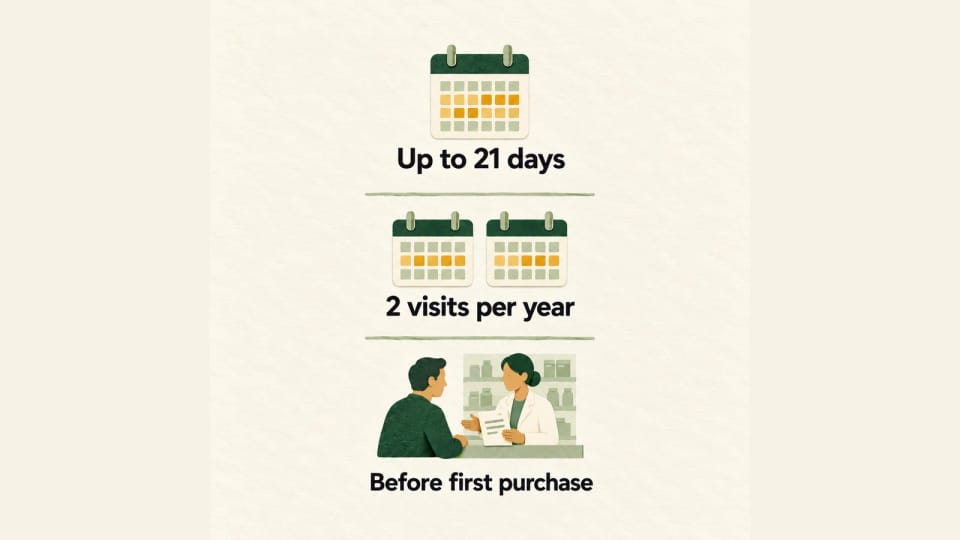
The limit is two visitation periods per calendar year, each up to 21 calendar days. Registration needs approval; the image is not a promise of approval or a continuous 42-day allowance.
What happens at the first pharmacy visit?
Meet with a pharmacist before the first purchase. The official visitor instructions say the consultation can be in person or, where offered, by video or phone. Call the pharmacy about availability and scheduling. A registration payment receipt does not take the place of this meeting.
After the first consultation, the program says you can buy at any Utah medical cannabis pharmacy or use pharmacy delivery. The approved card and valid ID are still required for those purchases. Ask the pharmacist about product form, directions and how your available purchase allowance is calculated. Official first-purchase instructions
Keep the shop check separate from the patient check. Our dispensary red flags checklist covers questions about the seller and products. When reviewing a lab report, match the batch or lot to the package. Having a patient card does not make every marketing claim reliable.
How much can you buy or possess?
The 21-day visitor term is not the purchase or possession amount. Utah uses different rules for the length of access, dispensing records and the legal dosage limit.
| Rule | What it measures |
|---|---|
| Up to 21 calendar days, twice per calendar year | Visitor registration periods |
| Any one 28-day period | The pharmacy dispensing window; purchases are checked in EVS |
| A sufficient amount for 30 days of treatment, within statutory outer limits | The legal dosage limit, according to the recommending provider’s or pharmacy medical provider’s guidelines |
The statutory outer limits are 113 grams of unprocessed cannabis and 20 grams of active THC in other medicinal products. The 20 grams refers to active THC, not the total weight of gummies, oil or other finished products. These are legal ceilings, not suggested doses or an instruction to buy both maximums. Your treatment guidelines still matter. Definitions, §26B-4-201
The pharmacy checks the dispensing record before a sale. Moving to a different pharmacy does not create a separate 28-day allowance. Ask it to check what can actually be dispensed for your registration and guidelines; do not prorate the numbers yourself or turn a calendar month into the statutory window. Pharmacy sales, §4-41a-1102
If weight units are unfamiliar, our grams and ounces guide explains them. Weight and THC content answer different questions, and neither alone sets a personal dose.
Which product and travel rules still apply?
Use Utah’s permitted medicinal forms and keep the pharmacy packaging and labels. The program prohibits smoking cannabis; permitted vapor use is different. Utah’s medicinal-form definition has specific restrictions, so do not assume every edible or concentrate sold elsewhere is an allowed Utah product. Chocolate, for example, is excluded from the medicinal confection category. Medicinal forms, §26B-4-201, official patient guidance
Keep your card and the pharmacy-identifying tracking label with Utah purchases. Retain the original container with its labels intact, and use an opaque outer bag or box when carrying the product in public. The pharmacy must supply that outer bag or box if you do not have one. Possession rules, §26B-4-216, packaging at sale, §4-41a-1102
Public-view use is prohibited, with a defined medical-emergency exception. A visitor card is not permission to drive impaired or ignore property rules. Arrange a permitted place for use and transport that does not depend on driving after use. Keep products secured away from children and pets; child-resistant packaging is not childproof.
Plan this as Utah access to Utah pharmacy products. The program says not to bring cannabis bought in another state into Utah. Utah registration also does not settle another jurisdiction’s or federal transport rules; do not plan to take purchases home across a border. Official patient guidance
FAQ
Can I buy with only my home medical card?
No. Buying requires Utah nonresident registration as well as the corresponding valid government photo ID. The separate conditional protection for qualifying nonresident use or possession does not replace that purchase requirement.
Is the temporary card valid for a full month?
No. Each visitation period lasts up to 21 calendar days, with no more than two periods per calendar year. The pharmacy’s 28-day dispensing window and the 30-day treatment-based dosage definition do not lengthen the card term.
Can I consult the pharmacist by phone before arriving?
The official visitor page allows phone or video consultation where the pharmacy offers it. Call your chosen pharmacy to ask about its process and scheduling. Do not assume every location offers remote appointments or that a call replaces registration approval.
Do these steps establish eligibility for a minor or caregiver?
No. This guide covers an adult applying for themself and does not establish a minor’s, an under-21 applicant’s or a caregiver’s route. Contact the Utah medical cannabis program about that situation before paying or traveling.
Key takeaways
- Check both the home medical credential and the Utah qualifying condition before applying.
- Budget the $15 nonresident card fee, allow for review and wait for approval.
- Plan for up to 21 days per visitation period, no more than twice per calendar year.
- Arrange the pharmacist consultation before the first purchase, then bring the approved card and valid ID.
- Keep the visitor term, dispensing window, legal quantity and transport rules separate.



