What Does Child-Resistant Cannabis Packaging Actually Mean?
Learn what child-resistant cannabis packaging tests measure, why a passing package is not childproof, and what changes after you open it.

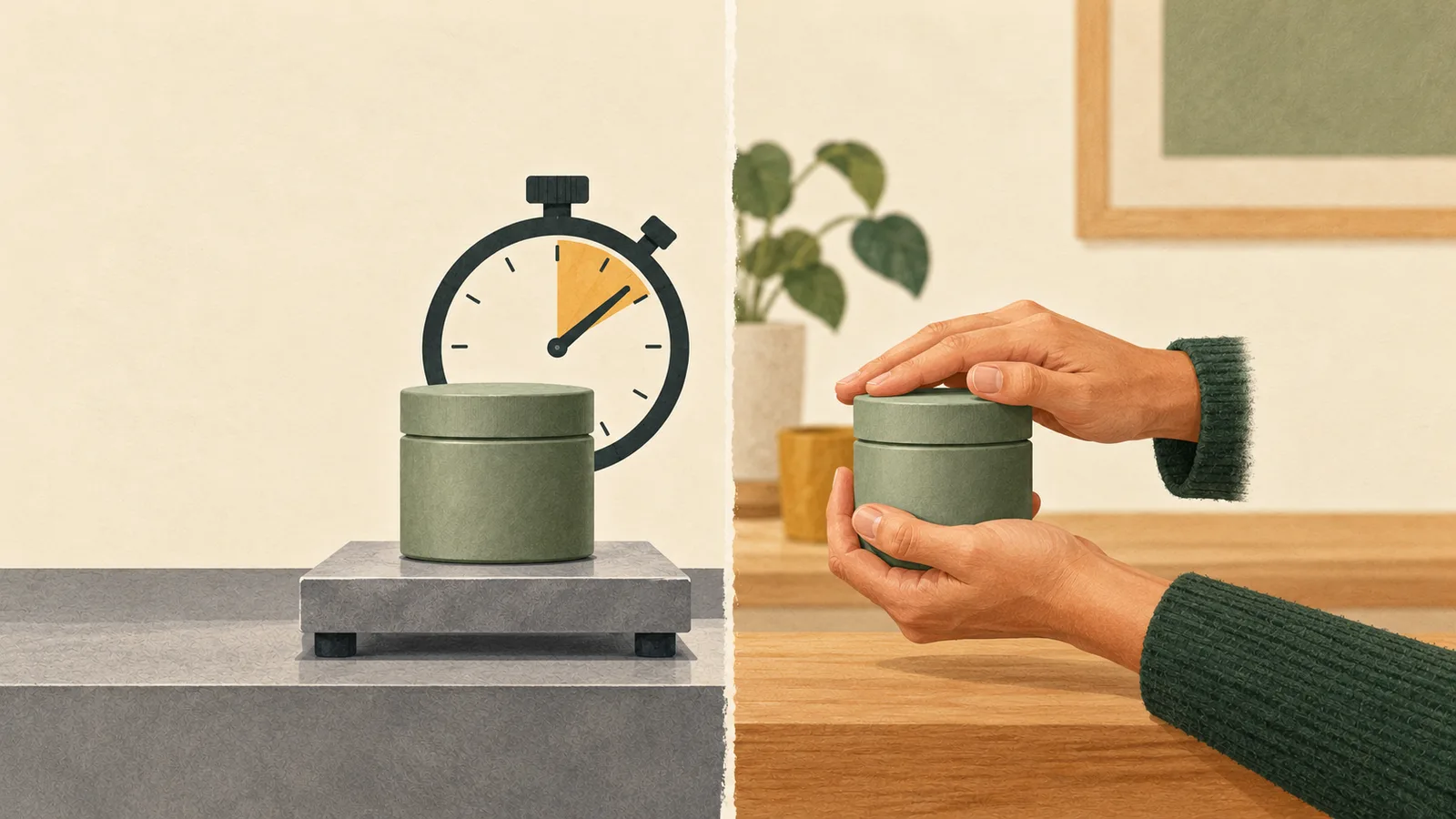
Child-resistant cannabis packaging is meant to make access difficult for young children; it does not promise that no child can open it. Cannabis rules often refer to a federal test. Passing that test means meeting set goals in defined groups. It also matters whether the package still works after you first open it. Federal performance standard, California packaging rule
A stubborn lid is not proof of a passing test. An adult’s struggle with that lid is not proof of a failed test, either. Ask what was tested, who took the test, and what they had to do.
This guide explains the US federal test and uses California as a specific cannabis-rule example. It does not assume every state requires the same package. Sources checked October 17, 2026.
What does the child-resistance test measure?
16 CFR 1700.15 sets the pass marks. 16 CFR 1700.20 sets the test method. For ordinary packages that can be opened and closed again, the main goals are:
| Stage | Required child-resistant effectiveness | Meaning |
|---|---|---|
| First five minutes, without a demonstration | At least 85% | Most test participants must be unable to open the package or reach its contents |
| Full ten minutes, including a demonstration before the second five minutes | At least 80% | The standard allows some children to succeed even when the package passes |
The second figure covers the full ten minutes, not a fresh 80% requirement applied only to the second half. Unit packaging has its own 80% rule. It also defines failure differently, based on access to single units. These figures do not tell you how likely your child is to open a package. Performance requirements, test procedure
The child panel covers 42–51 months of age. Testing starts with 50 children and can expand in groups of 50 to a maximum of 200. A table sets when the results pass, fail, or need another group. It is not simply a home experiment with ten children. Section 1700.20(a)(2)
That explains two limits. Passing does not mean every child in the test failed to open the package. It also does not show what happens at every age or in every home. Never ask a child to try a cannabis package to see whether it works.
Does the test check whether adults can open it?
Yes. The usual federal senior-adult test uses 100 adults ages 50–70, with a required use-effectiveness score of at least 90%. Adults first get five minutes. They then get one minute with another package of the same design. They must also close it properly if it can be reclosed. The rules provide a different adult test for certain products that require aerosol or metal containers. Adult performance standard, adult protocol
That does not test access for every adult. People cannot take part if an illness, injury, or disability would affect their ability to do the test. Adults who fail to open the first package get a further test with two standard closures. Those who cannot open and properly close both are not counted in the panel. Section 1700.20(a)(3)
So a passing package can still be hard for someone with painful or limited hand movement. Before buying, ask the store to explain the package instructions. Discuss a format you can both open and properly close. Leaving the closure loose solves one problem by creating another.
Does protection last after the first opening?
Not always. California has two types of protection. Edibles, orally consumed concentrates, and suppositories require child resistance for the life of the product. There is an exception for packs with more than one serving. The outer pack need not be child-resistant if each serving has its own child-resistant pack. DCC §17412(a)(1)
Inhaled and topical products may instead use packaging that is child-resistant only until first opened. That option requires the warning: “This package is not child-resistant after opening.” DCC §17412(a)(2)
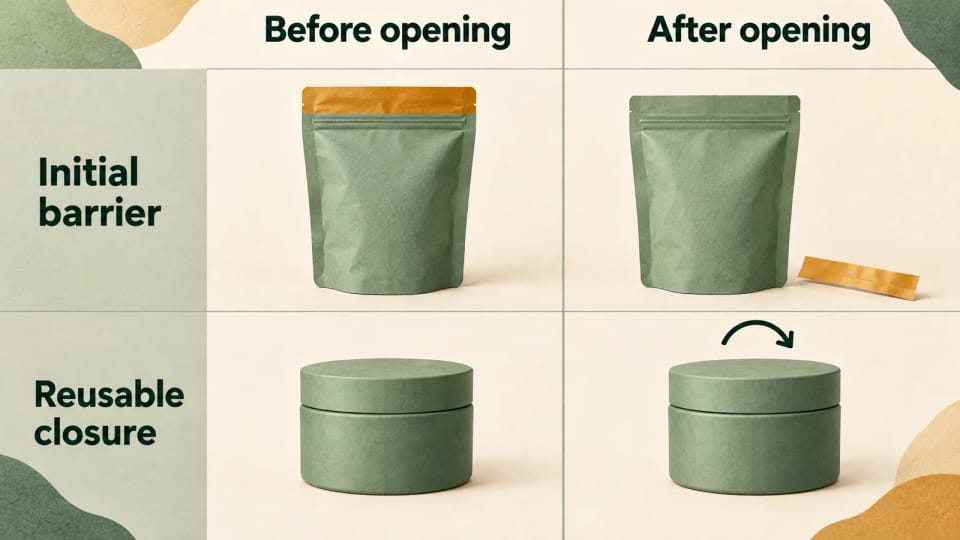
Conceptual comparison only. These drawings do not identify approved package designs. A zipper or screw cap alone does not establish child resistance.
Read that warning before you decide where to keep the rest. A pouch that can still zip shut may have lost its original child-resistant barrier. Resealable and child-resistant answer different questions.
California accepts some other package types too. These include certain single-serving crown-cap bottles and heat-sealed plastic packs that meet set rules. They are alternatives to packages certified under the federal child-resistance standard. Do not assume every lawful California package went through the same panel test. The exact conditions are in §17412(b); the state’s plain-language packaging guide explains the categories.
Is a safety seal the same thing as child resistance?
No. California has separate rules for tamper evidence, resealing, and child resistance. A tamper seal shows signs that someone first opened the pack. Child resistance makes access harder. The federal test removes a tamper-resistant feature beforehand unless it forms part of the child-resistant design. DCC §17411, federal test preparation
A THC warning symbol has another job: identifying cannabis contents. It cannot tell you whether a closure still works. And a batch-matched laboratory report answers questions about the product tested, not whether you closed its container properly.
What matters when you use the package at home?
Follow the opening and closing instructions, and check that the closure is fully secured after each use. For reusable special packaging under the federal standard, the pack must keep working through its normal number of openings and closings. That does not make a broken or partly closed pack dependable. Section 1700.15(a)
If the closure breaks or no longer closes as directed, stop relying on it. Ask the store or maker how to handle that product. Keep the label details. Our dispensary red-flag guide covers problems to spot before purchase; batch and lot recall checks help if a notice later names your product.
Keep cannabis sealed and where children and pets cannot see or reach it. California’s consumer guidance recommends those precautions even with child-resistant packaging. Our edible safety guide covers locked, separate storage in more detail. The package test is a reason to use the barrier correctly, not a reason to leave cannabis accessible.
Key takeaways
- A passing test permits some children to gain access; child-resistant does not mean childproof.
- The test uses defined age groups and conditions. Adult testing does not cover every accessibility need.
- Check whether protection continues after opening, then reclose and store the product as directed.
FAQ
Does child-resistant mean no child can open the package?
No. The federal pass marks are below 100%. Testing also uses a set child age group. A pass does not promise to stop any one child.
Does a hard-to-open lid prove child resistance?
No. A stiff lid does not show how the package did in testing. Nor does it prove that the pack meets your state’s rule.
Can a package legally lose child resistance after opening?
California allows that for specified inhaled and topical products with the required after-opening warning. That example does not establish the rule in another state.
If I have trouble with the cap, should I leave it partly closed?
No. Ask the retailer about the instructions and a package you can use correctly. The adult test includes proper reclosing where needed. A loose lid does not work like a secured one.


