Why Your Dispensary Labels Are (Mostly) Wrong: A Professor High Investigation
THC percentages are inflated, indica/sativa is botanical fiction, and terpene data is often missing. Here's what the science says — and how to shop smarter.

The Label You’re Reading Is Telling You a Story — Just Not the Right One
Here’s a number that might ruin your next dispensary trip: THC percentage explains roughly 0.02% of the variation in how high people feel. That’s not a typo. A landmark 2020 study from the University of Colorado Boulder measured blood THC levels and subjective intoxication in 121 regular cannabis users. Participants who consumed 24% THC flower versus 16% THC flower showed no significant difference in self-reported intoxication, mood, or cognitive impairment [Bidwell et al., 2020]. Different blood levels. Nearly identical experiences.
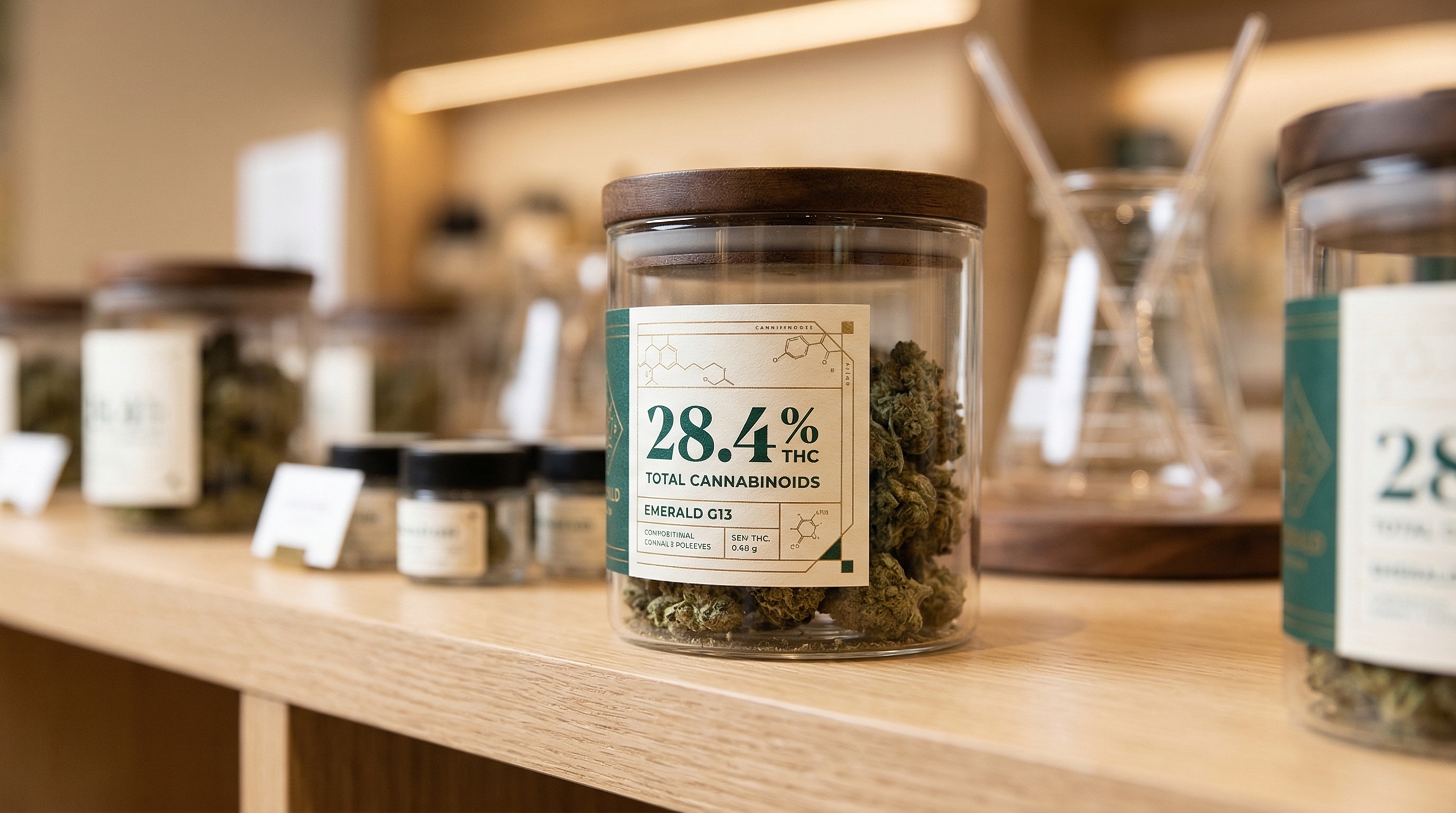
Now look at the label on your last purchase. What was the biggest, boldest number on it? The THC percentage. And right next to it? Probably the word “indica” or “sativa” — a classification system that, genetically speaking, has about as much scientific rigor as sorting wines by the color of the vineyard’s soil.
You’ve been shopping for cannabis based on information that ranges from misleading to essentially meaningless. And it’s not your fault. The entire legal cannabis industry built its retail experience around metrics that don’t reliably predict what you actually care about: how a strain will make you feel.
I’ve spent time digging into the peer-reviewed literature on this, and what I found was worse than I expected. The labels have three distinct problems — and they compound each other. Let’s investigate them one by one.
The Science Explained
Problem #1: The THC Percentage Is Probably Wrong
Let’s start with the number doing the most work on that label.
Consumers routinely reach for the highest-THC option on the shelf, and dispensaries charge a premium for it. There’s also a less visible problem: the number itself may not be accurate. A 2018 analysis of Washington State’s legal cannabis market found significant and systematic inconsistencies in THC testing results across laboratories [Jikomes & Zoorob, 2018]. Some labs consistently produced higher numbers than others — and growers knew it.
This created a market incentive called “lab shopping”: cultivators submitting their products to multiple laboratories and choosing to release results from whichever lab reported the highest potency. When there’s no independent oversight enforcing which lab result gets used, the consumer ends up trusting a number that was selected to flatter the product.
The inflation is quantifiable. A 2024 peer-reviewed study published in the Journal of Cannabis Research evaluated 107 dispensary flower products from California, Oregon, and Colorado. The lab claimed THC content ranged from 12% to 58% on labels. When researchers independently tested the same products, they found the true range was 13% to 37%. The average THC content was inflated by up to 30% from observed measurements. Only 30% of products had THC content within ±20% of their labeled claim [Geweda et al., 2024].
A separate 2024 study from the University of Colorado confirmed the pattern: among 23 flower samples, approximately 70% of labels reported THC percentages more than 15% higher than what was independently measured [Schwabe, 2024]. Notably, only one sample in the entire dataset had slightly more THC than reported. Every other inflated result went in the same direction — upward.
Why? Because that’s what sells. The cannabis market has accidentally recreated one of the same dysfunctions as the pharmaceutical supplement industry: when there’s money in a metric, that metric gets gamed.
The uncomfortable truth: A 28% THC strain may actually contain 18% — and in terms of your experience, that gap matters less than you’d think anyway.
This is connected to a deeper issue we cover in why THC percentage is a terrible way to choose cannabis. But the accuracy problem makes it worse: you’re relying on a misleading metric that’s also frequently wrong.
Problem #2: Indica and Sativa Are Botanical Fiction
Now for the other pillar of dispensary labeling. “Indica” for body relaxation. “Sativa” for cerebral energy. “Hybrid” for somewhere in between. It’s clean, it’s simple, and it’s not supported by the data.
The indica/sativa distinction was coined by 18th-century botanist Jean-Baptiste Lamarck to describe plant morphology — how tall plants grow, how wide their leaves are, how their flowers structure. He was describing plant anatomy, not pharmacology. Nobody in 1785 was thinking about how it would make someone feel after smoking it.
Somewhere along the way, dispensary marketing hijacked these agricultural terms and assigned them mood categories. The science says that assignment was fiction.
A 2015 genetic study by Sawler et al. analyzed 81 cannabis strains labeled as indica or sativa and found that the genetic structure did not consistently align with the labels [Sawler et al., 2015]. What dispensaries call “indica” and “sativa” doesn’t map onto measurable genetic differences in any reliable way. Most modern cannabis is so thoroughly hybridized through decades of crossbreeding that the original botanical categories have essentially collapsed — that “pure indica” at your dispensary has been crossed with sativa genetics dozens of times.
The largest chemical analysis ever conducted on commercial cannabis drove the point home definitively. Researchers at the University of Colorado examined 89,923 cannabis samples from six states, looking at their chemical profiles and comparing them to their indica/sativa labels. Their conclusion, published in PLOS ONE: “A sample labeled ‘Indica’ is likely to contain a terpene composition that is indistinguishable from those labeled ‘Sativa’ or ‘Hybrid’” [Smith et al., 2022]. When they tried to group strains by actual chemistry, they found three clusters — but those clusters didn’t align with the indica/sativa/hybrid labeling system. They aligned with dominant terpene profiles.
Dr. Ethan Russo, one of the most cited cannabinoid researchers in the world, has called the commercial use of indica/sativa “total nonsense and an exercise in futility” [Russo, 2016]. That’s coming from a researcher who has spent decades studying cannabis pharmacology. He’s not being hyperbolic.
Problem #3: The Information That Actually Matters Is Usually Missing
So if THC percentages are unreliable and indica/sativa labels are botanical fiction, what would tell you something useful? The emerging scientific consensus points to the full chemical profile — and particularly to terpenes.
Terpenes are the aromatic compounds responsible for cannabis’s smell. They’re found throughout the plant kingdom — in pine trees, citrus fruit, lavender. But they’re not just fragrance. Research shows they interact with cannabinoids in what’s called the entourage effect, modulating and shaping the overall pharmacological experience [Russo, 2011].
Some of the better-understood terpene relationships:
- Myrcene — the most abundant terpene in cannabis — appears to act as a sedative and promotes muscle relaxation. It’s responsible for the “couch-lock” quality associated with strains people call “strong indicas.” The effect comes from the myrcene, not from being an indica.
- Limonene appears to elevate mood and reduce anxiety, with animal and some human studies showing antidepressant-like effects.
- Pinene may counteract some THC-induced short-term memory impairment and promotes alertness.
- Caryophyllene is uniquely capable of binding directly to CB2 receptors in the endocannabinoid system — making it the only terpene that functions as a cannabinoid itself [Gertsch et al., 2008].
A 2021 study found that terpenes from cannabis actually enhance cannabinoid activity at the cellular level, providing direct mechanistic evidence for the entourage effect [LaVigne et al., 2021]. This isn’t marketing language — it’s receptor pharmacology.
The problem? Most dispensary labels don’t include terpene data. Some legally require it; many don’t. When terpene panels do appear on a certificate of analysis, they’re often tucked into a QR code that most consumers never scan. The information that would actually help you make a better choice is buried under information that doesn’t.
This is why we’ve built the High Families system here at This Is Why I’m High. Instead of sorting cannabis by debunked botanical categories, High Families groups strains by their actual terpene chemistry and the experiences those chemical profiles tend to produce:
- Limonene-dominant strains cluster into the Uplifting High family — mood elevation, social energy, creative engagement
- Myrcene-heavy strains belong in the Relaxing High family — deep calm, body heaviness, sleep support
- Caryophyllene-rich strains align with the Relieving High family — physical comfort, anti-inflammatory support, body focus
- Pinene and terpinolene combinations tend toward the Energetic High family — alertness, focus, outdoor activities
It’s a more honest framework than anything you’ll find on a typical dispensary label.
Practical Implications
How to Shop Smarter Right Now
Armed with this, here’s how to navigate a dispensary differently — starting today:
1. Ask to see the Certificate of Analysis (COA). Most licensed dispensaries have these. The COA is the full lab report, and it includes the terpene panel if one was run. Look at the terpene breakdown, not just the THC number. If your dispensary doesn’t have COAs available, ask why — and consider that a data point about their commitment to transparency.
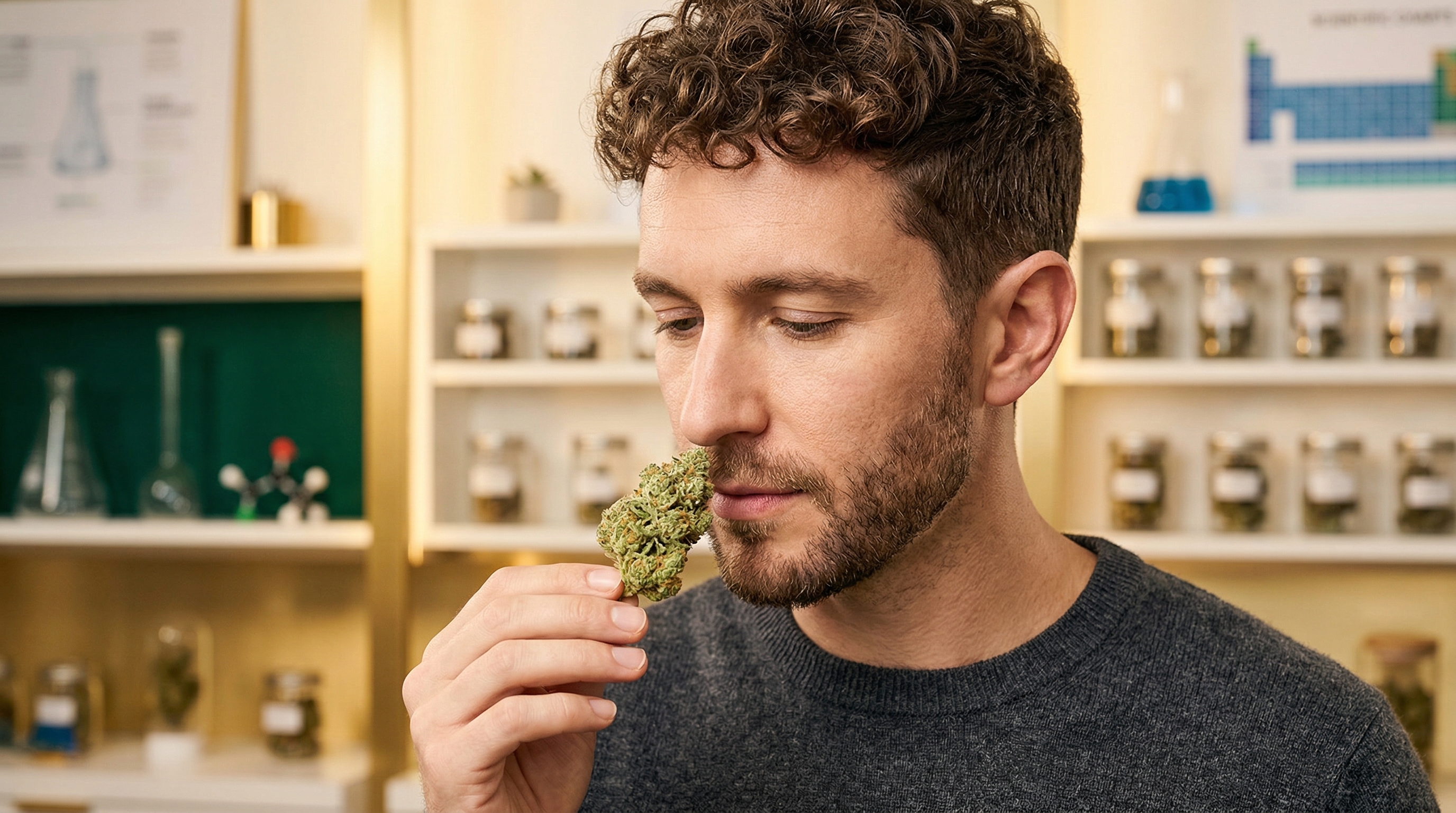
2. Use your nose as a primary tool. Before lab testing existed, experienced cannabis users selected strains by smell — and they were identifying terpenes intuitively. The aroma you’re drawn to often correlates with the terpenes that will produce effects you’ll enjoy. Pine and citrus suggest pinene and limonene. Musky, earthy, almost mango-like notes suggest myrcene. Spicy, black-pepper notes suggest caryophyllene. You can learn to read a strain’s likely effects through its nose.
3. Describe the experience you want, not the product you think you need. Instead of asking for “a strong indica,” try: “I’m looking for something calming that might help me wind down and sleep.” Instead of “a sativa for creativity,” try: “Something that keeps me energetic and focused without making me anxious.” Budtenders who know their products can make far better recommendations when you give them an experience to match rather than a category label.
4. Track your patterns. Because individual responses to cannabis vary significantly based on your endocannabinoid system, tolerance, and body chemistry, the most accurate database of what works for you is your own journal. Note the strain, the terpene profile if available, and how it actually made you feel. A few weeks of data beats any label.
5. Look for the honest numbers, not the impressive ones. A brand willing to show you a modest but accurately tested 18% THC with a full terpene panel is giving you more trustworthy information than a brand advertising 32% with nothing else on the label. Transparency is a proxy for quality.
The bottom line: The most predictive information on a cannabis label is often the smallest text — or absent entirely. Terpene profiles, minor cannabinoid ratios (THC:CBD:CBN:CBG), and the overall chemical fingerprint of a strain tell you far more about your likely experience than the THC percentage or the word “indica” ever could.
For a deeper look at how testing failures compound these problems industry-wide, see why lab testing standards are failing cannabis consumers.
Key Takeaways
- THC percentage is unreliable and probably inflated. Studies show 70%+ of flower products have THC levels significantly lower than labeled, and the number itself is a poor predictor of experience.
- Indica and sativa labels describe plant morphology, not pharmacology. The largest chemical analysis of commercial cannabis (89,923 samples) found these labels don’t correlate with actual chemical profiles.
- Terpenes are the chemical signal that actually matters. The entourage effect is real — terpenes modulate how cannabinoids affect you, and terpene profiles outperform indica/sativa labels as predictors of experience.
- The information you need is often missing. Push for full COAs with terpene panels. Use your nose. Describe experiences to budtenders.
- High Families gives you a terpene-based framework for finding what you actually want from cannabis — without relying on marketing language.
FAQs
Does THC percentage matter at all?
It’s not completely irrelevant — a 5% THC strain and a 25% THC strain will produce noticeably different levels of intoxication. But within the typical dispensary range (15-30%), the THC percentage is far less predictive than the terpene profile, and the number may not even be accurate. Think of it as a rough baseline, not a quality score.
Why do dispensaries still use indica/sativa labels if they’re meaningless?
Largely because consumers expect them and the system is familiar. Changing it requires educating millions of people that what they’ve been told for decades was wrong — which is commercially awkward. Some progressive dispensaries are adopting effect-based or terpene-based classification systems, but the shift is slow. Consumer demand accelerates it.
Are terpene test results reliable?
More reliable than THC results in many cases, but with caveats. Terpenes are volatile and degrade during storage, so the profile at the time of testing may not perfectly match what’s in the jar weeks later. Still, they provide a substantially more useful signal about likely effects than THC percentage alone — and the degradation problem is an argument for fresher product with recent test dates, not for ignoring terpenes.
What should I look for on a label if no terpene data is available?
Smell the product if possible — it’s reading the terpenes directly. Look for minor cannabinoid content (CBG, CBC, CBN) as signals of a more complex chemical profile. Look for the lab name and test date; fresher tests from reputable labs are more trustworthy. And most importantly, describe the experience you want to your budtender rather than pointing at a THC number.
How does the High Families system help?
High Families groups cannabis strains by their dominant terpene chemistry and the experience patterns that chemistry tends to produce. It gives you a way to navigate cannabis using the information that science says actually matters, rather than the marketing categories that science says don’t. Start with Understanding High Families if you’re new to the framework.
Sources
- Bidwell, L.C. et al. (2020). “Association of Naturalistic Administration of Cannabis Flower and Concentrates With Intoxication and Impairment.” JAMA Psychiatry, 77(8), 787-796. DOI: 10.1001/jamapsychiatry.2020.0927
- Gertsch, J. et al. (2008). “Beta-caryophyllene is a dietary cannabinoid.” Proceedings of the National Academy of Sciences, 105(26), 9099-9104. DOI: 10.1073/pnas.0803601105
- Geweda, M.M. et al. (2024). “Evaluation of dispensaries’ cannabis flowers for accuracy of labeling of cannabinoids content.” Journal of Cannabis Research, 6, 11. DOI: 10.1186/s42238-024-00220-4
- Jikomes, N. & Zoorob, M. (2018). “The Cannabinoid Content of Legal Cannabis in Washington State Varies Systematically Across Testing Facilities and Popular Consumer Products.” Scientific Reports, 8, 4519. DOI: 10.1038/s41598-018-22755-2
- LaVigne, J.E. et al. (2021). “Cannabis sativa terpenes are cannabimimetic and selectively enhance cannabinoid activity.” Scientific Reports, 11, 8232. DOI: 10.1038/s41598-021-87740-8
- Russo, E.B. (2011). “Taming THC: potential cannabis synergy and phytocannabinoid-terpenoid entourage effects.” British Journal of Pharmacology, 163(7), 1344-1364. DOI: 10.1111/j.1476-5381.2011.01238.x
- Russo, E.B. (2016). “The Cannabis sativa Versus Cannabis indica Debate.” Cannabis and Cannabinoid Research, 1(1), 44-46. DOI: 10.1089/can.2015.29003.ebr
- Sawler, J. et al. (2015). “The Genetic Structure of Marijuana and Hemp.” PLOS ONE, 10(8), e0133292. DOI: 10.1371/journal.pone.0133292
- Schwabe, A.L. (2024). “Lab tests show THC potency inflated on retail marijuana in Colorado.” PLOS ONE. Published via The Conversation, March 22, 2024.
- Smith, C.J. et al. (2022). “The phytochemical diversity of commercial Cannabis in the United States.” PLOS ONE, 17(5), e0267498. DOI: 10.1371/journal.pone.0267498


