Women in Cannabis: How Women Are Shaping the Modern Industry
Women hold nearly 40% of cannabis executive roles and now outpace men in consumption. Here's how female leaders are reshaping science, business, and equity.

The Hidden History You Weren’t Taught
Here’s something that might surprise you: for most of human history, cannabis was primarily women’s work. Ancient texts from China, Egypt, and Mesopotamia describe women as the main herbalists, seed keepers, and healers. They grew cannabis, prepared it, and used it for medicine, textiles, and ritual [Russo, 2007]. Yet if you looked at the cannabis industry’s leadership just a decade ago, you’d think the plant was discovered by men in business suits around 2012.
That gap is closing fast. Women now hold nearly 40% of executive roles in the U.S. cannabis industry, up from just 12.1% in earlier years (Forbes, 2025). That makes cannabis one of the most gender-diverse industries in America. For context, only 8.8% of Fortune 500 CEOs are women.
But this isn’t just a diversity story. Women are changing how cannabis science gets done, who products are made for, and what the industry cares about. From lab research to brand building to policy reform, female leaders are driving some of the most important shifts in cannabis today.
Let’s look at the science, the history, and what it means for you as a consumer.
The Science Explained
Women Pioneering Cannabinoid and Terpene Research
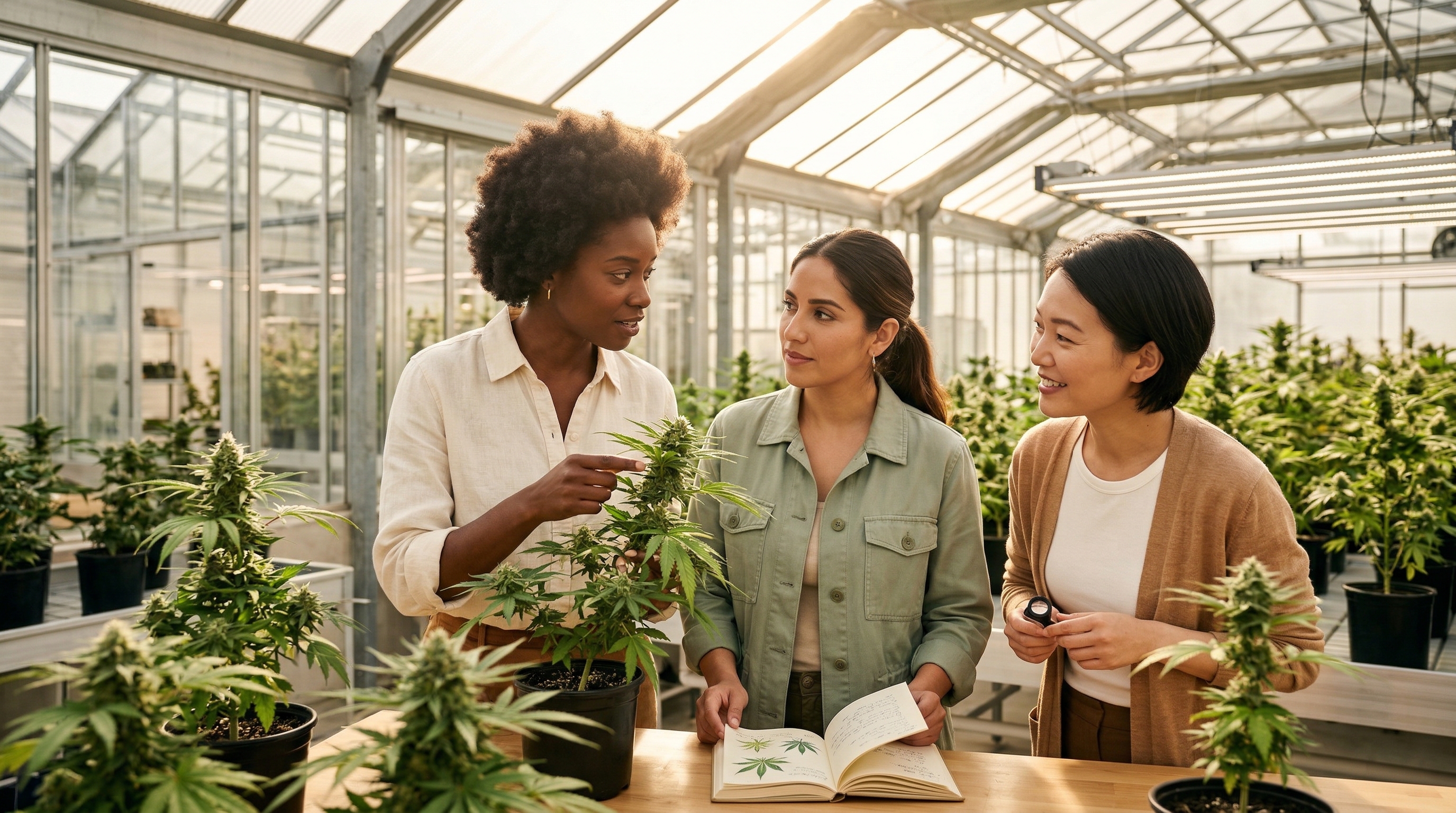
Some of the most important cannabis discoveries have come from women researchers—often working against the grain to study a Schedule I substance.
Dr. Cristina Sánchez, a molecular biologist in Madrid, published research showing that THC may trigger cell death in certain cancer cell lines [Sánchez et al., 2001]. Her work helped open an entire field of cannabinoid cancer research. This is lab science, not a clinical treatment—but it changed how researchers think about what cannabinoids can do.
Dr. Daniela Parolaro studied how the endocannabinoid system shapes anxiety and mood. Her work on CB1 receptors helps explain why different High Families produce such different experiences—and it forms a foundation for much of what we know about cannabis and mental state.
Dr. Sue Sisley spent over a decade fighting to run FDA-approved trials on whole-plant cannabis for PTSD in veterans. She pushed through regulatory roadblocks to show that serious cannabis research is both possible and necessary [Sisley et al., 2021].
What Research Shows About Sex Differences
Here’s where women’s leadership in research has real practical value. Evidence suggests the endocannabinoid system works differently depending on biological sex.
One study found that estrogen may affect how sensitive CB1 receptors are. That means people with higher estrogen levels might feel THC more strongly—and may need lower doses to get similar effects [Craft et al., 2013]. Another study found sex-based differences in how tolerance builds and how withdrawal feels [Cooper & Haney, 2014].
This matters for product design. For decades, cannabis products were built by and for one demographic. As more women enter research and development, products are starting to reflect a wider range of bodies, hormone cycles, and consumption preferences.
Key insight: The entourage effect—how terpenes and cannabinoids work together—may feel different depending on your biology. Hormones, genetics, and sex all play a role. This is why approaches like High Families matter more than one-size-fits-all recommendations.

Practical Implications
How Women’s Leadership Is Changing What You Buy
The growth of women in cannabis business and science has tangible effects on the products available to you right now.
More precise dosing options. Companies led by women—like Kiva Confections (co-founded by Kristi Palmer) and Curio Wellness (co-founded by Wendy Bronfein)—have been at the forefront of low-dose and micro-dose products. These align with what we’d classify under the Balancing High family: gentle, controlled experiences designed for people who want functional effects without overwhelming intensity.
Terpene-forward product design. Women-led brands have been early adopters of terpene profiling on packaging, moving beyond the outdated indica/sativa binary. When a product tells you it’s rich in limonene and linalool, you know you’re likely looking at an Uplifting High experience—mood-elevating and socially energizing. That transparency helps you choose based on actual chemistry, not marketing mythology.
Wellness integration. Research by women scientists on the endocannabinoid system’s role in sleep, stress response, and hormonal balance has driven a new category of cannabis wellness products. If you’ve ever reached for a myrcene-rich product to support sleep—something in the Relaxing High family—you’re benefiting from research that women scientists helped champion.
Social equity and access. Women-led organizations like Women Grow (led by CEO Dr. Chanda Macias) and Supernova Women (founded by Amber Senter) have pushed the industry to address the racial and economic disparities created by prohibition. This isn’t just activism—it’s shaping licensing laws, reinvestment programs, and who gets to participate in legal cannabis markets.
Key Takeaways
- Women have been central to cannabis cultivation and medicine for millennia—the modern industry is a return to historical norms, not a new development.
- Pioneering women researchers like Dr. Cristina Sánchez, Dr. Daniela Parolaro, and Dr. Sue Sisley have advanced cannabinoid science against significant institutional barriers.
- Biological sex appears to influence endocannabinoid system function, meaning diverse research teams produce better science and better products for everyone [Craft et al., 2013].
- Women-led companies are driving innovation in low-dose products, terpene transparency, and approaches like High Families that help consumers choose by effect rather than category.
- Supporting women-owned cannabis businesses isn’t just an ethical choice—it improves the quality and diversity of products available to all consumers.
FAQs
Why does it matter who leads cannabis research and business?
Diverse leadership produces products and research that serve a wider population. When cannabis science only studied one demographic, it missed critical differences in how cannabinoids interact with different bodies. More inclusive research means better, safer recommendations for everyone.
Are there biological differences in how women experience cannabis?
Early research suggests yes—estrogen may modulate cannabinoid receptor sensitivity, potentially affecting dosing needs and tolerance patterns [Craft et al., 2013]. However, this is emerging science and individual variation is significant. Start low, go slow, and pay attention to your own body’s responses.
How can I support women in the cannabis industry?
Seek out women-owned brands, follow women cannabis scientists and educators, and support organizations working on social equity in cannabis licensing. Many states maintain directories of equity-licensed businesses. Organizations like Women Grow (womengrow.com) are good starting points.
Is the cannabis industry really more gender-diverse than other sectors?
Current data suggests yes—cannabis has a higher percentage of women in executive roles than most American industries [Forbes, 2025]. However, significant gaps remain, particularly in funding: less than 3% of cannabis financing goes to women-owned businesses, according to Women Grow CEO Dr. Chanda Macias.
Sources
- Russo, E.B. (2007). “History of Cannabis and Its Preparations in Saga, Science, and Sobriquet.” Chemistry & Biodiversity, 4(8), 1614-1648. DOI: 10.1002/cbdv.200790144
- Sánchez, C. et al. (2001). “Inhibition of Glioma Growth in Vivo by Selective Activation of the CB2 Cannabinoid Receptor.” Cancer Research, 61(15), 5784-5789. PMID: 11479216
- Russo, E.B. (2011). “Taming THC: Potential Cannabis Synergy and Phytocannabinoid-Terpenoid Entourage Effects.” British Journal of Pharmacology, 163(7), 1344-1364. PMID: 21749363
- Craft, R.M. et al. (2013). “Sex Differences in Cannabinoid Pharmacology: A Reflection of Differences in the Endocannabinoid System?” Life Sciences, 92(8-9), 476-481. PMID: 22728714
- Cooper, Z.D. & Haney, M. (2014). “Investigation of Sex-Dependent Effects of Cannabis in Daily Cannabis Smokers.” Drug and Alcohol Dependence, 136, 85-91. PMID: 24440051
- Sisley, S. et al. (2021). “A Randomized, Triple-Blind, Placebo-Controlled Crossover Study of Botanical Cannabis in PTSD.” PLoS ONE. DOI: 10.1371/journal.pone.0246990
- Forbes / Budvue. (2025). “Women in Cannabis Leadership Report.” Women now hold nearly 40% of executive roles in U.S. cannabis.
- Women Grow / Dr. Chanda Macias. (2025). Women Grow Leadership Summit. Less than 3% of cannabis financing goes to women-owned businesses.


