Your Brain on Endocannabinoids: How 2-AG Controls Decisions
Your brain makes its own cannabinoid called 2-AG. New research shows it controls dopamine-driven decisions — and why this matters for cannabis users.

Professor High
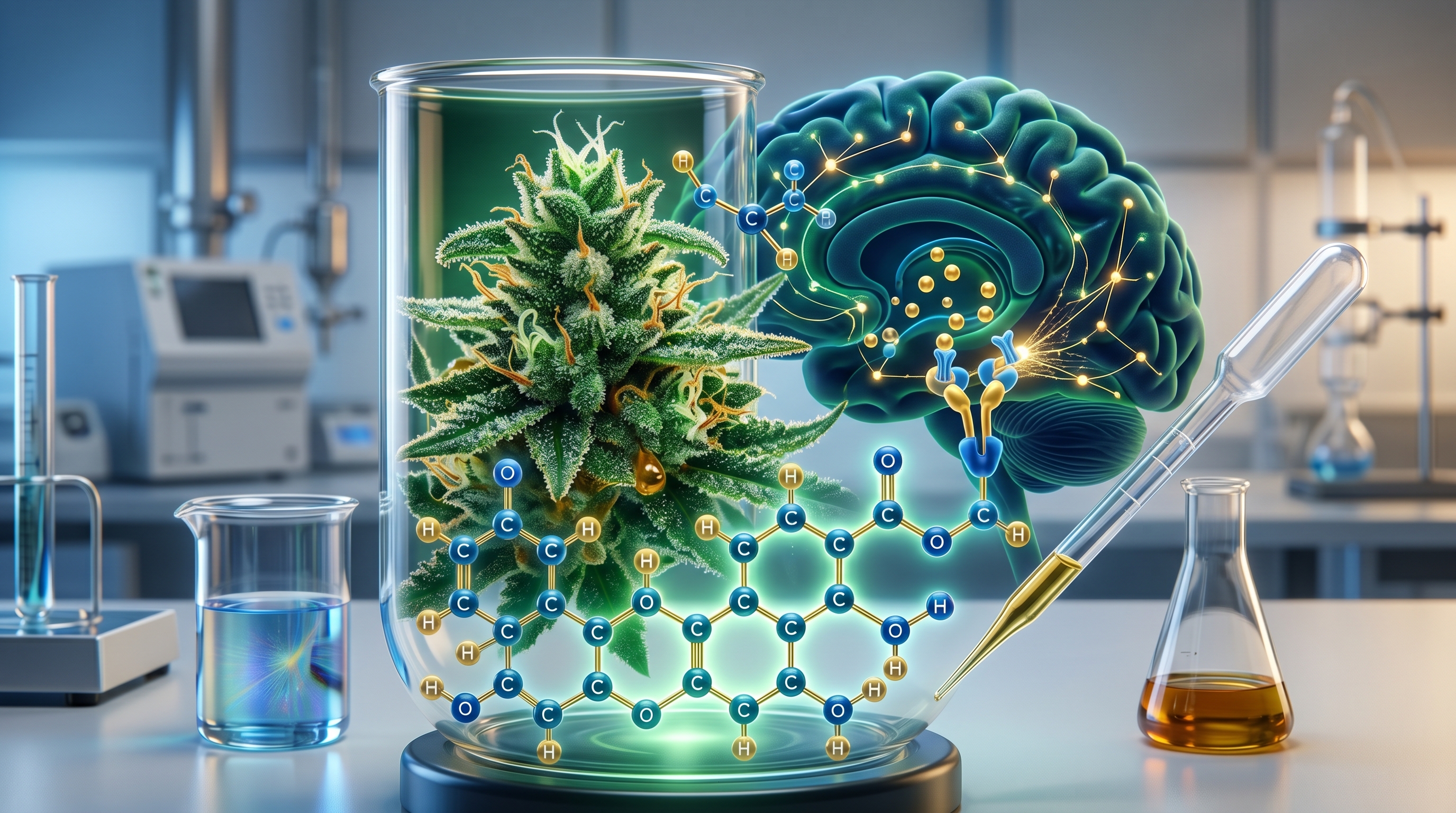
Your Brain Already Makes Cannabis Compounds
Most cannabis articles tell you about THC. A smaller number get into anandamide, your body’s natural THC — the “bliss molecule” with the catchy Sanskrit name. But anandamide is not even the most important endocannabinoid in your brain.
That title goes to a less photogenic molecule called 2-arachidonoylglycerol — 2-AG, for short. It is roughly 170 to 200 times more abundant than anandamide in brain tissue, and the dominant signal at most cannabinoid synapses. New neuroscience research shows 2-AG is one of the central regulators of how your brain makes decisions about reward, effort, and motivation.
If anandamide is a quiet whisper of bliss, 2-AG is the conductor of an orchestra you did not know was playing. Recent work — a 2023 paper in Nature Communications and a 2024 paper in Science Advances — has finally pinned down what 2-AG does in the part of your brain that decides whether something is worth chasing. That circuit also happens to be the one THC hits hardest.
What 2-AG Actually Does
To understand 2-AG you need to understand a strange feature of brain communication called retrograde signaling.
Most neurotransmitters flow one direction. The presynaptic neuron releases molecules into the synaptic gap; the postsynaptic neuron picks them up via receptors and reacts. Glutamate, GABA, serotonin, dopamine — all flow forward.
2-AG flows the other way.
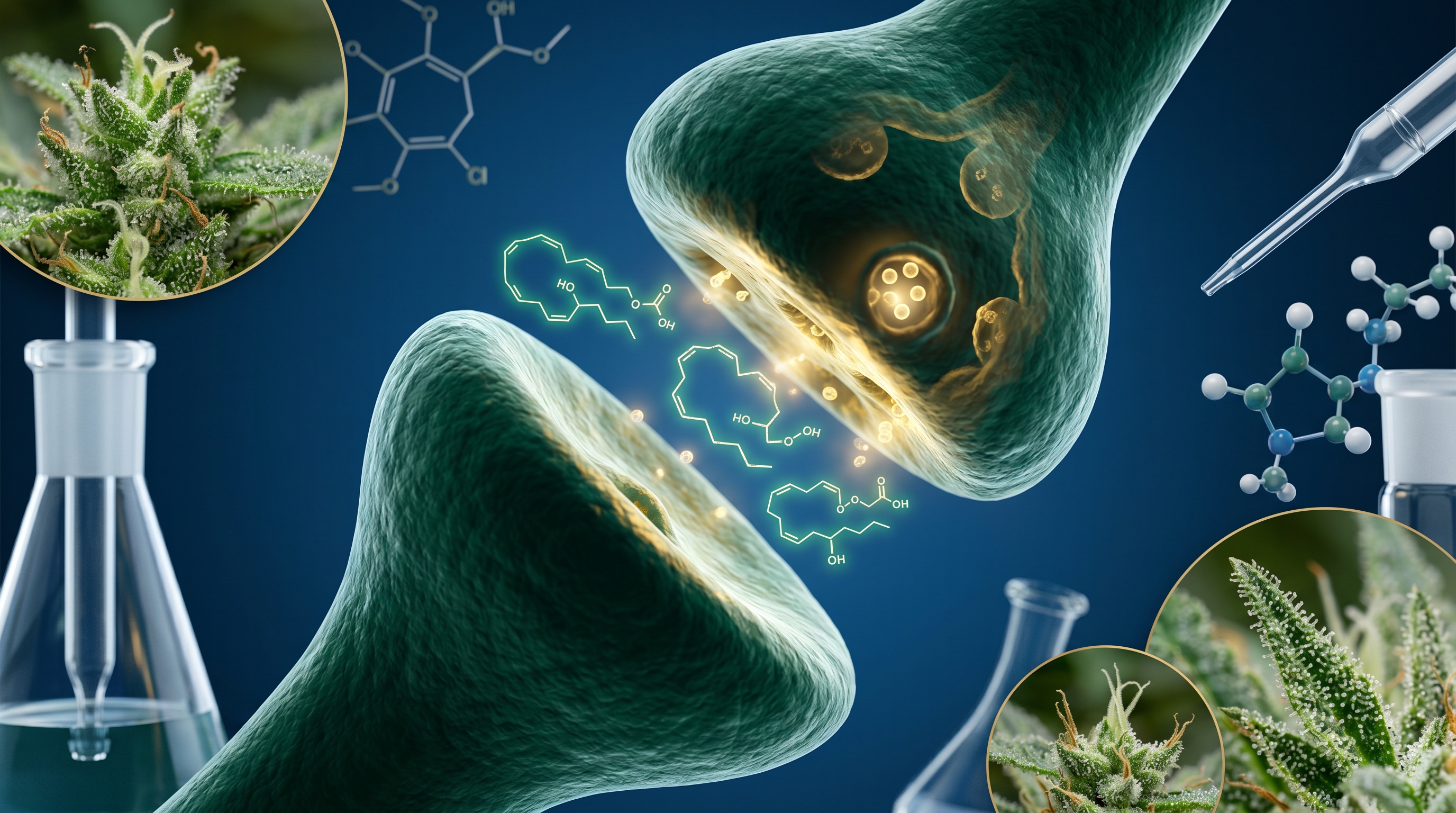
When the postsynaptic neuron gets excited and floods with calcium, an enzyme called DAGLα (diacylglycerol lipase alpha) wakes up and manufactures 2-AG from membrane lipids on the spot. There is no warehouse of pre-made 2-AG. It is built fresh the moment it is needed.
The freshly minted 2-AG drifts backwards across the synaptic gap and binds to CB1 receptors on the presynaptic terminal — the side that sent the original signal. Activating those receptors tells the presynaptic neuron “you can stop now.” Neurotransmitter release drops. The signal quiets down.
Picture a phone call where the listener taps a button on the receiver to send a “quieter, please” tone back through the line. That is retrograde signaling, and 2-AG is the message.
The signal gets cleared seconds later by another enzyme, MAGL (monoacylglycerol lipase), which breaks 2-AG into glycerol and arachidonic acid. Synthesize, signal, degrade — the whole cycle completes in seconds. Neuroscientists call the resulting effect DSE (depolarization-induced suppression of excitation) and DSI (suppression of inhibition). Both are 2-AG-mediated. Without 2-AG, this throttle on neural activity disappears.
The Dopamine Connection
Follow 2-AG into the brain’s reward circuit — the mesolimbic pathway — and the picture sharpens.
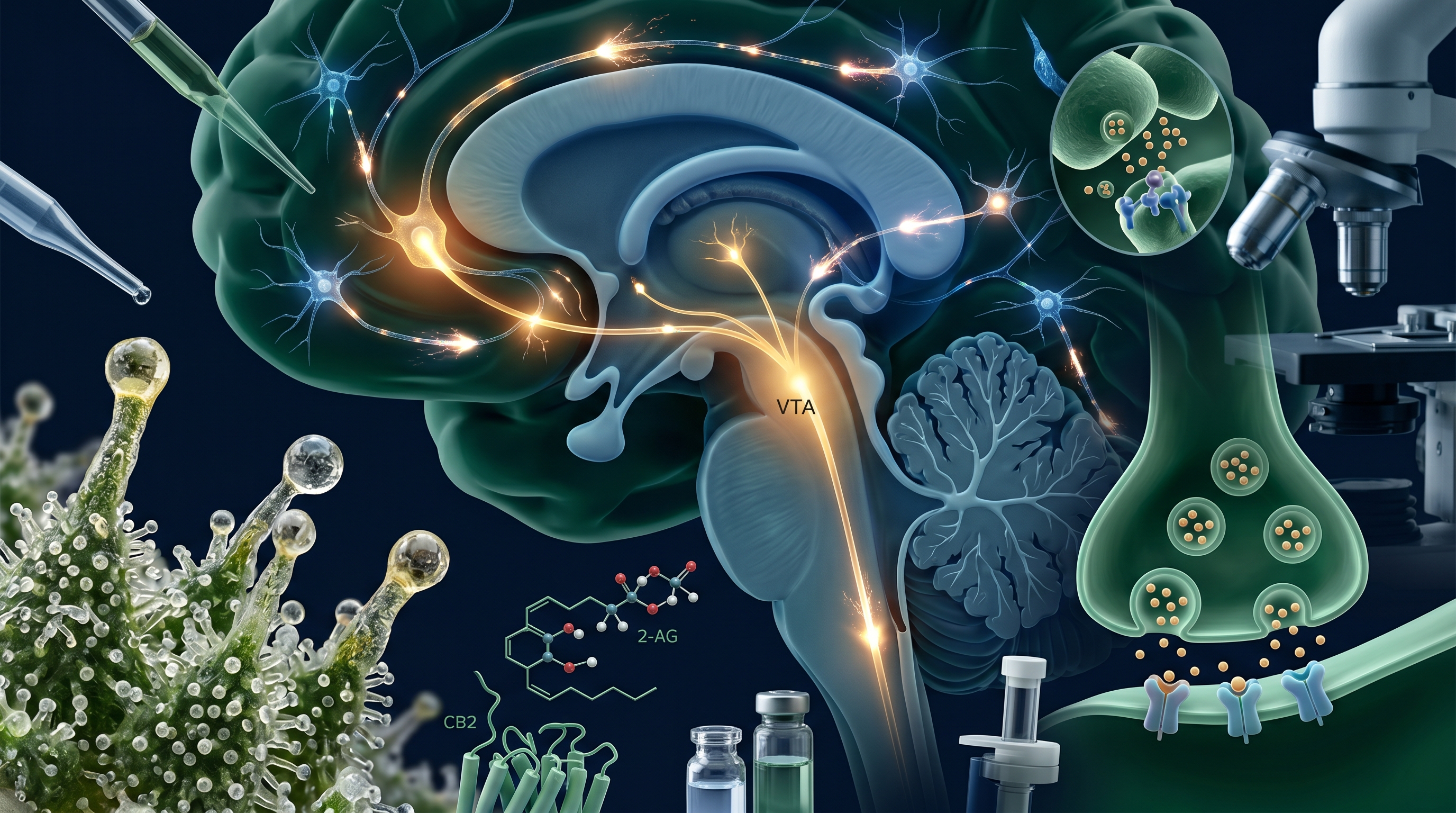
The crucial node is the VTA, or ventral tegmental area: a tiny cluster of neurons in your midbrain that does an outsized amount of work. Its dopamine neurons project up into the nucleus accumbens (NAc) and prefrontal cortex. When something rewarding happens — or when a cue predicts a reward — VTA neurons fire in short, high-frequency bursts called phasic firing, and dopamine floods into the NAc.
Phasic dopamine is not a “pleasure signal” in the way pop science often suggests. It is closer to a prediction signal: “this is more rewarding than expected,” or “this cue means a reward is coming.” It is the currency of motivated behavior — the spark that turns a thought into action. Between bursts, VTA neurons fire slowly and steadily (tonic firing), providing baseline dopamine tone.
Here is the punch line: 2-AG controls how the VTA switches between tonic and phasic modes.
VTA dopamine neurons are bombarded by GABAergic (inhibitory) inputs that hold them on a tight leash. When a dopamine neuron itself depolarizes in response to an exciting cue, calcium pours in, DAGLα fires up, and 2-AG retrograde-signals to those incoming GABA terminals. GABA release drops. The leash loosens. The dopamine neuron is suddenly free to fire in a vigorous burst.
Neuroscientists call this disinhibition. In plain English: 2-AG is the brake on the brake. It tells the brain’s reward circuit when to let loose.
The 2026 Research
Researchers have chipped away at this picture for two decades, but recent studies nailed down causality in striking detail.
In November 2023, a team published in Nature Communications a paper with one of the most pointed titles in the field: “Mobilization of endocannabinoids by midbrain dopamine neurons is required for the encoding of reward prediction” [Mátyás et al., 2023]. Using a viral-genetic technique, they selectively deleted the DAGLα gene only in VTA dopamine neurons of adult mice. Those mice could no longer make 2-AG in that cell population — everything else stayed intact.
What they found:
- DSE was abolished in those VTA dopamine neurons. The retrograde 2-AG signal was gone.
- Effortful, cue-driven reward-seeking dropped dramatically. Mice still managed simple, low-effort tasks. But when a task required them to translate a cue into action — the hallmark of motivated behavior — performance collapsed.
- Phasic dopamine release in the NAc no longer transferred from rewards to their predictors. In a normal animal, dopamine bursts initially fire when a reward is delivered, then shift earlier in time to fire when the cue predicting the reward appears. That shift is the foundation of associative learning. Without 2-AG, the dopamine signal stayed glued to the reward itself, never moving forward to the predictor.
That last finding is enormous. 2-AG is not just modulating dopamine — it is required for dopamine to encode prediction itself. Without retrograde endocannabinoid signaling, the reward circuit cannot learn what is worth chasing.
A second key paper, published November 2024 in Science Advances, came at the same circuit from the opposite direction [Lee et al., 2024]. Instead of removing 2-AG, they boosted it — using JZL184 to inhibit MAGL so 2-AG sticks around longer. The result: elevating 2-AG in the VTA blunted opioid reward without affecting opioid pain relief. NAc dopamine release in response to morphine dropped. The rewarding pull weakened. The effect required CB1 receptors specifically in the VTA — knocking them out there abolished it.
Together, these studies converge on a single picture: 2-AG in the VTA is a tunable dial on the dopamine reward signal. Less 2-AG, less prediction-based motivation. More 2-AG, less drug-driven reward salience.
What This Means in Plain English
Strip the jargon and you get something clean. Your brain has a reward circuit that decides what is worth chasing. The circuit runs on dopamine, which would fire too freely if nothing held it back. So the brain installed a built-in regulator: a homemade cannabinoid made on the spot, signaling briefly, cleared in seconds.
When the system works, your decisions are calibrated. Cues that reliably predict good outcomes capture your attention. Effort feels matched to payoff. When the system is impaired — by genetics, chronic stress, or external compounds hammering it from outside — calibration drifts. Motivation fuzzes. The signal between “this matters” and “this doesn’t” loses resolution.
So what is THC doing inside this system?
The THC Wrinkle
THC and 2-AG both activate CB1 receptors. That is why cannabis works. But the way they do it differs in three ways that matter.
Timing. 2-AG is pulsatile — built in milliseconds, signaling for a few seconds, then destroyed. THC arrives all at once and stays for hours. Where 2-AG is a brief tap, THC is a sustained press.
Location. 2-AG is local, made at the exact synapse where it is needed. THC is global, hitting every CB1 receptor it can reach in every circuit, whether that circuit was asking for a signal or not.
Regulation. When CB1 stimulation rises persistently, the brain downregulates CB1 receptors — pulling them off the cell surface, reducing numbers, dampening sensitivity. This happens with chronic heavy THC use. MAGL knockout mice (where 2-AG cannot be cleared and accumulates) show the same CB1 desensitization. The system is built to handle pulses, not steady streams.
This is why tolerance is not just psychological — it is the endocannabinoid system literally turning down the volume on over-stimulated receptors. It is also why T-breaks work: 2 to 4 weeks of quiet lets CB1 receptors repopulate the synaptic surface and regain sensitivity. Light, occasional cannabis use is not the same biological event as daily high-THC concentrate use. The system handles pulses. The steady high-potency streams disrupt the calibration.
CBD’s Role
CBD complicates the picture in interesting ways. First: CBD is not a CB1 agonist. It does not bind and activate CB1 the way THC does. Research suggests CBD acts as a negative allosteric modulator — sitting on the side of the receptor and dampening its response to agonists like THC. That is one mechanism behind CBD’s reputation for softening THC-induced anxiety.
More interesting is CBD’s modulation of the endocannabinoid system itself. CBD inhibits FAAH, the enzyme that breaks down anandamide. By slowing FAAH, CBD lets your own anandamide persist longer — indirectly raising your endogenous cannabinoid tone rather than substituting an external one. CBD also engages other receptor systems: 5-HT1A (serotonin), TRPV1 (pain and inflammation), and GPR55. The result is a compound that works with your endocannabinoid system rather than overwhelming it.
For someone whose 2-AG/anandamide signaling has been blunted by chronic high-THC use, CBD’s profile is genuinely interesting — far less likely to drive receptor downregulation than THC alone.
What This Means for Cannabis Users

So what do you actually do with this?
Treat your endocannabinoid system as something worth maintaining. It is a regulator, not a free resource. Hammering it daily with high-potency THC produces measurable changes in receptor density. The system you lean on to feel good is the same system that calibrates your motivation, mood, and learning when you are not high.
T-breaks are real and worth taking. 2 to 4 weeks restore CB1 receptor density and sensitivity. Subsequent cannabis feels stronger at lower doses — exactly what you would predict from a recalibrated system.
Dose and frequency matter. Light or occasional use of balanced flower operates within the system’s design parameters. Daily high-THC concentrate use does not.
Choose cannabis that supports rather than overwhelms. Profiles emphasizing linalool, limonene, or caryophyllene tend to produce more even experiences than pure-THC isolates. Caryophyllene binds CB2 directly, contributing to the entourage effect without adding CB1 load.
Pay attention to motivation, not just mood. 2-AG’s role in encoding prediction means if your endocannabinoid system is dysregulated, the first thing to drift is often not mood — it is your sense of what is worth pursuing. The “amotivational” pattern some heavy users notice is, in part, the kind of dopamine prediction failure the recent research explains.
Strain selection follows. Strains for energy and motivation like Sour Diesel or Blue Dream lean toward energy-family profiles. Relax-family strains like OG Kush or Gelato lean the other way. Neither is “better” — but matching what you use to the cognitive state you want, and noticing how responses change over time, is the practice the biology recommends.
The Bigger Picture
The endocannabinoid system is fundamentally a homeostatic regulator — a feedback system that keeps neural activity balanced across many circuits at once. It mediates synaptic plasticity, motivation, mood, appetite, pain, and immune response. It does not have one job; it has dozens, all of which involve dialing other systems up or down.
The recent research clarifies one specific corner: at the level of individual reward decisions, on a millisecond-by-millisecond timescale, 2-AG is making sure the dopamine signal stays meaningful.
When you put cannabis into this system, you are entering a regulator. You are not adding a new signal — you are perturbing one that was already running. Whether that perturbation feels like enhancement, inspiration, creative flow, or impairment depends on three things: dose, frequency, and what your endocannabinoid system was doing before you arrived.
This is also why the entourage effect matters. Terpenes like myrcene and cannabinoids beyond THC interact with the system at multiple points — receptors, enzymes, transporters — rather than just slamming CB1. The result is a more nuanced perturbation, often closer to how the system would naturally regulate itself. The difference between a band playing music and someone leaning on one piano key for an hour.
Tracking Your Own Response
No article — even one going this deep — can tell you how your endocannabinoid system handles cannabis. The research is averaged across mice. Your CB1 density, your DAGLα expression, your MAGL clearance rate, your baseline 2-AG and anandamide tone — all of these vary from person to person, and they shift over weeks and months in response to use patterns, stress, sleep, and life.
The only way to learn your own pattern is to track it. What strains, what doses, what time of day, paired with what you notice in mood, focus, motivation, and sleep over the days that follow. Patterns emerge over months that you cannot see in a single session.
That is part of why we built the High IQ app — to make tracking endocannabinoid response something you actually do, not something you mean to do. Your data, building over time, into something that finally tells you what your system is doing.
Your brain runs on a cannabinoid system. The cannabis is optional. The biology is not.
Sources
- Mátyás et al. (2023). Mobilization of endocannabinoids by midbrain dopamine neurons is required for the encoding of reward prediction. Nature Communications, 14. doi.org/10.1038/s41467-023-43131-3 | PubMed 37985770
- Lee et al. (2024). Elevating levels of 2-arachidonoylglycerol blunts opioid reward but not analgesia. Science Advances, 10(48). doi.org/10.1126/sciadv.adq4779
- Tanimura et al. (2010). The endocannabinoid 2-AG produced by DAGLα mediates retrograde suppression of synaptic transmission. Neuron, 65(3), 320–327. doi.org/10.1016/j.neuron.2010.01.021
- Gao et al. (2010). Loss of retrograde endocannabinoid signaling and reduced adult neurogenesis in DAGL knock-out mice. J. Neuroscience, 30(6). doi.org/10.1523/JNEUROSCI.5693-09.2010
- Doherty & Williams (2025). DAGLα/β, 2-AG release, and Parkinson’s Disease. bioRxiv. doi.org/10.1101/2025.04.17.649373
- Schlosburg et al. (2010). Chronic MAGL blockade causes functional antagonism of the endocannabinoid system. Nature Neuroscience, 13(9). doi.org/10.1038/nn.2616
- Tanigami et al. (2019). Endocannabinoid signaling from 2-AG to CB1 facilitates reward-based learning. Neuroscience, 421.
- Lu & Mackie (2016). An introduction to the endogenous cannabinoid system. Biological Psychiatry, 79(7).
Education only — not medical advice. Talk to a clinician about your individual situation.
